Application Closes In:
Days
Hours
Minutes
Sec
Become the Context Engineer every AI & ML team needs to design scalable, business-driven workflows.
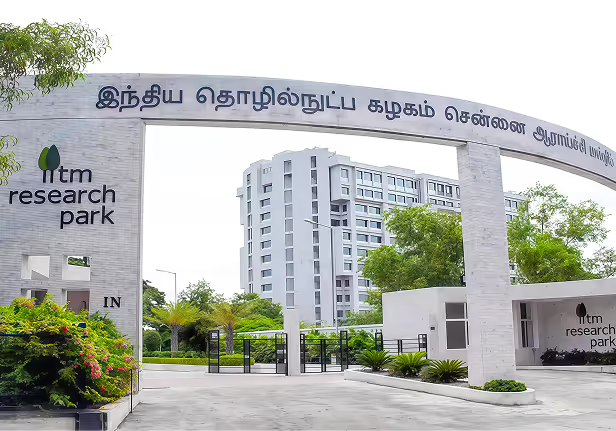
IITM Pravartak Technologies Foundation is the Technology Innovation Hub of IIT Madras, established under the Department of Science and Technology, Government of India. Embedded within the IITMRP ecosystem, it combines renowned faculty, cutting-edge labs, and specialised research facilities to drive skilling, innovation, and incubation.
Working at the intersection of academia, research, and industry, IITM Pravartak fosters the adoption of deep technology, nurtures next-generation talent, and enables real-world impact.

Dr. Indu Joshi is an Assistant Professor at IIT Mandi’s School of Computing and Electrical Engineering. Her research spans Bayesian Deep Learning, Domain Adaptation, Generative Models, Continual Learning, Attention Models, Medical Image Processing, and Biometrics, with multiple publications in these areas.
Dr. Joshi has represented India at the BRICS Young Scientist Conclave, attended the prestigious Heidelberg Laureate Forum, and has been recognized for her popular science writing by India’s Minister of Science & Technology.
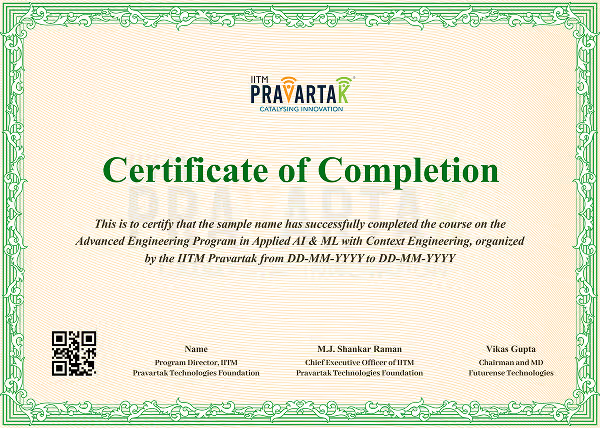
Receive a Certificate of completion from IITM Pravartak,
recognizing your achievement.
in Just 6 Months
Module 0: Understanding Prompt and Context-Driven Artificial Intelligence
Understanding how traditional ML and DL is transforming by infusing models with real-world context driven prompts rather than relying solely on raw historical data
Module 1: Python Programming Foundations
Python basics, functions, OOP, NumPy, Pandas, data visualization and EDA
Module 2: Applied Math and Stats for ML
Linear algebra, probability, statistics, derivatives, gradient descent, optimization
Module 3: Feature selection and Feature Engineering for ML
Data splitting, pipelines, hyperparameter tuning, model evaluation, reproducibility
Module 4: Machine Learning with Context Engineering
Supervised & unsupervised learning, regression, classification, clustering, PCA
Module 5: Deep Learning with Context Engineering
ANNs, CNNs, RNNs, Transformers, Computer Vision and NLP
Module 6: Generative AI Foundations
LLMs, Embeddings, Generative models, Transfer learning, Diffusion models
Module 7: Large Language Models and Prompt and Context Engineering
LangChain, HuggingFace, prompt engineering, LLM pipelines
Module 8: RAG based Context Engg with LLMs
What is context in GenAI and why it matters, Understanding context (tokens, anatomy), instruction & schema design (few-shot, JSON/tool specs), and grounding via RAG (chunking, hybrid retrieval, re-ranking, freshness & citations), Memory & optimization (rolling summaries, compression, cost controls), safety/governance (injection defenses, PII minimization), evaluation & observability (golden sets, KPIs, tracing), and production patterns.
Module 9: Vision & Multimodal AI
Image-text alignment, CLIP, BLIP, image captioning, multimodal tasks
Module 10: Agentic AI
Autonomous agents, memory, tool use, planning, multi-agent systems
Module 11: Distributed ML and Federated Learning and Attacks
Parallel vs Distributed training, FL architectures and applications, security and privacy in FL, adversarial attacks and defences, contextual applications
Module 12: AI Ethics and Bias, Governance and Risk
Bias & fairness, explainable AI (SHAP, LIME), transparency, accountability, DPDP Act, GDPR, IP rights in AI, AI audits, risk registers
Module 13: AI in Healthcare
Disease prediction, medical image analysis, GenAI in clinical assistance
Module 14: AI in Retail & E-commerce
Recommender systems, churn prediction, product search, GenAI for content
Module 15: AI in Manufacturing and Heavy Engineering Industries
Defect detection using computer vision (e.g., weld defects, surface anomalies), Process optimization and Supply chain forecasting and downtime prediction, Real-time safety monitoring (e.g., helmet detection, gas sensor alerts)
Module 16: MLOps & Scaling
Model deployment, Docker, CI/CD, MLflow, monitoring
Module 17: GenAI Ops
Prompt evaluation, moderation, hallucination testing, cost optimization
Module 18: AI Product and System Design
LLM system design, chaining, fallback mechanisms, prompt management






Through the Futurense AI Clinic, you’ll gain hands-on exposure to real enterprise-grade AI projects, from ideation to deployment.
Solve high-impact engineering tasks across RAG, agents, ML pipelines, and deployment, so your portfolio reflects the work actual AI teams do.
Train and build with GPT models, HuggingFace, CNNs, RNNs, CLIP, BLIP, LangChain, LangGraph, Docker, and MLflow - the same stack used by modern AI companies.
Create retrieval-driven systems, structured prompts, function-calling agents, and multi-agent pipelines with memory, guardrails, and evaluation frameworks.
Containerize, monitor, and automate AI systems with CI/CD, observability, cost–latency tuning, and bias audits, giving you real-world readiness from Day 1.






















Bachelor’s degree (3 or 4 years) in Engineering, CS/IT, Math, Statistics, Analytics, or Business. MCA, M.Sc, M.Tech, and MBA (with tech exposure) are also eligible. Final-year students can apply with 50% minimum marks.
No prior experience required. Candidates with IT, software, analytics, or data-related experience will be given preference.
Open to fresh graduates and final-year students with basic programming exposure. The program is structured to build job-ready AI engineering skills from the ground up.
Basic programming (Python preferred) and foundational math. Must clear the Pre-Screening Test.
Short Qualifying Test (non-technical)
What You’ll Be Tested On
Duration: 45 minutes
who want to shift into AI, ML, GenAI, or Data roles with a strong, engineering-first foundation.
seeking industry-ready skills to accelerate their entry into high-growth tech careers.
in software, analytics, IT, or business roles who want to upskill into next-gen AI workflows and systems.
who want hands-on experience building, deploying, and integrating real-world AI systems, not just learning models in theory.

Craft a recruiter-ready identity with optimized resumes, LinkedIn profiles, and a strong career narrative.

Develop job-ready skills with role-focused training, capability tests, AI tools workshops, and continuous upskilling to match real hiring expectations.

Access curated, pre-vetted roles before they hit public portals, with priority visibility for Futurense learners.

Get insider interview guidance with structured playbooks: FAQs, sample answers, frameworks, recruiter insights, and round-wise preparation.

Experience real interview simulations with personalized feedback from mentors, industry leaders, and FLC members.

Unlock referral advantages, insider recommendations, alumni-driven opportunities, and FLC mentorship that accelerates your career entry.
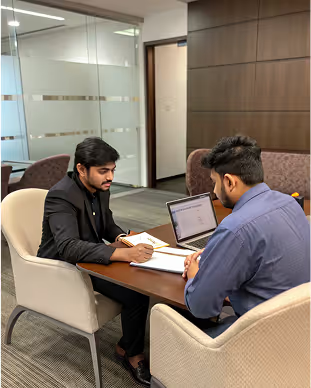
Get guidance on positioning, benchmarking, negotiation strategy, and communication to secure the compensation you deserve.
They are working at companies which are a dream for most


























Admissions close once the required number of students is enrolled for the upcoming cohort. Apply early to secure your seat.
How it Works
Fill in your details and share your interest in joining the program.
A short, non-technical test designed to assess your skills.
Secure your spot in the upcoming cohort with flexible payment options
Kick things off with a 2-Week Bridge Course that gets you course-ready

Worth ₹29,000
A collective of CXOs, AI leaders, and digital transformation heads from global and Fortune 500 companies shaping the AI-native workforce.

Build context-driven, deployable AI systems trusted by real-world teams.
We know you might have some questions before getting started in our platform
The program is called the Advanced Engineering Program in Applied AI, ML with Context Engineering, offered by IITM Pravartak Centre of Excellence (IITM Pravartak CoE).
The program is 6 months long, and the first cohort is tentatively scheduled to begin on 18th April 2026.
Criteria:
1. Bachelor’s degree in Engineering, Computer Science, IT, Mathematics, Analytics, or Business.
2. Minimum 50% marks in graduation.
3. Basic familiarity with Python.
Ideal Candidates:
1. Fresh graduates with 0–3 years of experience.
2. Early-career professionals earning ₹3–8 LPA who aspire to move into higher technical roles.
Applications can be submitted through the official program portal by clicking the Apply link and completing the online application form. Once submitted, applicants will be guided through the next steps of the admissions process.
The application process has already begun, and interested candidates can apply through the official program portal.
Yes. Admission requires candidates to meet the eligibility criteria and successfully clear a mandatory qualifying exam.
1. Aadhaar card.
2. Updated resume.
3. Graduation marksheet or degree certificate.
4. 10th marksheet.
5. 12th marksheet.
6. Professional documents such as experience letters or salary slips (if applicable).
Yes, applicants must clear a pre-screening exam as part of the admission process.
Yes, basic programming knowledge with Python is preferred.
The program is delivered through 100% live online sessions with an optional campus immersion at the IITM Pravartak campus at the end.
It combines Applied AI, ML, GenAI, Agentic AI, and Context Engineering into one curriculum focused on building context-aware, production-ready systems. Offered by IITM Pravartak Technologies Foundation, it is among India’s first IIT-backed programs focused on Context Engineering.
The 2-day campus immersion is optional and takes place at the end of the program.
Dr. Indu Joshi, an Assistant Professor at IIT Mandi with a PhD from IIT Delhi, is the director. Her extensive research in Bayesian Deep Learning and Generative Models, along with international postdoctoral experience, provides significant academic depth to the program.
IITM Pravartak drives innovation in AI and data science through advanced research labs, industry collaborations, and Centres of Excellence that build industry-aligned programs. This strong focus on applied research and real-world problem solving helps learners develop skills that are directly relevant to emerging technology roles.
It covers Applied AI, ML, Deep Learning, GenAI, Agentic AI, and Context Engineering, integrating traditional techniques with modern agent-based and generative models.
The program provides hands-on experience with 30+ tools, platforms, and open-source AI frameworks such as LangChain, Hugging Face, Docker, and MLflow to help learners build and deploy production-ready AI systems.
Agentic AI enables autonomous systems to make context-driven decisions and collaborate dynamically across various applications. This allows AI systems to move beyond simple responses to performing complex, multi-step tasks with minimal human intervention.
It equips learners with advanced AI, ML, and GenAI skills along with domain-specific applications, making it ideal for engineers transitioning into AI-driven roles. The program also offers the added advantage of an industry-aligned curriculum backed by IITM Pravartak Technologies Foundation, providing strong academic credibility and recognition.
The curriculum progresses from core Machine Learning and Deep Learning to Generative AI foundations, Context Engineering, Retrieval-Augmented Generation (RAG), Agentic AI, and multi-agent system development. It also includes MLOps and deployment practices to help learners build and manage production-ready AI systems.
The program incorporates domain-focused applications across sectors such as BFSI, Healthcare, Retail, and Manufacturing, enabling learners to apply AI techniques to real industry use cases. This helps participants contextualize AI solutions within their specific engineering or business domains.
Learners complete 10+ hands-on tasks, assignments, case studies, and a Capstone Project applied to real-world business problems.
It prepares learners for next-gen automation by teaching them to design scalable and collaborative AI systems.
Graduates can pursue roles such as LLM Engineer, Prompt & Evaluation Engineer, Context/Inference Engineer, and AI Governance Analyst.
Participants learn to design and deploy context-aware AI systems, build retrieval-augmented generation (RAG) pipelines, work with large language models, and develop autonomous agent workflows that can solve real enterprise problems.
The capstone project enables participants to build a production-ready AI solution using tools such as LLMs, RAG pipelines, and deployment frameworks. This helps learners showcase real engineering capability and create a recruiter-ready portfolio.
Participants develop skills in designing context-driven AI systems, implementing distributed ML workflows, building multi-agent architectures, and deploying AI systems with monitoring, safety, and governance mechanisms.
The fee is ₹99,000 + 18% GST. Loan options with low-cost EMIs are available.
Yes, there is a tentative additional charge of ₹10,000 for the immersion.
Yes, accommodation will be arranged, subject to availability.
Full payment must be made within 5 days of receiving the offer letter. A ₹5,000 non-refundable application deposit is required, which is adjusted against the final fee.
Yes, partial or full self-funding is allowed based on your preference.
Yes, Futurense has partnered with various financial institutions to assist. If interested, you can rely on our support team for assistance.
Rates vary by partner but are competitive and based on the chosen repayment plan.
For loan processing, keep your PAN, Aadhar, and last 3 months' bank statements ready.