Executive Post Graduate Certificate Programme IN
Generative AI and Agentic AI
Stop prompting AI. Start building systems that act.
Start Date
Jan 2027 (Tentative)
Duration
8-9 months | 160+ Hours
FORMAT
Weekends, Live Online


Stop prompting AI. Start building systems that act.
Start Date
Jan 2027 (Tentative)
Duration
8-9 months | 160+ Hours
FORMAT
Weekends, Live Online

AI has moved beyond answering questions. The next generation of AI engineers will build systems that can plan, use tools, call APIs, retrieve information, correct their own mistakes, and complete complex tasks with minimal human intervention.
That means the real engineering challenge is no longer just the model. It is the system around it, the agents, workflows, retrieval, evaluation, and infrastructure that make AI reliable in the real world.
“We believe that, in 2025, we may see the first AI agents ‘join the workforce’ and materially change the output of companies.”

Build the skills to move from using AI models to engineering systems that plan, act, and ship.
*Salary ranges are indicative market ranges compiled from Glassdoor, LinkedIn and NASSCOM job-posting data; not a programme placement or salary guarantee.
Built for engineers and technical professionals who want to move beyond using AI tools and start building the systems behind them.
Technical Background
Engineering or technology graduates from disciplines such as CS, IT and ECE.
Python & Maths
Foundational Python along with mathematics,
statistics and basic AI/ML.
50%+ UG
A minimum 50% undergraduate score.

Modules
Hands-On Labs
Capstone
CURRICULUM
M0 to M1 · Foundations · 27 hrs
Python recall, AI, ML, and deep learning, neural networks, CNNs, and backpropagation.
You walk out able to: work fluently across the classical stack, so nothing in the LLM modules rests on a gap.
M2 to M3 · NLP and Embeddings · 21 hrs
Transformers, BERT, vector databases, semantic search, FAISS.
You walk out able to: build with transformer architectures and run semantic retrieval over a vector store you set up yourself.
M4 to M5 · Generative AI · 22 hrs
GANs, VAEs, diffusion models, LLM architecture, open-source LLMs.
You walk out able to: build across text, image, and multimodal generation, and work inside an open-source LLM rather than around it.
M6 to M7 · Prompt Engineering and LangChain · 11 hrs
Prompt strategies, structured JSON output, LangChain chains, memory, introduction to RAG.
You walk out able to: enforce reliable structured output and chain memory-aware pipelines.
M8 to M9 · RAG Systems · 15 hrs
Basic RAG, Advanced CRAG, Graph RAG on Neo4j, RAGAS evaluation.
You walk out able to: ship production retrieval and prove it works with a real evaluation harness.
M10 · Fine-Tuning LLMs · 6 hrs
LoRA, QLoRA, instruction tuning, PEFT, LM Eval Harness.
You walk out able to: fine-tune efficiently on constrained hardware and benchmark the result.
M11 · Agentic AI and Multi-Agent Systems · 15 hrs
LangGraph, Microsoft AutoGen, CrewAI, Agentic RAG, multi-agent systems.
You walk out able to: build agent teams that plan, delegate, and recover from their own failures.
M12 to M14 · LLMOps and Deployment · 16 hrs
MLFlow, Docker, Kubernetes, FastAPI, LangSmith, low-code and vibe coding.
You walk out able to: deploy, monitor, trace, and scale an AI system in production.
M15 · Capstone · 12+ hrs
End-to-end agentic build, deployment, and evaluation by IIT Roorkee faculty.
You walk out able to: run one problem from architecture to a live, monitored system and defend every choice in it.

.avif)
AI has moved beyond making predictions or generating responses. The new challenge is the system around the model: retrieval that goes beyond document search, agents that work as a team, evaluation that goes beyond accuracy, and deployment you own rather than hand off.
One model, trained or called, judged on a held-out set.
Plan
ACT
RETRIEVE
VERIFY
RECOVER

Founded in 1847, IIT Roorkee is one of India’s oldest and most prestigious institutions, with a legacy of academic leadership and technological innovation. As a pioneer in interdisciplinary education, IIT Roorkee has been at the forefront of engineering, data science, AI, and management education.
Its executive education programs are designed to equip working professionals with industry-aligned, future-forward skill sets, combining academic rigor with hands-on learning and strategicthinking.
₹10–20 LPA
₹12–25 LPA
₹10–22 LPA
₹20–45 LPA
They are working at companies that are a dream for most


EMI options available through our NBFC partners. Speak to an advisor for the current plans.
Non-refundable, adjusted in final fee.
One-shot, or EMI via NBFC partners.
(Including 18% GST)
Fill in your details and share your interest in joining the program
A short, non-technical test designed to assess your skills
Secure your spot in the upcoming cohort with flexible payment options
Enquire in under two minutes, or speak to an admissions advisor first, whichever you prefer.
9 of 40 seats left · Apply by 20th Sept 2026
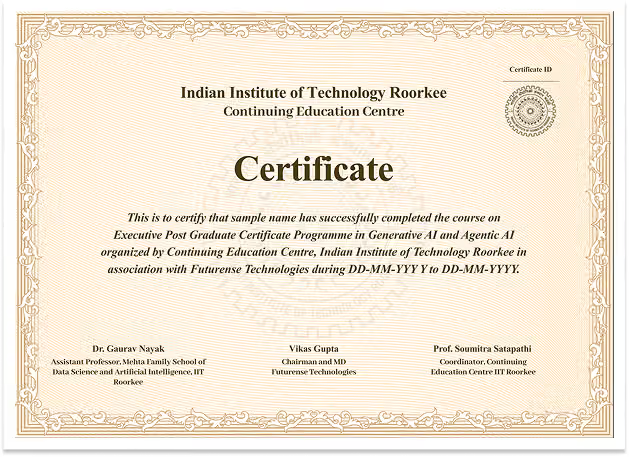
Representative sample certificate. Subject to change.
A collective of CXOs, AI leaders, and digital transformation heads from global and Fortune 500 companies shaping the AI-native workforce.

FAQ
It is a professional programme designed to help learners build expertise across Generative AI and Agentic AI, from LLMs, prompt engineering and RAG to multi-agent systems, evaluation and production deployment.
The programme covers the AI engineering stack across five stages: AI/ML foundations, Generative AI and LLMs, RAG and fine-tuning, Agentic and Multi-Agent AI, and AI deployment and operations.
It is designed around hands-on learning. The programme includes 10+ labs, two mini projects and an end-to-end capstone, allowing learners to apply concepts while building AI systems.
Generative AI focuses on models that create content such as text, code or other outputs. Agentic AI goes further by enabling AI systems to plan, use tools, make decisions, collaborate across agents, and execute multi-step tasks.
The programme includes tools and frameworks such as LangChain, LangGraph, CrewAI, AutoGen, Hugging Face, FAISS, Neo4j, MLflow, Docker, Kubernetes, FastAPI and LangSmith.
The programme is designed for learners with a technology or engineering background, including professionals and graduates from relevant disciplines such as CS, IT and ECE. Applicants need a minimum 50% undergraduate score and foundational knowledge of Python, mathematics/statistics, and AI/ML or data science.
A basic understanding of AI/ML or data science is expected. The programme then builds progressively from foundations into LLMs, RAG, Agentic AI and production deployment.
Yes. This is a technical AI engineering programme, and learners should have foundational Python knowledge. The programme progresses into hands-on development, frameworks, APIs and deployment tools.
Yes. Freshers with the required technical background and foundational skills can apply. The programme specifically identifies CS/IT/ECE freshers among its target learners.
Yes. The programme is also designed for software engineers, data scientists/analysts, ML/AI professionals, and engineering leaders or product professionals looking to deepen their AI engineering capabilities.
The programme fee is ₹1.4 Lakhs + GST. A non-refundable application fee of ₹5,000 is payable at the time of applying and is adjusted against the final fee.
Yes. EMI options are available through our NBFC partners. Speak to an admissions advisor for the plans currently available.
Yes. The programme includes an optional 2-day campus immersion at IIT Roorkee, available at an additional fee of ₹10,000 + GST. The learner bears travel, accommodation, and meals. Attendance is optional and does not affect certification.
The programme comprises approximately 160 hours of learning, including structured modules, hands-on labs, projects, masterclasses, and the capstone, delivered across 8 to 9 months.
The learning journey progresses from AI/ML foundations to Generative AI & LLMs, then RAG & fine-tuning, Agentic & Multi-Agent AI, and finally deployment and LLMOps.
The programme is delivered live online.
Sessions are held on weekends, live online, across 8 to 9 months.
The programme includes 10+ hands-on labs, two mini projects and a 27+ hour capstone, giving learners multiple opportunities to apply the concepts they learn.
The capstone is an end-to-end Agentic AI build where learners apply the programme's concepts to architect, develop, deploy and evaluate an AI system. It is designed to demonstrate practical AI engineering capability.
Yes. The programme covers LLMOps and production deployment, including Docker, Kubernetes, FastAPI, MLflow and LangSmith for deploying, monitoring and tracing AI systems.
Yes. The programme covers Basic RAG, Advanced RAG, Graph RAG and Agentic RAG, along with retrieval evaluation using RAGAS.
Yes. The curriculum covers techniques including LoRA, QLoRA, PEFT and instruction tuning, along with benchmarking and evaluation.
Yes. The Agentic AI component covers multi-agent architectures and frameworks including LangGraph, AutoGen and CrewAI.
The programme emphasises applied assessment through labs, projects, and the capstone rather than relying solely on traditional examinations.
Learners who successfully complete the programme receive a certificate from IIT Roorkee.
It is a professional certificate programme, not a degree programme.
The programme is designed around roles including Generative AI Engineer, Agentic AI Specialist, ML Engineer (LLM), AI Solutions Architect, AI Data Scientist and Prompt Engineer.
Compensation varies significantly based on experience, role, location and employer. Indicative market ranges compiled from Glassdoor, LinkedIn and NASSCOM job-posting data show ₹15 to 50 LPA in India for relevant Generative and Agentic AI roles at 3 to 5 years of experience. This is a market reference, not a placement or salary guarantee.
No. The programme is designed to build relevant AI engineering skills, projects and a recognised IIT Roorkee credential, but employment and compensation depend on the learner's profile, experience, performance and the hiring market.
You graduate with hands-on experience across the modern AI engineering stack, multiple projects, an end-to-end Agentic AI capstone and exposure to the tools used to build and deploy AI systems.
The programme focuses not only on individual AI tools but on foundational and transferable capabilities across LLMs, RAG, agent orchestration, evaluation, deployment and LLMOps. This helps learners build skills that can evolve alongside the rapidly changing AI ecosystem.
A GenAI course can help learners develop a practical understanding of how generative artificial intelligence is used to create applications, automate workflows, and solve real-world problems. The learning journey can cover the foundations behind modern AI models while also introducing learners to their practical applications.
Learners can explore areas such as prompt engineering, generative models, LLM applications, RAG, AI agents, and AI-powered automation. By connecting these concepts through practical exercises and projects, students can gain a clearer understanding of how generative AI solutions are designed and implemented.
For professionals looking to transition into modern AI roles, a structured GenAI course can provide a pathway to build relevant technical knowledge while applying it to practical use cases.
A Generative AI course can help learners understand how AI technologies can be transformed from concepts into practical applications. Instead of learning individual tools separately, learners can explore how models, data, APIs, and AI workflows can work together to address specific problems.
Practical learning can include working with LLM-based applications, retrieval systems, AI agents, and automated workflows. This gives learners an opportunity to understand the development process behind AI applications and the considerations involved in creating useful and reliable solutions.
For engineers and technology professionals, this type of learning can help bridge the gap between existing technical experience and the skills increasingly required for modern AI development.
Learning GenAI and Agentic AI together provides a broader understanding of how modern intelligent applications are evolving.
Generative AI enables systems to understand and generate content, while agent-based approaches can extend these capabilities by allowing systems to plan tasks, interact with tools, and complete multi-step workflows.
Understanding the relationship between these technologies can help learners move beyond basic AI applications and explore how intelligent systems can be designed to perform more complex tasks. This combination is particularly relevant for professionals who want to build practical AI solutions rather than focus only on individual AI models.
An Agentic AI course can introduce learners to the concepts involved in developing AI systems capable of handling tasks with greater autonomy. This includes understanding how AI agents can reason through objectives, interact with tools, access information, and coordinate multiple steps within a workflow.
Learners can also explore how agent-based systems connect with LLMs, APIs, external data, and other AI components. Understanding these connections can help students approach the development of intelligent workflows from both a technical and practical perspective.
These skills can complement existing knowledge of machine learning and generative AI, giving learners a broader foundation for working with emerging AI applications.
Designed around modern AI technologies and practical applications, the program can be relevant for engineers and technology professionals who want to expand their existing technical capabilities.
An AI course for engineers can be especially valuable when it connects AI concepts with practical implementation. Learners can build on their existing technical background while exploring generative AI, LLM applications, AI agents, machine learning, and intelligent automation.
This combination can help professionals understand where AI fits within software development, engineering workflows, and business applications while building skills that can support their transition into AI-focused roles.