Program Highlights

Master 15+ Real-World Tools, Frameworks & AI Workflows

Learn from IIT Faculty & CXOs Behind Scalable AI Systems

High-Growth Job Paths in AI Engineering

Scale Enterprise AI on Cloud

About IIT Roorkee

Founded in 1847, IIT Roorkee is one of India’s oldest and most prestigious institutions, with a legacy of academic leadership and technological innovation. As a pioneer in interdisciplinary education, IIT Roorkee has been at the forefront of engineering, data science, AI, and management education.

Its executive education programs are designed to equip working professionals with industry-aligned, future-forward skill sets, combining academic rigor with hands-on learning and strategicthinking.

Program Director

Prof. Kaushik Ghosh

Coordinator, Continuing Education Centre (CEC)

Prof. Kaushik Ghosh is a Distinguished Academician and a Leading Researcher in Bioinorganic and Organometallic Chemistry. As the Coordinator of the Continuing Education Centre (CEC) at IIT Roorkee and a Professor (HAG) in Department of Chemistry and Joint Faculty Department of Bio Sciences and Bio Engineering IIT Roorkee, he has been at the forefront of interdisciplinary research, bridging fundamental science with real-world applications.

With expertise in Bioinorganic Chemistry, Catalysis, and Metal Complexes in Protein Aggregation, Prof. Ghosh has authored over 130 research papers, contributed to severalbook chapters, and secured multiple research grants. He is a Fellow of Royal Society of Chemistry (FRSC) and his contribution have been recognized with prestigious accolades, including the DST-SERC Fast Track Award for Young Scientists and the ICMR International Fellowship.

Prof. Neetesh Kumar

Associate Professor at IIT Roorkee

Prof. Neetesh Kumar is an Associate Professor at IIT Roorkee and one of India’s leading voices in applied AI, cloud systems, and intelligent infrastructure. With multiple patents, global research citations, and editorial leadership at IEEE’s top AI journal, his work bridges the gap between academic depth and industry impact.With 180+ citations on intelligent traffic systems, multiple patents, and a position on the editorial board of IEEE’s top-ranked journals, he knows exactly where AI is headed: cloud-native, production-grade, real-world systems.That’s why this program isn’t academic theory, it’s a hands-on blueprint for the AI engineer India needs next. From deep research in parallel computing to running projects funded by DST, SERB, and CSIR, Prof. Neetesh brings the best of research, industry, and teaching into one classroom.He’s here not to teach code, but to train system thinkers who can lead India’s AI future.

The IIT Advantage

Experience Campus Immersion At IIT Roorkee Research Park

Certification From IIT Roorkee

Receive a Certificate of completion from IIT Roorkee,
recognizing your achievement.

Why This Matters?

We understand talent evolution better—because we train them first. We know their skill gaps, learning curves, and real-world readiness—long before they join your teams.

AI Engineering AIOps

in Just 7-8 Months

How You Go From Learning to Orchestrating

Module 1: Foundations of AI ML and Generative AI

  1. Understanding Supervised Machine Learning, Unsupervised Machine Learning and Reinforcement Learning
  2. Data Manipulation for Machine Learning
  3. Exploratory Data Analysis for Machine Learning
  4. Essential Mathematics for Machine Learning and AIDefinition of Generative AI
  5. Generative AI Applications
  6. Definition of LLMs

Module 2: Deep dive into Machine Learning Algorithms

  1. Regression Supervised Machine Learning
    Linear Regression
    Decision Tree Regressor
    Random Forest Regressor
    Overfitting, Underfitting and Regularization
  2. Classification Supervised Machine Learning
    Logistic Regression
    Decision Tree Classifier
    Random Forest Classifier
  3. Unsupervised Machine Learning
    KMeans Clustering
    Hierarchical Clustering
    Dimensionality Reduction
    Anomaly detection
  4. Understanding Reinforcement learning: Basic concepts
    (Action, reward, process), MPD, RL, DRL, DQN, etc.
  5. MLOps for Machine Learning model deployment

Module 3: Understanding Deep Learning

  1. Exploring Deep Learning
  2. Understanding Neural Networks with TensorFlow
  3. Deep dive into Neural Networks with TensorFlow
  4. Artificial Neural Networks (ANN)
  5. Convolutional Neural Networks (CNN)
  6. Object detection using YOLO framework
  7. Transfer Learning in CNN
  8. Recurrent Neural Networks (RNN) and LSTMs

Module 4: Exploring NLP

  1. Architechtures of RNN - One to One, Many to Many, Many to One etc
  2. Understanding Text for NLP
  3. Tokenization, Stemming and Lemmatization, Stopwords and Keywords in NLP
  4. Text Vectorization using TF-IDF, Bag of Words and Word 2 Vec
  5. Use cases across domains in NLP

Module 5: Engaging with Generative AI

  1. How Generative AI works
  2. Text generation
  3. Image generation
  4. Audio generation and video generation
  5. Using Hugging face to access models for text generation, image generation
  6. GANs
  7. Types of GANs - ProGAN, SRGan, CycleGAN
  8. Auto Encoders, Variational Auto Encoders (VAEs), Diffusion Models

Module 6: Understanding LLMs

  1. Definition of LLMs
  2. LLM Use Cases
  3. Prompt Tuning
  4. Attention Mechanism
  5. Transformer Model and architecture
  6. Encoder-Decoder arrangements
  7. Train and Generate text using Encoder-decoder Architecture
  8. BERT for Transfer learning
  9. Leveraging multiple pretrained LLMs from Hugging Face
  10. Fine tuning LLMs

Module 7: GenAI Application Development Prompting Techniques

  1. Introduction to Prompt Engineering
  2. Successful and Unsuccessful prompts
  3. Types of Prompting
  4. Introduction to Open AI, GPT , Open AI Playground
  5. Cost & latency considerations when calling APIs (OpenAI, Azure, AWS).
  6. Multimodal prompting for GPT 4
  7. Image generation using Open AI DALLE 3
  8. Prompt evaluation
  9. Implementing Agents and Chains
  10. Implementing zero-shot-react, conversational-react agents with LangChain
  11. Open AI Function (Tool Integration)
  12. Testing various LLMs with Prompt Engineering

Module 8: Synthetic Data and Datasets for LLMs

  1. Introduction to Synthetic Data
  2. Generating Synthetic Data
  3. Synthetic Data for LLMs
  4. Real-world Applications and Use Cases
  5. Hands-on generating and using Synthetic Data

Module 9: AI Embeddings & Retrieval

  1. Understanding AI Embeddings
  2. Advanced Retrieval Techniques
  3. Hugging Face Embeddings
  4. Vector Databases in AI
  5. CRUD operations with Vector Databases
  6. RAG - Retreival Augmented Generation
  7. RAG solutions using Open AI models and Hugging face models
  8. Ethical Considerations in AI Embeddings
  9. Navigating AI Hallucinations, Drift, and Bias
  10. Embeddings in Real-world Applications
  11. Embeddings Optimization and Fine-tuning
  12. Embeddings Security and Privacy
  13. LLM Ops and model deployment best practices

Module 10: Understanding Agentic AI

  1. Agents, Agentic AI and Multi-Agent Systems
  2. Agent Definition & Autonomy
  3. Simple vs. Knowledge-Based Agents
  4. Reflex vs. Goal-Driven Agents
  5. Microsoft AutoGen
  6. Agent Architecture (Perception, Decision, Action)
  7. Integrating Knowledge Bases (RAG, Domain Data)
  8. Measuring Performance (Success Rate, Resource Usage)
  9. Hierarchical Agent Planning
  10. Multi-Step Reasoning with LLM
  11. Memory & Long-Term Context
  12. Integrating Retrieval Augmentation in Agent Workflows
  13. Domain-Specific Knowledge & Dynamic Prompting

Module 11: Exploring Cloud Ecosystems

  1. Cloud Ecosystems
  2. Introduction to Cloud Ecosystem
  3. Definitions
  4. Cloud characteristics
  5. Deployment models
  6. Leading Service providers (AWS, Google, Azure, etc.)
  7. Comparing AWS, Azure, and GCP core services for compute, storage, and AI/ML.
  8. Data Centres and their components
  9. Service (SaaS, IaaS, PaaS)
  10. Issues & Challenges

Module 12: Advancement in Hypervisors

  1. Understanding hypervisors
  2. Reference model
  3. Virtualisation characteristics
  4. Principles of hypervisor design interfaces
  5. Types of hypervisors (type-1 and type-2)
  6. Differences between Type-1 and Type-2 hypervisors.
  7. Design methods of hypervisors (full virtualization, para virtualization, and hardware-assisted virtualization)
  8. Memory Virtualisation
  9. I/O virtualisation
  10. OS virtualization
  11. Comparative Analysis of hypervisors
  12. Understanding performance, requirements, and bottleneck

Module 13: Container Orchestration

  1. Understanding LLM Deployment Architectures
  2. Containerizing LLM Inference Services (e.g., using FastAPI + Docker)
  3. Managing GPU Workloads in Kubernetes
  4. Scaling LLM APIs with Kubernetes and Istio
  5. Optimizing Latency and Throughput for LLM Containers
  6. Secure Access and Rate Limiting for AI APIs
  7. CI/CD for LLM-Powered Microservices
  8. Monitoring and Logging for LLM Containers
  9. Model Versioning and Rollbacks
  10. Cost Optimization Strategies for LLM Inference in Production

Module 14: Cloud Security & Resilience

  1. Infrastructure security: Network-level security
  2. Host-level security
  3. Application-level security
  4. Data security and storage: Data privacy and security issues
  5. Jurisdictional issues raised by data location
  6. Identity and access management
  7. Access control
  8. IAM, Key Management Services, and zero-trust architecture trust, reputation, risk authentication in cloud computing
  9. Client access in the cloud
  10. Cloud contracting model
  11. Commercial and business considerations

Module 15: Understanding Cloud in context of Gen AI and LLMs

  1. EC2 Deep Dive and AMIs
  2. EBS vs S3 vs EFS – Storage Solutions
  3. Load Balancing and Auto Scaling Basics
  4. Intro to Serverless: AWS Lambda
  5. Using AWS Bedrock for GenAI (including foundation models)
  6. Deploying Open-Source LLMs on EC2/EKS
  7. Fine-Tuning and Inference
  8. Pipelines on Cloud
  9. Cost & Performance
  10. Considerations for LLM Workloads
  11. SageMaker Pipelines for Model Training and Inference
  12. Model Versioning, A/B Testing, and Rollbacks
  13. Security and Compliance for GenAI in Production

Total

Total Duration - 132 Hours

Hours trained by IIT - 66 Hours

Hours trained by Futurense - 66 Hours

Participants will work on 10+ diverse hands-on activities with AI Tools

AI Clinic

Through the Futurense AI Clinic, you’ll gain hands-on exposure to real enterprise-grade AI projects, from ideation to deployment.

Work on Live Projects

Solve real business challenges using GenAI, Agentic AI, and automation workflows.

Use Industry-Standard Tools

Hands-on with LangChain, CrewAI, Flowise, OpenAI APIs, Zapier, HubSpot, and more.

Collaborate with Experts

Guided by IIT faculty and industry mentors through each phase of your project.

End-to-End AI Execution

Build, test, and deploy intelligent workflows that simulate real-world problem solving.

While mastering 20+ Tools

Cloud
ML/DL
Orchestration
GenAI/Agents
Pipelines
Security & DevOps
Next
Next

By The End, You’ll Be AbleTo Do All This

Build full-stack GenAI systems

Master the complete development cycle of GenAI applications using LLMs, LangChain, RAG, and sophisticated agent orchestration - moving beyond basic notebooks to production-ready APIs.

Own the AI engineering lifecycle

Master the complete spectrum from foundational machine learning to advanced multimodal GenAI and agentic architectures, becoming a full-stack AI engineering professional.

Design enterprise-ready agents

Create automated workflow solutions using cutting-edge frameworks including AutoGen, Crew AI, and n8n, bringing true intelligence to business processes.

Navigate cloud platforms

Gain expertise in architecting, containerizing, and deploying AI solutions across major cloud platforms - AWS, Azure, and GCP.

Secure and scale AI

Implement robust systems with rollback capabilities, comprehensive observability, security measures, and compliance protocols for enterprise-grade AI deployments.

Master AI pipelines

Learn to deploy, version, monitor, and retrain models using industry-standard tools like Docker, Kubernetes, and advanced MLOps workflows for seamless production environments.

This Program is for

Educational Qualification

3–4 year STEM degree (B.Tech, B.Sc, MCA, etc.)

Work Experience

Preferred 1+ years of industry experience; however, qualified freshers who have prior courses done in AI or ML may apply.

Freshers

Exceptional freshers with strong fundamentals may be considered via screening

Prior Knowledge

Programming experience required, via academics, work, or projects.

Educational Qualification

Mandatory pre-screening test to assess readiness for the program

Qualifying Test

What You’ll Be Tested On

Logical Reasoning

Basic coding (Python or Java)

Technical fundamentals

Scenario-based thinking

Duration: 45 minutes

Important Guidelines

2-hour

Non-invasive online qualifying test with coding + MCQs

No prior experience in cybersecurity required.

AI Engineers & Data Engineers

Looking to move from prototypes to production with GenAI, MLOps, and Agentic AI.

Cloud Developers & DevOps Engineers

Aiming to add full-stack AI deployment, observability, and orchestration skills.

Software & System Architects

Building intelligent, cloud-native systems that scale across enterprise use cases.

Tech Entrepreneurs & Founders

Creating AI-powered products and looking to fast-track engineering capabilities.

Roles Thatʼll Be Looking for You

Data & ML Engineering
MLOps & AIOps Transformation
Cloud & Platform Engineering
AI Product, Solutions & Consulting
AI-Native Engineering
Role Now

Data Analyst

Salary

₹4–8 LPA

Role Upgraded

AI Product Analyst

Earning Potential

₹18–30 LPA

Role Now

Machine Learning Engineer

Salary

₹5–10 LPA

Role Upgraded

Generative AI Engineer

Earning Potential

₹20–40 LPA

Role Now

Data Scientist

Salary

₹4–12 LPA

Role Upgraded

AI Engineer

Earning Potential

₹18–35 LPA

Role Now

AI Engineer

Salary

₹5–12 LPA

Role Upgraded

AI Systems Engineer

Earning Potential

₹25–50 LPA

Role Now

MLOps Engineer

Salary

₹6–10 LPA

Role Upgraded

AIOps Engineer

Earning Potential

₹15–35 LPA

Role Now

DevOps Support

Salary

₹4–8 LPA

Role Upgraded

Cloud AI Engineer

Earning Potential

₹25–45 LPA

Role Now

Model Deployment Engineer

Salary

₹6–10 LPA

Role Upgraded

AI Infrastructure Engineer

Earning Potential

₹20–40 LPA

Role Now

Automation / Monitoring Engineer

Salary

₹5–8 LPA

Role Upgraded

MLOps Pipeline Specialist

Earning Potential

₹18–38 LPA

Role Now

Cloud Engineer

Salary

₹4–8 LPA

Role Upgraded

Cloud AI Engineer

Earning Potential

₹25–45 LPA

Role Now

Infra Ops

Salary

4-7 LPA

Role Upgraded

AI Cloud Solutions Developer

Earning Potential

₹20–35 LPA

Role Now

Backend/Platform Engineer

Salary

₹5–10 LPA

Role Upgraded

Agentic AI Engineer

Earning Potential

₹25–50 LPA

Role Now

API Developer

Salary

₹5–9 LPA

Role Upgraded

AI Systems Engineer

Earning Potential

₹25–50 LPA

Role Now

Business Intelligence Developer

Salary

₹4–7 LPA

Role Upgraded

AI Solutions Developer

Earning Potential

₹20–35 LPA

Role Now

Product Analyst

Salary

₹4–8 LPA

Role Upgraded

AI Product Analyst

Earning Potential

₹18–30 LPA

Role Now

Junior Product Engineer

Salary

₹5–9 LPA

Role Upgraded

GenAI Application Engineer

Earning Potential

₹20–40 LPA

Role Now

Tech Consultant

Salary

₹4–8 LPA

Role Upgraded

AI/GenAI Consultant

Earning Potential

₹25–40 LPA

Role Now

AI Engineer (Basic ML/NN)

Salary

₹5–12 LPA

Role Upgraded

Agentic AI Engineer

Earning Potential

₹25–50 LPA

Role Now

Software Developer / API Engineer

Salary

₹4–8 LPA

Role Upgraded

AI Cloud Integrations Engineer

Earning Potential

₹20–35 LPA

Role Now

Developer with ML Basics

Salary

₹5–10 LPA

Role Upgraded

Generative AI Engineer

Earning Potential

₹20–40 LPA

Role Now

Full-Stack Developer

Salary

₹6–12 LPA

Role Upgraded

AI Systems Engineer with AIOps

Earning Potential

₹25–50 LPA

Next
Next

Career Assistance By Futurense

Young man studying math, writing notes with a pen while looking at a laptop screen displaying a right triangle and equations.

 Profile, Narrative & Resume Building

Craft a recruiter-ready identity with optimized resumes, LinkedIn profiles, and a strong career narrative.

Students seated at desks with laptops attending an online video conference featuring a man speaking.

Career-Specific Training

Develop job-ready skills with role-focused training, capability tests, AI tools workshops, and continuous upskilling to match real hiring expectations.

Two men sitting at a table in an office, reviewing documents and discussing work with a laptop and coffee cups nearby.

Futurense Job Board - Exclusive Opportunities

Access curated, pre-vetted roles before they hit public portals, with priority visibility for Futurense learners.

Two men reviewing a resume document together at a table in a modern office setting.

Interview Playbooks & Cheat Sheets

Get insider interview guidance with structured playbooks: FAQs, sample answers, frameworks, recruiter insights, and round-wise preparation.

Mock Interviews with Experts

Experience real interview simulations with personalized feedback from mentors, industry leaders, and FLC members.

Three young professionals enjoying coffee and snacks while collaborating around a laptop in a modern office.

Mentor Referrals & Networking

Unlock referral advantages, insider recommendations, alumni-driven opportunities, and FLC mentorship that accelerates your career entry.
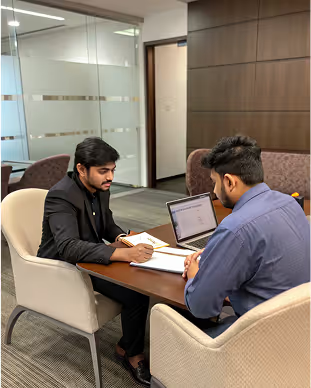
Two men sitting across a wooden table in an office, one taking notes and the other using a laptop.

Salary Negotiation Support

Get guidance on positioning, benchmarking, negotiation strategy, and communication to secure the compensation you deserve.

Our students are acing it!

They are working at companies which are a dream for most

Fee Structure

Total Admission Fee

₹1,47,500

( Inclusive of All Tax )
Apply Now
Program fee is subject to change from the next cohort.

EMI Starts From

₹7,847 to ₹27,533/month

A non-refundable application deposit of ₹5,000 will be adjusted in the total fee. Program fees are refundable only if the student withdraws before the start date. No refunds will be made after the program begins.

An additional ₹10,000 will be applicable if you opt for the Campus Immersion (optional).

Deserving candidates opting for the upfront payment plan may be eligible for a scholarship of up to ₹15,000.

Application Deadline

28th March, 2026

Admissions close once the required number of students is enrolled for the upcoming cohort. Apply early to secure your seat.

How it Works

Application Process

1

Submit Your Application

Fill in your details and share your interest in joining the program.

2

Clear the Qualifying Test

A short, non-technical test designed to assess your marketing aptitude.

3

Pay and Confirm Your Seat

Secure your spot in the upcoming cohort with flexible payment options

Traditional AIOps vs. AI Engineering on Cloud and AIOps by CEC IIT Roorkee

Dimension

This Programme

Other Programme

Core Philosophy
Engineering-driven, production-first program focused on building deployable, scalable, cloud-native AI systems and AIOps workflows
Learning is largely centred around model building, concepts, or isolated AI techniques
Program Structure
Structured 9-month hybrid program with a defined learner journey, bridge course, core modules, projects, assessments, and capstone
Standalone or loosely connected modules without an integrated system-level framework
Curriculum Depth
End-to-end coverage from AI & ML foundations to GenAI, Agentic AI, MLOps, AIOps, cloud infrastructure, security, and deployment
Fragmented topic coverage with limited focus on full-stack or production AI systems
Learning Method
Live interactive sessions with IIT Roorkee faculty and industry experts, supported by assignments, projects, and evaluations
Primarily pre-recorded video lectures with limited instructor interaction
Hands-on Exposure
Strong emphasis on building real-world AI systems, including RAG pipelines, agent workflows, cloud deployments, and monitoring
Hands-on work is often limited to notebooks, demos, or small, isolated exercises
Cloud & Infrastructure Focus
Cloud-native by design, with explicit focus on AWS, Azure, GCP, Kubernetes, Docker, GPU provisioning, observability, and rollback
Cloud concepts are  often optional or treated as add-ons rather than core foundations
GenAI & Agentic AI Coverage
Deep focus on Generative AI, LLMs, RAG, embeddings, multi-agent systems, memory orchestration, and autonomous workflows
GenAI is often limited to prompt engineering or API usage without system orchestration
MLOps & AIOps Orientation
Dedicated coverage of MLOps and AIOps, including versioning, retraining, monitoring, CI/CD, cost optimization, and reliability
MLOps concepts, if present, are usually introductory or theoretical
Security & Reliability
Explicit training in cloud security, IAM, data privacy, compliance, observability, resilience, and production SLAs
Security and reliability aspects are often minimally addressed or excluded
Industry Alignment
Use-case-driven curriculum aligned to enterprise applications across finance, compliance, operations, risk, and SaaS
Content is frequently driven by trends or tools rather than enterprise deployment needs
Assessment Rigor
Continuous evaluation through assignments, hands-on projects, and a capstone aligned with real-world deployment outcomes
Limited assessments, often quiz-based or completion-focused
Capstone / Project Work
Full-scale deployment of production-grade GenAI and Agentic AI systems as a capstone project
Optional or basic final project without production deployment expectations
Campus & Peer Learning
Optional 2-day campus immersion at IIT Roorkee with faculty interaction, project presentations, and peer collaboration
Fully remote with no campus or institutional immersion
Credential Value
Advanced PG Certificate issued by Continuing Education Centre (CEC), IIT Roorkee
Certificate of completion from online platforms
Career Readiness
Prepares learners for roles such as AI Engineer (GenAI), Agentic AI Engineer, Cloud AI Engineer, MLOps/AIOps Engineer
Primarily suitable for introductory learning or incremental upskilling

Feeling Underconfident About Your Tech Skills?

Kick things off with a 2-Week Bridge Course that gets you course-ready

Young man in a blue shirt resting his chin on his hand, looking thoughtfully upward.

What you'll learn:

Maths Refresher

Programming Foundations

Databases with MySQL

GenAI, Agentic AI and Prompt Engineering

Cloud Foundations

Worth ₹29,000

Included free with your enrollment.

Led by the Futurense Leadership Council (FLC)

 A collective of CXOs, AI leaders, and digital transformation heads from global and Fortune 500 companies shaping the AI-native workforce.


Aditya Khandekar

President, Corridor Platforms

Akshay Kumar

Research & Analytics Leader

Alok Tiwari

Director of Analytics, Junglee Games

Anand Das

Chief Digital & AI Officer, TVS Motors

Aneel kumar

Global Chapter Leader - ICSS, DD&T

Anirban Nandi

Head of AI Products & Analytics (Vice President), Rakuten India

Ankit Mogra

Director – Insights & Analytics, Ather Energy

Anupam Gupta

Independent Consultant – AI/ML Product Development, Amplify Health

Arpit Agarwal

Data Science Manager, Google

Arvind Balasundram

Executive Director, Commercial Insights & Analytics

Ashish Dabas

Vice President, Capital One

A V Rahul

Director, Analytics, - Barracuda

Bhairav M

Senior Manager Data Science and Product Management

Bhargab Dutta

Chief Digital Officer, Centuryply

Deepa Mahesh

Head of Strategy & Operations, Board Member

Divesh Singla

SVP, Global Operations Services and Managing Director, India & Philippines, SignantHealth

Indrani Goswami

Director of Analytics, NYKAA

Ishu Jain

Head of Analytics

Kaushik Das

Managing Director, JCPenney

Krithika Muthukrishnan

Chief Data Science Officer, Scripbox

Madhu Hosadurga

Global Vice President, Enterprise AI, Schneider Electric

Madhurima Agarwal

Managing Director - Microsoft for Startups

Monica S Pirgal

Chief Executive Officer, Bhartiya Converge

Muthumari S

Global Head of Data & AI Studio

Nithya Subramanian

Senior Director Data & AI COE - Best Buy

Nitin Srivastava

Global Head of Data and Analytics, Dr. Martens plc

Pankaj Rai 

Group Chief Data and Analytics Officer, Aditya Birla Group

Pankaj Srivastava

Partner, PwC

Praveen Sathyadev

Head - EU/UK Business Growth (VP) - Analytics, Insights and AI, Course5i

Ruchika Singh

Director, Data Science & Insights, Spotify

Satyakam Mohanty

Founder & Managing Partner, Wyser

Saurabh Agarwal

Chief Executive Officer

Saurabh Kumar

Director - Data Engineering

Sharmistha Chaterjee

Executive Engineering Manager - Head of Software and Systems Engineering, Commonwealth Bank

Shirsha Ray Chaudhuri

Director of Engineering

Srini Oduru

Head of IT Delivery and Operations, Cervello India

Sulabh Jain

Chief Analytics Officer

Sumon Mal

Head of Backend Engineering, Sony LIV

Supria Dhanda

Co-Founder & Managing Partner, Wyser

Swati Jain

Partner - Digital, AI & Analytics, Deloitte

Tushar Chahal

Chief Technology Officer, Numisma Bank

Tushar Sahu

Director Engineering, Google

Vidhi Chugh

AI Executive | Microsoft MVP

Vishal Nagpal

Director of Data and AI at Best Buy

Vishal Nagpal

Director of Data and AI at Best Buy

Vidhi Chugh

AI Executive | Microsoft MVP

Tushar Sahu

Director Engineering, Google

Tushar Chahal

Chief Technology Officer, Numisma Bank

Swati Jain

Partner - Digital, AI & Analytics, Deloitte

Supria Dhanda

Co-Founder & Managing Partner, Wyser

Sumon Mal

Head of Backend Engineering, Sony LIV

Sulabh Jain

Chief Analytics Officer

Srini Oduru

Head of IT Delivery and Operations, Cervello India

Shirsha Ray Chaudhuri

Director of Engineering

Sharmistha Chaterjee

Executive Engineering Manager - Head of Software and Systems Engineering, Commonwealth Bank

Saurabh Kumar

Director - Data Engineering

Saurabh Agarwal

Chief Executive Officer

Satyakam Mohanty

Founder & Managing Partner, Wyser

Ruchika Singh

Director, Data Science & Insights, Spotify

Praveen Sathyadev

Head - EU/UK Business Growth (VP) - Analytics, Insights and AI, Course5i

Pankaj Srivastava

Partner, PwC

Pankaj Rai 

Group Chief Data and Analytics Officer, Aditya Birla Group

Nitin Srivastava

Global Head of Data and Analytics, Dr. Martens plc

Nithya Subramanian

Senior Director Data & AI COE - Best Buy

Muthumari S

Global Head of Data & AI Studio

Monica S Pirgal

Chief Executive Officer, Bhartiya Converge

Madhurima Agarwal

Managing Director - Microsoft for Startups

Madhu Hosadurga

Global Vice President, Enterprise AI, Schneider Electric

Krithika Muthukrishnan

Chief Data Science Officer, Scripbox

Kaushik Das

Managing Director, JCPenney

Ishu Jain

Head of Analytics

Indrani Goswami

Director of Analytics, NYKAA

Divesh Singla

SVP, Global Operations Services and Managing Director, India & Philippines, SignantHealth

Deepa Mahesh

Head of Strategy & Operations, Board Member

Bhargab Dutta

Chief Digital Officer, Centuryply

Bhairav M

Senior Manager Data Science and Product Management

A V Rahul

Director, Analytics, - Barracuda

Ashish Dabas

Vice President, Capital One

Arvind Balasundram

Executive Director, Commercial Insights & Analytics

Arpit Agarwal

Data Science Manager, Google

Anupam Gupta

Independent Consultant – AI/ML Product Development, Amplify Health

Ankit Mogra

Director – Insights & Analytics, Ather Energy

Anirban Nandi

Head of AI Products & Analytics (Vice President), Rakuten India

Aneel kumar

Global Chapter Leader - ICSS, DD&T

Anand Das

Chief Digital & AI Officer, TVS Motors

Alok Tiwari

Director of Analytics, Junglee Games

Akshay Kumar

Research & Analytics Leader

Aditya Khandekar

President, Corridor Platforms

form bg-gradient blur

Ready to Engineer AI That Actually Works in Production?

Design, deploy, and scale reliable AI systems using cloud platforms and AIOps.

Frequently Asked Questions

We know you might have some questions before getting started in our platform

Program Overview & Eligibility
Financials & Support
Curriculum & Tools
Faculty & Institutional Strength
Career Pathways & Outcomes

What is the name of the certification program, and which IIT offers it?

The program is titled Advanced PG Certificate Program in AI Engineering on Cloud and AIOps and is offered by the Centre of Excellence in Cyber Systems and Information Assurance (CEC), IIT Roorkee.

What is the duration of the program, and when does the first cohort begin?

The program runs for 9 months and includes over 132 hours of learning. The upcoming cohort is scheduled to commence on 30th March, 2026.

What are the eligibility criteria for this program, and who should ideally enroll?

Eligibility:
1. 3–4 year undergraduate degree in a STEM field (BSc, BTech, or equivalent).
2. Minimum 50% aggregate marks in graduation.
3. Exposure to programming and computing is required.
While 1+ years of work experience is preferred, strong fresh graduates may apply.

How can I apply to the Advanced PG Certification in AI Engineering on Cloud and AIOps?

The application process is simple and seamless. Candidates need to complete the online application form and submit the required details. Once the application is submitted successfully, they will be required to appear for the qualifying exam.

When will the application process start?

Applications are currently open. Admissions are conducted in limited-seat cohorts.

What is the program’s fee, and what financing options are available?

The program fee is ₹1.25 lakhs + 18% GST. Loan options with flexible repayment tenures are available through financing partners.

How is the teaching format structured for this hybrid program?

The program follows a hybrid format with approximately 70% live online sessions and 30% recorded content, totaling 132+ hours.

What technical background do I need before starting this course?

A strong foundation in Python, data structures, linear algebra, statistics, and basic cloud concepts (AWS/Azure/GCP) is recommended. This is a technically intensive program designed primarily for engineers and developers.

Is this course suitable for non-technical professionals?

No. The program is designed for technical professionals with prior exposure to coding and software development.

How challenging is this course, and how much time should I expect to invest?

Participants should dedicate 10–15 hours per week. The curriculum progresses from AI/ML fundamentals to advanced topics such as LLMOps, multi-agent systems, and cloud-native deployment.

What’s the value proposition compared to other AI education options?

 Unlike programs that focus only on model development, this curriculum emphasizes end-to-end AI engineering — from model building to cloud deployment, monitoring, and AIOps integration.

What foundational skills should I focus on to succeed in this comprehensive AI course?

Strengthen your Python programming, mathematics (linear algebra, probability, calculus), data handling, and cloud fundamentals. A Bridge Course is included to reinforce key concepts.

Why is this program considered unique compared to other certifications in AI?

It integrates AI Engineering, Generative AI, Agentic AI, Cloud Deployment, and AIOps into one production-focused curriculum delivered by IIT faculty and industry experts.

What if I can’t take 2 days of leave for the campus immersion?

The 2-day campus immersion is optional and conducted toward the end of the program.

Will there be any additional cost for attending the optional campus immersion?

Yes. Immersion-related costs, if applicable, are communicated in advance and are based on actual expenses.

Will hostel accommodation be provided during immersion?

Accommodation may be provided subject to campus facility availability.

Is there a selection process?

Yes. The selection process includes application review, eligibility verification, and a mandatory pre-screening test.

What documents are required for the application?

Applicants must submit ID proof, academic mark sheets (Class 10, 12, and graduation), degree certificates, work experience certificates (if applicable), and a passport-size photograph.

Will there be any pre-screen exams for enrolling in the program?

Yes — candidates must clear a mandatory pre-screening test that evaluates foundational knowledge in programming, problem-solving, logical reasoning, and core technical concepts relevant to AI and cloud engineering.

Should I have coding experience to qualify for the pre-screening exam?

Yes. Basic coding proficiency in Python is necessary to clear the pre-screening test.

Can I self-fund this program?

Yes. Candidates may fully or partially self-fund the program.

Does Futurense help with loans?

Yes. Financing support is available through partnered lending institutions.

Will there be any additional cost for attending the optional campus immersion?

Yes. Immersion-related costs, if applicable, are communicated in advance and are based on actual expenses.

What is the interest rate on the loans?

Interest rates vary based on lender policies and repayment tenure. Candidates are connected with financing partners to determine applicable terms.

What documents should I keep ready for loan processing?

PAN card, Aadhaar card, recent bank statements, income documents, and payslips (if applicable) may be required.

What areas of AIOps does this program cover?

It covers the full AI engineering lifecycle relevant to AIOps, including scalable MLOps workflows, containerized LLM deployment, cloud-native AI systems on AWS/Azure/GCP, pipeline automation, monitoring, and secure production-grade operations.

What tools and platforms are covered in this program?

Learners gain hands-on experience with 20+ industry-relevant tools and platforms, including LangChain, LangGraph, CrewAI, AutoGen, Hugging Face, Kubernetes, Docker, n8n, GPT-4, LLaMA, Amazon Web Services, Microsoft Azure, and Google Cloud Platform.

What makes this certificate program particularly suitable for engineers and tech professionals?

It emphasizes production-grade AI deployment, cloud-native engineering, DevOps integration, and multi-agent orchestration.

What are the key modules in the program?

Modules progress from AI/ML foundations to LLM engineering, agentic AI systems, containerization, cloud ecosystems, and AIOps pipelines.

How does the program enable participants to specialize in their specific engineering domains?

Participants design end-to-end AI pipelines, fine-tune LLMs, deploy scalable architectures, implement monitoring systems, and build domain-relevant AI solutions.

What practical projects are included in the course?

Learners complete 15+ hands-on projects involving AI model development, deployment, monitoring, and orchestration on cloud environments.

What is the significance of teaching multi-agent systems and agent collaboration?

Multi-agent systems enable the development of scalable, autonomous AI solutions that can collaborate and execute complex tasks efficiently across enterprise environments.

Who is the Program Coordinator, and why is their expertise significant?

The program is coordinated by Prof. Neetesh Kumar, Associate Professor at Indian Institute of Technology Roorkee, whose expertise in applied AI and cloud infrastructure enhances academic rigor and industry alignment.

What makes CEC, IIT Roorkee, a trendsetter in technological education?

Indian Institute of Technology Roorkee is one of India’s premier IITs, known for its research excellence and strong industry impact in technology domains.

How do industry leaders and the Futurense Leadership Council contribute to the program?

Industry experts conduct masterclasses, mentorship sessions, and curriculum advisory to ensure real-world alignment.

What job roles can participants expect to pursue after completing this program?

Graduates can pursue roles such as AI/ML Engineer, Generative AI Engineer, Cloud AI Engineer, AIOps Engineer, Data Scientist, and AI Solutions Developer.

How does having skills in AIOps impact salary and job prospects?

Having skills in AIOps significantly enhances salary potential and job opportunities, as organizations actively seek professionals who can manage, automate, and scale AI systems reliably in production environments.

How does this program align with rapid generative AI adoption by companies?

The curriculum reflects enterprise AI stacks integrating GenAI, RAG pipelines, and agent-based automation into production systems.

Why will IIT Roorkee’s Advanced PG Certificate in AI Engineering on Cloud and AIOps future-proof careers in a rapidly evolving market?

The program equips learners with in-demand skills across Generative AI, LLMs, MLOps, cloud-native deployment, and AIOps to build and scale production-ready AI systems. Its hands-on, industry-aligned approach ensures professionals stay competitive in a rapidly evolving AI landscape.

Next
Next