Application Closes In:
Days
Hours
Minutes
Sec

Orchestrate and scale strategies trusted by enterprise AI teams
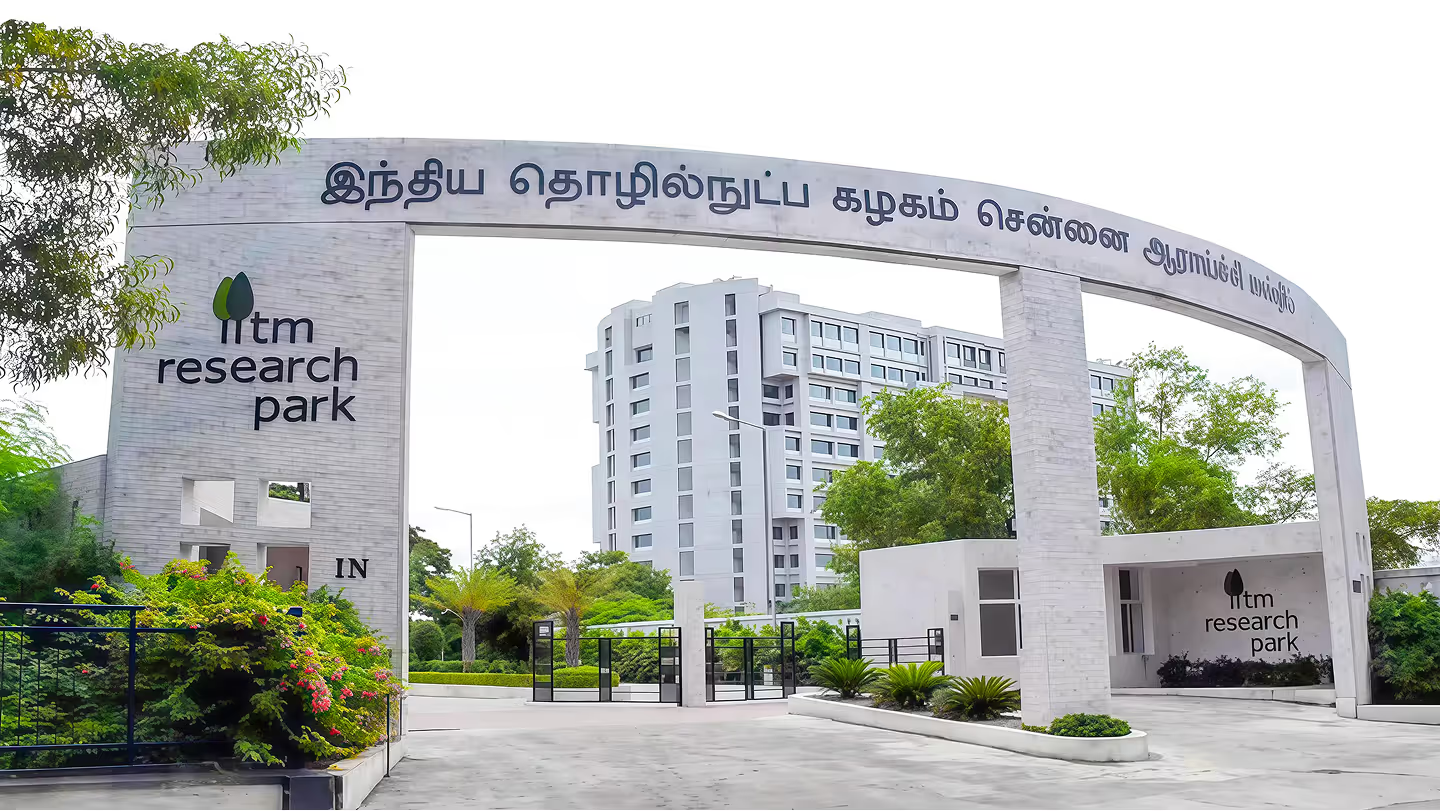
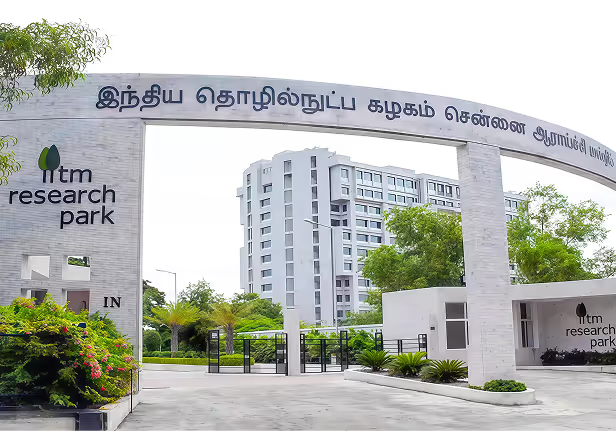
IITM Pravartak Technologies Foundation is the Technology Innovation Hub of IIT Madras, established under the Department of Science and Technology, Government of India. Embedded within the IITMRP ecosystem, it combines renowned faculty, cutting-edge labs, and specialised research facilities to drive skilling, innovation, and incubation.
Working at the intersection of academia, research, and industry, IITM Pravartak fosters the adoption of deep technology, nurtures next-generation talent, and enables real-world impact.

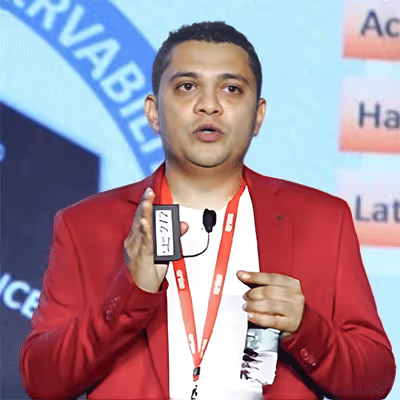
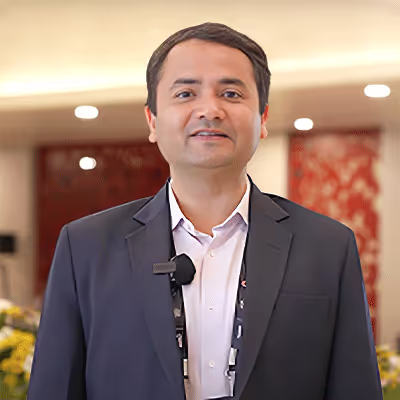
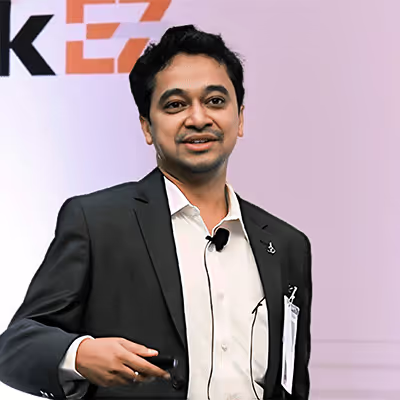
Prof. Balaji Srinivasan is a Professor in the Department of Mechanical Engineering and founding core faculty at the School of Data Science and Artificial Intelligence at IIT Madras, pursuing research in the areas of fundamental Machine Learning and Deep Learning with focus on applications to science and engineering disciplines. He earned his B.Tech from IIT Madras, MS from Purdue University, and PhD from Stanford University, where he was the William K. Bowes, Stanford Graduate Fellow. Prior to his current role at IIT Madras, he was a faculty member at IIT-Delhi and a post doctoral fellow at University of Michigan, Ann Arbor. His current research involves developing computational algorithms and models for a range of practical engineering problems that use a combination of probabilistic models, PDE based approaches as well as data-driven approaches. He has published research papers across multiple domains including Machine Learning, Partial Differential Equations, Computational algorithms, and High performance computing.

Prof. Ganapathy Krishnamurthi is a Professor in the Department of Engineering Design and founding core faculty at the School of Data Science and Artificial Intelligence at IIT Madras. He earned his PhD from Purdue University, and MSc in Physics from IIT Madras. He worked as a post-doctoral research fellow at Case Western Reserve University, USA and at Mayo Clinic, USA. His research and work experience focuses on applying Machine Learning and Artificial Intelligence techniques to problems in medical image analysis, computer vision, interpretability/explainability ability of Deep Learning models across various applications and using deep learning to solve inverse problems in medical imaging and computer vision. His current research involves developing deep learning solutions for time series data in business, engineering and imaging applications. He has published numerous research papers pertaining to Deep Learning and Machine Learning applied to many areas in science, engineering and technology.

Prof. Kushal Shah is a Professor of Applied Mathematics and Computer Science. He previously served as Associate Professor in the Department of Electrical Engineering and Computer Science at IISER Bhopal and as Assistant Professor in the Department of Electrical Engineering at IIT Delhi. He earned his B.Tech and Ph.D. in Electrical Engineering from IIT Madras, and later pursued postdoctoral research as a Feinberg Graduate Fellow in Applied Mathematics at the Weizmann Institute of Science, Israel. His research spans Artificial Intelligence, Machine Learning, Large Language Models, and Dynamical Systems, focusing on developing ethical and practical frameworks for intelligence testing, data-centric AI systems, and algorithms for anomaly detection, biomedical text mining, and time-series analysis. He has published extensively in reputed journals including PNAS, Physical Review Letters, IEEE Transactions, and AI & Society, and is the author of the book Plasma and Plasmonics (Ane Books / De Gruyter). Recipient of the INAE Young Engineer Award, he has delivered invited talks at leading global institutions such as Imperial College London, University of Warwick, and the Weizmann Institute of Science.
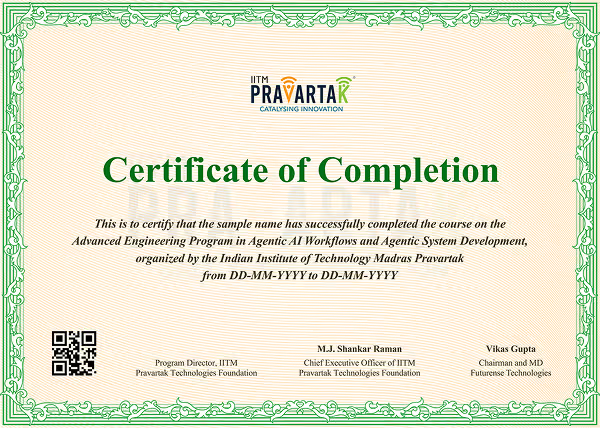
Receive a Certificate of completion from IITM Pravartak,
recognizing your achievement.
in Just 7 Months
Module 1: Essential AI Literacy
Exploring Deep Learning
• What is Deep Learning and how it differs from traditional ML
• Key components – neurons, layers, weights, biases, propagation and its types
• Types of Neural Networks (Feedforward, ANN, CNN, RNN overview)
• Use cases of DL in AI Agents & NLP
NLP for AI Agents
• Why NLP matters in intelligent agents
• Tokenization, stemming, lemmatization
• Embeddings and word vectors (BoW, TF-IDF, Word2Vec, Word Embeddings and more)
• Connecting DL models with text understanding
Word Embeddings and Semantic Understanding
• Limitations of TF-IDF and BoW
• Concept of distributed representations
• Word2Vec: skip-gram and CBOW models
• Word Embeddings and contextual embeddings overview
Module 2: Large Language Models & Their Applications
Introduction to Large Language Models (LLMs)
• Evolution of LLMs — from rule-based NLP to transformer-based architectures
• What makes an LLM “large”: scale, parameters, data
• Overview of popular LLMs: GPT, BERT, T5, LLaMA
• Comparison: rule-based vs statistical vs deep learning vs LLMs• Understanding generative models: GANs and VAEs
• Generator vs Discriminator networks
• Applications in text, image, and data synthesis
Transformer Architecture & Attention Mechanisms
• Deep dive into encoder, decoder, and attention
• Self-attention explained with visualization
• Positional encoding, tokenization, embeddings
• Practical implications for language understanding and generation
Pre-training and Fine-tuning LLMs
• Concept of pre-training vs fine-tuning
• Masked language modeling and next-token prediction
• Transfer learning with domain data
• Fine-tuning small models (DistilBERT, T5-small)
Building with LLMs: Real-World Applications
• Using OpenAI GPT models and APIs for text generation
• Designing a chatbot using GPT-3/4 or open LLMs
• Prompt engineering basics for task-specific responses
• Ethical considerations, hallucinations, and bias mitigation
Module 3: Transitioning from AI Models to AI Agents
Understanding AI Agents and Their Evolution
• What are AI agents and how they differ from AI models
• Historical progression — from static models to interactive agents
• Components of an AI agent: perception, reasoning, action, and memory
• Real-world examples: customer support bots, recommendation agents
Integrating Neural Networks and LLMs into Agents
• Role of neural networks in decision pipelines
• Using LLMs for perception, conversation, and reasoning
• Combining structured data (NNs) and unstructured text (LLMs)
• Prompt-driven behavior and state maintenance
Contextual Decision-Making and Memory in Agents
• Importance of context in autonomous decision-making
• Techniques for persistent memory and reasoning chains
• Conversation history and retrieval-based context
• Planning and goal-oriented agent behavior
Designing and Deploying Multi-Agent Systems
• Multi-agent communication and collaboration
• Role assignment and message passing
• Decision-making with multiple specialized agents
• Deployment considerations and ethics
Module 4: Systems Thinking for Multi‑Agent Workflows
Holistic Systems Thinking for Multi-Agent Environments
• Introduction to systems thinking in AI contexts
• Understanding interconnected subsystems and feedback loops
• Identifying reinforcing and balancing feedback in AI ecosystems
• Mapping dependencies across agents, data flows, and decisions
• Recognizing emergent behaviors and unintended consequences
• Balancing optimization trade-offs in complex systems
Module 5: Human‑First Prototyping & Service Blueprints
Problem Immersion & Journey Mapping
• Introduction to human-first design and its relevance in AI systems
• Understanding user context and problem ecosystems
• Mapping the As-Is journey — identifying current pain points and inefficiencies
• Designing the To-Be journey — envisioning desired outcomes and improved flows
• Leverage point discovery — identifying high-impact intervention spots
Defining KPIs, Guardrails & Service Blueprinting
• Translating user journeys into measurable KPIs
• Defining ethical and operational guardrails for agent workflows
• Building a Service Blueprint linking user touchpoints, frontstage/backstage processes, and AI agent interactions
• Aligning AI capabilities with human-centric outcomes
Module 6: Agent Collaboration Topologies
Understanding Collaboration Topologies in Multi-Agent Systems
• Overview of collaborative structures in MAS (Hierarchical, Manager-Worker, Peer-to-Peer, Blackboard, Contract-Net, Debate/Hybrid Human-Agent)
• How communication protocols and roles influence efficiency and scalability
• Real-world examples of each topology (e.g., search and rescue agents, customer support agents)
• Decision criteria for selecting a collaboration model based on workflow requirements
Design and Evaluation of Agent Topologies
• Comparing topologies on metrics: communication overhead, fault tolerance, decision latency & scalability
• Exploring hybrid and human-in-the-loop approaches (Debate and Collaborative Agents)
• Ethical and control considerations in multi-agent coordination
• Evaluating performance trade-offs for different topologies
Module 7: Contextual Reasoning for Multi-Agent Systems
Understanding Context in AI Workflows
• What is context and why it matters in intelligent systems
• Static vs dynamic context in AI decision-making
• Context types: environmental, conversational, user, and task-based
• Real-world examples of context-aware systems (e.g., personal assistants, adaptive chatbots)
• Introduction to context representation in MAS
Passing Context Between Agents
• Context propagation models and shared memory spaces
• Inter-agent communication and message-passing mechanisms
• Challenges in maintaining coherence across agents
• Synchronization and state management strategies
Context Engineering for Task Completion
• Designing inputs and outputs that preserve context
• Schema alignment for structured information sharing
• Contextual chaining and RAG (Retrieval-Augmented Generation) principles
• Using vector stores (FAISS, Pinecone, Chroma) for memory-based retrieval
Designing Context-Aware Multi-Agent Workflows
• Integrating context management in multi-agent architectures
• Memory-enhanced agents: retrieval, summarization, and adaptive context
• Case study: Building a workflow where agents collaborate using shared context
• Debugging, evaluation metrics, and scaling considerations
Module 8: Multi-Agent Planning & Workflow Design
Introduction to Multi-Agent System (MAS) Architecture
• Overview of MAS design principles and key components
• Understanding agent types: reactive, deliberative, hybrid
• Architecture layers — communication, reasoning, execution
• Identifying suitable use cases for MAS (e.g., research, automation, support systems)
• Demo walkthrough of CrewAI / AutoGen multi-agent setup
Agent Coordination and Task Delegation
• Agent roles: planner, executor, critic, verifier, etc.
• Task distribution strategies (sequential, parallel, hierarchical)
• Role-based collaboration patterns and dependencies
• Handling dynamic goal reassignment and error recovery
Message Passing and Context Sharing Between Agents
• Agent-to-agent communication channels (text-based, API calls, shared memory)
• Ensuring consistent context across agents
• Managing concurrent communications and synchronization
• Incorporating RAG components for shared contextual memory
End-to-End Workflow Design and Evaluation
• Building a coordinated multi-agent workflow (Planner + Executor + Evaluator)
• Testing coordination and context transfer across steps
• Debugging and evaluating communication latency & task accuracy
• Real-world applications: content pipelines, research assistants, automation agents
Module 9: Workflow Design & Optimization
Designing Agent Workflows
• Introduction to workflow design in multi-agent systems
• Workflow design templates: linear, branching, parallel, and feedback-based
• Task decomposition — breaking complex goals into sub-tasks for specialized agents• Mapping interactions and dependencies between agents
• Integrating business process logic into AI agent systems (e.g., e-commerce, logistics)
Workflow Optimization for Scalability & Efficiency
• Identifying performance bottlenecks and communication overhead
• Optimization metrics — throughput, latency, resource utilization
• Leveraging LangChain Memory and LCEL (LangChain Expression Language) for efficiency
• Design-first principles for scalable agent orchestration
• Monitoring and improving workflow performance
Module 10: Prototyping Multi-Agent Systems
Design-First Approach to Multi-Agent Prototyping
• Understanding design-first thinking in AI system development
• Translating conceptual workflows into technical blueprints
• Defining system goals, agent roles, and interaction models
• Selecting the right framework (LangChain, CrewAI, AutoGen, or Flowise) based on use case
Integrating Agent Workflow Design into Prototyping
• Mapping designed workflows into executable prototypes
• Defining communication protocols and message routes
• Using Flowise for visual orchestration and LangChain for logic
• Linking sub-agents (retriever, planner, executor, verifier) within a pipeline
Simulating Real-World Applications with Multi-Agent Systems
• Creating real-world context (customer queries, datasets, product data, etc.)
• Running the prototype end-to-end to simulate user-agent interactions
• Capturing logs, context flow, and decision outcomes
• Debugging agent behaviors and message passing
Validation, Iteration & Improvement
• Evaluating prototype performance (accuracy, latency, consistency)
• Feedback loops — how to iterate based on testing outcomes
• Scaling from prototype to production-ready systems
• Ethics, reliability, and user experience considerations in MAS design
Module 11: Real-World Tools for Agentic Workflows
Integrating Real-World Tools and External Systems
• Introduction to real-world integrations in AI agent workflows
• Using APIs and data connectors to extend agent functionality
• Leveraging memory systems (short-term vs long-term) for context continuity
• Hands-on: connecting agents to live data sources like CRMs, product catalogs, or databases
• Understanding API rate limits, authentication, and data security
Scaling and Optimizing Real-Time Agentic Workflows
• Designing scalable, event-driven agentic workflows
• Incorporating advanced vector stores (FAISS, Pinecone, Chroma) for retrieval
• Real-time optimization techniques for latency, reliability, and throughput
• Using orchestration tools (Flowise) to visualize and debug agent interactions
• Testing end-to-end performance in simulated real-world use cases
Module 12: Contextual Input & Output Management
Dynamic Input Handling and Context Injection Basics
• Understanding dynamic input variations in agent workflows
• Context injection fundamentals — why adaptive context matters
• Role-based prompting and modular context design
• Managing evolving prompts in multi-turn conversations
Role-Based Prompts and Adaptive Output Management
• Designing role-specific prompts for different agents (planner, critic, executor)
• Multi-agent communication with adaptive inputs/outputs
• Simulating dynamic environments — handling incomplete or changing data
• Testing robustness of contextual reasoning
Module 13: Transforming Business Processes with Multi-Agent Systems
Introduction to Business Process Automation via Multi-Agent Systems
• Identifying business workflows suitable for multi-agent automation
• Use cases: customer service, lead generation, HR automation, supply chain
• Mapping business rules into agent logic
• Aligning KPIs and ROI with AI agent deployment
Automation and Orchestration Design
• Orchestrating agents for end-to-end process automation
• Workflow decomposition and communication protocols
• Integrating human-in-the-loop checkpoints
• Using Flowise or LangGraph for visualization
Coordination, Context Passing, and Scaling
• Coordination challenges in enterprise-scale systems
• Context passing in long workflows with diverse agents
• Scaling across data sources, departments, and time-sensitive operations
• Monitoring and failure recovery mechanisms
Business Use Case Deployment and Validation
• End-to-end project: design → build → validate
• Testing automation performance, latency, and cost-efficiency
• Ensuring smooth collaboration across agents and tools
• Presenting business impact metrics and results
Module 14: Monitoring & Managing Agent Systems
Real-Time Monitoring and Management of Multi-Agent Systems
• Understanding why real-time monitoring is critical for MAS
• Logging frameworks and observability in LangChain-based systems
• Tracking communication latency, error rates, and decision flow
• Debugging agent communication breakdowns and workflow errors
• Interpreting logs for performance refinement
Module 15: Enterprise Integration with Multi-Agent Workflows
Integrating Multi-Agent Systems into Enterprise Workflows
• Understanding enterprise workflow architecture (ERP, CRM, SCM)
• Identifying integration points for AI agents
• Designing data and command interfaces between MAS and enterprise systems
• Security, authentication, and API access management
Building Real-Time Integrations
• Real-time event-driven task handling in enterprises
• Agent orchestration for live data exchange and decision triggers
• Managing concurrency and handoff mechanisms
• Error handling and logging in enterprise-grade agents
Scaling Multi-Agent Workflows Across Enterprise Systems
• Scaling strategies — modular agent clusters, microservices pattern
• Cross-department coordination and centralized orchestration
• Caching and rate-limiting for API-heavy workflows
• Version control and CI/CD for multi-agent pipelines
Validation and Performance Optimization
• Measuring business impact and system performance
• Creating enterprise dashboards for monitoring agent operations
• Ethical, compliance, and governance aspects in enterprise MAS deployment
Module 16: Advanced Context Engineering
Deep Dive into Context Engineering Concepts - Revisiting foundational context management principles and applications at an Enterprise level through Case Studies
Adaptive Context Switching in Large-Scale Multi-Agent Systems
• Designing adaptive context switching logic
• Handling concurrent context updates across multiple agents
• Synchronizing memory systems and vector databases
• Evaluating performance impact of dynamic context changes
Through the Futurense AI Clinic, you’ll gain hands-on exposure to real enterprise-grade AI projects, from ideation to deployment.
Solve real business challenges using GenAI, Agentic AI, and automation workflows.
Hands-on with LangChain, CrewAI, Flowise, OpenAI APIs, Zapier, HubSpot, and more.
Guided by IIT faculty and industry mentors through each phase of your project.
Build, test, and deploy intelligent workflows that simulate real-world problem solving.


.png)















Bachelor’s degree (minimum 3 years) in Computer Science, IT, Engineering, Mathematics, or a related field. MCA / M.Sc / M.Tech candidates with exposure to technology, analytics, or systems are also eligible
Minimum 1 year of experience in product management, software development, enterprise/solution architecture, data science, ML engineering, automation & process excellence, or consulting.
Exceptional fresh graduates with strong programming skills and aptitude for AI workflows may be considered via screening.
Familiarity with programming (Python preferred), AI concepts, APIs, and data-driven systems.
Clear a pre-screen exam testing programming fundamentals, logic, and workflow/AI readiness.
What You’ll Be Tested On
Duration: 60 minutes
looking to transition into agentic development.
designing AI-enabled business systems.
moving from prototypes to production-ready workflows.
and Service Designers re-engineering processes with multi-agent systems.

Craft a recruiter-ready identity with optimized resumes, LinkedIn profiles, and a strong career narrative.

Develop job-ready skills with role-focused training, capability tests, AI tools workshops, and continuous upskilling to match real hiring expectations.

Access curated, pre-vetted roles before they hit public portals, with priority visibility for Futurense learners.

Get insider interview guidance with structured playbooks: FAQs, sample answers, frameworks, recruiter insights, and round-wise preparation.

Experience real interview simulations with personalized feedback from mentors, industry leaders, and FLC members.

Unlock referral advantages, insider recommendations, alumni-driven opportunities, and FLC mentorship that accelerates your career entry.

Get guidance on positioning, benchmarking, negotiation strategy, and communication to secure the compensation you deserve.
They are working at companies which are a dream for most


























Admissions close once the required number of students is enrolled for the upcoming cohort. Apply early to secure your seat.
How it Works
Fill in your details and share your interest in joining the program.
A short test designed to assess your programming fundamentals and AI/workflow readiness
Secure your spot in the upcoming cohort with flexible payment options
Kick things off with a 2-Week Bridge Course that gets you course-ready

Worth ₹29,000
A collective of CXOs, AI leaders, and digital transformation heads from global and Fortune 500 companies shaping the AI-native workforce.

Advance your career with IITM Pravartak's Advanced Certificate in AI Agent Workflows. Learn to design intelligent systems and multi-agent workflows with industry experts.
We know you might have some questions before getting started in our platform
The program is called Advanced Engineering Program in AI Agent Workflows and Agentic Systems Development, offered by IITM Pravartak Centre of Excellence in collaboration with Futurense Technologies.
The program duration is approximately 7 months (140+ hours), with the first cohort scheduled to begin as per the announced program start date.
• Engineers interested in AI systems and automation
• Software professionals looking to build expertise in AI agents
• Data professionals working with AI and machine learning
• Product managers exploring AI-driven product development
• AI enthusiasts interested in agentic workflows and intelligent systems
Applicants can apply through the official Futurense admissions portal by submitting the application form along with the required documents.
The application process is currently open, and interested candidates can apply online as seats are limited.
The program focuses on AI agents, autonomous systems, and real-world agentic workflows, combining technical AI concepts with practical product and workflow implementation.
Yes. Admission typically requires meeting eligibility criteria and clearing a pre-screening or evaluation process.
Applicants must submit identity proof, educational certificates, resume, and relevant professional documents as part of the application process.
Yes, applicants may be required to complete a pre-screening assessment as part of the admission process.
Coding experience is helpful but not mandatory, as the program focuses on understanding AI systems and workflows along with practical implementation.
Applicants should keep PAN, Aadhaar, educational documents, resume, and financial documents if applying for loan support.
The program combines AI engineering concepts with real-world agentic workflow implementation, helping professionals build skills required for next-generation AI-powered systems.
The program follows a hybrid format with live online sessions, hands-on learning, and a campus immersion experience.
The campus immersion is scheduled toward the end of the program, allowing participants to plan in advance.
Yes, accommodation may be arranged for outstation participants, subject to availability.
The program director provides academic leadership and ensures the curriculum remains aligned with the latest advancements in AI and agentic systems.
IITM Pravartak is associated with IIT Madras and focuses on cutting-edge research, AI innovation, and industry collaboration.
Industry experts conduct live sessions, masterclasses, mentorship programs, and real-world case discussions, ensuring strong industry relevance.
The program covers AI agents, generative AI, autonomous systems, agent orchestration, and real-world AI workflow implementation.
Participants learn tools such as ChatGPT, Claude, Gemini, LangChain, AI development frameworks, and product development tools.
AI agents enable autonomous decision-making, task execution, and intelligent workflow automation, making them essential for scalable AI systems.
Modules include AI foundations, generative AI applications, agentic systems design, multi-agent collaboration, workflow automation, and AI-powered product development.
Participants can apply AI agent concepts to domains such as fintech, SaaS, healthcare, e-commerce, and enterprise automation.
Hands-on work includes building AI agents, designing automated workflows, creating AI-driven prototypes, and developing AI-powered MVPs.
Multi-agent systems allow multiple AI agents to collaborate, automate complex workflows, and improve decision-making efficiency.
Traditional AI focuses on predictive models, generative AI creates new content, and agentic AI enables autonomous systems capable of planning and executing tasks.
Participants can pursue roles such as AI Engineer, AI Agent Developer, GenAI Specialist, AI Product Manager, Automation Architect, and AI Solutions Consultant.
Professionals with these skills often experience higher salary growth and increased demand across AI-driven companies.
The program prepares professionals to design and deploy AI agents for real-world enterprise workflows and product systems.
It equips professionals with skills in AI systems design, automation, and agentic architectures, which are rapidly becoming industry standards.
Examples include AI healthcare assistants, intelligent manufacturing automation, and AI-powered customer support systems in telecom.
The generative AI market is projected to reach over $1 trillion in value by 2032 , with a large percentage of enterprises prioritizing adoption.
India is among the top global hubs for AI startups, with rapid growth in generative AI and AI agent development.
The program fee is announced during admissions and includes flexible EMI and loan options through financial partners.
Yes, there may be an additional immersion fee of ₹10,000, which covers participation and campus-related expenses.
Participants must pay an application deposit first, followed by the remaining program fee within the specified timeline after receiving the offer letter.
Yes, candidates can self-fund the program either fully or partially.
Yes, Futurense partners with financial institutions to provide loan and EMI options.
Interest rates depend on the financial partner and repayment plan, and are generally competitive.
The program fee is ₹1,10,500 + 18% GSTand possible scholarships for deserving candidates.