

India's Only Residential AI PG Diploma Program In
AI-ML & Agentic AI Engineering
Curated for Forward Deployed AI Engineering Roles
5.5 Months On-Campus
60 Seats Per Class
AINPT Selection Test
Built With IIT Faculty
Eligibility: Open to working professionals, freshers, and final-semester students
(STEM Degree Required)
Application Deadline: 25th October, 2026
As featured in







One Programme. Engineered for Deployment
CORE PROGRAMME
AI-ML & Agentic AI Engineering
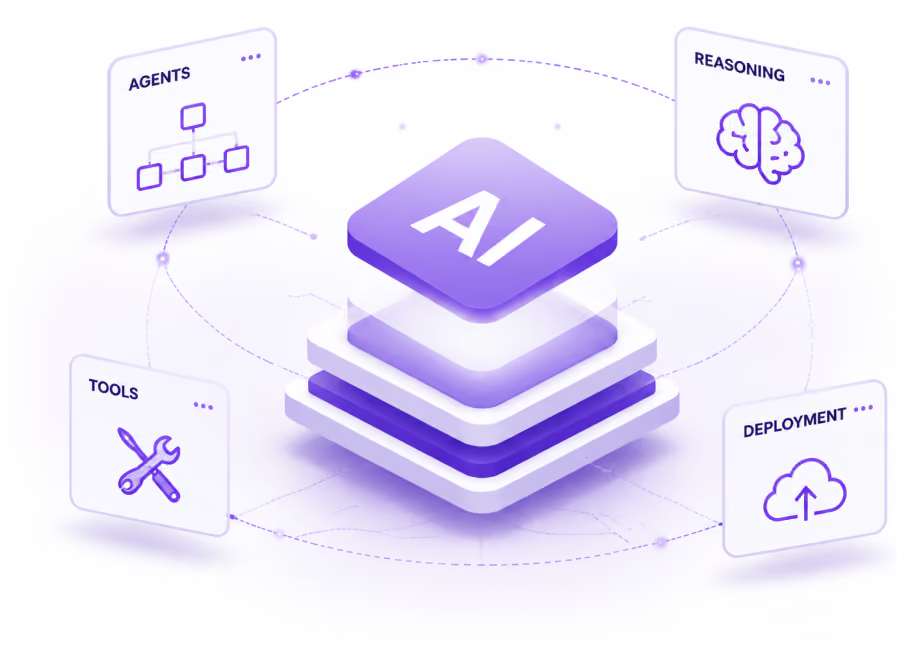
Train models, build multi-agent systems, deploy intelligent applications that reason, plan, and act autonomously.
Graduate Ready for:
AI / ML Engineer
Generative AI Engineer
Agentic AI Engineer
Data / Business Analyst
AI Solutions Engineer
Tools

LangChain

CrewAI

Amazon SageMaker

FastAPI

Docker

Prometheus
and more.
ADDED MODULE
Path to Forward Deployed Engineering
Work at the intersection of product ownership, solutioning, and AI-augmented implementation. Drive outcomes in the hottest role in AI.
Graduate Ready for:
Forward Deployed Engineer
Forward Deployed AI Engineer
Agentic AI Engineer
AI Solutions Engineer
Tools

AWS

Cursor

Google Antigravity

Claude

Strands

Mermaid
and more.
What you walk away with
01
A PG Diploma from IIT Gandhinagar
A credential that carries the weight of the IIT system. A diploma, not a certificate.
02
Alumni Status, IIT Email & ID
IITGN Alumni Status on completion, with an institute email during the program and an alumni email after.
03
Six flagship systems on GitHub
Six systems built to real client-style briefs, plus weekly builds, all documented publicly as your portfolio.
04
Career and interview support from Month 1
Placement preparation, counselling, and interview opportunities for candidates who meet the criteria.
05
A built-in safety net
One re-examination per subject after the programme, so a single subject never derails your diploma.
FROM FUNDAMENTALS TO A DEPLOYED SYSTEM
The programme moves in a deliberate arc across 5.5 months.
01
PHASE 1
Foundations
Python and data foundations, built by hand, assistant-free.
02
PHASE 2
Core ML
Machine learning, from models through to evaluation.
03
PHASE 3
Generative AI
LLMs, retrieval systems, and grounding.
04
PHASE 4
Agentic systems
Agent design and multi-agent orchestration.
05
PHASE 5
Delivery
Deployment, then a month-long end-to-end capstone defended before a panel.
What you can do by the end
Build and ship six production-style AI systems, from scoping to deployment.
Design and orchestrate multi-agent systems that reason, plan, and act.
Work with generative AI end-to-end across LLMs, retrieval, grounding, and evaluation.
Write product and specification documents and think through solution design.
Defend a month-long capstone before a panel, and carry a public GitHub portfolio into every interview.
YOUR RESIDENTIAL LIFE ON CAMPUS
Live where you learn.
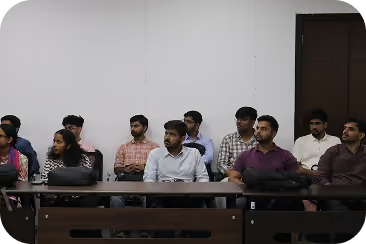
IIT Gandhinagar sits on 400 acres, India's first 5-star GRIHA-LD campus, at the doorstep of GIFT City. You live in twin-sharing rooms, five minutes from campus, with four meals a day and IIT mess access.
Six-plus hours of hands-on building, every single day, for 5.5 months.
9:30 AM
Recap and Sync
10:00 AM
Conceptual Mastery
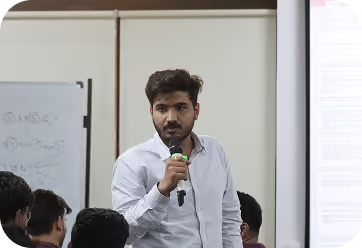
11:45 AM
Hands-On Application
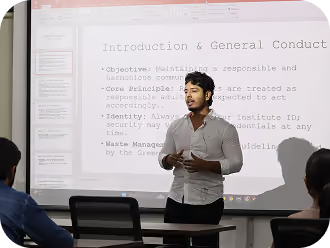
2:30 PM
Build what you learnt
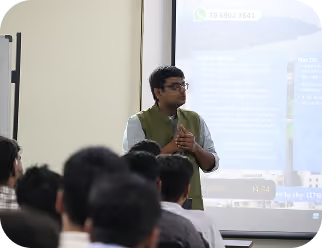
5:45 PM
Review and daily stand-up
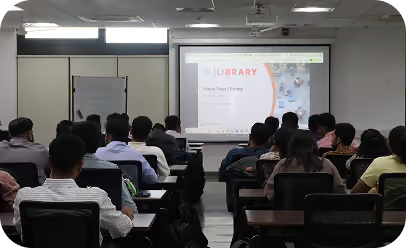
7:30 PM
Assignments & self study
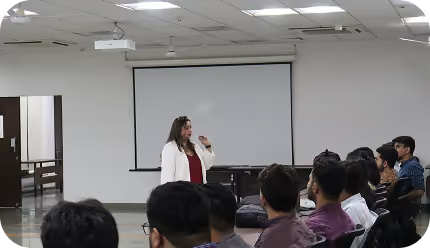
AI assistants stay off for the first six weeks, and graded work stays assistant-free for all twenty. (Representative schedule, subject to faculty discretion.)
EARN YOUR SEAT THROUGH AINPT
One Exam. One Interview.
60 Seats Per Class.
AINPT, the All India National Proficiency Test, is how you qualify. No JEE, no GATE. It tests technical aptitude, problem-solving, and reasoning under pressure. 120 minutes, no shortcuts.
Every person in your cohort cleared the same bar you did. That changes the quality of every conversation, every project, and every late-night sprint.
Visit www.iitgncdf.com for test details.
Step 1
Apply online
Submit your application and documents.
Step 2
AINPT exam
120 minutes.
Step 3
Panel interview
Industry mentors assess capability and hunger, followed by an interaction with an IIT Gandhinagar faculty member.
Step 4
Offer
Issued by IIT Gandhinagar. Confirm your seat, and begin.
WHO YOU LEARN FROM
IIT Faculty Design the Curriculum. Practitioners Bring The Depth.
IIT faculty design the curriculum and assess your progress. Industry practitioners run live sessions, review your builds, and bring real-world depth to every module.

Prof. Mithun Radhakrishna
Associate Professor, Chemical Engineering
IIT Gandhinagar
IIT Gandhinagar

Dr. Ravi S. Hegde
Associate Professor, Electrical Engineering
IIT Gandhinagar
IIT Gandhinagar

Dr. Yogesh Kumar Meena
Assistant Professor, Cognitive and Brain Sciences
IIT Gandhinagar
IIT Gandhinagar

Dr. P. Manisha
Assistant Professor, Computer Science and Engineering
IIT Gandhinagar
IIT Gandhinagar

Dr. Sameer Gundurao Kulkarni
Assistant Professor, Computer Science & Engineering (Jointly with Electrical Engineering)
IIT Gandhinagar
IIT Gandhinagar

Dr. Sameer Patel
Assistant Professor, Civil Engineering (Jointly with Chemical Engineering)
IIT Gandhinagar
IIT Gandhinagar
Hired by India's Top Companies
Disclaimer: All products and company names are trademarks or registered trademarks of their respective holders. Use of product and company names does not imply any affilation with or endorsement by the holders.

















Programme fees
₹5,00,000
Inclusive of taxes
450 contact hours + 60 project hours. IIT faculty, grading, transcript, and the PG Diploma. Payable to IITGN CAA. ₹1,00,000 of this is non-refundable.
₹1,47,500
Inclusive of taxes
Twin-sharing rooms, four meals a day, and admin for 5.5 months. Payable to Futurense. Non-refundable for hostel.
EMI options available. This is an invitation-only programme, and applications close once 60 seats are filled.

A PG Diploma, not a Certificate
You finish with a PG Diploma from IIT Gandhinagar, a transcript listing every subject and grade with your final CPI, and IITGN Alumni Status. A credential that carries the weight of the IIT system.
2-1.png)
Representative sample certificate. Subject to change.


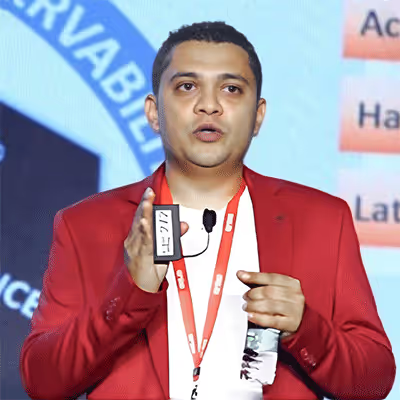
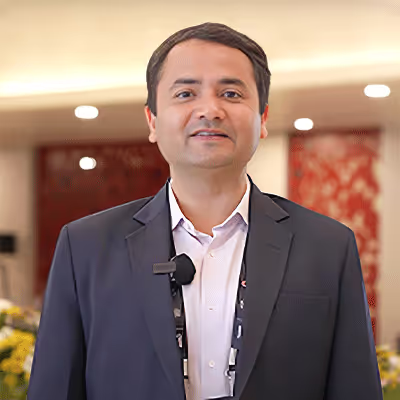
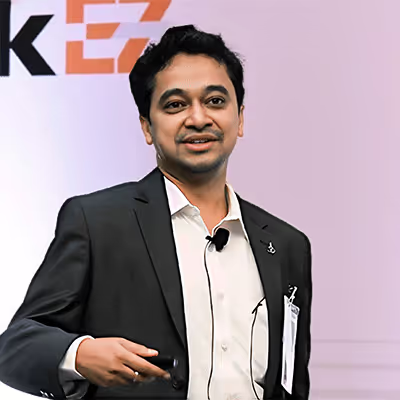
Led by the Futurense Leadership Council (FLC)
A collective of CXOs, AI leaders, and digital transformation heads from global and Fortune 500 companies shaping the AI-native workforce.


















































































About IIT Gandhinagar
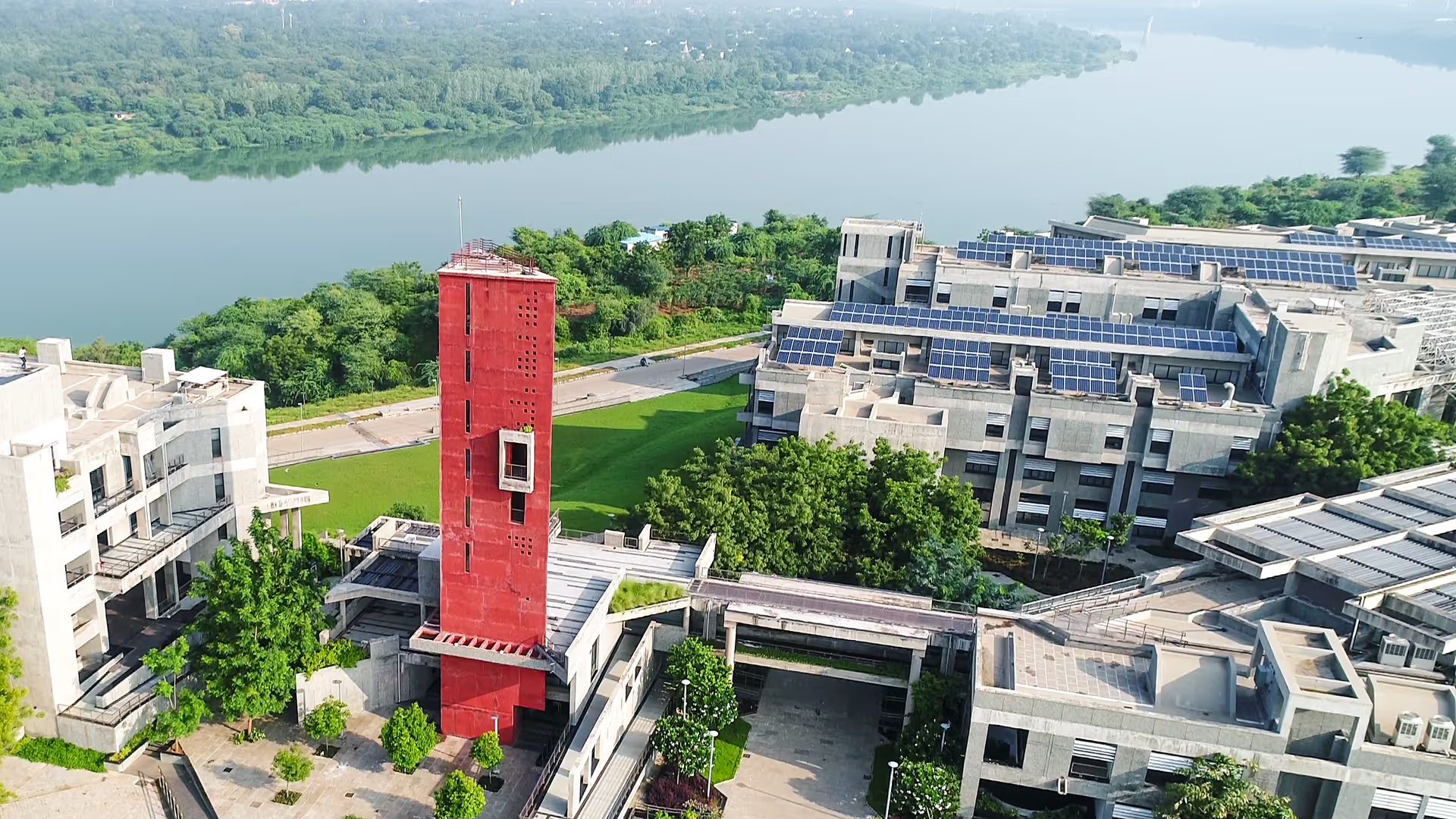
Founded in 2008. 400 acres on the Sabarmati. India's first 5-star GRIHA-LD campus. Known for pioneering liberal arts in engineering, deep interdisciplinary research, and a faculty-to-student ratio among the best in the IIT system. Located at the doorstep of GIFT City, India's emerging centre for AI, fintech, and global capability.

Frequently Asked Questions
We know you might have some questions before getting started in our platform
How long is the programme?
The programme runs for 5.5 months, with two further weeks held in reserve so the calendar can absorb any disruption. Students should plan for up to 22 weeks on campus.
Is this a full-time programme?
Yes. It is a full-time, in-person residential programme, so students cannot hold a job or pursue another course alongside it.
How many hours of instruction does the programme carry?
The programme carries 510 hours in total. That covers 450 hours of theory and hands-on contact time, plus 60 hours dedicated to the capstone project.
Where is the programme delivered?
Every session is delivered in person at IIT Gandhinagar. There is no online or hybrid mode.
Who teaches the programme?
Sessions are taught by IIT and industry experts. IIT faculty handle the theoretical foundations and industry practitioners lead the applied and project work.
How is the programme phased?
The opening six weeks build foundations, the middle stretch strengthens the core specialisation, and the closing weeks are given over to the capstone and applied work.
What does a typical week look like?
Weekdays combine theory sessions, labs, project work and an evening coding slot. Saturdays are reserved for assessment and review.
Who is eligible to apply?
Applicants need a completed full-time, in-person degree in a STEM discipline. The full eligibility criteria are listed in the brochure.
Are online or distance degrees accepted?
No. A degree earned through an online, distance or executive mode does not meet the eligibility requirement.
My bachelor’s degree is non-STEM and my master’s is in computer science. Am I eligible?
The academic background needs to be consistent across degrees. A mixed profile of this kind is normally not eligible.
Can students still completing their degree apply?
Final-semester students are welcome to apply.
Is work experience required?
No. The programme takes both fresh graduates and professionals in the earlier years of their career.
What is the admission process?
Applicants take a screening aptitude test, then a technical panel interview, and finally an interaction with an IIT Gandhinagar faculty member. An offer letter is issued only after all three rounds are cleared.
What does the final interaction round assess?
It looks at attitude, aptitude and mindset rather than technical skill. It is mandatory for every applicant.
Why is the programme described as invitation only?
A candidate can join only once an offer letter has been issued at the end of the selection process. There is no open enrolment.
My profile does not match the stated criteria. Can I still be considered?
Exceptions are reviewed case by case by the institute. Share your documents with the admissions team and the case will be put forward for a decision.
What does the curriculum cover?
It moves from Python and data foundations into machine learning, then into generative AI, retrieval systems, agent design and multi-agent orchestration, closing with deployment and the capstone.
What does "curated for forward deployed AI engineer roles" mean?
Forward deployed engineering is a family of competencies rather than a single job title. The curriculum builds the engineering depth those roles need, along with the solution thinking and client-facing judgement they demand.
Is system design part of the programme?
Yes. Design of agentic systems runs through the curriculum, and dedicated master classes cover high-level and low-level design in the form interviews ask for.
Does the programme teach data structures and algorithms?
Formal DSA preparation is not a focus, since generative AI interviews rarely test it. Supervised coding practice runs through the programme to keep implementation skills sharp.
Is product and solution thinking covered?
Yes. Students write product requirement and specification documents and work through solution design as part of their projects and capstone.
Are students allowed to use AI coding assistants?
Not in the first six weeks, where the point is to build the fundamentals yourself and marks can be deducted for assisted work. From week seven, students are taught to use these tools deliberately.
Do students need their own laptop?
Yes. All work is done on the student’s own machine, and projects are deployed to the student’s own cloud accounts.
How many projects does a student build?
Students build six systems to real-world briefs, alongside smaller weekly builds. The sixth is the end-to-end capstone.
How are projects run?
Projects run in an agile format with sprints, reviews and working demonstrations, which mirrors how engineering teams actually deliver.
What is the capstone project?
The capstone is a month-long, end-to-end build carrying 60 dedicated hours, taken from scoping through to deployment and defended before a panel.
Can projects be extended after the programme?
Yes. Every project is built to be deployed and can be scaled further afterwards, and students are encouraged to keep developing them as portfolio pieces.
Are any resources provided for the capstone?
Students receive LLM tokens and cloud credits for their capstone, and are shown how to make the most of the free tiers cloud providers offer.
How does a student show this work to recruiters?
Everything is committed to GitHub from day one, so each student finishes with a public repository of working projects that serves as a portfolio.
Can students get help with a project outside session hours?
Yes. Teaching assistants are on campus through the day and escalate to instructors or the wider trainer network when a problem needs deeper input.
How are students assessed?
Assessment is continuous. Weekly work, module-end examinations, supervised coding, presentations, group discussions, case study discussions and mock interviews all count, alongside three major examinations.
How many major examinations are there?
Three, spread across the programme, each covering cumulative content up to that point.
What does a student receive on completion?
A transcript listing every subject, its credits and the grade earned, together with the final CPI, and a completion certificate.
What is CPI?
CPI is the cumulative performance index used across the programme. For all practical purposes it works the same way as a CGPA.
What is required to be awarded the diploma?
A student must score at least 60 percent overall across all subjects by the end of the programme.
What happens if a student falls short of that mark?
Any subject graded E or F can be attempted again in a re-examination held in person at IIT Gandhinagar a month or two after the programme ends. Students arrange their own stay for those days.
Can a student who has passed reappear to improve a grade?
No. Re-examination is open only to students who did not meet the diploma requirement.
Is attendance tracked?
Yes. Attendance is recorded for every session, and cumulative attendance carries weight in eligibility for interview opportunities.
What alumni status do graduates receive?
Graduates receive regular alumni status from IIT Gandhinagar, the same status held by other alumni of the institute.
Do students get an institute email address?
Students are issued an institute email for the duration of the programme. On completion, graduates are issued an alumni email address they keep for life.
What campus access do students have?
Students live on campus and have access to the library, the research park and faculty through the programme. This access is one of the reasons the programme is run in person.
Does the programme guarantee placement?
No. Students who meet the stated criteria are guaranteed interview opportunities. Whether an offer follows depends on how they perform in those interviews.
What are the criteria for interview opportunities?
A CPI of 7 or above, cumulative attendance of 90 percent or above, and no active backlogs.
When does the placement phase begin?
It begins around 60 days before the programme ends and runs alongside the closing weeks of teaching.
What support is offered during that phase?
Placement preparation, guidance, career counselling and mock interviews, along with interview opportunities once a student meets the criteria.
Are interviews conducted on campus?
Interviews are usually conducted online. A company may occasionally ask a candidate to travel to its office for a later round.
What roles does the programme prepare students for?
Roles across the generative AI stack, including generative AI engineer, agentic AI engineer, AI and ML engineer, and forward deployed engineer.
Program Learning & Career Pathways
What Can You Learn in a PG Diploma in AI/ML?
A PG Diploma in AI/ML can help learners build a strong foundation in artificial intelligence and machine learning while developing practical skills for solving real-world problems. The program is designed to go beyond theoretical concepts by helping learners understand how AI technologies can be applied to develop intelligent applications and systems.
The learning experience can cover important areas such as machine learning fundamentals, model development, generative AI, data-driven problem-solving, and modern AI applications. This helps learners understand how different technologies work together and develop the technical foundation required for working on industry-relevant projects.
The program also provides exposure to emerging areas of artificial intelligence, helping learners understand how the field is evolving and how new technologies are being integrated into modern AI solutions.
How Does the Program Prepare You for AI/ML Engineering?
Building a career in AI/ML engineering requires more than understanding machine learning concepts. Professionals also need the ability to apply their knowledge to practical problems, work with modern technologies, and develop solutions that can address real-world requirements.
The program combines foundational learning with practical exposure, allowing learners to connect concepts with implementation. Through hands-on learning and projects, students can develop their ability to approach AI problems systematically, experiment with different approaches, and understand how intelligent solutions are developed.
This practical approach can help learners strengthen their technical problem-solving abilities and build a foundation for working on AI and machine learning applications.
What Is the Role of Agentic AI in Modern AI Development?
Agentic AI is an emerging approach to building intelligent systems that can understand goals, reason through tasks, make decisions, and take actions with a greater degree of autonomy. As businesses explore more advanced AI applications, understanding these systems is becoming increasingly relevant for aspiring AI professionals.
Unlike traditional AI applications that may perform a specific task based on a predefined input, agent-based systems can be designed to handle multiple steps, interact with tools, and adapt their actions based on the task they are given.
Learning how these systems work alongside machine learning and generative AI can give learners a broader understanding of modern AI development and the technologies shaping the future of intelligent applications.
Why Combine AI/ML with Agentic AI?
AI/ML & Agentic AI bring together the fundamentals of artificial intelligence and machine learning with newer approaches to building intelligent, goal-oriented systems.
For learners, this combination provides an opportunity to understand both the foundations behind AI models and how those models can be incorporated into practical applications. It also creates a broader learning pathway covering areas such as machine learning, generative AI, AI agents, automation, and intelligent workflows.
Developing knowledge across these areas can help learners better understand how AI is evolving from individual models and applications toward systems capable of handling more complex tasks and processes.
What Career Paths Can You Explore After the Program?
The growing adoption of artificial intelligence is creating opportunities for professionals with knowledge of machine learning, generative AI, and modern AI development. Building relevant technical skills can help learners explore different career paths within the broader AI ecosystem.
Depending on their skills, experience, and career interests, learners may explore roles such as AI Engineer, Machine Learning Engineer, Generative AI Engineer, or other technology-focused positions involving intelligent applications and machine learning systems.
A strong foundation in AI engineering can help professionals adapt as the field evolves. Combining technical fundamentals with practical project experience and knowledge of emerging technologies can provide a stronger starting point for building a long-term career in AI engineering.
Come hungry. Leave transformed.
Cohort 3 · 60 Seats Per Class · Applications Closing Soon.