


My neighbor's daughter asked her parents for one thing after her boards. Not a course name. A laptop that could actually run design software properly.
That request tells you more about how to choose the Best Graphic Design Course than most course-comparison articles do.
Because here's the thing nobody says clearly enough: the course name on your certificate matters far less than what you can actually show someone. A portfolio. Real work. Something a hiring manager can look at for thirty seconds and understand what you're capable of.
So this isn't another list of "top 10 institutes." It's a straight answer to what actually separates a good graphic design course after 12th from a mediocre one, and why the field itself is quietly shifting in a direction most course brochures don't mention.
Should You Even Do a Formal Graphic Design Course After 12th?
This question comes up more than course brochures would like. It's genuinely fair.
Self-taught graphic designers absolutely exist and succeed, especially now that quality tutorials, design communities, and feedback platforms are more accessible than ever. If you're genuinely self-motivated and disciplined about seeking critique, self-study can work.
But most 17 and 18-year-olds haven't built that discipline yet, and that's not a criticism, it's just realistic. A structured course provides something self-study genuinely struggles to replicate: deadlines, structured critique from people who've done this professionally, and a peer group pushing you to keep improving instead of stalling out after the initial excitement fades.
The honest answer for most people right after 12th: a structured course is the more reliable path, but only if you actually use it to build a portfolio, not just attend and collect a certificate.
What Makes the Best Graphic Design Course Worth Taking?
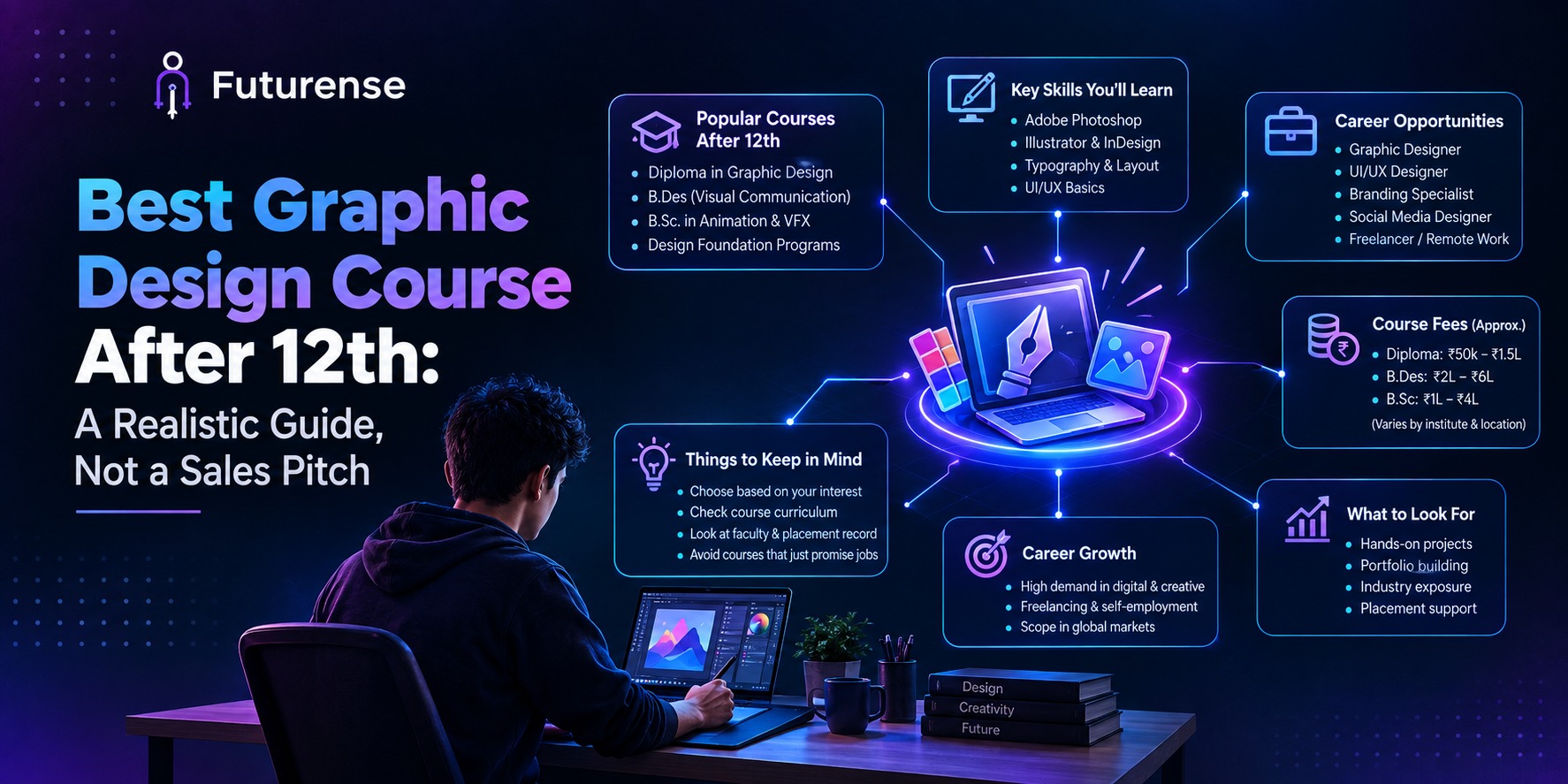
Skip the rankings for a second. Here's what genuinely matters when you're comparing graphic design courses after 12th.
Software Training, Done Properly
Adobe Photoshop, Illustrator, and increasingly Figma, since design work has moved heavily toward digital and interface-adjacent projects, not just print.
A weak course teaches you which button does what. A strong one teaches you why a designer would make that choice in the first place.
You should also look at whether the curriculum includes typography, color theory, layout, branding, visual hierarchy, image editing and digital design fundamentals rather than focusing almost entirely on software tutorials.
A Portfolio-Building Structure
This is the single biggest differentiator between courses, and the one prospective students check least.
Does the program require you to build real, varied projects? Branding work, a poster series, social media creatives, packaging concepts, or a mock app interface? Or does it hand out generic assignments that every student in the batch turns in looking nearly identical?
A strong graphic design course after 12th should give you enough practical work to finish with a portfolio that demonstrates different skills and design approaches.
Genuine Industry Exposure
Guest faculty who actually work in design agencies or in-house teams. Internship placement support that isn't just a LinkedIn post. A final capstone project reviewed by someone outside the institute.
These experiences can help students understand how professional design work actually happens, including deadlines, client feedback, revisions and collaboration.
Faculty Who Design, Not Just Teach
There's a real difference between someone who's spent fifteen years designing for real clients and someone who's only ever taught the software.
Ask directly, before enrolling, whether faculty currently freelance or work in the industry alongside teaching. Their professional experience can make a major difference to the quality of feedback you receive.
Degree, Diploma, or Certificate: Which Actually Fits?
This decision matters more than which specific institute you pick.
A full bachelor's degree such as BDes, BFA, or a specialized design degree makes sense if you want the broadest foundation, genuine time to explore different design disciplines, and a credential that can support further postgraduate study later. It's a three-to-four-year commitment.
A diploma program, typically one to two years, suits students who already know graphic design specifically is the goal and want faster, more focused entry into the workforce without the broader structure of a full degree.
Short certificate courses work best as a supplement, not necessarily as a starting point. They're useful for someone already studying or working who wants to add a specific skill, but they can be limited as the only formal training straight out of 12th if they don't provide enough sustained project work.
Graphic Design Course Eligibility and Fees After 12th
Most graphic design programs after 12th accept students from any stream, Science, Commerce, or Arts, which is genuinely one of the more open fields in terms of academic background requirements.
Some competitive design schools do require an entrance exam or portfolio submission even at the undergraduate level, so it's worth checking individual eligibility requirements rather than assuming open admission everywhere.
Fees vary enormously depending on institute reputation and format. Self-paced online certificates sit at the lower end, while reputed full-time bachelor's programs at design-focused institutes can cost considerably more.
Rather than comparing sticker price alone, it's worth understanding the actual syllabus, fees, and eligibility behind a UI/UX design course as a comparison point. The fee-to-outcome ratio in design depends heavily on how project-driven the curriculum actually is, not simply the total tuition.
Why Graphic Design and UI/UX Are Increasingly the Same Conversation
Here's the part most "best graphic design course after 12th" articles miss entirely.
The field has genuinely shifted. A huge share of graphic design work today isn't posters and print layouts. It's app screens, websites, digital product interfaces and social media experiences.
The tools overlap. The visual design principles overlap. Many graphic designers now build careers specifically in UI/UX, where the same eye for color, layout and typography is applied to how people actually interact with a digital product.
This matters practically. If you're choosing a graphic design course because you enjoy visual problem-solving, it's worth seriously considering whether a UI/UX-focused program might actually serve that same interest with stronger alignment to current digital design roles.
What Employers Actually Look For Beyond a Graphic Design Certificate
A finished course gets you a certificate. It doesn't automatically get you a job.
A few things genuinely move the needle once you're job hunting.
A focused portfolio, not a scattered one: Five strong, varied, well-explained projects beat twenty rushed ones. Employers want to see thinking, not just output volume.
Case study framing, not just final images: Show the brief, your process and why you made specific design decisions. This is exactly what separates a design student from someone who thinks like a working designer.
Comfort with feedback and revision: Design work gets critiqued constantly in real jobs. Courses that build in structured critique sessions are quietly preparing you for something course brochures rarely mention directly.
Some understanding of the business side: Understand why a client wants a specific outcome, not just an aesthetic preference. Designers who can connect their choices to a business goal can bring more value to agencies and in-house teams.
A Realistic Graphic Design Career Timeline After 12th
If you choose a diploma path: roughly one to two years of structured coursework, ideally with an internship in the final months, followed by entry-level roles as a junior designer or design intern.
If you choose a full degree: three to four years, with the middle years being genuinely critical for building a real portfolio through electives, personal projects and internships, not just coursework alone.
Either path, the actual differentiator isn't the number of years. It's whether you spent that time building things you can show, or just attending classes and collecting a certificate at the end.
Career Options After a Graphic Design Course
Graphic design opens into several genuine career directions, not one fixed job title.
You could move into:
- Graphic Designer
- Brand and Visual Identity Designer
- UI/UX Designer
- Digital Designer
- Motion Graphics Designer
- Social Media Designer
- Packaging Designer
- Creative Designer
- Freelance Designer
- Agency-based design roles
It's worth knowing how digital marketing and design skills increasingly overlap too, since a huge share of design output today feeds directly into marketing campaigns, social content and brand strategy.
If the digital, interface-focused side of design appeals more than print and branding work specifically, it's also worth checking what UI/UX designers actually earn once they've built real experience.
Red Flags to Watch For Before Choosing a Graphic Design Course
Not every course marketed as a "top graphic design program" actually delivers on that label.
A few warning signs are worth checking before you commit money and a year or more of your time.
Vague curriculum descriptions: If a course website talks about "creativity" and "industry exposure" without naming specific software, project types or portfolio outcomes, that vagueness can be a warning sign.
No visible student work: A genuinely strong program should be able to show examples of student projects or graduate portfolios. If a course has been running for years and can't point to actual student work, ask why.
Overpromising placement guarantees: Design hiring depends heavily on portfolio quality and individual effort. Any program guaranteeing a specific salary or guaranteed placement regardless of your own work should be approached carefully.
No mention of feedback or critique culture: Design improves through repeated, honest critique. A program that only shows tutorials and never structures peer or faculty feedback is missing one of the most important parts of actually becoming good at design.
How to Compare the Best Graphic Design Courses Side by Side
Once you've shortlisted two or three options, a simple comparison approach helps more than reading reviews alone.
Ask each program for a sample syllabus with actual project briefs, not just topic headings.
Ask to see three or four recent graduate portfolios.
Ask directly what percentage of students complete a portfolio-ready project by the end of the program.
Also check:
- Software covered
- Project-based learning
- Faculty industry experience
- Internship opportunities
- Portfolio development
- Course duration
- Total fees
- Placement support
- Degree, diploma or certificate recognition
- Student reviews and graduate outcomes
The answers to these questions will tell you more about course quality than any ranking list.
TLDR
The Best Graphic Design Course After 12th should focus on practical skills, portfolio projects, industry exposure, and tools like Photoshop, Illustrator, and Figma. Compare courses based on curriculum, faculty, internships, fees, and real student work rather than rankings alone.
What is the Best Graphic Design Course After 12th?
There is no single universally best graphic design course. The right choice depends on whether you want a full degree for broader study and career options or a focused diploma for faster entry into the workforce.
Can I Do a Graphic Design Course After 12th From Any Stream?
Yes. Many graphic design programs accept students from Science, Commerce and Arts backgrounds. However, some competitive design institutes may have entrance exams, portfolio requirements or specific eligibility criteria.
Is a Degree or Diploma Better for Graphic Design?
A degree suits students who want broader exploration, longer-term academic options and a formal undergraduate qualification. A diploma can suit students who already know graphic design is their preferred field and want a more focused route toward employment.


Advanced Certificate Program in UI/UX Design with Agentic AI & GenAI
IITM Pravartak
Built for Designers Who Want to Stay Ahead, this program helps you
