

Are you curious to know the difference between financial accounting and management accounting? Well, they both deal with financial data but differ significantly in purpose, decision-making role, rules, and audience. Financial accounting shows what has already happened in a business, whereas management accounting helps in deciding future moves. Here is everything you need to know about them!
Financial accounting and management accounting are two of the most important branches of accounting. Whether you are a commerce or accounting student, or a professional preparing for any corporate or analytics role, you need to have a clear understanding of the difference between these two types of accounting.
In this write-up, we will walk you through the concepts of financial accounting and management accounting in detail while highlighting the major differences between them. We will use practical examples and comparison tables to help you clearly understand these two distinct fields of accounting while enabling you to apply them in real-world scenarios. So, let's first begin with understanding what financial accounting is!
What is Financial Accounting?
In this branch of accounting, the main focus is on recording, summarizing, and reporting the financial transactions of a company to external users. It is simply the process of preparing financial statements such as the Cash Flow Statement, Balance Sheet, and Income Statement in order to show the financial performance and position of a business.
Financial accounting information is primarily used by the following:
- Investors
- Shareholders
- Regulators
- External Analysts
- Government and Tax authorities
- Creditors and Lenders
Example of Financial Accounting
To understand better, you can consider a company which prepares a Profit & Loss Account for the year, Cash Flow Statement, and Balance Sheet as of 31st March. These reports are shared with shareholders, banks, and government authorities. So, this clearly serves as an example of financial accounting.
Purpose of Financial Accounting
The key purposes of financial accounting include the following:
- Financial accounting helps to show whether the company is profitable.
- It provides standardized information to outsiders.
- It shows the true financial position of a company.
- To ensure legal compliance, financial accounting is required.
- It also helps in raising capital and building trust among investors.
- Comparison between different companies gets easier due to financial accounting.
What is Management Accounting?
When it comes to management accounting, the key focus is on providing internal information to managers to assist them in making the right decisions regarding the planning, controlling, and decision-making processes. It involves the preparation and analysis of financial as well as non-financial information for helping the management in planning operations, controlling costs and making strategic decisions.
Management Accounting is significant for the following:
- Managers
- Executives
- Heads of Departments
- Internal decision-makers
Management accounting focuses on internal decision-making, planning, and performance analysis, making it especially relevant for professionals aiming to move into leadership or strategic roles. This is why many learners choose an MBA for working professional, as it allows them to apply management accounting concepts directly to real business challenges while continuing their careers.
Example of Management Accounting
Let’s consider a scenario where a manager wants to know the cost of producing one unit or which product is more profitable or whether to expand or shut down a department. To assist the manager, the company prepares cost reports, budget reports, and break-even analysis. So, this becomes an example of management accounting.
Purpose of Management Accounting
The chief goals of management accounting are as follows:
- Management can plan future actions using management accounting.
- Management accounting helps in cost control during the different business operations.
- It supports strategic decisions.
- Besides, management accounting also enhances business efficiency while helping in the early identification of problem areas.
What is the Difference Between Financial Accounting and Management Accounting?
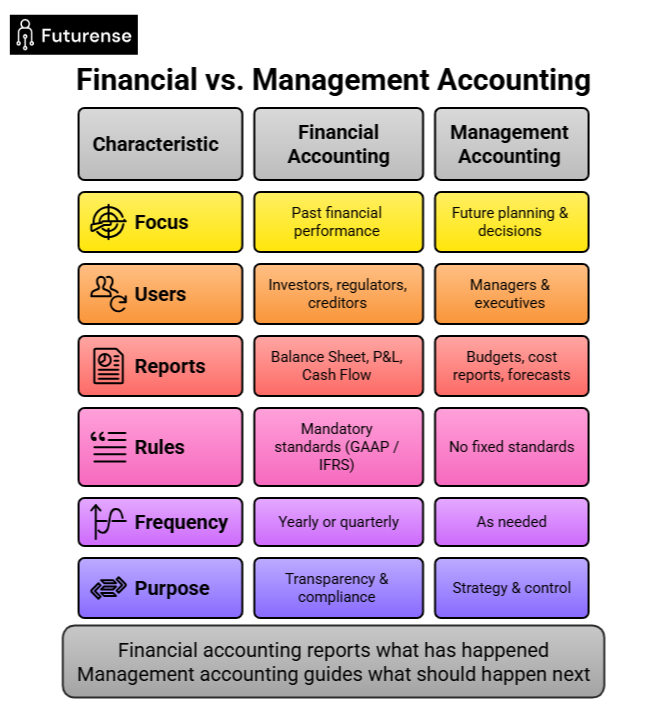
For a quick visual summary, here’s the difference between financial accounting and management accounting:
Career Scope Comparison in Financial Accounting and Management Accounting
If you look at the career scope for the two branches of accounting, then there you will find significant differences between the two fields. The financial accounting field involves reporting and compliance related work while the management accounting field includes work related to planning and decision-making. Let’s understand this difference with the help of a table:
Apart from this, you need a different set of skills for working in the above two fields. Let’s look at the required skills:
Skills for Financial Accounting
For financial accounting, you need skills like:
- Financial reporting skills
- Understanding of Compliance
- Accuracy and attention to detail
- Knowledge of accounting standards
The right course for financial accounting is one that will equip you well with all these skills.
Skills for Management Accounting
Management accounting demands the following skills:
- Strategic planning
- Cost analysis
- Business understanding
- Decision-making ability
- Analytical thinking
For those who want to build expertise in finance, strategy, and managerial decision-making, advanced management programs are a logical next step. Options like the IIM Sirmaur MBA program are designed to strengthen practical business skills while offering the academic depth required for senior management roles.
Final Words
As we have explained above, the difference between financial accounting and management accounting lies mainly in their purpose, application, rules, and users. Both fields are equally important as well as complementary. If you are a commerce, finance, and management students master both areas, then they can have a strong foundation for academic success and professional growth.
Understanding the difference between financial accounting and management accounting is also important for both students as well as professionals. If you are a student then it will help you choose the right career path, perform better in exams, and understand real-world business practices. On the other hand, as a professional, you need to understand this difference for improved organizational performance and stronger financial decision-making. Besides, it will also help in making better coordination between departments.
FAQ: Financial Accounting and Management Accounting Difference
What are the main differences between financial accounting and management accounting?
Financial accounting focuses on past financial performance and is prepared for external users like investors and regulators. Management accounting focuses on future planning and decision-making and is used internally by managers.
What is the difference between FA and MA?
FA (Financial Accounting) records and reports financial results using fixed standards like GAAP or IFRS. MA (Management Accounting) provides flexible, detailed reports to help management plan, control, and make decisions.
What is the difference between accounting and finance management?
Accounting focuses on recording, classifying, and reporting financial data, while financial management focuses on planning, allocating, and controlling funds to achieve business goals.
What is the difference between accounting and financial accounting?
Accounting is a broad field that includes multiple branches. Financial accounting is a specific branch of accounting that deals with preparing financial statements for external users.
What are the 4 types of accounting?
The four main types of accounting are: Financial Accounting – reporting financial performance Management Accounting – internal planning and decisions Cost Accounting – cost control and efficiency analysis Auditing – verification of financial records


MBA with AI for Working Professionals
IIM Sirmaur
India’s first AI-native MBA, designed for tech & non-tech professionals.