

Enterprise AI has a deployment problem that rarely gets discussed with precision.
MIT’s NANDA Initiative studied 300 public enterprise AI projects in 2025 and found that 95% produced no measurable impact on profit and loss. The models were not the problem. The gap between a working AI demo and a working AI system inside a real company’s infrastructure, data, compliance rules, and operational workflows is the problem.
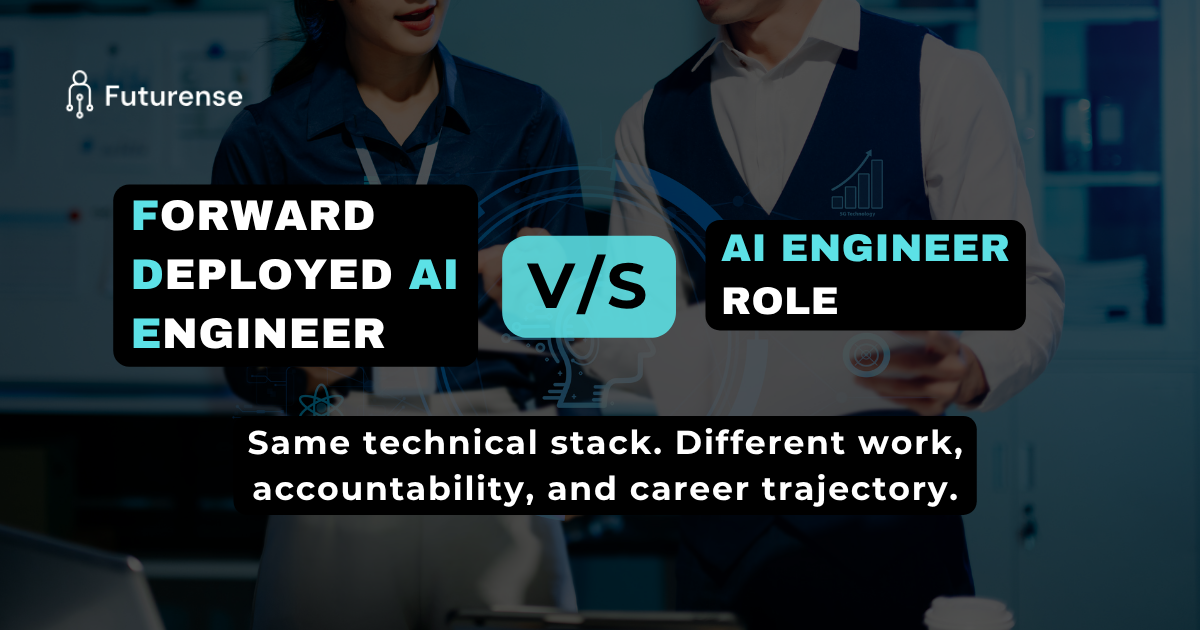
Two engineering roles exist specifically to address this. They share a technical foundation, get conflated regularly in job descriptions, and the distinction between them is one of the more consequential career decisions a working engineer can make right now.
What AI Engineer Roles Actually Involve in 2026
The AI Engineer role has shifted significantly over the past two years. The work is no longer centred on model training or ML pipeline research. It is primarily an application-building role.
An AI Engineer builds software systems that use AI as a component, not as the end product. The daily work includes:
- Designing and shipping RAG pipelines against internal company data
- Building agentic workflows using LangChain, LangGraph, or equivalent frameworks
- Writing and maintaining evaluation suites that catch hallucinations and regressions before production
- Integrating LLM APIs into larger software architectures
- Working across LLMOps, context engineering, and model evaluation as the role matures
The AI Engineer operates inside their employer’s product or platform. Same codebase, same internal stakeholders, same sprint cadence. Accountability is internal and problem scope is set by the product roadmap.
In India, fresher AI Engineers with deployment exposure start at Rs. 6 to 10 LPA. GenAI and RAG specialists at mid-senior levels earn Rs. 20 to 70 LPA depending on company tier and production depth. “AI Engineer” overtook “ML Engineer” as LinkedIn’s fastest-growing job title in 2026.
As the field matures, the role is fragmenting into sub-specialisations: LLMOps Engineers, Evals Engineers, context engineers, AI Data Engineers. The same pattern software engineering followed two decades ago when one title split into frontend, backend, mobile, DevOps, and data engineering.
What a Forward Deployed AI Engineer Does That an AI Engineer Does Not
A Forward Deployed AI Engineer is an AI Engineer who operates inside the client’s environment, not their employer’s. That one sentence carries significant operational weight.
When an FDE starts an engagement, the codebase belongs to the client. The data pipelines were built by someone else, often years earlier, often with minimal documentation. Compliance rules are non-negotiable constraints. The domain experts the forward deployed engineer works alongside understand their industry deeply but speak little technical language. The FDE is expected to produce working, production-grade output on a timeline the client has already committed to their own leadership.
Palantir created this role in the early 2010s under the internal title “Deltas.” Their engineers embedded directly inside U.S. government agencies to deploy analytics systems on air-gapped networks. Until 2016, Palantir employed more FDEs than software engineers, an unusual ratio that reflects how central the embedded model was to making their product function in the real world.
What was a Palantir-specific model is now an industry default. In May 2026 alone:
- OpenAI launched The Deployment Company, a separately incorporated FDE business unit with over $4 billion in committed enterprise capital
- Anthropic announced a $1.5 billion joint venture with Blackstone and Goldman Sachs to embed AI engineers inside financial services clients
- Google announced hundreds of new forward deployed engineer hires across its Cloud division
FDE job postings grew over 800% year-over-year in 2025, with 224 open roles tracked across 118 companies as of mid-2026 (Jobs By Culture platform data). The demand is structural, not cyclical.
The Technical Stack AI Engineers and Forward Deployed AI Engineers Share
This is where most comparisons go wrong. The technical baseline for both roles in 2026 is nearly identical. Both are expected to have:
- Production-grade Python
- Cloud platform fluency across AWS, GCP, or Azure
- RAG pipeline design and implementation
- Agent orchestration using LangGraph, LangChain, or CrewAI
- LLM evaluation framework design: hallucination checks, grounding, and regression testing
- LLM API integration and prompt engineering at production scale
Anthropic’s public FDE job specification requires “production experience with LLMs including advanced prompt engineering, agent development, evaluation frameworks, and deployment at scale.” That description fits a strong AI Engineer equally well. The distinction becomes less obvious when comparing the underlying tooling, since the Forward Deployed Engineer tech stack shares substantial overlap with the platforms, frameworks, and deployment infrastructure used across modern AI engineering teams.
Where Forward Deployed AI Engineer Roles Structurally Differ from AI Engineer Roles
The divergence is operational and contextual, not technical.
One consideration worth factoring for clients evaluating the FDE model: when a forward deployed engineer from an AI lab embeds deeply inside a client’s workflows, switching vendors later becomes expensive. In a market where the best-fit AI service in 2027 may not be today’s best choice, that lock-in is real and worth weighing before committing to an engagement.
Why Enterprise AI Needs AI Engineers and Forward Deployed Engineers Simultaneously
If forward deployed engineers solve the deployment problem, why are AI Engineer roles growing at the same time?
Because the problems they solve are different in kind.
AI Engineers build internal capability: making AI work reliably inside the company’s own product or platform, serving many users over time. Forward Deployed Engineers fix last-mile deployment: making a vendor’s AI product work inside one specific client environment, with that client’s data, constraints, and workflow logic.
One role scales horizontally across a user base. The other goes deep inside a single organisation. Neither makes the other redundant.
The MIT NANDA data explains why demand for both is growing simultaneously. Enterprise clients need AI Engineers to build internal capability. They also need deployment specialists to bridge the gap when off-the-shelf AI products cannot self-install into complex, real-world environments. Both gaps are large and expanding.
The Operational Skill That Separates a Forward Deployed AI Engineer from an AI Engineer
The technical stack is not what separates candidates in practice. The operational layer is.
A Forward Deployed AI Engineer works inside an unfamiliar system, on a client’s timeline, debugging problems created by decisions made years before they arrived, while managing the expectations of stakeholders who may not fully understand what is being built or why it takes as long as it does.
OpenAI documented what this looks like in practice during their John Deere deployment: reviewing hundreds of real-world examples with domain experts, building custom evaluation systems to measure accuracy, and iterating continuously. That embedded, client-accountable iteration is the actual job.
For a broader view of what the forward deployed role scope looks like across industries and company types, the Forward Deployed Engineers overview on Futurense covers deployments across AI labs, enterprise SaaS, and India-based companies.
Signals that point toward a forward deployed AI engineer role:
- You have debugged production systems you did not build, under external accountability and time pressure
- You hold technical conversations with non-engineers clearly, without over-simplifying the real constraints
- You can scope and begin delivering when requirements are incomplete or actively changing
- Client feedback cycles drive rather than disrupt your output
Signals that point toward an AI Engineer role:
- You want to go deep in one technical specialisation over a multi-year arc
- You prefer internal product ownership and long-term codebase stewardship
- You are leaning toward a specific sub-specialisation: evals engineering, LLMOps, context engineering, or AI infrastructure
- You are more energised by building for scale across a large user base than by depth inside one organisation
Forward Deployed AI Engineer vs AI Engineer Salaries in India (2026)
The salary difference between the two roles in India directly reflects the skill premium.
Forward Deployed AI Engineer salaries in India
AI Engineer salaries in India
Sources: SalaryExpert India 2026, Taggd AI Engineer Salary Report 2026, FDE Academy India Jobs Guide 2026.
The FDE premium over Ai engineer salary is real at every experience level. It reflects the scarcity of engineers who combine production AI depth with demonstrated client-embedded deployment experience.
The barrier for most Indian engineers targeting the forward deployed path is not technical. The gap is in client-embedded deployment work. Most early-career engineering roles in India are structured around internal product work, which does not build the customer-facing, high-accountability deployment muscle that FDE roles demand. Engineers with technical account management, implementation consulting, or customer-facing solutions roles alongside AI engineering are the most competitive candidates for this transition.
The PG Certificate in Forward Deployed AI Engineering at IIT Roorkee addresses both the technical and deployment-facing dimensions before engineers enter the market, which is the gap that is otherwise difficult to close through standard on-the-job experience alone.
For engineers coming from a data engineering background specifically, the skills transfer and the gaps involved are laid out in the Forward Deployed Engineer vs Data Engineer comparison.
Key Takeaways
- AI Engineers and Forward Deployed AI Engineers often work with the same underlying technologies, including LLMs, RAG pipelines, vector databases, cloud platforms, and agent frameworks.
- The primary difference is not technical capability but responsibility. AI Engineers focus on building AI systems, while Forward Deployed AI Engineers focus on deploying and adapting those systems within client environments.
- Forward Deployed AI Engineers spend significantly more time working directly with customers, gathering requirements, managing stakeholders, and ensuring production adoption.
- Production ownership is a defining characteristic of the FDE role. Success is measured by real-world outcomes rather than model performance alone.
- Enterprise AI companies increasingly hire engineers who can bridge technical implementation and customer-facing problem solving, making Forward Deployed AI Engineering one of the fastest-growing AI career paths.
- Professionals with backgrounds in software engineering, AI engineering, solutions engineering, or technical consulting can all transition into Forward Deployed AI Engineering with the right deployment and client-facing experience.
- As enterprise AI adoption accelerates, demand is growing for engineers who can move beyond model development and deliver measurable business outcomes in production environments.
Frequently Asked Questions
What is the difference between an AI Engineer and a Forward Deployed AI Engineer?
An AI Engineer builds AI-powered software systems inside their own company’s product or platform. A Forward Deployed AI Engineer does the same technical work but operates embedded inside a client’s environment, integrating AI into the client’s existing systems, data, and workflows. The technical skills overlap significantly. The work context, accountability structure, and communication demands are structurally different.
Is the Forward Deployed AI Engineer role a good career choice in India in 2026?
Yes, with one condition: the role requires a combination of production AI engineering depth and demonstrated client-facing deployment experience. Engineers who have both access salaries from Rs. 18 LPA to Rs. 90 LPA or above depending on employer tier. The market is growing rapidly and the supply of qualified candidates has not kept pace with demand.
Do Forward Deployed AI Engineers write production code?
Yes. An FDE is a software engineer, not a consultant or implementation manager. They write production-grade code, build integrations, configure agent workflows, and design evaluation systems, all inside the client’s environment. The role demands strong generalist engineering instincts because the FDE inherits systems they did not design.
Which role pays more in India: AI Engineer or Forward Deployed AI Engineer?
Forward Deployed AI Engineers earn significantly more on average. The market average for AI FDEs in India is Rs. 27.7 LPA, with senior global-remote roles reaching Rs. 90 LPA and above. AI Engineers without FDE specialisation start at Rs. 6 to 10 LPA, with senior GenAI and RAG specialists reaching Rs. 20 to 70 LPA. The premium reflects the scarcity of the combined technical and client-facing skill profile.
Can an AI Engineer transition into a Forward Deployed AI Engineer role?
Yes. The technical foundation is largely the same. The transition requires building client-facing deployment experience: working in production environments you did not design, under external accountability, with non-technical stakeholders involved in delivery. Engineers with implementation work, technical account management, or customer-facing solutions engineering alongside AI depth are the most competitive candidates for this move.
What technical skills are required to become a Forward Deployed AI Engineer?
The non-negotiable baseline: production Python, cloud fluency on AWS, GCP, or Azure, RAG pipeline implementation, agent orchestration using LangGraph or LangChain, LLM evaluation framework design, and integration engineering across APIs and data pipelines. Beyond the technical foundation, FDE roles specifically require experience debugging unfamiliar production systems and configuring AI outputs against real-world data constraints and compliance requirements.


PG Certificate Program in Forward Deployed AI Engineering
IIT Roorkee
Become the Engineer Who Makes AI Work Inside Client Stacks