

Retrieval Augmented Generation (RAG) has become the standard way to ground large language models in real, current, and domain-specific data. But as teams move from simple Q&A bots to systems that answer multi-step, relationship-heavy questions, a common problem shows up: standard vector RAG starts giving shallow, disconnected, or outright wrong answers. This is where the GraphRAG vs Vector RAG comparison enters the conversation.
The debate of GraphRAG vs Vector RAG isn't about picking a trendy new tool, it's about matching your retrieval architecture to the actual shape of your data and your queries. In this guide, we'll break down how each approach works, where each one fails, how to combine them, and how to decide which fits your use case.
Why Retrieval Architecture Matters More Than Model Size
Most teams chasing better RAG performance start by swapping LLMs or fine-tuning prompts. But in practice, the retrieval layer, not the model, is usually the bottleneck. An LLM can only reason as well as the context it's given. If retrieval hands it fragmented, unrelated, or incomplete passages, no amount of prompt engineering fixes the output. This is why understanding retrieval augmented generation architecture, and specifically the difference between vector-based and graph-based retrieval, matters more than picking the "best" model on a leaderboard.
What Is Vector RAG?
Vector RAG is the retrieval method most people mean when they say "RAG." It works in three steps:
- Chunking - documents are split into smaller passages.
- Embedding - each chunk is converted into a numerical vector using an embedding model, capturing semantic meaning.
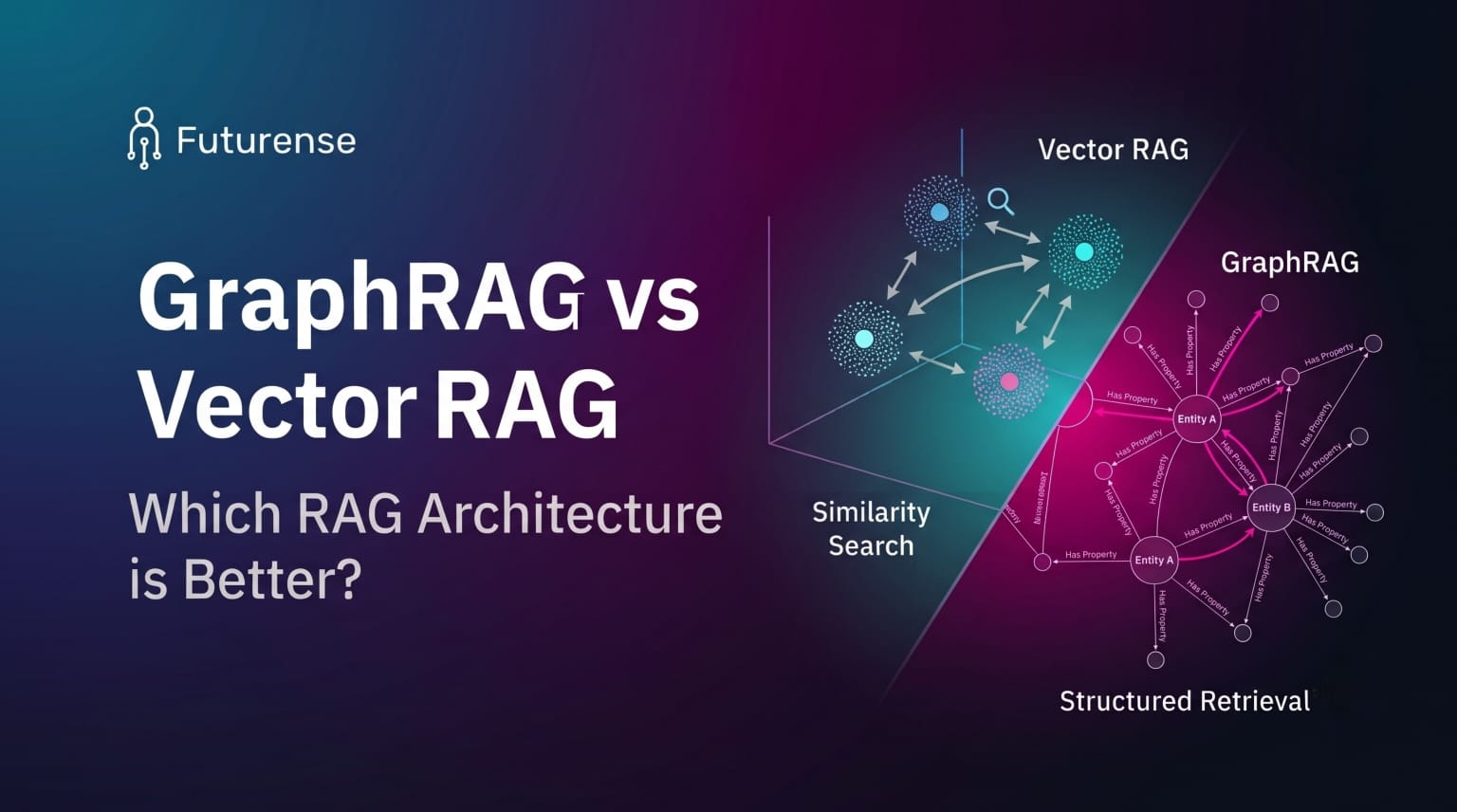
- Similarity search - when a user asks a question, it's embedded too, and the system retrieves the chunks whose vectors are closest in the embedding space, typically stored in a vector database like Pinecone, Weaviate, or FAISS.
This approach is fast, cheap to set up, and works well for straightforward factual lookups "What is our refund policy?" or "Summarize this contract clause." Semantic search based on vector embeddings excels when the answer lives inside a single passage or a small set of similar passages.
How Vector Similarity Search Actually Works
Under the hood, an embedding model maps text into a high-dimensional vector space where semantically similar concepts sit close together. A query about "employee termination policy" and a passage about "grounds for dismissal" might land near each other even without shared keywords, because the model captures meaning rather than exact wording. Approximate nearest neighbor (ANN) algorithms then scan this space efficiently, even across millions of vectors, to return the top-k closest matches in milliseconds.
Where Vector RAG Breaks Down
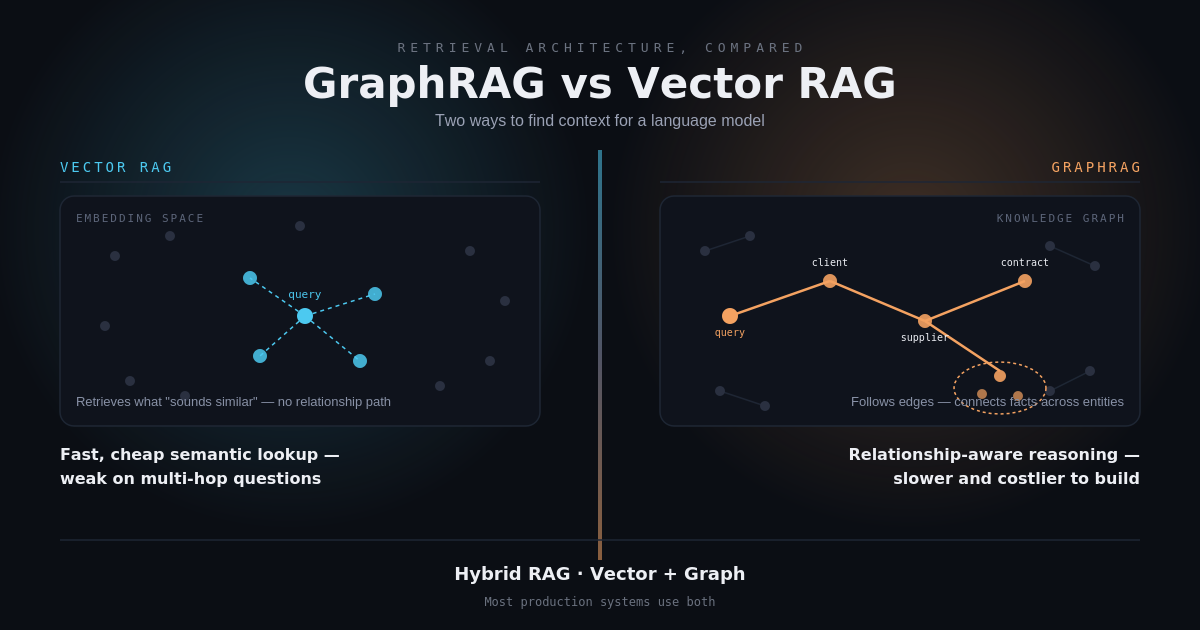
Vector similarity measures how semantically close two pieces of text are not how they're connected. This creates blind spots for:
- Multi-hop reasoning - questions that require chaining facts across multiple documents (e.g., "Which suppliers used by our top three clients had compliance violations last year?").
- Relationship-heavy queries - anything asking "how," "why," or "which entities are connected to."
- Global or aggregate questions - "What are the major themes across all customer complaints in Q2?" Vector retrieval pulls a handful of similar chunks, not a synthesized view of the whole dataset.
- Context fragmentation - chunking splits related information apart, so an LLM may retrieve a fact but miss the surrounding relationships that make it meaningful.
These gaps are exactly why LLM hallucination rates climb on complex enterprise queries, even with retrieval in place.
What Is GraphRAG?
GraphRAG combines knowledge graphs with retrieval augmented generation. Instead of (or alongside) storing text as flat vectors, it extracts entities and their relationships, people, organizations, products, events and organizes them into a structured graph. Retrieval then traverses this graph to pull connected, multi-hop context instead of isolated chunks.
The GraphRAG Pipeline, Step by Step
A typical GraphRAG pipeline looks like this:
- Entity and relationship extraction - an LLM or NLP pipeline identifies entities (nodes) and how they relate (edges) from source documents.
- Graph construction - this structured data is stored in a graph database (like Neo4j or Amazon Neptune) and often clustered into communities of related entities.
- Community detection and summarization - algorithms group densely connected entities into clusters, and each cluster gets a summary, giving the system a "global" view of themes, not just individual facts.
- Graph-aware retrieval - a query triggers traversal across relevant nodes and edges, returning connected context rather than a flat list of similar passages.
- Response synthesis - the LLM combines retrieved subgraphs and summaries into a coherent, relationship-aware answer.
This structure lets GraphRAG answer questions that require reasoning across relationships, not just semantic similarity, a core reason Microsoft Research introduced the approach for large, interconnected datasets.
Local vs Global Search in GraphRAG
GraphRAG systems typically support two retrieval modes. Local search answers specific, entity-centered questions by traversing the graph around a particular node similar in spirit to vector RAG but relationship-aware. Global search answers broad, dataset-wide questions by pulling from pre-generated community summaries, something vector RAG structurally cannot do well since it has no concept of "the whole dataset," only individual chunk similarity.
GraphRAG vs Vector RAG: A Side-by-Side Comparison
When Standard Embeddings Miss the Point
Vector embeddings answer "what sounds similar to this question?" That's a fundamentally different question from "what is connected to this concept, and how?" A pharmaceutical researcher asking "Which drug interactions involve compounds tested in trials sponsored by Company X?" needs the system to walk through entities, company, trial, compound, interaction not just find text that resembles the phrasing of the question. This is the exact gap that pushes teams from vector databases toward graph-based context retrieval.
The Cost and Complexity Trade-Off
It's worth being honest about what GraphRAG actually costs. Building a knowledge graph requires an entity extraction pass over your entire corpus, which itself consumes LLM tokens and engineering time. Keeping the graph accurate as source documents change means designing an update pipeline, not just re-running an embedding job. Teams evaluating GraphRAG should budget for:
- Higher initial indexing cost (entity/relationship extraction at scale).
- Graph database hosting and maintenance.
- Ongoing schema and ontology decisions (what counts as an entity, what relationships matter).
- More complex evaluation, since "correct" retrieval now depends on graph structure quality, not just embedding accuracy.
Vector RAG, by contrast, remains the lower-friction default for teams that don't yet have a clear need for relationship-aware retrieval.
Hybrid RAG: Getting the Best of Both
In practice, most production-grade systems don't pick one architecture exclusively. A hybrid approach uses vector search for fast, broad candidate retrieval, then applies graph traversal to enrich results with relationship context sometimes called Graph-Vector RAG or hybrid retrieval. This tends to outperform either method alone on complex enterprise knowledge bases, because it captures both semantic similarity and structural relationships.
Common hybrid patterns include:
- Using vector search to find a starting set of relevant entities, then expanding via graph edges.
- Running both retrieval methods in parallel and letting a re-ranker merge results.
- Using GraphRAG for high-level thematic questions and vector RAG for granular lookups within the same application.
How to Decide Which Approach Fits Your Use Case
Ask these questions before building:
- Does your query require connecting facts across documents? If yes, learn GraphRAG.
- Is your dataset naturally relational (organizations, people, transactions, citations)? Graph structure adds real value here.
- Do you need fast, low-cost retrieval at scale for simple lookups? Vector RAG is usually sufficient and cheaper to maintain.
- Do you need explainable, auditable answers (e.g., for compliance or legal use cases)? GraphRAG's traceable relationships help justify answers to stakeholders.
- What's your engineering capacity? Knowledge graph construction and maintenance requires more ongoing investment than a vector index.
Real-World Applications
- Vector RAG: customer support chatbots, internal document search, product FAQs, code search.
- GraphRAG: fraud investigation (tracing transaction networks), pharmaceutical research (compound-trial-interaction chains), legal discovery (case law relationships), enterprise knowledge management across siloed departments.
Common Mistakes Teams Make When Choosing Between Them
- Defaulting to GraphRAG because it's newer. If your queries are mostly single-fact lookups, a knowledge graph adds cost without meaningful accuracy gains.
- Sticking with vector-only RAG after query complexity grows. Teams often notice hallucinations increasing over time without realizing the root cause is architectural, not a model quality issue.
- Treating graph construction as a one-time task. Entity graphs go stale just like any index; without a refresh pipeline, retrieval quality degrades silently.
- Skipping evaluation entirely. Both approaches need query-level testing against real user questions, not just spot-checking a few examples.
TL;DR
- Vector RAG retrieves text based on semantic similarity fast and cheap, but weak on multi-hop and relationship-based questions.
- GraphRAG builds a knowledge graph of entities and relationships, enabling traversal-based retrieval that handles complex, connected queries and global/thematic questions.
- Standard embeddings miss relationship context because they measure "sounds similar," not "is connected to."
- GraphRAG costs more to build and maintain, so it's worth it mainly when your queries genuinely require relationship reasoning.
- Hybrid RAG (vector + graph) is often the strongest real-world approach for enterprise-scale, complex knowledge retrieval.
- Choose based on your query complexity, data structure, explainability needs, and engineering capacity not hype.
Is GraphRAG better than Vector RAG?
Neither is universally better; it depends on the query type. GraphRAG outperforms on multi-hop, relationship-heavy, and thematic questions, while vector RAG is often faster and cheaper for direct factual lookups.
Can I combine GraphRAG and Vector RAG in one system?
Yes. Hybrid retrieval, using vector search for candidate generation and graph traversal for relationship enrichment, is increasingly common in production systems handling complex knowledge bases.
Does GraphRAG require a knowledge graph database like Neo4j?
Most implementations use a graph database to store entities and relationships efficiently, though some frameworks build lightweight in-memory graphs for smaller datasets.
Is GraphRAG more expensive to run than Vector RAG?
Generally yes. Entity extraction, graph construction, and community summarization add upfront processing cost and ongoing maintenance compared to simply embedding and indexing text.
What's the main reason standard vector embeddings fail on complex queries?
Vector embeddings measure semantic similarity, not structural relationships. They retrieve text that "sounds related" but can't traverse chains of connected facts across multiple documents, which is where multi-hop questions fail.


PG Certificate in Building Professional Agentic AI with AIOps
IIT Jammu
Design, Deploy, and Operate AI Agents that Actually Work in Production