

Marketing communication is a key business activity and not an aspect of advertising. It helps individuals see your brand in a better light, value your credibility, and connect. Every post, whether in the form of text, photo, or video, contributes to a brand experience, even if it appears across different channels.
Brands nowadays have more than one way of communicating. They can communicate through the web, advertisements, email, social media, workshops, and door-to-door marketing. The message should remain the same, regardless of the medium used.
This is where marketing communication comes into play, to make sure there’s consistency in different forms of communication.
In this guide, we will cover marketing communication, explaining the step-by-step process, the role of advertising communication, and the challenges faced by marketers.
What Is Marketing Communication?
Before we move into further details, it is important to understand what marketing communication is.
In layman's language, marketing communication refers to the clear and planned exchange of messages between the brand and its target audience. Marketing communication defines how a business shapes perception, explains its valid values to the audience, and presents itself in an open market.
The communication comprises several working areas, such as:
- Advertising across offline (traditional) and online channels
- Brand’s public relations and messaging.
- Brand’s content and digital communication via websites, social platforms, and ads.
- Sales process/communication and customer touchpoints.
The primary intent of marketing communication, regardless of the channel, remains the same: to inform the audience with clear and relevant information, influence and persuade behavior, and build a long-term, sustainable brand-to-customer relationship.
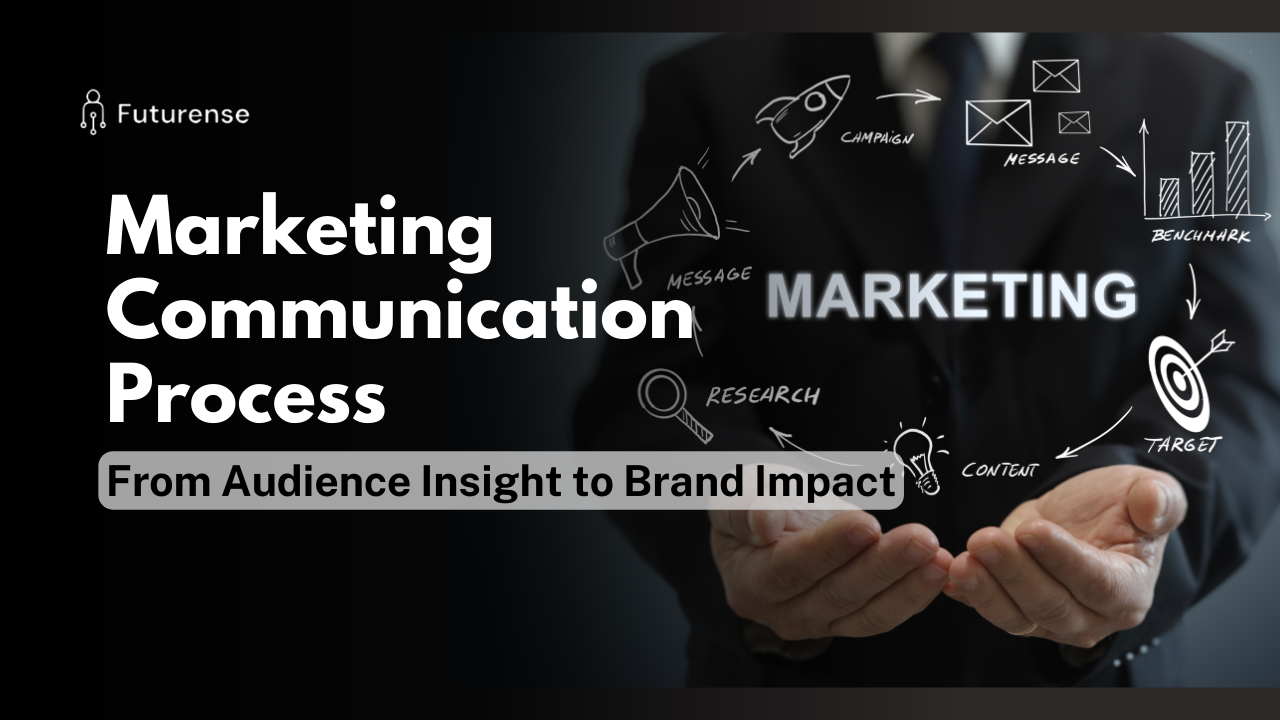
Marketing Communication Process: Step-by-Step Breakdown
Step 1: Audience Analysis and Understanding
Messages fail to communicate when they are composed based on assumptions rather than what the audience wants to hear. A strong communication starts with insight, not just creativity.
At this stage, marketers analyze various factors:
- Demographics and psychographics to understand the audience and their thinking process
- Pain points, motivations, and objections that lead to purchase decisions
- Media consumption behaviour, where attention is spent, and how the information is processed.
The above insights help understand how each message should be framed, and this is the stage where the audience persona helps shape the entire marketing message.
Marketers turn this research into practical guidance by defining tone, language, priorities, and emotional triggers.
Step 2: Setting Communication Objectives
A clear marketing message revolves around having a clear vision of what you need to achieve from the message.
Is it about a new product launch? A product survey? Customer feedback?
Clear marketing communication depends on knowing what the message must achieve. Business goals define outcomes such as revenue growth or market expansion. Communication objectives support those goals by shaping what the audience should think, feel, or do after receiving a message.
Common communication objectives include:
- Building awareness in new or competitive markets
- Driving consideration by educating or repositioning an offer
- Supporting lead generation through targeted messagingEncouraging conversion or strengthening customer retention
To keep objectives focused, many teams apply SMART principles. Goals should be specific, measurable, achievable, relevant, and time-bound. This clarity ensures communication efforts stay accountable and aligned with real business performance.
Step 3: Message Strategy and Value Proposition
Once the audience is understood and the objective is clear, the next step is deciding what the brand will say and how it will convey it. This is where message strategy takes shape.
At this point, the marketers clarify some of the main aspects:
- The fundamental story behind the reason why the brand or offer is important.
- The brand voice and tone define how the message is conveyed in touchpoints.
- The main advantages that need to be highlighted, along with the evidence sources that make them credible.
A strong message strategy should also balance emotional and rational appeal. Emotional cues help capture attention and influence perception, while rational arguments serve as justifications for decisions. Strike a balance between both, ensuring that communication doesn’t seem forced.
Step 4: Channel Selection and Media Planning
A strong message would mean nothing if posted in the wrong channel. Hence, channel selection plays a crucial role in marketing communication. This step ensures that the message reaches the audience at the right time and in the right place, so that it isn’t lost among background noise.
A majority of the strategies include paid, earned, owned, and shared, which differ in terms of visibility, credibility, control, and interaction.
Too many channels dilute focus. Stretched messages cause a lack of consistency and poor performance. Narrow channel selection will form better recall and better communication. So make sure to focus on the niche.
Step 5: Campaign Execution and Coordination
Campaign execution goes beyond launch. It requires clear timelines of when the message will be posted and how it will unfold across channels. Budget allocation is also an important aspect of execution because it is important to utilize and distribute according to priorities.
The visuals, language, and messaging should remain consistent across all the channels, which makes creative alignment also a very integral part of execution.
The product, marketing, and sales teams should be working with the same understanding and purpose. When such teams operate separately, communication breaks down, and the audience gets conflicting messages.
Step 6: Measurement, Feedback, and Optimization
Marketing communication is effective only if performance is tracked properly.
Without measurement, teams cannot have a foundation or understanding of what works and what doesn’t. This is why almost every platform has analytics, which helps understand how each post performed, so the marketing team can analyse and create further posts (messages) in a similar manner.
Some of the most common performance metrics are:
- Reach and impressions to understand virality and visibility
- Engagement to measure how the audience interacted with the content
- Conversion to track action and intent
- Clicks and interactions such as like, comment, share, and save.
How Real Brands Apply the Marketing Communication Process
It’s said that relatable learning connects more easily than long, boring paragraphs, so here are real-world examples of how brands use marketing communication.
This shows how two different niche brands have the same marketing framework, even though the execution differs, the underlying logic remains the same.
Core Models Used in Marketing Communication
Several established models help marketers create a communication model that can be implemented across various channels.
AIDA Model
The AIDA model maps communication to the buyer/customer’s journey. It moves the audience through attention, interest, desire, and action. With each stage, marketers craft a different message focus, from awareness-driven to conversion-centric content.
STP Model
STP, which stands for Segmentation, Targeting, and Positioning, takes care of the message relevance by defining the target audience, key segments, and how a brand should be positioned in the market.
SOSTAC Model
The SOSTAC model refers to Situation, Objectives, Strategy, Tactics, Action, and Control. The primary function of this model is to ensure that the communication is measurable.
PESO Model
PESO organizes communication channels into paid, earned, shared, and owned media. This marketing model helps the brand coordinate messaging and amplify reach while maintaining brand tone consistency across all platforms.
Importance of Marketing Communication for Business
Marketing communication helps a business establish trust and identity across offline and online media. A brand’s awareness and recall improve with consistent messaging because the audience knows what the brand stands for without a second guess.
A strong and well-planned marketing communication aligns internal teams around a common narrative. Sales, marketing, and customer service teams share a common communication intent with customers, which helps avoid mixed messages and internal friction.
Clear communication and messaging improve audience engagement and loyalty by setting accurate expectations and reinforcing value at every touchpoint. It also helps drive revenue-led outcomes such as leads, conversions, and retention.
Marketing Communication in the Age of AI and MarTech
AI is rapidly changing how marketing communication is executed. AI in digital marketing allows a brand to personalize a message at scale without incurring any higher costs.
There are several automation tools now available on the market that help brands convey their message and connect with their audience easily.
AI can help you create and execute strategies, however, you still need to help train AI with brand and customer knowledge, customer demographics, queries, and everything that matters for clear communication.
Marketing Communication as the Foundation of Digital Marketing
Marketing communication is the foundation of AI-powered digital marketing. Without a clear message strategy, defined goals, and a thorough understanding of the audience, AI tools can only assist with generic messaging and hallucination.
Core communication concepts directly fuel advanced capabilities like prompt engineering, AI-driven personalization, and MarTech orchestration. A prompt generates a meaningful message when the messaging intent is clear, and an automation succeeds only when audience logic is in place with defined objectives.
FAQs
What is meant by marketing communication?
Marketing communication is the planned process of delivering clear, consistent messages about a brand, product, or service to its target audience across multiple channels to inform, influence, and build relationships.
What is the 7 times 7 rule in marketing?
The 7 times 7 rule suggests that a customer needs to see or hear a brand message at least 7 times across 7 different touchpoints before they recognize, trust, and act on it.
What are the four types of marketing communication?
The four main types of marketing communication are advertising, public relations, sales promotion, and direct or digital marketing, all working together to deliver a consistent brand message.
What are the 4 C's of marketing communication?
The 4 C’s of marketing communication are Clarity, Consistency, Credibility, and Customer focus, ensuring messages are easy to understand, aligned across channels, trustworthy, and audience-centric.


PG Certificate Program in AI-Enabled Digital Marketing & MarTech
IIT Roorkee
Become the AI-native marketer every modern team needs. Engineer every part of the marketing funnel, across every function, like a full-stack generalist.