

Node.js and React are not competitors, they operate at different layers of the same application. Node.js is a server-side JavaScript runtime that handles APIs, business logic, and database operations. React is a client-side JavaScript library that builds the user interfaces people see and interact with in the browser. The confusion exists because both are JavaScript-based and frequently deployed together, but they solve completely different problems.
This guide breaks down exactly what each technology does, where they differ, and how to decide which one to learn first for a full-stack JavaScript career.
What Is Node.js?
Node.js is an open-source, server-side JavaScript runtime built on Google Chrome's V8 engine. It executes JavaScript outside the browser, enabling developers to build backend services — APIs, data pipelines, authentication systems, and real-time servers — entirely in JavaScript. First released in 2009, Node.js transformed JavaScript from a browser-only language into a full-stack development language.
How Node.js Works
Node.js runs on a single-threaded, non-blocking event loop. Instead of waiting for one operation (like a database query) to finish before starting the next, it handles multiple requests concurrently. This makes it exceptionally efficient for I/O-heavy workloads — applications that read and write lots of data but don't perform heavy computation.
According to the Stack Overflow Developer Survey 2025, Node.js holds a 48.7% developer adoption rate — the highest of any web technology surveyed. That number reflects its dominance in API development, microservices, and real-time application backends.
Key Features of Node.js
- Non-blocking I/O — handles high concurrency without spawning new threads per request
- NPM ecosystem — access to over 2 million packages via the Node Package Manager
- JavaScript on the server — the same language used in the browser, reducing context-switching
- Event-driven architecture — ideal for real-time apps like chat servers and live dashboards
- Cross-platform — runs on Windows, macOS, and Linux without modification
Where Node.js Falls Short
Node.js struggles with CPU-intensive tasks — image processing, machine learning inference, or heavy data transformation — because blocking the event loop halts all other operations. For compute-heavy workloads, Python or Go is typically a better fit.
What Is React?
React is an open-source JavaScript library developed by Meta (formerly Facebook) for building interactive user interfaces. It runs in the browser, managing how the UI renders and updates in response to user actions and data changes. React does not handle routing, server logic, or database operations — it manages the view layer only.
Released in 2013, React introduced a component-based architecture that reshaped how developers build frontends. Today it powers the UIs of Facebook, Instagram, Airbnb, Netflix, and hundreds of thousands of production applications worldwide.
How React Works
React's defining mechanism is the Virtual DOM. When a component's state changes, React computes a virtual representation of the new state, diffs it against the current state, and applies only the minimal set of actual DOM changes needed. This makes React applications fast and responsive, even when UI elements update frequently.
According to the Stack Overflow Developer Survey 2025, React holds a 44.7% developer adoption rate — making it the most widely used frontend framework globally.
Key Features of React
- Component-based architecture — every UI element is a self-contained, reusable component with its own logic and state
- Virtual DOM — efficient rendering that updates only what changed, not the entire page
- JSX syntax — write HTML-like markup directly in JavaScript files
- Unidirectional data flow — data flows from parent to child via props, making debugging predictable
- React Native — use the same component model to build native iOS and Android apps
- Server-side rendering — via Next.js, React can render on the server for improved SEO and load performance
Where React Falls Short
React is a view library, not a complete framework. You will need additional libraries for routing (React Router), global state management (Redux, Zustand), and data fetching (React Query, SWR). Best practices also shift as the library evolves — class components gave way to hooks, and hooks are now giving way to React Server Components. The ecosystem has a real learning curve.
Node.js vs React: Core Differences at a Glance?
The single most important takeaway: Node.js powers what happens behind the scenes; React powers what the user sees and clicks. They are complementary by design, not competing alternatives.
When to Use Node.js
Node.js is the right choice when your project needs a high-performance backend, real-time data handling, or a scalable API layer built in JavaScript.
Use Node.js when you're building:
- REST APIs or GraphQL backends — Node.js with Express.js or Fastify is the standard for lightweight, high-performance API layers
- Real-time applications — chat systems, live dashboards, collaborative editing tools, and multiplayer games all benefit from its event-driven architecture
- Streaming services — video platforms, audio processing pipelines, and file transfer services leverage Node.js's efficient stream handling
- Microservices — its lightweight footprint makes it well-suited for independent, containerized services
- Serverless functions — Node.js integrates natively with AWS Lambda, Azure Functions, and Google Cloud Functions
Don't use Node.js when:
Your workload is CPU-bound — video encoding, real-time ML inference, or scientific computation. For those tasks, Python (with FastAPI or Django), Go, or Rust is a more appropriate backend choice.
When to Use React?
React is the right choice when your project needs a dynamic, component-driven user interface — especially one where UI elements update frequently in response to user interactions or live data.
Use React when you're building:
- Single-page applications (SPAs) — apps that need seamless navigation without full page reloads (dashboards, admin panels, productivity tools)
- Dynamic, data-driven UIs — interfaces that update frequently based on user input or live data streams
- Complex component systems — large-scale UIs where reusability and maintainability matter across teams
- Cross-platform mobile apps — React Native shares component logic with React web code, reducing duplication
- SEO-critical frontends — when paired with Next.js for server-side rendering, React handles SEO requirements that client-side-only SPAs struggle with
Don't use React when:
Your frontend is a simple static page with minimal interactivity. For basic informational sites, plain HTML/CSS or a lightweight alternative like Alpine.js is faster to build and easier to maintain. React's overhead is justified by complexity — not page count.
How Node.js and React Work Together?
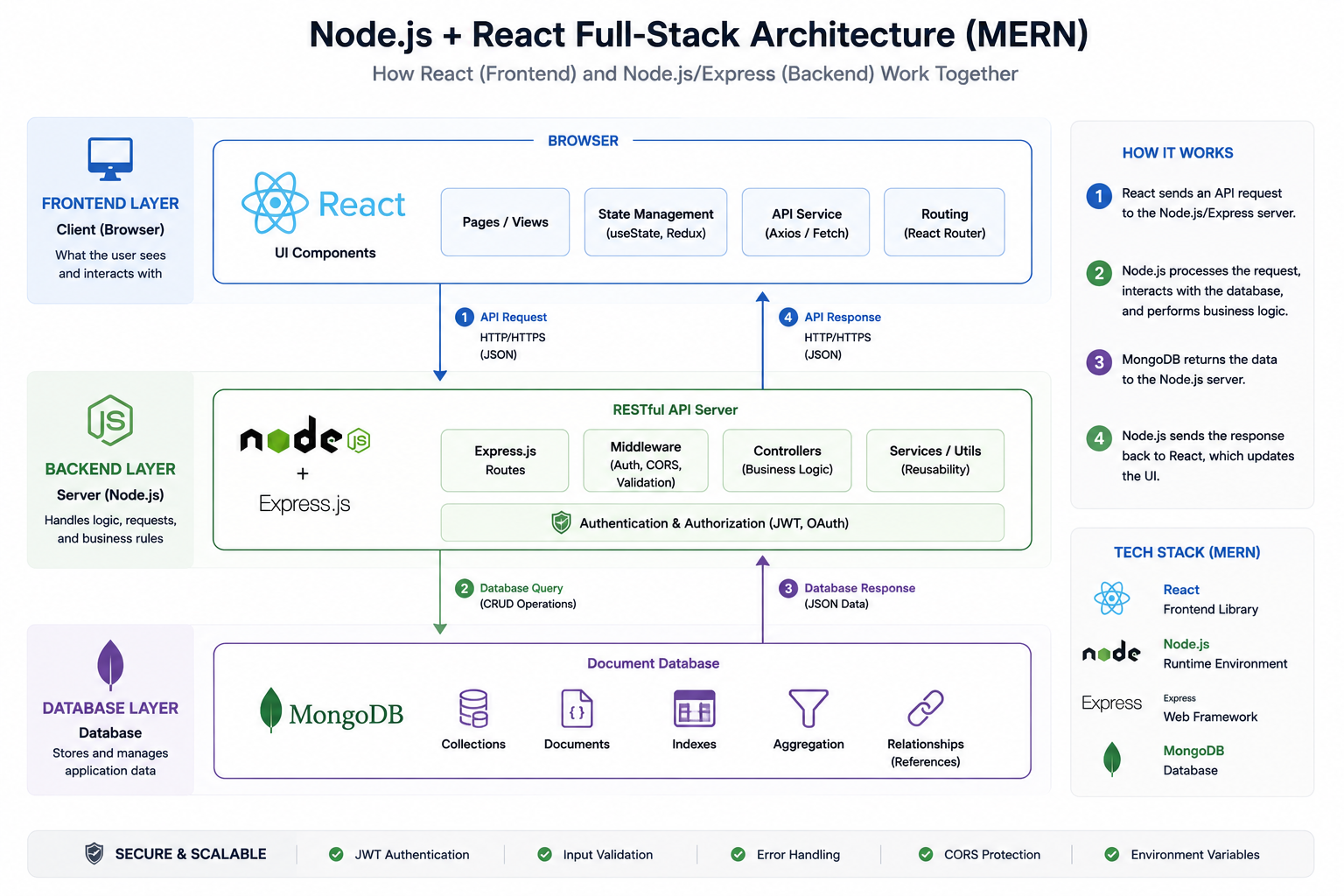
The most common full-stack JavaScript architecture pairs React on the frontend with Node.js on the backend — a setup known as the MERN stack (MongoDB, Express.js, React, Node.js).
This combination is used in production at companies ranging from early-stage startups to Netflix and LinkedIn, and it's the architecture taught in most full-stack developer programs.
How the request cycle works:
- React renders the UI in the browser; the user triggers an action (e.g., submitting a form)
- React makes an API call to the Node.js server via
fetchor a library like Axios - Node.js (with Express.js handling routing) receives the request, queries a database, applies business logic
- Node.js sends back a JSON response
- React updates the relevant UI components with the new data — without reloading the page
Why this combination works well
Using JavaScript across the full stack reduces context-switching, allows shared utility code between client and server, and means teams don't need separate frontend and backend specialists for every hire.
Server-side rendering (SSR) is another key integration point. Node.js can pre-render React pages on the server via Next.js before sending them to the browser. This improves initial load performance and makes React applications fully indexable by search engines — solving one of the biggest limitations of client-side-only React.
For AI-powered applications specifically, a Node.js API layer sits naturally between a React frontend and a Python ML backend — passing user requests to the model and returning results to the UI without exposing the model directly.
Which Should You Learn First: React or Node.js?
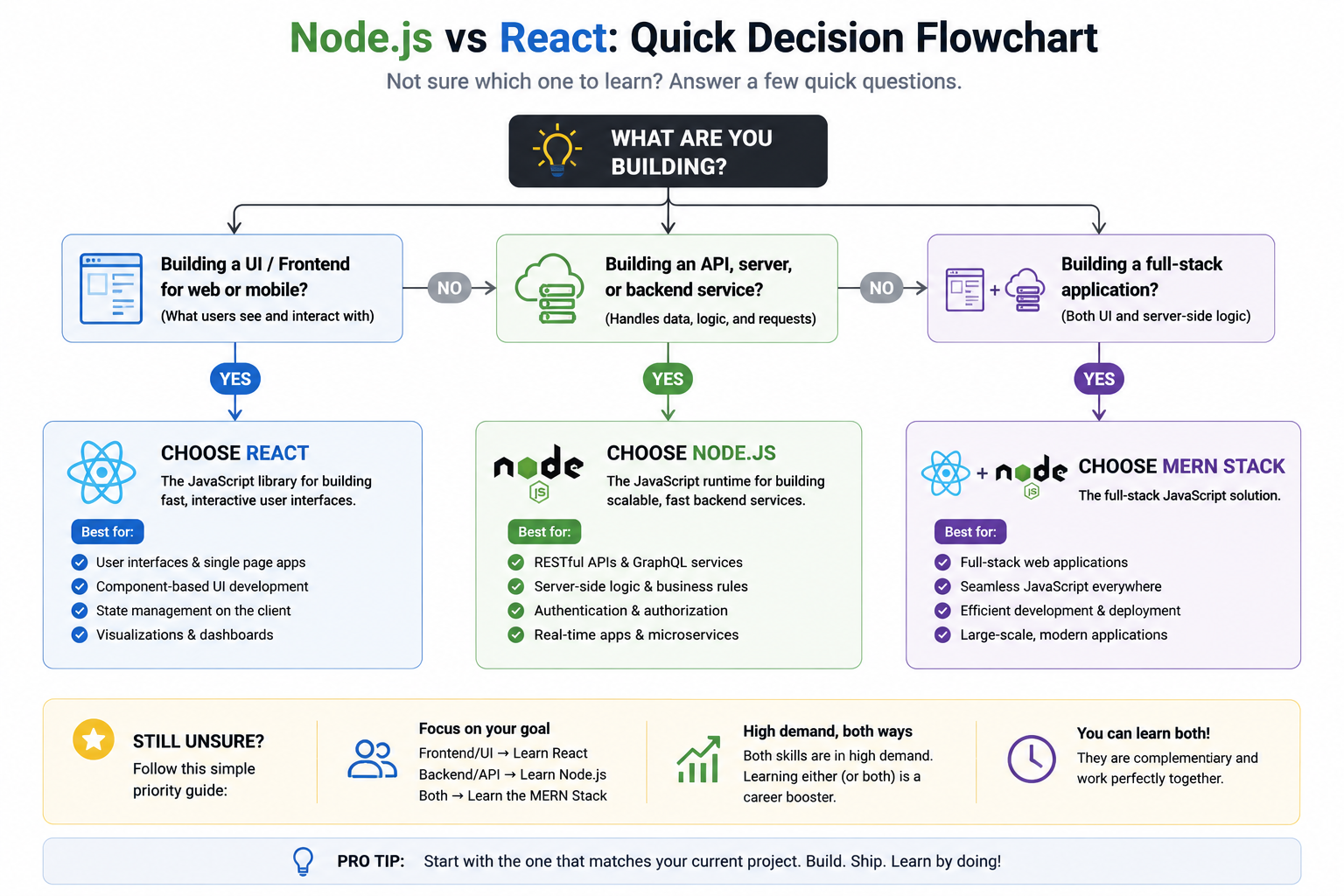
There is no universal answer — the right starting point depends on your current skills and target role.
Learn React first if:
You have an HTML/CSS/JavaScript foundation and want to build portfolio-visible projects quickly. React's immediate visual feedback accelerates learning, and frontend roles are abundant in the Indian job market. Product companies and AI startups actively hire React developers at every experience level.
Learn Node.js first if:
You're drawn to backend systems, API design, and how data flows from databases to the client. Node.js gives you a strong foundation in asynchronous programming patterns that transfer to almost any backend technology — including Python-based AI service architectures.
Learn both in sequence if:
Your goal is a full-stack engineering role. Most product companies in India now treat full-stack JavaScript proficiency — React for the frontend, Node.js for the backend — as a baseline expectation. Understanding both layers makes you dramatically more effective and more competitive for the highest-paying IT jobs in India.
The AI engineering angle
Engineers building AI-powered products need to understand both layers. A typical architecture places a React frontend on one end, a Node.js API layer in the middle, and a Python ML service on the other end. Knowing how to wire those three pieces together — and debug across them — is among the top skills engineering students need to break into applied AI roles.
Developers who combine full-stack JavaScript proficiency with AI/ML skills consistently outperform pure frontend or backend specialists in both AI engineer salaries in India and international remote roles. If you're building toward an AI career, Node.js and React together form a foundational toolset — not optional extras.
Futurense's Forward Deployed AI Engineering certificate (IIT Roorkee) covers applied AI deployment across full-stack environments — including building and shipping AI-powered features using modern JavaScript tooling alongside Python-based AI backends.
What to Learn Next
If you're clear on the Node.js vs React distinction and ready to go deeper, the natural next steps are:
- Build the MERN stack end-to-end — set up MongoDB, Express.js, React, and Node.js together in a single project. The architecture patterns click faster when you see the full data flow.
- Learn Next.js — it extends React with server-side rendering, file-based routing, and full-stack API routes in a single framework. For production React apps, Next.js has become the default starting point.
- Explore Node.js vs Python for AI backends — as you move into applied AI, you'll need to decide where Python fits relative to your Node.js services. The distinction matters for model serving, data processing, and latency-sensitive inference tasks.
The developers who stand out in 2026 are not the ones who pick a side in the Node.js vs React debate. They're the ones who understand both layers well enough to build, deploy, and debug the full stack independently.
What is the main difference between Node.js and React?
Node.js is a server-side runtime environment that executes JavaScript on the backend — handling APIs, database queries, and business logic. React is a client-side JavaScript library for building user interfaces in the browser. They are not alternatives — they operate at different layers of the same application and are frequently used together in full-stack JavaScript architectures.
Is Node.js frontend or backend?
Node.js is strictly backend. It runs JavaScript on the server, outside the browser, and is used to build APIs, process data, authenticate users, and serve responses to frontend applications. The browser never runs Node.js code directly.
Can Node.js and React be used together?
Yes — this is one of the most common full-stack setups in production. React manages the user interface in the browser; Node.js (typically with Express.js) manages API requests and server-side logic. The MERN stack (MongoDB, Express.js, React, Node.js) is the standard reference architecture for this combination and is widely taught in full-stack developer programs.
Which is better for beginners — Node.js or React?
Neither is dramatically easier. React's visual feedback loop (you see UI changes immediately in the browser) makes it motivating for beginners with an HTML/CSS background. Node.js requires grasping asynchronous programming early, which adds conceptual load. For most beginners targeting web development roles, starting with React and then moving to Node.js is the more natural sequence.
Is React a framework or a library?
React is technically a UI rendering library, not a full framework. It handles the view layer only and does not include routing, state management, or data-fetching out of the box. Developers pair React with React Router, Redux or Zustand, and React Query or SWR. When developers refer to the "React framework," they typically mean Next.js — which extends React with routing, server-side rendering, and API routes built in.
Can Node.js replace React?
No. Node.js cannot build the kind of dynamic, component-driven user interfaces that React produces. It can serve HTML via template engines (EJS, Handlebars, Pug), but these are server-rendered static pages — not interactive SPAs with live state updates. Node.js and React solve fundamentally different problems; neither can replace the other.