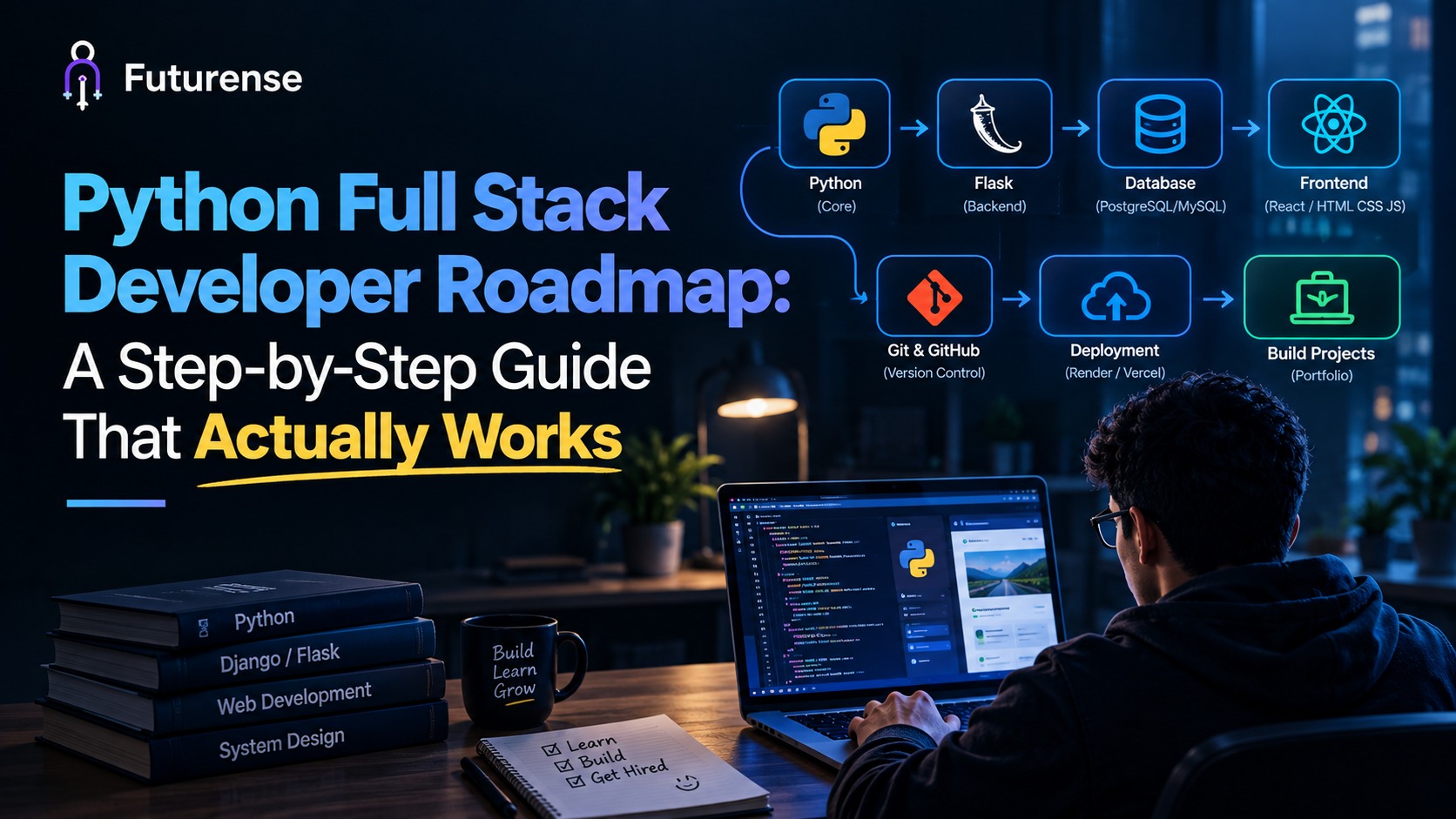


I spent about four months bouncing between YouTube tutorials before I figured out the actual problem with most advice on becoming a full stack developer: nobody tells you the order things need to happen in. You'll find a hundred lists of "skills you need," and maybe three of them actually explain why you'd learn HTML before React, or why touching a database before understanding APIs is a waste of your time. A real python full stack developer roadmap isn't a list. It's a sequence, and the sequence matters more than most people admit.
So here's the version I wish someone had handed me. Not a Pinterest-style infographic with forty logos crammed into it, but an actual month-by-month plan, with the reasoning behind each stage, so you know why you're doing something before you spend three weeks on it.
Why Python Specifically, and Why "Full Stack" Matters Here
Quick honesty check before the roadmap itself. Python isn't the only language you could build a full stack career on, JavaScript with Node.js is arguably more common for this exact purpose. But Python earns its place for a few concrete reasons: the syntax is genuinely gentler for beginners, the backend frameworks (Django, Flask, FastAPI) are mature and well-documented, and Python's dominance in data science and AI means your backend skills transfer sideways if you ever pivot, which is a real advantage JavaScript doesn't offer in quite the same way.
"Full stack" just means you can work across the entire application, the part users see (frontend), the part that handles logic and data (backend), and the database tying it together. Nobody expects you to be equally brilliant at all three. The goal is competent enough everywhere that you're not blocked waiting on someone else for basic things.
Stage 1: Frontend Fundamentals (Weeks 1-6)
This is where people either build a real foundation or skip ahead and pay for it later. Don't skip ahead.
HTML and CSS, properly, not skimmed: You need to actually understand the box model, flexbox, and basic responsive design before touching a framework. I know this feels slow when React tutorials are sitting right there looking exciting. Do it anyway.
JavaScript fundamentals: Yes, even on a "Python" roadmap. Every full stack developer needs working JavaScript, since the browser only speaks JavaScript natively. Variables, functions, DOM manipulation, fetch requests, get comfortable with these before moving to a framework.
A frontend framework, once fundamentals are solid: React is the most common pairing with a Python backend right now, though Vue is a genuinely gentler learning curve if React feels overwhelming at first. Pick one and go deep rather than dabbling in both.
Stage 2: Python Backend Fundamentals (Weeks 7-12)
Now the "Python" part of this roadmap actually kicks in.
Core Python, beyond "hello world": Data structures, functions, object-oriented basics, working with files. If you've already got this from earlier general Python learning, this stage moves fast. If not, don't rush it, weak Python fundamentals show up painfully later when you're debugging a backend issue at 11pm.
Pick a backend framework: Flask: Flask is lighter and better for understanding what's actually happening under the hood, genuinely useful pedagogically. Django gives you more built-in structure (admin panel, ORM, authentication) and gets you to a working app faster. Neither choice is wrong. If you're not sure, start with Flask specifically because it forces you to understand things Django would otherwise hide from you.
Build your first REST API: This is the moment the frontend and backend stop being two separate worlds in your head. Build something simple, a to-do list API is a cliché for a reason, it's genuinely the right size to learn CRUD operations without drowning in complexity.
Stage 3: Databases and Data Handling (Weeks 13-16)
SQL: Even if you plan to work mostly with NoSQL databases later, learn relational database concepts and basic SQL queries first. It's the foundation everything else builds on, and skipping it tends to create gaps that resurface later in ways that are annoying to fix retroactively.
PostgreSQL: It pairs naturally with Python's ecosystem and is what a lot of production Python backends actually run on.
Connect your database to your Flask or Django app: This is where things start feeling like a real application instead of a tutorial exercise, data that actually persists, instead of vanishing every time you restart your server.
Stage 4: Tying It All Together (Weeks 17-22)
Authentication and authorization: Login systems, password hashing, session or token-based auth (JWT is the common modern choice). Every real application needs this, and it's genuinely one of the trickier things to get right securely, worth the extra time here.
Deployment: An application sitting on your laptop doesn't count for much on a resume. Learn to deploy on a platform like Render, Railway, or a basic AWS/DigitalOcean setup. This step alone weeds out a lot of "portfolio" projects that were never actually shipped anywhere real.
Version control, properly: Not just git add . && git commit -m "stuff", actual branching, meaningful commit messages, a GitHub profile that shows a genuine work history rather than three commits from the night before you needed a portfolio link.
Stage 5: Build Real Projects (Ongoing, Weeks 20+)
Tutorials teach you syntax. Projects teach you everything tutorials can't, how to get unstuck, how to make architectural decisions, how to read documentation instead of watching someone else read it for you.
If you want a solid set of beginner-to-advanced Python projects with real source code to study or extend rather than starting from a completely blank page, that's a reasonable place to build momentum before attempting something fully original. The goal isn't copying, it's understanding a working codebase deeply enough that you could rebuild it yourself, then genuinely making it your own.
Aim for two or three finished, deployed, full stack projects by the end of this roadmap. Not five half-built ones. A recruiter looking at your GitHub cares far more about one thing that actually works end to end than five abandoned repos with a README and nothing else.
A Realistic Timeline, Laid Out
Five to six months total if you're consistent, longer if you're juggling college or a job alongside it, and that's completely fine. The sequence matters more than the speed.
Python Full Stack vs. Other Stacks: A Quick Reality Check
If you're still deciding whether Python is the right backend choice at all, it's worth reading what the MERN stack actually looks like if you're weighing JavaScript instead, since a JavaScript-only stack (React plus Node) has real advantages too, mainly that you're writing one language across the entire application instead of switching mental models between Python and JavaScript constantly. Neither choice is objectively better.
Python edges ahead if you might want data science or AI adjacency later. A JS-only stack edges ahead if you want fewer context switches while you're still learning.
What to Do Once the Roadmap Is Done
Finishing the technical roadmap is genuinely the easier half. The harder part is interview prep, since a working project and a confident interview performance are two different skills entirely.
It's worth looking at what recruiters actually ask in a full stack developer interview well before you start applying, not the week before your first interview, so you're not learning interview patterns and technical concepts simultaneously under pressure.
Mistakes That Slow People Down on This Roadmap
Framework-hopping before finishing fundamentals: Jumping from React to Vue to Django to Flask because a new tutorial looks shinier and resets your progress every time. Pick one path from this roadmap and finish it before you get curious about alternatives.
Skipping deployment: A project that only runs on localhost doesn't prove you can ship software. This step gets skipped constantly because it's genuinely annoying the first time, do it anyway.
Tutorial hell: Watching someone build something is not the same as building it yourself with the tutorial closed. If you can't rebuild what you just watched without pausing every thirty seconds, you haven't actually learned it yet.
Ignoring the "boring" backend concepts: Authentication, error handling, and database design aren't exciting, but they're what separate a toy project from something that resembles real software.
Should You Follow This Roadmap Full-Time or Part-Time?
Most people reading a python full stack developer roadmap are doing this alongside something else, college, a job, family responsibilities, and the honest answer is that the roadmap adapts fine either way, it's the consistency that matters more than the intensity.
Someone dedicating four focused hours a day can realistically move through this in three to four months. Someone squeezing in an hour a night after work is looking at closer to eight or nine months, and that's a completely legitimate pace, not a failure to keep up.
What actually derails people isn't a slow pace, it's an inconsistent one. Three intense weeks followed by a month of nothing resets momentum in a way that steady, smaller sessions never do. If you can only manage thirty minutes some days, thirty minutes of real, focused work beats a planned two-hour session that never actually happens because it felt too big to start.
How to Know You're Actually Ready to Apply
There's no perfect, universally agreed moment where a checklist lights up green and says "ready." But a few honest signals are worth trusting more than a countdown of weeks. You can explain, out loud, to someone non-technical, what each of your projects does and why you built it the way you did.
You've deployed something that a stranger could actually visit and use, not just something running on your own machine. And you can look at a piece of your own code from two months ago and immediately spot what you'd do differently now, that specific kind of hindsight is a genuine sign of real growth, not just time passed.
If none of that feels true yet, that's fine, it just means there's more of this python full stack developer roadmap left to work through, not that something's gone wrong.
TL;DR
A successful Python full stack developer roadmap is about learning skills in the right order rather than trying to master everything at once. Start with HTML, CSS, JavaScript, and a frontend framework like React, then move to Python, Flask or Django, REST APIs, SQL, and PostgreSQL. After that, learn authentication, deployment, Git, and build 2 to 3 complete, deployed projects.
A realistic timeline is around 5 to 6 months with consistent learning, though part-time learners may take longer. Focus on strong fundamentals, hands-on projects, and real-world development instead of collecting certificates or jumping between frameworks.
How long does it take to become a python full stack developer?
A realistic python full stack developer roadmap takes five to six months of consistent, focused learning to reach a job-ready level with real projects, longer if you're balancing college or a job alongside it. Speed matters less than following the sequence properly.
Do I need to learn JavaScript for a Python full stack developer roadmap?
Yes. Even on a Python-focused path, JavaScript is unavoidable for frontend work, since browsers only execute JavaScript natively. Most Python full stack developers pair Python on the backend with React or Vue on the frontend.
Should I learn Django or Flask first?
Flask is generally better for beginners specifically because it exposes more of what's happening under the hood, which builds deeper understanding. Django gets you to a working application faster with more built-in structure, useful once you already understand the fundamentals Flask would have taught you.
What projects should be in a python full stack developer portfolio?
Two or three fully finished, deployed applications with authentication and a real database beat five incomplete projects. A to-do app, a small e-commerce clone, or a content management tool are all reasonable, well-scoped choices to demonstrate the full stack, not just the frontend.
Is Python full stack development a good career choice in 2026?
Yes, particularly because Python's overlap with data science and AI gives full stack developers a genuine pivot option later that a purely JavaScript-based stack doesn't offer as naturally. Demand for developers comfortable across the full stack remains consistently strong.


PG Diploma and M.Tech. in Data Engineering
IIT Jodhpur
Become the Data Engineer every modern team needs with IIT Jodhpur Faculty & Industry Experts.