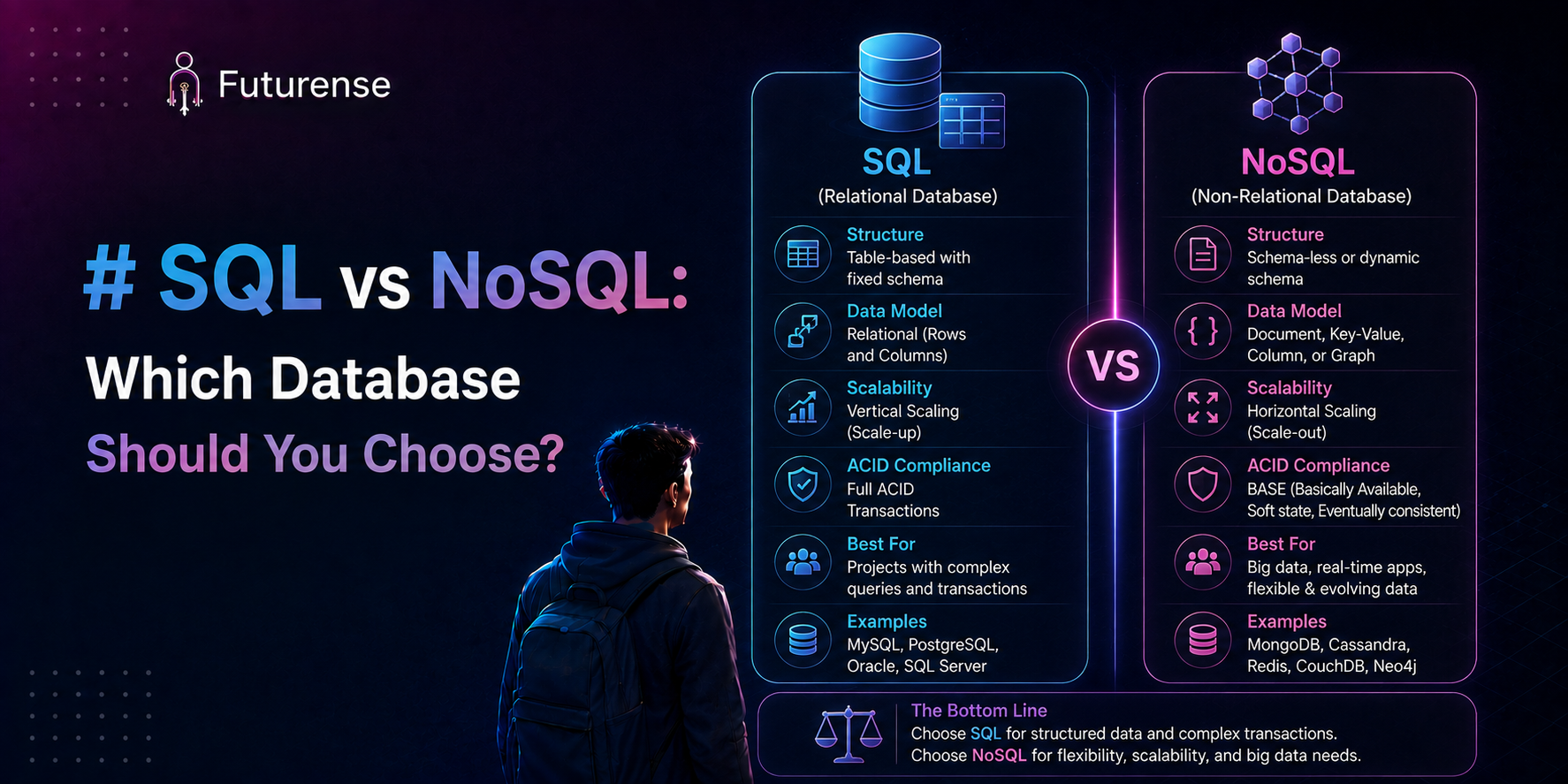


SQL databases store data in structured tables with a fixed schema and are built for complex, reliable transactions. NoSQL databases store data in flexible formats, documents, key-value pairs, graphs, or wide columns, and are built to scale easily across large, changing datasets. Neither is universally "better." The right choice depends entirely on the shape of your data and what your application actually needs to do with it.
SQL or NoSQL? It Depends on Your Data
If your data is highly structured, relationships between different pieces of data matter (customers to orders to products), and you need strong guarantees that a transaction either fully completes or doesn't happen at all, SQL is the right starting point. If your data doesn't fit neatly into rows and columns, changes shape often, or needs to scale across many servers to handle huge volume, NoSQL is usually the better fit.
Most modern engineers don't pick one exclusively and use it for everything. The realistic answer for anyone building a serious system in 2026 is understanding both well enough to choose deliberately, case by case, rather than defaulting to whichever one you learned first.
SQL Databases, Explained
SQL (Structured Query Language) databases organize data into tables with predefined columns and rows, similar to a well-organized spreadsheet, and use keys to define relationships between different tables. This structure is what makes SQL databases relational: a customer table connects to an orders table, which connects to a products table, all through defined relationships that the database enforces.
SQL databases are built around ACID compliance (Atomicity, Consistency, Isolation, Durability), a set of guarantees ensuring that transactions complete reliably and data stays consistent even when things go wrong mid-operation. This makes SQL the standard choice for systems where getting a transaction wrong has real consequences, financial systems, inventory management, anything involving money or precise counts. Common SQL databases include MySQL, PostgreSQL, Oracle Database, and Microsoft SQL Server.
The fixed schema is worth understanding as both a strength and a constraint. Once a table's structure is defined, every row has to follow it, which is exactly what makes SQL databases so reliable for structured reporting and complex queries. But it also means changing that structure later, adding a new column to a table with millions of existing rows, for instance, is a genuine operation that has to be planned and executed carefully, not something you casually adjust on the fly the way you might with a more flexible NoSQL structure.
NoSQL Databases, Explained
NoSQL ("Not Only SQL") databases store data without requiring a fixed, predefined schema, which makes them naturally suited to data that doesn't fit neatly into rows and columns, or that needs to change shape over time without a disruptive schema migration. Instead of relational tables, NoSQL databases use a single flexible structure, documents, key-value pairs, wide columns, or graphs, depending on the specific type.
This flexibility is what allows NoSQL databases to scale horizontally, adding more servers to handle growing load, rather than scaling vertically by making a single server more powerful, which has real limits. That horizontal scaling model is a big part of why NoSQL databases became popular alongside the growth of large-scale web and social platforms, where data volume and variety grew faster than a traditional relational schema could comfortably accommodate.
The tradeoff for this flexibility is usually in the consistency guarantees. Many NoSQL systems favor what's called eventual consistency over the strict, immediate consistency SQL databases guarantee by default, meaning a write to one part of a distributed system might take a brief moment to propagate everywhere before every read reflects it. For many applications, a social media like-count that's a second or two behind reality, or a product view count that isn't instantaneously exact, this tradeoff is completely acceptable in exchange for the scale and speed it enables. For a bank balance, it generally isn't, which is exactly the kind of distinction that should drive the choice between the two.
The Four Types of NoSQL Databases
NoSQL isn't one thing, it's an umbrella term covering four genuinely different database structures, each suited to different problems.
Document databases (MongoDB is the best-known example) store data as flexible, JSON-like documents, ideal for content management systems, product catalogs, and any data where different records might have different fields.
Key-value stores (Redis is a common example) function like a dictionary, a unique key maps to a specific value. They're extremely fast for simple lookups and are commonly used for caching and session management where speed matters more than complex querying.
Wide-column databases (Cassandra is a common example) organize data into flexible column families rather than fixed rows, built for extremely high write throughput and scale, common in large-scale logging and time-series data.
Graph databases (Neo4j is a common example) store data as nodes and relationships explicitly, purpose-built for data where the connections between things matter as much as the things themselves, social networks, recommendation engines, fraud detection.
When to Actually Choose Each
Choose SQL when your data has clear, stable relationships you need to query reliably, when transactional accuracy genuinely matters (financial transactions, inventory counts), and when your team already has strong SQL skills and the query patterns you need are well-served by structured queries and joins.
Choose NoSQL when your data doesn't fit a fixed schema well, when you're building for scale that a single server genuinely can't handle, when your application needs to evolve its data model frequently without disruptive migrations, or when your access pattern is dominated by simple, high-volume reads and writes rather than complex relational queries.
A concrete way to think through this: imagine building an e-commerce platform. Customer accounts, orders, and payments genuinely benefit from SQL's relational structure and transactional guarantees, you need to know with certainty that a payment was recorded and an order was placed together, or neither happened. But the product catalog itself, where a clothing item has size and color attributes, an electronics item has different specs entirely, and a book has yet another set of fields, fits far more naturally into a document database's flexible structure than into a rigid SQL table that would need dozens of mostly-empty columns to accommodate every possible product type.
The mistake worth avoiding: choosing NoSQL purely because it sounds more modern or scalable, without actually needing the specific tradeoffs it makes. A well-indexed SQL database handles far more scale than most applications will ever need, and the relational guarantees SQL provides are genuinely valuable when you give them up without a real reason to. Plenty of applications that could run comfortably on a single well-tuned PostgreSQL instance for years end up over-engineered with a distributed NoSQL setup that adds real operational complexity without a corresponding benefit.
Can You Use Both? (Polyglot Persistence)
Yes, and at real scale, most serious systems do. This pattern, using different database types for different parts of the same system based on what each part actually needs, is called polyglot persistence. An e-commerce platform might use a SQL database for orders and payments (where transactional accuracy is non-negotiable), a document database for product catalogs (where attributes vary widely by product type), and a key-value store for session data and caching (where raw speed matters most).
This is worth understanding early rather than treating SQL and NoSQL as a permanent, exclusive choice. Our What Is Data Engineering guide covers both relational and NoSQL databases as core skills any working data engineer needs, precisely because real systems rarely rely on just one.
TL;DR
- SQL = structured, table-based, fixed schema, strong transactional guarantees (ACID compliance). Best for complex queries, relationships, and data integrity
- NoSQL = flexible schema, scales horizontally, comes in four main types: document, key-value, wide-column, and graph. Best for large-scale, fast-changing, or unstructured data
- Choose SQL when data relationships and consistency matter most (banking, e-commerce orders, inventory)
- Choose NoSQL when scale and flexibility matter most (content management, real-time analytics, catalogs with varying attributes)
- Most real-world systems at scale use both, a pattern called polyglot persistence
- See our What Is Data Engineering guide for how both database types fit into a broader data engineering skill set
What is the main difference between SQL and NoSQL?
SQL databases store data in structured tables with a fixed schema and strong transactional guarantees. NoSQL databases store data in flexible formats (documents, key-value pairs, wide columns, or graphs) without a fixed schema, built for scale and flexibility.
Is NoSQL always better for scalability than SQL?
Not always. NoSQL is generally easier to scale horizontally across many servers, but modern SQL databases have significantly improved their own scaling capabilities. The right choice depends on your specific data shape and access patterns, not scalability alone.
When should I use SQL instead of NoSQL?
When your data has clear, stable relationships, when transactional accuracy is critical (financial data, inventory), and when your queries rely heavily on joining related data together reliably.
When should I use NoSQL instead of SQL?
When your data doesn't fit a fixed schema well, when you need to scale across many servers to handle large volume, or when your application's data model needs to evolve frequently without disruptive migrations.
What are the four main types of NoSQL databases?
Document databases (MongoDB), key-value stores (Redis), wide-column databases (Cassandra), and graph databases (Neo4j), each suited to different data shapes and access patterns.
Can a single application use both SQL and NoSQL databases?
Yes, this is common and is called polyglot persistence, using different database types for different parts of the same system based on what each specific part actually needs.


PG Diploma and M.Tech. in Data Engineering
IIT Jodhpur
Become the Data Engineer every modern team needs with IIT Jodhpur Faculty & Industry Experts.