

Are you curious to know which is the toughest exam in India? Well, the UPSC Civil Services Examination (CSE) is widely recognized for its high level of difficulty, but there are many more in this category. In this article, we’ll explore the top toughest exams in India and what makes them so challenging.
India is home to some of the toughest exams in the world, where lakhs of students compete for limited seats. Some of them have a selection rate of even less than 1%. In 2025, around 10 lakh students applied for the UPSC CSE exam for just 979 vacancies. This shows how tough the competition is!
Similarly, there are exams like IIT JEE and UGC NET that also come under the category of the toughest exams in India. In this article, we will list the top 10 toughest exams in India and will also tell you what makes them fall under this category!
Which Is the Toughest Exam in India?
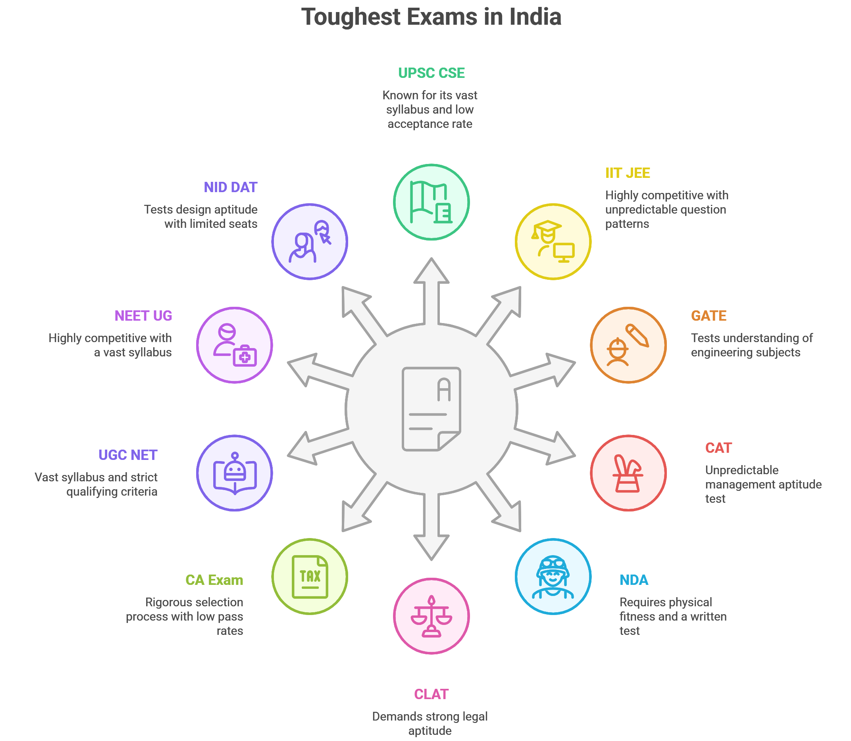
The UPSC Civil Services Examination (CSE) is widely regarded as the toughest exams in India due to its vast syllabus, three-stage selection process, extremely low success rate (less than 1%), and intense competition. Other highly challenging exams include IIT JEE Advanced, NEET UG, CA, GATE, CAT, NDA, CLAT, UGC NET, and NID DAT.
What are the Top 10 Toughest Exams in India?
If you compare on the basis of competitiveness, popularity, and difficulty level, you can find the following 10 exams in the top 10 list:
What Makes These Exams So Tough?
The above-listed competitive exams are very popular and attract millions of students every year. These are the toughest for the following reasons:
- Pass Rate Puzzle: The pass rates for top exams like UPSC CSE and JEE Advanced are extremely low, often below 1–2%.
- Assessment Overload: These exams include multi-stage and diverse assessments, including subjective and personality tests.
- Syllabus Overwhelm: Vast syllabi that cover multiple disciplines and analytical reasoning add to the difficulty of these exams. Some exams include general awareness and current affairs sections too.
- Cutthroat Competition: Students face a very intense national competition with millions of competitors during these exams.
- High-Stakes Rewards: Success in these exams opens pathways to the best institutions and most prestigious careers in India.
Most Toughest Exams in India: A Detailed Overview
Let’s now have a closer look at each exam mentioned on the above list, one by one, for a detailed overview.
- UPSC Civil Services Examination ( UPSC CSE)
Conducted By: Union Public Service Commission (UPSC)
The UPSC Civil Services Examination (CSE) is widely regarded as the toughest exam in India due to its extensive syllabus, multi-stage selection process, and extremely low success rate. Every year, nearly 10 lakh candidates apply for the exam, but only around 1,000 candidates are finally selected for prestigious services like IAS, IPS, IFS, and IRS, making the success rate less than 1%.
The examination is conducted in three stages: Preliminary Examination, Main Examination, and Personality Test (Interview).
Eligibility: Bachelor's degree from a recognized university
Selection Process: Prelims → Mains → Interview
Average Preparation Time: 1–2 years
Career Opportunities: IAS, IPS, IFS, IRS, and other Group A Civil Services
- IIT Joint Entrance Examination (IIT JEE)
Conducted By: Joint Admission Board (IITs)
Those who want to enter the prestigious IITs need to go through the Joint Entrance Exam. Over 1.5 lakh students appear in this exam every year, while the number of seats is just 18,000. The exam has a very great difficulty level and an unpredictable question pattern.
Didn't crack JEE? You can still get an IIT degree. The B.Sc/B.S in Applied AI and Data Science at IIT Jodhpur through Futurense does not require JEE.
Eligibility: Qualified JEE Main candidates
Exam Subjects: Physics, Chemistry, Mathematics
Average Preparation Time: 2 years
Career Opportunities: Engineering, Artificial Intelligence, Data Science, Research, Software Development
- GATE
Conducted By: IITs/IISc
Various engineering graduates who want to pursue a master's in their field appear for this exam. The exam tests the students’ understanding of various subjects with difficult questions. Due to a very limited number of seats, the competition level remains high.
Eligibility: Engineering or Science graduates
Exam Pattern: General Aptitude + Core Subject
Average Preparation Time: 8-12 months
Career Opportunities: M.Tech, PSU Jobs, Research, Higher Education
- CAT
Conducted By: IIMs (rotational)
The Common Admission Test (CAT) is the entrance exam for admission to the Indian Institutes of Management (IIMs) and several other top B-schools across India. Every year, more than 3 lakh students appear for the exam, making it one of the country's most competitive MBA entrance tests.
CAT assesses candidates in Quantitative Ability (QA), Data Interpretation & Logical Reasoning (DILR), and Verbal Ability & Reading Comprehension (VARC). Since the question pattern can change from year to year and each section has a fixed time limit, strong preparation and effective time management are essential.
Eligibility: Graduation in any discipline
Exam Sections: VARC, DILR, QA
Average Preparation Time: 6-12 months
Career Opportunities: MBA, Consulting, Finance, Marketing, Product Management
- NDA
Conducted By: UPSC
The National Defence Academy (NDA) examination is conducted twice every year for admission into the Army, Navy, and Air Force wings of the Indian Armed Forces. Candidates must clear both a written examination and the rigorous Services Selection Board (SSB) Interview, which assesses leadership, communication, intelligence, and personality.
Eligibility: 10+2 pass
Selection Process: Written Exam → SSB Interview → Medical Test
Average Preparation Time: 8–12 months
Career Opportunities: Officer in the Indian Armed Forces
- CLAT
Conducted By: Consortium of NLUs
This national-level law entrance exam requires candidates to have strong legal aptitude and reasoning skills. It becomes highly competitive due to the limited availability of seats.
Eligibility: 10+2
Average Preparation Time: 6–12 months
Career Opportunities: Lawyer, Legal Advisor, Corporate Counsel, Judiciary
- CA Exam
Conducted By: ICAI
CA exam is one of the toughest professional exams in India. Its selection process is very rigorous, and its low pass percentage makes it a challenging test.
Average Preparation Time: 3–5 years
Career Opportunities: Chartered Accountant, Auditor, Tax Consultant, CFO
- UGC Net
Conducted By: NTA
This national-level exam is conducted to determine eligibility for college and university lectureships. It again has a very vast syllabus and strict qualifying criteria.
Eligibility: Master's degree
Average Preparation Time: 6–12 months
Career Opportunities: Assistant Professor, Research Fellow
- NEET UG
Conducted By: NTA
NEET-UG is a highly competitive exam where over 20 lakh medical aspirants compete for limited seats. Its vast syllabus and high stakes make it a challenging test for candidates.
Eligibility: 10+2 with PCB
Average Preparation Time: 2 years
Career Opportunities: Doctor, Dentist, Medical Researcher
- NID DAT
Conducted By: National Institute of Design
This exam tests the design aptitude and skills of candidates. With limited seats available, the NID entrance exam is a highly competitive test.
Eligibility: 10+2
Selection Process: DAT Prelims → DAT Mains
Average Preparation Time: 6–12 months
Career Opportunities: UI/UX Designer, Product Designer, Graphic Designer, Industrial Designer
Comparison of the Toughest Exams in India
The difficulty of the hardest exams in India can vary based on the syllabus, competition, exam pattern, selection rate, and career opportunities. The table below provides a quick comparison of the exams covered in this guide.
What is the Best Strategy for Passing the Top Exams?
Everything in life requires some kind of sacrifice, as success never comes easy. If you are fully dedicated and have set clear targets, then you can definitely make a way to your dream career. We have provided a brief strategy below that can help you succeed in your exams.
- UPSC/NEET/JEE: You need consistent preparation spanning 1–2 years with a daily study of at least 6 to 8 hours. Mock tests and in-depth revision are also important for passing these exams.
- CA: You require a very strong foundation in accountancy for this exam. Proper time management across multiple levels can help you win.
- CAT/CLAT/GATE: For these exams, you should strengthen your problem-solving skills. Taking regular mock exams and focusing on time accuracy will give you the best results.
Alternative Pathways with Futurense: Study at IIT Without JEE
If you are unable to crack these exams on the first attempt, it does not mean your journey ends here. Many students today explore alternative academic pathways that still lead them to top institutions. Through industry-aligned programs offered by Futurense UNI, learners can get a second chance at pursuing an IIT-level education even without clearing JEE. These programs follow a modern, application-focused learning model and come with features such as campus immersion, flexible learning, and placement support.
Along with IIT pathways, learners can also explore the IIM Sirmaur MBA for Working Professionals program offered through Futurense UNI, which helps students build strong management and leadership skills without appearing for exams like CAT.
So, even if the toughest exams feel overwhelming, you still have valuable opportunities to build a high-growth career through structured and guided learning.
Final Words
Choosing to prepare for one of India's toughest exams is a significant commitment. While the UPSC Civil Services Examination is widely regarded as the most challenging, every exam on this list demands dedication, consistent practice, and a well-planned preparation strategy.
Instead of worrying about how difficult an exam is, focus on understanding its pattern, strengthening your fundamentals, and practicing regularly. Solving previous years' question papers, taking mock tests, and following a structured study plan can make a noticeable difference in your performance.
FAQs on the Toughest Exams in India
Which is the toughest exam in India?
The UPSC Civil Services Examination (CSE) is considered the toughest exam in India due to its vast syllabus, multi-stage selection process, and a success rate of less than 1%.
Which exam is the toughest in India after UPSC?
After UPSC, IIT JEE Advanced is seen as the next toughest exam because of its highly complex questions, unpredictable patterns, and extremely low acceptance rate.
Is IIT JEE tougher than NEET?
Both are difficult, but IIT JEE is generally considered tougher for problem-solving and conceptual depth, while NEET is challenging due to its vast syllabus and extremely high competition.
Which exam has the lowest pass percentage in India?
UPSC CSE, CA exams (especially CA Final), and JEE Advanced have the lowest pass percentages, often below 1–2%.
Can I study at IIT without clearing JEE?
Yes, through alternative pathways like industry-aligned IIT certification and diploma programs offered by Futurense UNI, where students can access IIT-level learning without appearing for JEE.
Which government exam is toughest in India?
UPSC CSE is the toughest government exam, followed by the NDA exam and SSC CGL (for specific high-ranking posts).


Your Second Chance At the IIT Dream
IIT Course
Build an AI-first career with IIT-powered degrees, industry mentorship,and real-world learning.