

What Is a Digital Twin in Manufacturing?
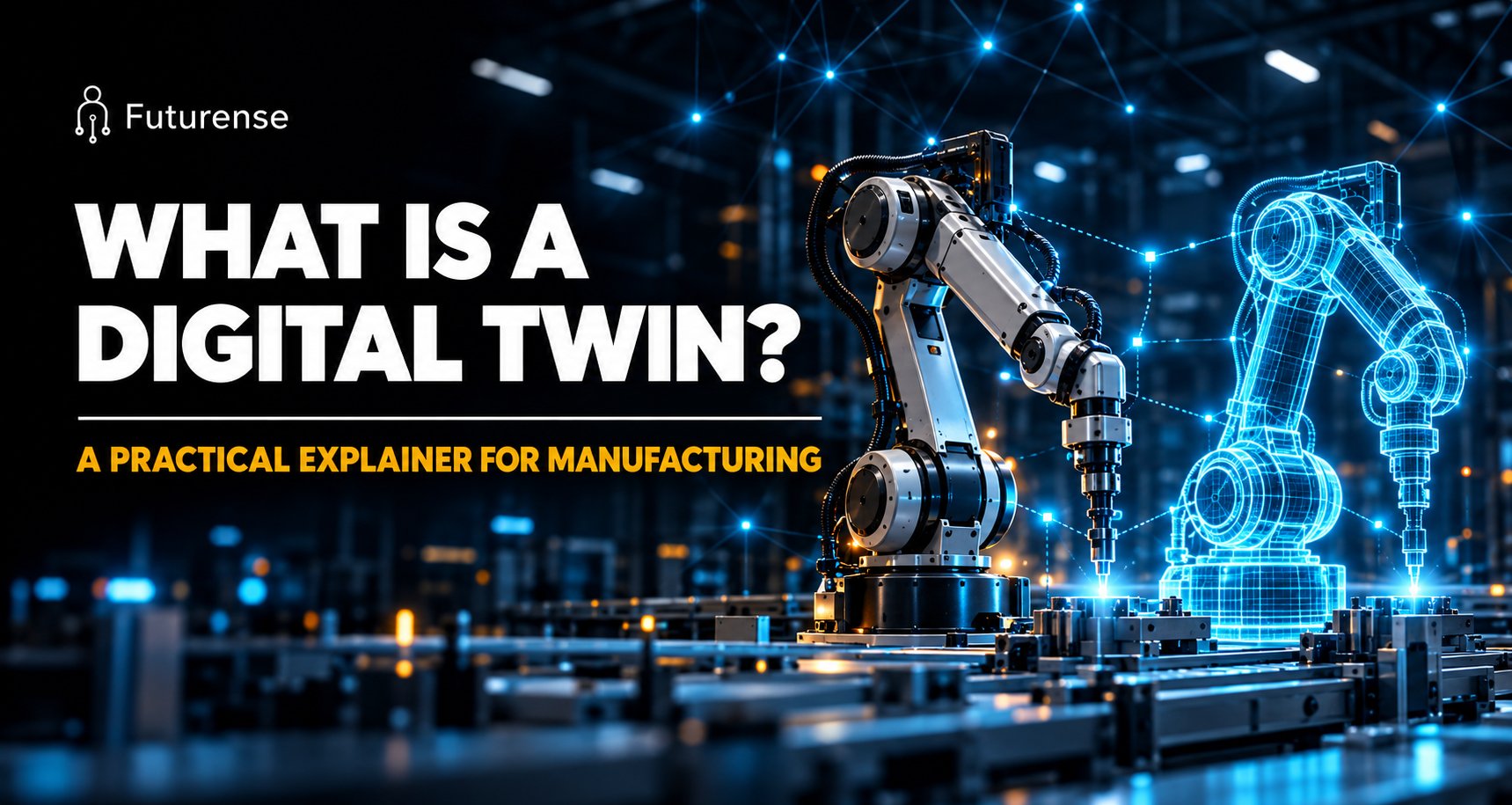
A digital twin in manufacturing is a virtual representation of a physical manufacturing asset, process or system that is connected to it through data, so the virtual copy reflects the real thing's current state and can be used to analyse, predict and test.
Two ideas sit inside that sentence. The first is the virtual replica: a model that captures the structure and behaviour of the thing, such as a CNC machine, a conveyor, a robot cell or a full production line. The second is the connection: sensors and systems feed real-time data into the model, so it changes as the physical asset changes.
Standards bodies have worked on this because the term gets used loosely. NIST has noted that "there remains a lot of confusion about the digital twin concept" and that standards can supply common terminology and implementation guidelines, particularly for small and mid-sized manufacturers. The relevant standard is ISO 23247, titled Digital Twin Framework for Manufacturing; Part 1, published in 2021, covers terms and definitions and the requirements for such a framework.
If you remember one line: a digital twin is a model that stays in sync with the real asset. A model that is not connected is just a model.
Digital Twin vs Simulation vs Digital Model
These terms are often mixed up. A practical way to separate them is by how data flows.
Different vendors and researchers draw these lines slightly differently, so treat the table as a working guide. The key test is whether the model is continuously updated from the real asset and used to support decisions.
How a Digital Twin Works
Most manufacturing twins are built from the same layers.
- The physical asset. A machine, line, building or process with something worth measuring.
- Sensing. IoT sensors capture temperature, vibration, pressure, speed, energy use, and sometimes camera or PLC data.
- Connectivity. Industrial networks and gateways move the data, sometimes processing part of it at the edge, close to the machine, to cut delay.
- Data platform. The data is cleaned, stored and organised. This is where data engineering matters, because a twin is only as trustworthy as its inputs.
- The model. Physics-based equations, machine learning, or a mix of both represent how the asset behaves.
- Applications. Dashboards, alerts, what-if tools and sometimes control feedback into the real system.
Much of the analytics and model hosting runs in the cloud; our explainer on cloud AI covers that side. Where latency or connectivity is a problem, parts run on the factory floor instead.
A related idea is the digital thread: the connected record of a product or process across design, production and service. A twin often draws on the thread so engineers can trace a defect back to a design or supplier decision.
Types of Digital Twins
Manufacturers usually talk about twins at three levels:
- Asset or component twin. One machine or part, such as a motor, pump or robot arm. Most predictive maintenance work starts here.
- Process twin. A sequence of steps, such as a machining, assembly or packaging line, used to find bottlenecks and tune settings.
- System or factory twin. The plant as a whole: material flow, energy, workforce and logistics.
A separate cut, noted by RTInsights, is by purpose: operational twins that show what is happening now and flag problems, and higher-level simulation twins that support what-if analysis, such as whether speeding up a line would cause assets to fail earlier. Many projects combine both.
Beginners should start at the asset level, which has the clearest data and the shortest route to a result.
Digital Twin Use Cases in Manufacturing
Predictive Maintenance
Sensors on a motor or pump feed a model that learns what normal looks like. When vibration or temperature drifts, the twin flags a likely fault so maintenance happens in a planned window rather than after a breakdown. This is the most common first project.
Production Line Optimisation
A process twin lets engineers test changes, such as a faster conveyor, a different batch order or a new shift pattern, without disrupting output. Bottlenecks that are invisible on the floor show up in the model.
Quality Control
Combining process data with inspection results helps teams find which settings produce defects. Camera-based inspection is a common input; see our guide to computer vision for how that works.
Product Design and Testing
Engineers test how a product behaves under stress, heat or wear in the virtual copy, which can cut the number of physical prototypes. RTInsights also describes a virtual development environment that keeps product information in one place and reduces data silos.
Robot Cell Planning
Before installing a robot, teams can model reach, cycle time and safety zones. For the wider picture, see AI and robotics.
Training and Safety
Operators can practise rare or risky situations in a virtual copy of the plant. The wider automation backdrop is covered in our piece on the future of AI and automation.
For a view of how deployment engineers handle these projects on site, our sister site covers AI in manufacturing and how forward deployed engineers deploy it.
Benefits of a Digital Twin
The realistic benefits, when a project is well scoped, are:
- Less unplanned downtime through earlier fault detection.
- Better visibility, including remote views of plant conditions and the inside of individual machines.
- Faster design cycles where physical prototyping can be reduced.
- A shared data picture that links design, production and maintenance teams.
We have deliberately not quoted headline percentages, because published savings figures vary widely by plant and are usually vendor-reported. Measure your own baseline instead.
Challenges and Limits
Twins are not a quick win. Common obstacles include:
- Poor or missing data. Old machines may have no sensors, and data from different systems often does not line up.
- Integration effort. Connecting machines, PLCs, MES and ERP systems takes real engineering.
- Infrastructure and security. The system needs secure, reliable and scalable infrastructure, which means upfront investment, and more connected assets means a larger attack surface.
- Unclear return on investment. Teams need to pick high-value use cases and quantify the return. RTInsights goes further and says there is no end-to-end, single ultimate solution for digital twins yet.
- Model drift. A model that was accurate last year may be wrong after a machine is repaired or a material changes.
- Confusion over scope. NIST highlights ongoing confusion about the concept, especially for smaller manufacturers.
Skills and Careers Around Digital Twins
Digital twin work sits between engineering and data. A useful skill map:
Job titles vary: industrial data engineer, IoT engineer, simulation engineer, automation engineer, ML engineer for manufacturing, and customer-facing deployment roles. Related Futurense guides cover the robotics engineer career path in India and AI skills in demand. If you are new to the field, start with how to start a career in AI and add the industrial layer later. Pay varies widely by employer and city, so check current listings rather than relying on generic figures.
How to Start a Digital Twin Project
- Pick one problem with a cost. For example, a motor that fails twice a year or a line that stalls at one station.
- Check the data you have. Which sensors exist, how often do they sample, and how clean is the history?
- Start with one asset. Build a monitoring view before attempting prediction.
- Choose the model type. Use physics where the behaviour is well understood and machine learning where there is plenty of data. Many teams combine both.
- Validate against reality. Compare the model's predictions with actual outcomes for weeks, not days.
- Integrate with action. Connect alerts to the maintenance workflow, otherwise nobody acts on them.
- Measure and expand. Record downtime, scrap and cost before and after, then extend to the next asset or line.
A Worked Scenario (Hypothetical)
A mid-sized plant makes plastic containers. One extrusion machine fails unpredictably, and each failure halts a line for hours.
The team installs vibration and temperature sensors and streams the data to a platform. For a few weeks they only watch the dashboard and log what technicians find. They then train a simple model on the history to learn normal behaviour. When the signals drift, the twin raises an alert and a technician inspects the bearing during a planned stop. Early alerts include false alarms, so the team tunes thresholds.
After a few months, the plant extends the approach to a second machine and builds a line-level model to see how one machine's slowdown affects the rest. The lesson is that the value came from a narrow problem, clean data and a maintenance process that acted on alerts, not from a flashy 3D model. This scenario is illustrative, not a real case.
Common Mistakes
- Starting with the whole factory. Begin with one asset or line.
- Building a 3D visual with no data behind it. It looks impressive but does not support decisions.
- Ignoring data quality. Bad inputs make confident but wrong outputs.
- No owner on the shop floor. If operations does not use it, it dies.
- Skipping validation. Compare predictions with real outcomes before trusting the twin.
TL;DR: A digital twin in manufacturing is a virtual model of a machine, production line or whole factory that is kept up to date with live data from the real thing. Teams use it to watch performance, predict failures, test changes safely and improve designs before touching the physical plant. It is different from a one-off simulation because it stays connected to reality. Typical uses include predictive maintenance, line optimisation, quality control and operator training. The hard parts are data quality, integration and picking a use case with measurable value. People who can combine data engineering, IoT, modelling and domain knowledge are the ones who build them.
Factories are expensive places to experiment, so a digital twin gives engineers a safe copy to learn from. This guide explains what a digital twin in manufacturing really is, how it works, the main types, where it is used, what goes wrong, and what skills the work needs.
What is a digital twin in manufacturing in simple terms?
It is a virtual copy of a machine, production line or factory that is updated with live data from the real one. Engineers use it to monitor performance, predict problems and test changes safely before applying them on the shop floor.
What is the difference between a digital twin and a simulation?
A simulation usually runs on assumed or one-off inputs to test a design or scenario. A digital twin stays connected to the real asset and updates continuously, so it reflects current conditions and can support live decisions.
What are examples of digital twins in manufacturing?
Common examples include predictive maintenance models for motors and pumps, production line models used to find bottlenecks, virtual robot cells for layout planning, and quality models that link process settings to defect rates.
What are the types of digital twins?
They are usually grouped by scale into asset or component twins, process twins and system or factory twins. They can also be grouped by purpose, as operational twins that show current conditions and simulation twins that support what-if analysis.
What skills do you need to work on digital twins?
You need domain knowledge of manufacturing plus data engineering, IoT and industrial connectivity, modelling (physics-based and machine learning), cloud and edge basics, visualisation and basic cybersecurity.
Is a digital twin worth it for a small manufacturer?
It can be, if it starts with one costly, well-defined problem such as a machine that fails often. NIST notes that implementation uncertainty is especially common among small and mid-sized manufacturers, so start small, measure results and expand only when value is clear.


PG Diploma and M.Tech. in Data Engineering
IIT Jodhpur
Become the Data Engineer every modern team needs with IIT Jodhpur Faculty & Industry Experts.