
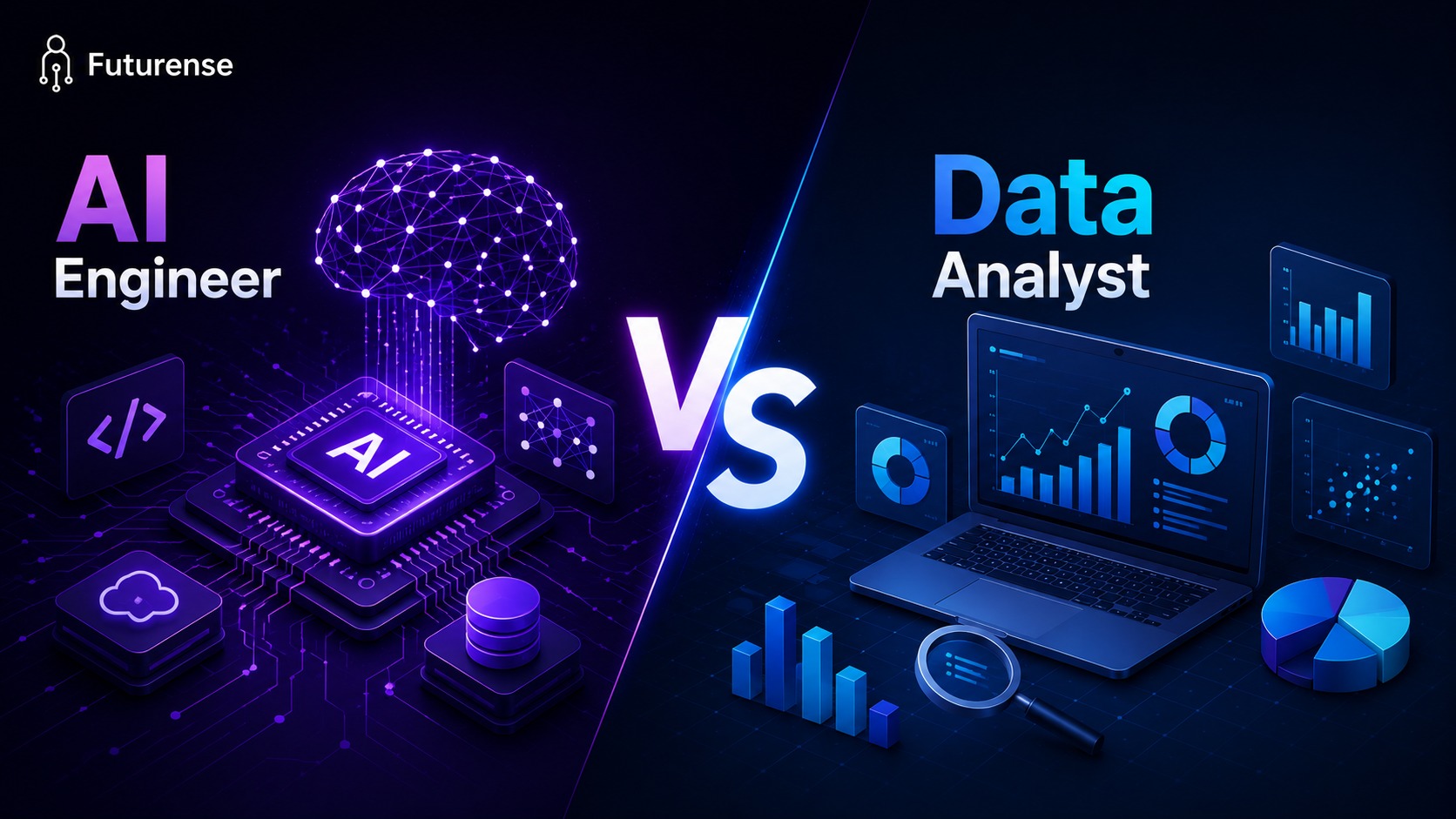


An AI engineer builds and deploys the intelligent systems that power product recommendation engines, fraud detection models, chatbots, generative AI tools. A data analyst turns existing data into insights that guide business decisions, dashboards, reports, trend analysis, the "what happened and why" behind the numbers.
Both careers sit inside the same broader data ecosystem, both are in strong demand in India right now, and both get compared constantly because the entry points can look deceptively similar. The actual day-to-day work is not similar at all.
If you're choosing between the two as a student, a career switcher, or a working data analyst wondering whether to go deeper into AI this guide breaks down what each role really involves, what it pays in India, and how to think about the decision instead of just comparing job titles.
Two Different Relationships With Data
An AI engineer designs, builds, trains, and deploys AI/ML systems in production combining software engineering with machine learning implementation so models actually work reliably inside a live product, not just in a notebook.
A data analyst collects, cleans, and analyzes existing data to answer specific business questions, then communicates those findings through reports, dashboards, and visualizations that shape decisions.
The core distinction: AI engineers build systems that generate new outputs from data (predictions, classifications, generated content). Data analysts extract meaning from data that already exists. One role is closer to software engineering with a machine learning specialization; the other is closer to applied statistics with a strong communication component.
What Does an AI Engineer Do, Day to Day?
An AI engineer's work centers on getting machine learning models from an experimental state into something running reliably in production. That typically includes:
- Building, training, and fine-tuning machine learning and deep learning models
- Writing production-grade code to integrate models into applications and APIs
- Working with frameworks like TensorFlow, PyTorch, and increasingly LLM-specific tools like LangChain
- Optimizing model performance, latency, and scalability once something moves beyond a prototype
- Monitoring deployed models for drift, failure modes, and retraining needs
- Collaborating closely with data engineers and software engineers to keep the surrounding infrastructure solid
AI engineers tend to work systems-first: the constraints of production infrastructure, inference cost, and reliability shape most of the day, more than any single analysis. It's a role that rewards people who like building things that run continuously and matter at scale.
What Does a Data Analyst Do, Day to Day?
A data analyst's work centers on a different question: what does this data actually tell us, and what should we do about it? That typically includes:
- Pulling and cleaning data using SQL, spreadsheets, and analytics platforms.
- Running statistical analysis to identify trends, patterns, and anomalies.
- Building dashboards and visualizations in tools like Power BI, Tableau, or Looker.
- Presenting findings to non-technical stakeholders in a way that actually drives decisions.
- Partnering with product, marketing, or operations teams to answer specific business questions.
Data analysts tend to work question-first: a stakeholder needs an answer, and the whole workflow is built around getting to a clear, communicable one. It's a role that rewards people who like translating numbers into a story someone can act on.
AI Engineer vs Data Analyst: Core Differences
At smaller companies, the lines blur a "data analyst" job posting sometimes expects basic ML familiarity, and some AI engineering teams still lean on analysts for the underlying data prep.
The Skills Gap: What Each Role Actually Requires
Skills That Transfer Between the Two Roles
Both roles share a real foundation: SQL, a working knowledge of Python, comfort with statistics, and the ability to reason about what data actually means rather than just running a tool on it.
This overlap is exactly why the transition between the two roles in either direction is more common than people expect, and why the two titles get compared so often in the first place.
Skills Unique to AI Engineering
AI engineers need production-grade software engineering skills: writing code that runs reliably at scale, working with ML frameworks (TensorFlow, PyTorch), understanding model deployment and MLOps practices, and increasingly, familiarity with generative AI tooling like LLM APIs and retrieval-augmented generation pipelines. Deep learning concepts neural networks, model architectures, training and fine-tuning are core, not optional.
Skills Unique to Data Analysis
Data analysts need strong data visualization skills, business communication skills sharp enough to explain a statistical finding to someone with zero statistics background, and a genuinely broad comfort with spreadsheets and reporting tools most engineers never touch.
AI Engineer vs Data Analyst Salary in India
Compensation reflects the scope and technical-depth gap AI engineering sits closer to specialized software engineering, which India's market pays a premium for.
The gap widens with seniority, not just at entry level which is the more important pattern to notice than the headline numbers. A fresher gap of roughly ₹2-3 LPA becomes a ₹15-40 LPA gap by the senior level, largely because AI engineering skills stay scarce relative to demand even as more people enter the field, while data analyst supply has grown faster than senior-level demand in many markets.
Which Career Path Grows Faster?
This is where the two paths diverge most sharply, and it's worth being honest about rather than picking a side.
AI engineers tend to hit a higher long-term salary ceiling, because the role sits closer to specialized software engineering and the skill floor keeps rising. Fewer people can credibly claim production ML experience than can claim SQL and dashboarding skills.
Data analysts, on the other hand, often have a faster path into leadership and cross-functional influence, because the role naturally puts them in front of decision-makers early, and strong analysts frequently move into analytics management, business intelligence leadership, or product roles without needing to close a large technical skills gap first.
Neither trajectory is objectively "better." One optimizes for technical ceiling; the other optimizes for breadth of influence and faster access to leadership tracks.
Can a Data Analyst Become an AI Engineer?
Yes. In fact, it's one of the most common career transitions in today's AI job market. Data analysts already have a solid foundation in SQL, Python, data handling, and business problem-solving, making it easier to build AI-specific skills.
The next step is to strengthen your Python programming, learn machine learning concepts, get comfortable with frameworks like TensorFlow or PyTorch, and build a few real-world AI projects. Hands-on experience matters far more than simply completing online courses.
If you're working full-time, this transition usually takes 12-24 months, depending on how consistently you learn and practice. Many professionals also move through roles like AI Data Analyst or Machine Learning Analyst before becoming AI Engineers, making the transition more gradual and practical.
TL;DR
An AI Engineer builds and deploys AI and machine learning systems, while a Data Analyst focuses on analyzing data to generate business insights through SQL, dashboards, and reports.
In India, AI Engineers typically earn ₹6-8 LPA as freshers and ₹30-60 LPA+ in senior roles, compared to ₹3.5-5 LPA and ₹15-20 LPA+ for Data Analysts. AI Engineering generally offers higher earning potential, while Data Analytics provides a more accessible entry point into the data industry.
The good news is that the two careers aren't mutually exclusive. Many data analysts successfully transition into AI engineering within 12-24 months by strengthening their programming skills, learning machine learning, and building real-world AI projects.
Is an AI engineer better than a data analyst?
Neither is objectively better; they're different careers with different ceilings and different entry points. AI engineering typically pays more at senior levels and involves deeper technical specialization; data analysis offers a more accessible entry point and often a faster path into cross-functional leadership roles.
What is the salary difference between an AI engineer and a data analyst in India?
Entry-level AI engineers typically earn ₹6-8 LPA versus ₹3.5-5 LPA for entry-level data analysts. The gap widens significantly with seniority. Senior AI engineers can earn ₹30-60 LPA or more, compared to ₹15-20 LPA+ for senior data analysts, mainly because AI engineering skills remain scarcer relative to demand.
Can a data analyst become an AI engineer?
Yes. The transition is common because both roles share a foundation in SQL, Python, and statistical thinking. The main gap to close is production-grade software engineering skills and machine learning frameworks, which typically takes 12-24 months of deliberate upskilling.
Do I need a coding background to become an AI engineer?
You need strong, production-level coding skills. AI engineering is closer to software engineering with an ML specialization than to pure data analysis. A data analyst background with strong Python skills is a reasonable starting point, but expect a real learning curve around production code quality and ML frameworks.
Which career has more job opportunities: AI engineer or data analyst?
Data analyst roles are currently more numerous and accessible at the entry level, since nearly every company with a data team needs analysts. AI engineering roles are growing faster in percentage terms and pay significantly more, but the entry bar is higher and the total number of open roles is still smaller than the analyst market.


B.S/B.Sc in Applied AI & Data Science
IIT Jodhpur
Be a Part of India’s First Advanced AI Regular Degree with the Best Minds at IIT


.avif)