

If you're exploring a career in data, you've probably landed on the same question thousands of students and career-switchers ask every year: Data Scientist vs Data Analyst, which is easy? Both roles work with data, both appear on every "best jobs" list, and both are often confused with each other in job postings. But the day-to-day skills, learning curve, and career path for each are genuinely different.
In this guide, we'll break down what each role actually does, compare the skills and learning curve side by side, look at the tools, math depth, salaries, and career paths involved, and help you figure out which path fits your background whether you're coming from a non-technical field, a math/stats background, or computer science.
Data Scientist vs Data Analyst: The Core Difference
Before comparing difficulty, it helps to understand what separates the two roles.
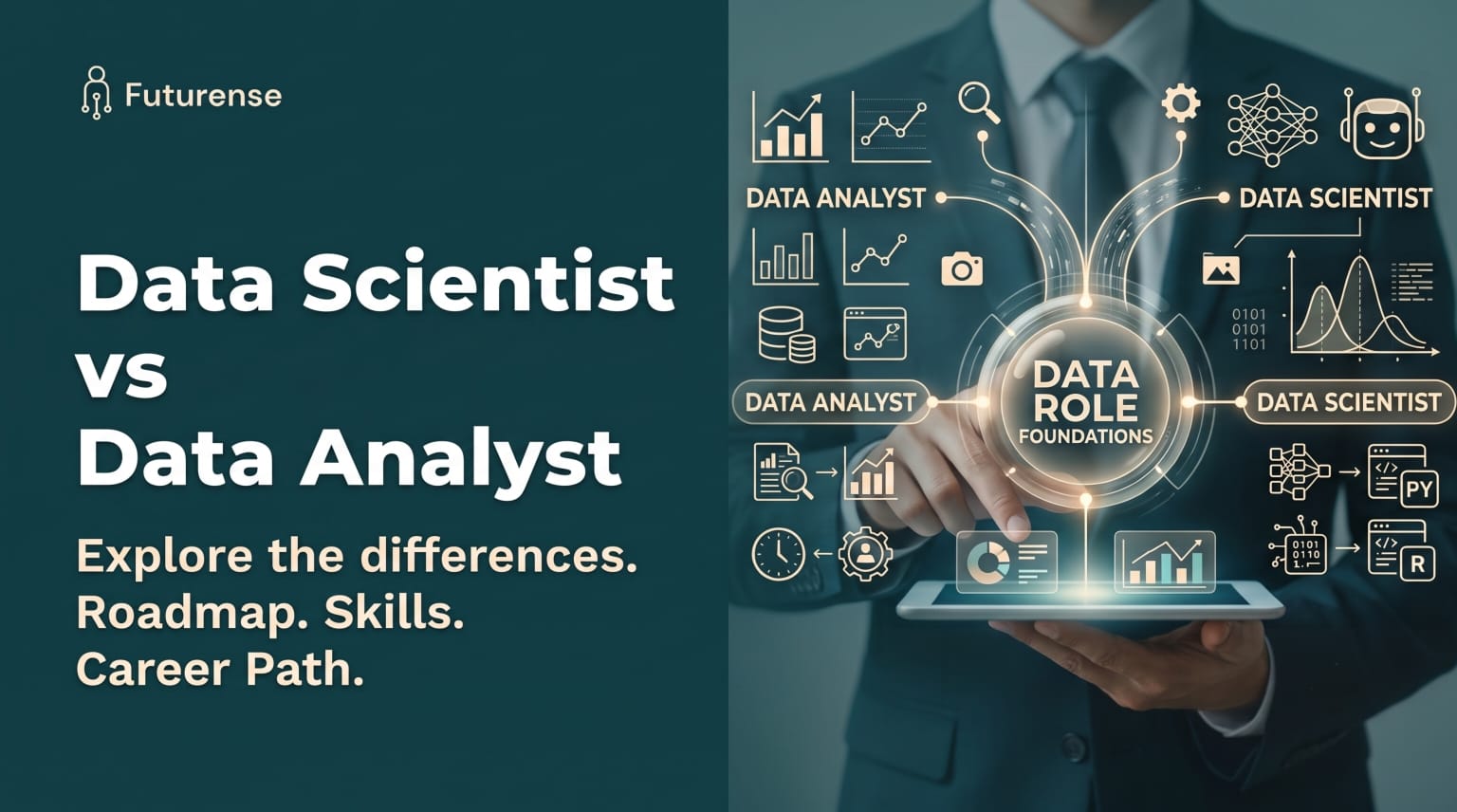
A data analyst works with existing data to answer specific business questions, sales trends, customer behavior, marketing performance mostly using SQL, Excel, and visualization tools like Power BI or Tableau. The output is usually a report, dashboard, or recommendation for a business team.
A data scientist goes further: building predictive models, running statistical experiments, and often deploying machine learning systems into production. This requires programming (usually Python or R), statistics, and increasingly, some software engineering and MLOps knowledge.
In short, analysts explain what happened and what's happening now; scientists predict what will happen next and often build systems that act on those predictions.
What Does a Data Analyst Actually Do?
A data analyst's daily work typically includes:
- Writing SQL queries to pull and clean data from databases
- Building dashboards and reports in tools like Tableau, Power BI, or Looker
- Performing exploratory data analysis to spot trends and anomalies
- Communicating findings to non-technical stakeholders
- Basic statistical analysis (averages, correlations, A/B test results)
The core toolkit is narrower and more standardized: SQL, spreadsheets, a BI tool, and enough statistics to interpret results correctly. Most of this can be learned through structured courses or bootcamps within a few months.
What Does a Data Scientist Actually Do?
A data scientist's work is broader and more technically demanding:
- Programming in Python or R for data manipulation and modeling
- Applying statistical methods and machine learning algorithms
- Feature engineering and model evaluation
- Working with big data tools (Spark, Hadoop) in larger organizations
- Collaborating with engineering teams to deploy models into production
- Designing and analyzing experiments (A/B testing, causal inference)
Because the scope includes both analysis and applied machine learning, the learning curve is steeper and the required math foundation (linear algebra, probability, statistics) is deeper.
SQL vs Python: Which Skill Set Is Easier to Master?
One of the clearest ways to gauge difficulty is by comparing the primary tools each role depends on.
SQL, the backbone of data analyst work, is a declarative query language you tell the database what you want, not how to compute it. Most learners can write functional SQL queries within a few weeks and reach a comfortable working level within one to two months.
Python, the backbone of data science work, is a full programming language. Beyond basic syntax, a data scientist needs to learn data manipulation libraries (Pandas, NumPy), visualization libraries (Matplotlib, Seaborn), and machine learning libraries (Scikit-learn, TensorFlow or PyTorch). Reaching a job-ready level typically takes several months to a year, especially for someone without prior programming exposure.
This gap alone explains much of the perceived difficulty difference between the two roles SQL has a shorter, shallower learning curve, while Python for data science has a longer, deeper one.
Business Intelligence Tools vs Machine Learning Frameworks
Another useful lens is the software ecosystem each role lives in.
Data analysts primarily work inside business intelligence (BI) tools Power BI, Tableau, Looker, or Google Data Studio. These tools are designed with visual, drag-and-drop interfaces, so the learning curve is centered on understanding data relationships and design principles for clear reporting, not writing complex code.
Data scientists work inside machine learning frameworks and cloud platforms Scikit-learn, TensorFlow, PyTorch, and cloud services like AWS SageMaker or Azure ML. These require understanding not just how to call a function, but why an algorithm behaves the way it does, how to tune hyperparameters, and how to validate model performance statistically.
BI tools are built to lower the barrier to entry; ML frameworks assume a working knowledge of statistics and programming as a prerequisite. This is a major reason data analyst roles remain more accessible to career-switchers.
Statistical Foundations: How Much Math Do You Really Need?
A common myth is that data analysts don't need math and data scientists need advanced math. The truth is more nuanced.
- Data analysts need descriptive statistics mean, median, standard deviation, correlation and enough inferential statistics to interpret A/B test results or confidence intervals correctly.
- Data scientists need descriptive and inferential statistics, plus probability theory, linear algebra (for understanding how models like linear regression or neural networks work internally), and optimization concepts used in training machine learning models.
If math was never your strong subject, this is one of the biggest factors that makes the data analyst path feel more approachable.
Data Scientist vs Data Analyst: Skills and Learning Curve Compared
Is Data Analyst Easier Than Data Scientist?
For most beginners, yes becoming a data analyst is generally easier and faster than becoming a data scientist. Here's why:
- Lower math requirement. Analysts need working statistical literacy, not deep probability theory or linear algebra.
- No mandatory programming. Many analyst roles run entirely on SQL and spreadsheet tools, without Python or R.
- Faster skill-to-job timeline. Bootcamps and self-paced courses can get someone job-ready as an analyst in a few months.
- Narrower toolkit. Analysts specialize in a smaller, more standardized set of tools compared to the broad, evolving ML/engineering stack data scientists need.
That said, "easier" doesn't mean "lesser." Data analysis still requires strong critical thinking, business context, and the ability to translate numbers into decisions skills that take real practice to master.
Why Data Science Has a Steeper Learning Curve
Data science difficulty comes from the breadth of skills required simultaneously:
- Statistical foundations - hypothesis testing, distributions, regression theory.
- Programming proficiency - writing clean, production-quality code, not just scripts.
- Machine learning theory - understanding when and why an algorithm works, not just calling.
- Domain and business context - knowing which problems are worth modeling.
- Communication - explaining model results and limitations to non-technical stakeholders.
Because these skills compound, most data scientists either come from a strong quantitative background (math, stats, CS, engineering) or spend significantly longer building foundational knowledge before landing their first role.
Predictive Analytics vs Descriptive Analytics: A Practical Way to Tell the Roles Apart
If the tool comparisons still feel abstract, think about it in terms of the type of analytics each role practices.
Descriptive analytics - the domain of data analysts answers "what happened?" and "what's happening now?" It relies on aggregating and visualizing historical data.
Predictive analytics - the domain of data scientists answers "what's likely to happen next?" using statistical models and machine learning trained on historical data to forecast future outcomes.
A simple test: if a task involves summarizing, reporting, or explaining past data, it's analyst territory. If it involves building a model to predict a future value or classify future events, it's data scientist territory. This distinction is often the clearest way recruiters and hiring managers separate the two roles in job descriptions.
Which Path Should You Choose?
Your decision should depend on your background, timeline, and interests, not just perceived difficulty.
Choose Data Analyst if you:
- Want to enter the data field quickly (within months, not years)
- Prefer working closely with business teams and stakeholders
- Are comfortable with SQL and visualization tools, but not excited about coding
- Want a lower-stress entry point into a data career
Choose Data Scientist if you:
- Enjoy math, statistics, and programming
- Want to build predictive models and machine learning systems
- Are willing to invest a year or more in deeper technical learning
- Are interested in AI/ML career growth long-term
Many professionals also treat data analytics as a stepping stone starting as an analyst, then transitioning into data science once they've built SQL, statistics, and business context, and are ready to add Python and machine learning to their toolkit.
Career Growth and Salary Comparison in Data Analytics and Data Science
Both roles offer strong long-term career growth, but the trajectories differ. Data analysts often move into senior analyst, BI manager, or analytics leadership roles, with strong demand across nearly every industry since almost all companies need data reporting. Data scientists, on the other hand, often progress toward senior data scientist, machine learning engineer, or applied AI roles positions that are seeing especially fast growth as more companies adopt AI-driven products and automation.
Salaries for data scientists tend to run higher on average due to the specialized skill set, but the gap narrows significantly at senior levels, where business impact matters more than job title. It's also worth noting that a highly experienced data analyst with strong SQL, business intelligence, and stakeholder management skills can out-earn an entry-level data scientist seniority and impact often matter more than title alone.
How Long Does It Actually Take to Become Job-Ready?
To put timelines in concrete terms:
- Data analyst: 3-6 months of focused learning (SQL, Excel, one BI tool, basic statistics) is often enough to build a portfolio and start applying for entry-level roles.
- Data scientist: 12-24 months is a more realistic range, covering Python, statistics, machine learning fundamentals, and enough project work to demonstrate applied skills though this varies widely based on prior math or programming background.
If you're switching careers and need income sooner rather than later, this timeline difference is often the deciding factor, independent of which role feels more intellectually interesting.
TL;DR
- Data Analyst vs Data Scientist comes down to depth: analysts explain data using SQL and dashboards; scientists build predictive models using statistics, Python, and machine learning.
- Data analyst roles are generally easier and faster to learn, often job-ready in a few months with SQL, Excel, and a BI tool.
- Data science has a steeper learning curve due to required math, programming, and machine learning depth, typically taking a year or more to master.
- SQL is faster to learn than Python for machine learning; BI tools are more beginner-friendly than ML frameworks.
- Many professionals start as analysts and transition into data science as they build technical skills.
- Choose based on your background and timeline, not just which title sounds more impressive both offer strong, growing career paths
1. Data Scientist vs Data Analyst, which is easy to learn for beginners?
Data analyst roles are generally easier to learn for beginners because they require less programming and math depth. Most people can become job-ready as an analyst in a few months, while data science typically takes a year or more of focused learning.
2. Can a data analyst become a data scientist later?
Yes, this is a common career path. Analysts who build strong SQL and business analysis skills can transition into data science by adding Python, statistics, and machine learning to their skill set.
3. Does a data scientist need a degree in computer science or statistics?
Not always, but a strong quantitative background helps significantly. Many data scientists come from CS, statistics, math, or engineering degrees, though self-taught and bootcamp paths are increasingly common too.
4. Which role pays more, data analyst or data scientist?
Data scientists typically earn more on average due to the specialized technical and machine learning skills required, though the salary gap narrows at senior levels where business impact and experience matter most.
5. Is coding necessary for a data analyst role?
Not always. Many data analyst roles rely primarily on SQL and visualization tools rather than full programming languages, though basic Python or R skills can be a helpful bonus for more advanced analyst positions.


B.S/B.Sc in Applied AI & Data Science
IIT Jodhpur
Be a Part of India’s First Advanced AI Regular Degree with the Best Minds at IIT