
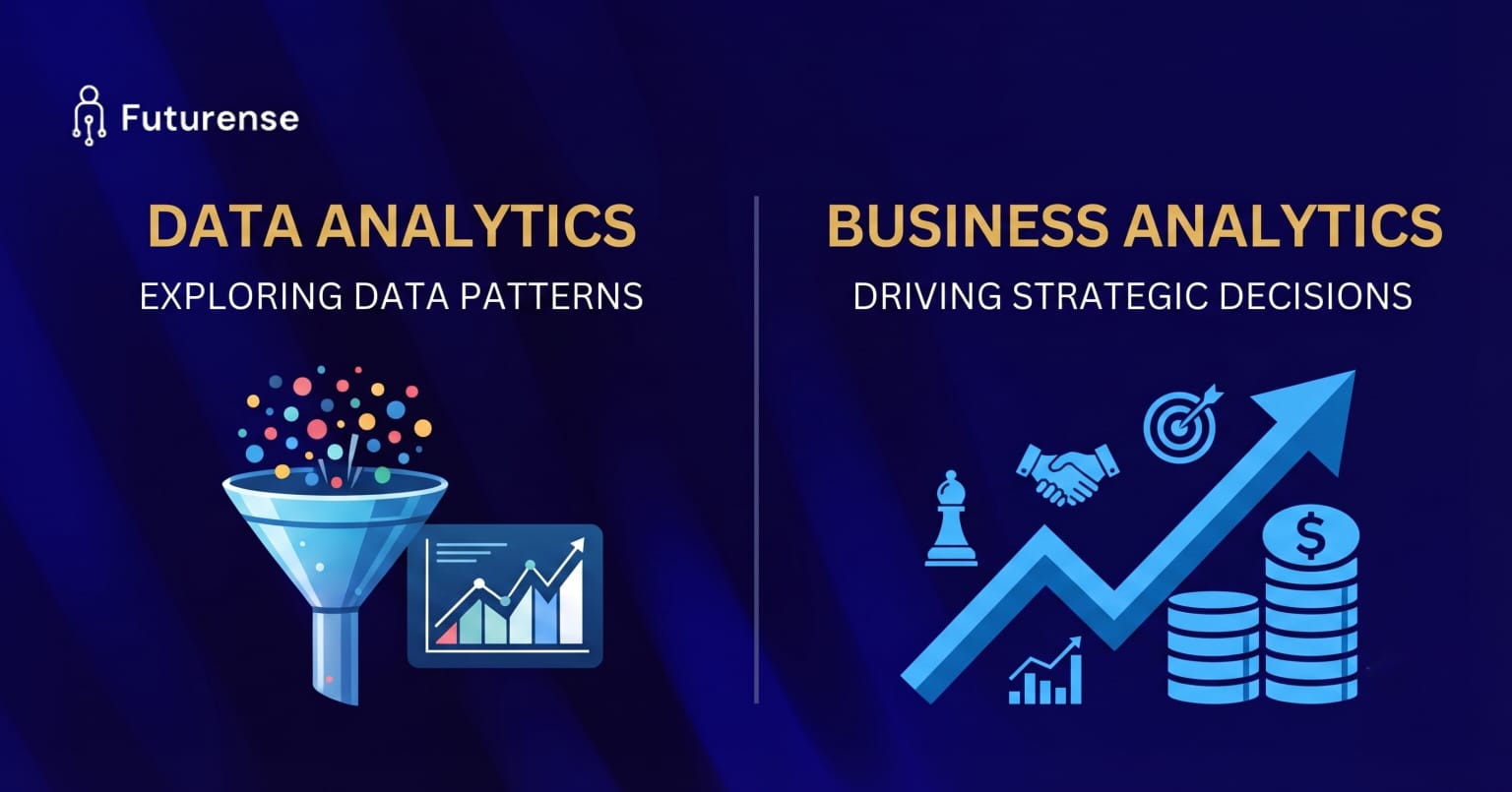


Data Analyst vs Business Analyst is a comparison that often confuses aspiring professionals because both roles work with data to support better business decisions. The key difference lies in their primary focus and day-to-day responsibilities.
A Data Analyst works primarily with numbers- writing SQL queries, cleaning datasets, building dashboards, creating reports, and uncovering patterns or trends in existing data. Their goal is to answer questions with evidence and provide accurate insights.
A Business Analyst, on the other hand, works primarily with people. They gather requirements from stakeholders, map business processes, identify operational challenges, and translate business needs into technical or process-based solutions that may or may not involve data analysis. While both roles rely on data, a Data Analyst's responsibility typically ends once the data reveals meaningful insights.
A Business Analyst takes those insights further by determining what the business should do next, aligning recommendations with organizational goals, coordinating with technical teams, and helping ensure that the proposed solution delivers measurable business value.
The confusion between these two roles is understandable: job postings use the titles inconsistently, responsibilities overlap heavily at smaller companies, and both roles sit at the intersection of technical work and business impact. This guide draws a clear line between them, covering what each role actually does day to day, how their skills and tools differ, what each pays in India, and how to decide which path fits you.
What Does a Data Analyst Actually Do?
A Data Analyst extracts, cleans, and analyzes data to answer specific business questions, then communicates findings through reports and visualizations. The day-to-day work centers on structured data: pulling records from a database with SQL, cleaning inconsistent or missing values, running statistical analysis to find trends, and building dashboards in Tableau or Power BI that let stakeholders explore the findings themselves.
The core skill is technical rigor with data itself. A Data Analyst needs to know whether a correlation is meaningful or coincidental, whether a sample size is large enough to trust, and how to structure a query that returns exactly the right rows without accidentally double-counting or dropping records. The output is typically a report, dashboard, or dataset, something concrete that shows what the data says.
What Does a Business Analyst Actually Do?
A Business Analyst identifies business problems, gathers requirements from stakeholders across departments, and defines the solution a project should deliver, whether that solution involves a new software system, a redesigned process, or a policy change.
The day-to-day work centers on people and process: running stakeholder interviews, mapping current and future-state workflows, writing requirements documents, and facilitating alignment between business teams and the technical teams who'll build the solution.
The core skill is translation. A Business Analyst needs to take a vague complaint like "our onboarding process is too slow" and turn it into a specific, actionable set of requirements that a development team can actually build against. Data often informs this work, a Business Analyst might pull basic metrics to support a case, but the analysis itself is rarely the deliverable. The output is typically a requirements document, a process map, or a recommendation that drives a decision.
Data Analyst vs Business Analyst: Core Differences
Primary Output
The clearest way to understand Data Analyst vs Business Analyst is by looking at each role's primary output. A Data Analyst's main deliverable is insight- a number, a trend, or a validated pattern uncovered through data analysis. A Business Analyst's primary output is a decision, recommendation, or specification, such as a documented set of business requirements, a proposed process improvement, or a clearly scoped project.
When a job posting's title doesn't make the distinction obvious, ask what the role is expected to hand over at the end of a project. If the final deliverable is a dashboard, report, or data-driven insight, it's typically a Data Analyst role. If the outcome is a requirements document, process redesign, or business solution aligned with stakeholder needs, it's much more likely to be a Business Analyst role.
Tools and Technical Depth
Data Analysts need deeper technical tooling: SQL is close to non-negotiable, Python or R shows up frequently for more advanced statistical work, and visualization tools like Tableau or Power BI are core to the job, not optional extras.
Business Analysts need lighter technical depth and heavier process tooling: Excel remains central, requirements-management and process-mapping tools (Visio, Jira, Confluence) are common, and while SQL and BI tools are increasingly expected, they're typically used at a surface level rather than the deep, query-optimization level a Data Analyst needs. For a full breakdown of the specific tools each role actually uses, see our guide to the top data analysis tools every analyst should know.
The practical test for which depth you'll actually need on the job: a Data Analyst is expected to write a multi-table SQL join with window functions to answer a question nobody's asked before. A Business Analyst is expected to open an existing dashboard, pull the two or three numbers that support a stakeholder conversation, and move on to facilitating the next requirements workshop.
Both are "using data," but the depth and frequency of that use differ substantially, and job postings that blur this line are usually describing a hybrid role, common at smaller companies that haven't yet split the two functions apart.
Who They Talk To
Data Analysts typically work closest to data engineers, data scientists, and the specific team requesting an analysis, their stakeholder conversations tend to be narrower and more technical. Business Analysts work across a much wider stakeholder map: business unit heads, end users, IT teams, project managers, and sometimes external vendors, since their job is explicitly to align different groups around a shared understanding of the problem and solution.
This is why strong communication and facilitation skills matter more, proportionally, for Business Analysts than for Data Analysts, even though both roles need to explain technical findings to non-technical audiences.
Where in the Decision Cycle They Sit
Data Analysts typically sit earlier in the decision cycle: they answer "what is happening" and "what does the data show." Business Analysts typically sit slightly later: they take that understanding (sometimes produced by a Data Analyst, sometimes gathered directly from stakeholders) and turn it into "here's what we should do about it."
In practice, this means Data Analysts are often reactive to specific analysis requests, while Business Analysts are often proactive in defining what a project should even include before work starts.
Data Analyst vs Business Analyst Salary in India
In 2026, Data Analysts in India earn an average of ₹6.5 to ₹7 LPA overall, with freshers starting around ₹3.5 to ₹4.5 LPA, mid-level professionals (3 to 6 years) earning ₹6 to ₹10 LPA, and senior analysts (7+ years) earning ₹15 to ₹20+ LPA. For the full breakdown by city and skill, see our detailed Data Analyst salary guide.
Business Analysts in India see a similar starting range but a higher ceiling at the senior end: freshers typically start between ₹3 and ₹7 LPA, Business Intelligence Analysts average around ₹9.5 LPA, and senior Business Analysts earn between ₹19 and ₹24 LPA, with strategy and leadership-track roles going higher still.
For the complete picture including MBA-track Business Analyst compensation, see our Business Analyst salary guide.
The pattern worth noting: Business Analyst compensation tends to scale faster with stakeholder scope and business impact than with technical depth alone, which is why an MBA or an internal move into strategy work often accelerates Business Analyst pay more than an additional technical certification does. Data Analyst compensation, by contrast, scales more predictably with technical skill depth, particularly Python, advanced SQL, and machine learning exposure.
Industry also shifts both numbers meaningfully. BFSI and fintech pay premiums for both roles due to regulatory complexity and the direct revenue impact of getting analysis or requirements wrong.
IT services firms tend to cap both roles lower and grow salaries more slowly through structured, incremental raises rather than the sharper jumps seen at product companies and consulting firms. If total compensation is the primary driver of your decision between the two paths, the company and industry you target will likely matter more than the title itself.
Which Role Should You Choose?
Choose Data Analyst if you enjoy working with numbers directly, want a technically deep skill set you can point to concretely (SQL, Python, statistics), and prefer analysis work where the deliverable is a clear, data-backed answer. This path also gives you a more direct route toward Data Scientist or Analytics Engineering roles later, since the core technical foundation overlaps heavily.
Choose Business Analyst if you're energized by working across teams, enjoy translating ambiguous problems into clear plans, and want a role where communication and stakeholder management matter as much as technical skill. This path routes more naturally toward Product Management, Program Management, or business strategy roles, since the core skill (turning ambiguity into a defined plan) transfers directly.
If you're genuinely unsure, a useful gut check: imagine two Monday mornings. One starts with a stakeholder request to figure out why weekend signups dropped 15%, and you spend the day in SQL and a dashboard.
The other starts with a VP saying "our returns process is broken," and you spend the day interviewing three departments to figure out what "broken" actually means before anyone touches a system. If the first scenario sounds more engaging, lean Data Analyst. If the second does, lean Business Analyst.
Can You Move Between the Two Roles?
Yes, and it's a common transition in both directions. Data Analysts moving into Business Analyst roles typically need to build stakeholder management and requirements-gathering skills, softer skills that don't show up in a SQL portfolio but get tested directly in BA interviews and daily work.
Business Analysts moving into Data Analyst roles typically need to build deeper technical skills, particularly SQL fluency and comfort with statistical reasoning, since BA work often only requires surface-level data tool usage.
The transition is easier in whichever direction matches your existing strength: a Data Analyst who already handles some stakeholder communication has a shorter path to BA work than one who's purely heads-down in queries all day, and a Business Analyst who's already comfortable pulling their own SQL reports has a shorter path to DA work than one who relies entirely on requesting analysis from someone else.
TL;DR: Data Analyst vs. Business Analyst
The main distinction comes down to their primary focus: Data Analysts work with numbers, while Business Analysts work with people. A Data Analyst uses deep technical tools like SQL, Python, and Power BI to clean datasets, build dashboards, and uncover concrete trends. Their main goal is to answer "what happened" and deliver precise, evidence-backed insights, serving as a direct stepping stone toward Data Science.
In contrast, a Business Analyst takes those insights and focuses on strategy, processes, and cross-team communication to figure out "what we should do next." They act as translators, interviewing stakeholders across departments to map workflows and turn ambiguous business problems into actionable project requirements. While both roles are highly lucrative in India, a Data Analyst's salary scales predictably with technical expertise, whereas a Business Analyst's compensation accelerates faster through strategic impact, leadership scope, or an MBA.
What is the main difference between a Data Analyst and a Business Analyst?
A Data Analyst works primarily with data, extracting and analyzing information to answer specific questions. A Business Analyst works primarily with people and process, gathering requirements and defining solutions to business problems. Data Analysts produce insights and dashboards; Business Analysts produce requirements and recommendations.
Which pays more, Data Analyst or Business Analyst?
In India, both roles start at a similar range (₹3.5 to ₹5 LPA for freshers), but Business Analyst compensation tends to scale higher at the senior and strategy-track level (₹19 to ₹24 LPA and above), while Data Analyst compensation scales more predictably with technical depth like Python and advanced SQL skills.
Does a Business Analyst need to know SQL?
Increasingly, yes, at a basic to intermediate level, since many BA roles now expect analysts to pull their own reports rather than always requesting them from a Data Analyst. However, the depth expected is typically much lighter than what a Data Analyst role requires.
Can a Data Analyst become a Business Analyst?
In India, both roles start at a similar range (₹3.5 to ₹5 LPA for freshers), but Business Analyst compensation tends to scale higher at the senior and strategy-track level (₹19 to ₹24 LPA and above), while Data Analyst compensation scales more predictably with technical depth like Python and advanced SQL skills.
Which role is better for someone who wants to become a Data Scientist?
Data Analyst is the more direct path, since the core technical skills (SQL, statistics, and often Python) overlap heavily with Data Scientist requirements. Business Analyst skills transfer more naturally toward Product Management or strategy roles instead.
Do Data Analysts and Business Analysts work on the same teams?
Often, yes, particularly on cross-functional projects where a Business Analyst defines what a system should do and a Data Analyst measures whether it's working once it's live. The two roles are frequently complementary rather than competing for the same work.


B.S/B.Sc in Applied AI & Data Science
IIT Jodhpur
Be a Part of India’s First Advanced AI Regular Degree with the Best Minds at IIT


.avif)