

Are you a cybersecurity professional or enthusiast worrying about how the increased role of AI-detection systems will replace your job?
With increased and advanced IT infrastructure, cybersecurity threats are scaling and even becoming complex. Millions of cyberattacks are attempted every day, and it's not feasible for traditional systems to address them all. AI-based phishing, malware, advanced ransomware, and state-sponsored hacking are just a few to name.
Many are yet unidentified, so prevention is nearly impossible with rule-based detection and manual monitoring.
Here's where artificial intelligence in cybersecurity addresses the issue. It enables security systems to analyze huge volumes of network data, detect unusual patterns, and respond to threats quickly as compared to human analysts.
Hence, AI combines ML, behavioral analytics, and automation to build a resilient cyber defense system. Yet, there are several shortcomings in it as well, which need human cybersecurity analysts working with AI, and this article will give you detailed insights about it.
What Is Artificial Intelligence in Cyber Security?
Artificial intelligence in cybersecurity uses machine learning algorithms and AI-based systems to identify, prevent, and respond to cyber threats. It does not use predefined rules, but rather AI-based security tools that analyze large datasets to identify patterns that can present potential malware.
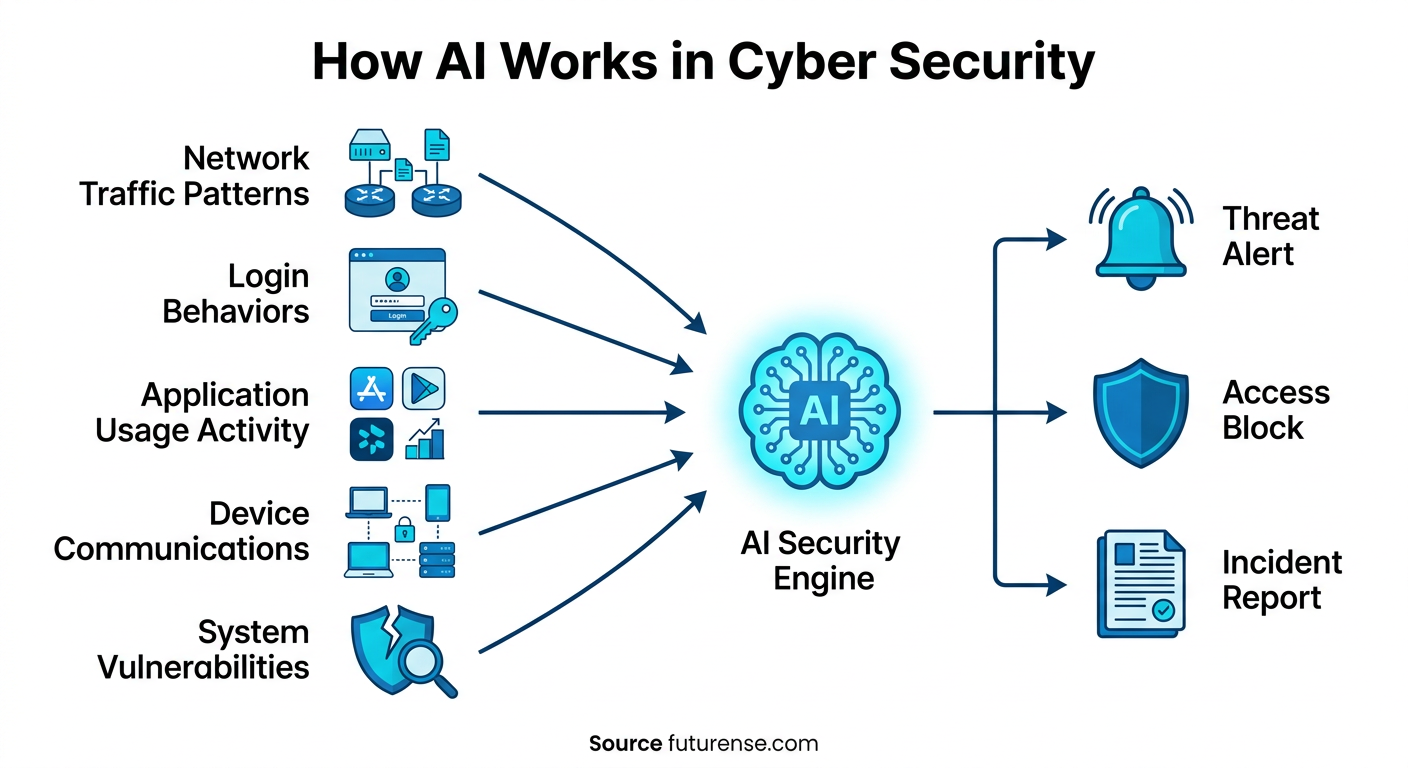
AI security systems analyze data for things like:
- Network traffic patterns
- Login behaviors
- Application usage activity
- Device communications
- System vulnerabilities
By continually learning from this data, AI models detect anomalies that indicate cyberattacks.
For example, if an employee tries to access systems with confidential data at odd times or from unfamiliar locations, then the AI-based security platform will flag it as suspicious, thus triggering alerts. It can also block access for that particular employee.
As AI is wise enough to detect such unusual behavior hence AI-based security systems are greatly increasing.
Role of AI in Cyber Security
AI is not replacing cybersecurity professionals; rather, it is augmenting human expertise by handling tasks that need large-scale data analysis and quick response. While AI is transforming cybersecurity, its core objective still revolves around the three fundamental principles defined by the CIA Triad.
Thus, it plays the following roles in cybersecurity:
- Threat Detection
AI security systems can detect threats in real-time. Previously, conventional cybersecurity tools used to detect identified threats by attackers' signatures. In comparison, AI can analyze behavioral patterns to identify new threats and loopholes as well.
- Automated Security Monitoring
Most organizations today release a huge amount of security data. So monitoring logs from servers, endpoints, cloud platforms, and networks manually is not feasible. Here's where AI systems automate it by continually analysing security events and detecting potential threats.
Besides, professionals also automate tasks, which helps security teams prioritize high-risk incidents instead of manually checking each log.
- Malware Detection
AI is widely used to detect malware and malicious software. ML models now analyse files and accordingly identify suspicious activities despite the fact that the malware has been detected before. This helps in case of zero-day attacks, which exploit vulnerabilities that security teams might not even know.
To do so, AI systems analyse patterns in file behavior and code structure that traditional antivirus software misses.
- Fraud Detection
Financial institutions and online platforms often use AI to detect fraudulent transactions. These models check for transaction patterns, and this identifies unusual behavior which can lead to fraud.
- Security Automation and Response
Cybersecurity teams find it difficult to respond to security incidents because of the huge volume of reported alerts. Hence, AI automates the incident response process by identifying threats and initiating defensive actions.
Some of the automated responses include:
- Isolating compromised systems
- Blocking suspicious IP addresses
- Triggering multi-factor authentication (MFA) checks
- Notifying security teams about to investigate
Hence, automation greatly reduces response time during cyber incidents.
Artificial Intelligence Hacking: How Attackers Use AI
Though AI has improved the cyber defense system greatly yet attackers can also exploit it. AI hacking means using AI to automate cyberattacks or improve malicious activities.
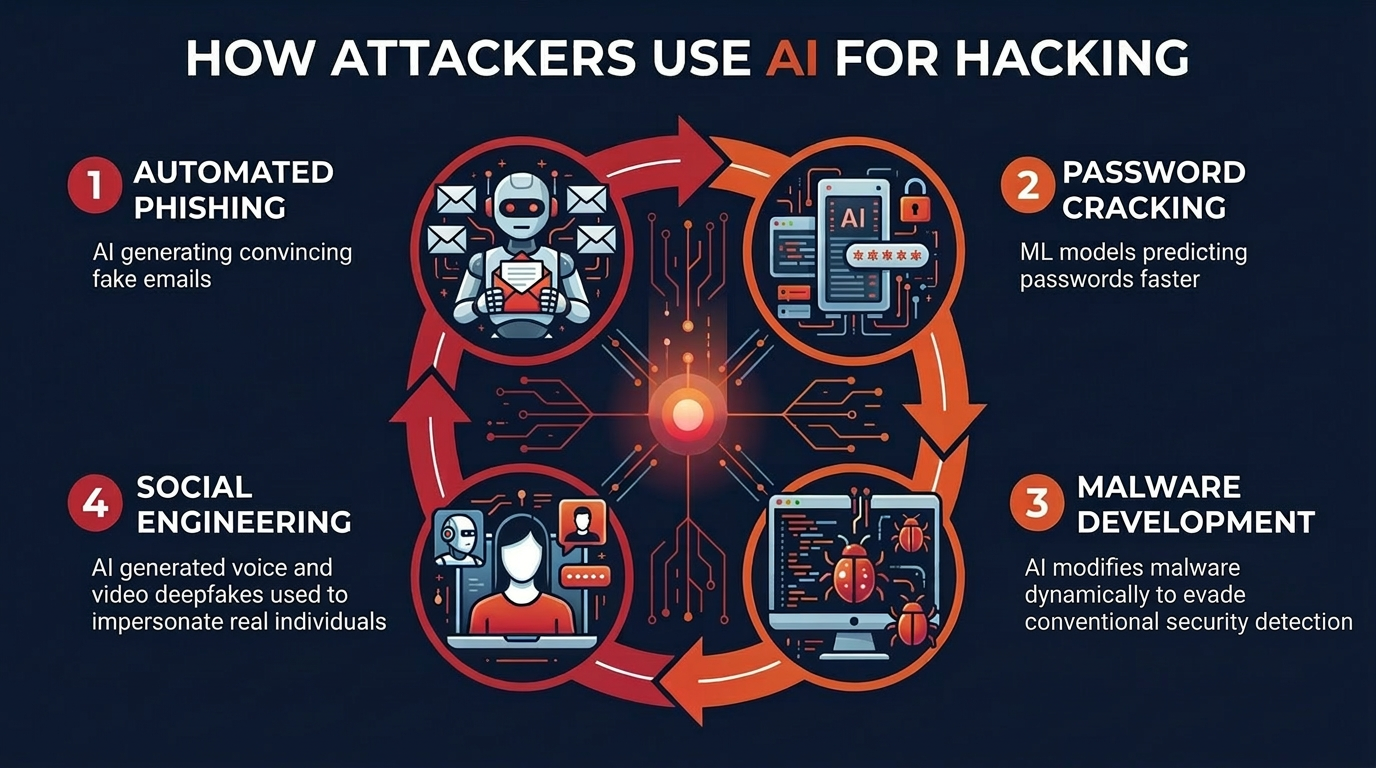
Cybercriminals are using AI for the following motives:
- Automated Phishing Attacks: AI tools generate phishing emails that look human-written. Even AI-detects cannot detect them sometimes.
- Password Cracking: ML models analyze password patterns and try to predict commonly used ones more efficiently than brute-force attacks.
- Malware Development: Attackers use AI to modify malware dynamically, and hence, conventional security systems don't detect it.
- Social Engineering Attacks: AI-generated content and voice synthesis technologies can impersonate and mimic individuals to deceive employees and access sensitive information.
Besides, these are just a few examples, but advancements in cybersecurity due to AI are quite more, which are challenging to prevent even after detection. Hence, professionals have to upgrade themselves to thrive as cybersecurity professionals.
Benefits of AI Cybersecurity Systems
Organizations should greatly adopt AI cybersecurity tools because of their huge benefits over traditional approaches.
Some of them include:
- Faster Threat Detection: AI systems do real-time data analysis and thus identify threats quickly without human supervision.
- Better Accuracy: Machine learning models identify even minor patterns in data, which can indicate malicious activity.
- Decreased Security Workload: With automation, security teams can manage a large volume of alerts more effectively.
- Adaptive Security Systems: AI models continuously learn from new threats, due to which security systems adapt as cyberattack techniques advance.
- Better Risk Management: AI-based analytics help organizations detect vulnerabilities and strengthen their security strategies.
Challenges of AI in Cyber Security
As AI has several benefits in security, it creates several challenges as well.
- Data Quality Issues: AI models depend on large datasets for training, and a poor-quality dataset will reduce detection accuracy.
- False Positives: Often, AI systems flag legitimate behavior as well as suspicious behavior that needs human verification.
- High Implementation Costs: Developing and deploying AI-based security systems require huge investments.
- Adversarial AI Attacks: Cyber attackers often try to manipulate AI models by giving them misleading data.
Due to such challenges, human security analysts work alongside AI cybersecurity systems and don't replace them.
Why Are AI Cybersecurity Skills in High Demand?
As cyber threats are advancing, organizations need professionals who understand the domain of artificial intelligence technologies. Hence, various roles emphasize this demand, which include:
- AI Cybersecurity Analyst
- Machine Learning Security Engineer
- Threat Intelligence Specialist
- Cybersecurity Automation Engineer
As such roles are in high demand, professionals willing to work in them should understand aspects like:
- ML models for threat detection
- Network security architectures
- Vulnerability assessment
- Automated incident response systems
To cater to such increased demand, professionals need specialized education programs that emphasize AI and cybersecurity with a structured cybersecurity certification program.

Here's where many opt for an Artificial Intelligence cybersecurity course to get real-time learning of how to apply ML, Gen AI, and security automation technologies in cyber defense systems.
The Future of AI in Cybersecurity
AI is rapidly becoming more advanced and a must-have in contemporary cybersecurity systems. Besides the advancement of digital infrastructure, even cyber threats will advance, and organizations will rely on AI-based systems to secure networks, applications, and sensitive data.
Some of the future developments in AI cybersecurity can be:
- Autonomous threat detection systems
- AI-based security operation centers
- Predictive cyber risk analysis
- Intelligent security automation platforms
- Gen AI integration for threat intelligence analysis
Thus, with these technologies, organizations will be able to detect threats early, respond faster, and manage complex digital environments.
Final Words
The quick advancement of cyber threats is forcing organizations to reconsider their conventional security strategies. AI in cybersecurity provides robust tools to detect threats, automate defense mechanisms, and analyze huge volumes of security data.
AI cybersecurity systems are changing how organizations protect their IT infrastructure by automated incident response, malware detection, fraud detection, and more. Simultaneously, increased AI hacking techniques have increased the need for continuous innovation in cyber defense.
Similarly, there is a need for cybersecurity professionals who understand ML and security systems to cope with the advancements.
FAQs: AI in Cybersecurity
How is AI used in cybersecurity?
AI is used in cybersecurity to monitor networks, detect threats, and respond to attacks in real time. Instead of relying on fixed rules, AI systems learn from data patterns to spot unusual behavior, like someone logging in from an unexpected location or a file acting suspiciously. It also helps automate repetitive security tasks so human analysts can focus on more critical issues.
Which AI is best for cyber security?
There is no single "best" AI for cybersecurity since different tools serve different purposes. However, some of the most widely trusted platforms include Darktrace for autonomous threat detection, CrowdStrike Falcon for endpoint protection, and IBM QRadar for security intelligence. The best choice depends on your organization's size, budget, and specific security needs.
What are the 4 types of AI risk?
The four key types of AI risk in cybersecurity are adversarial attacks where hackers feed misleading data to fool AI models, data privacy risks where AI systems process sensitive information that can be exploited, model bias where poor training data leads to inaccurate threat detection, and over-reliance risk where organizations trust AI too much and reduce human oversight, leaving gaps in security.
Can AI replace cybersecurity professionals?
No, AI cannot replace cybersecurity professionals. While AI is excellent at processing large volumes of data and detecting patterns quickly, it still lacks human judgment, contextual understanding, and creative thinking. Cybersecurity professionals are needed to interpret AI findings, handle complex incidents, make strategic decisions, and continuously improve AI systems. Think of AI as a powerful tool that makes security teams more efficient, not a replacement for them.
What is AI hacking?
AI hacking refers to cybercriminals using artificial intelligence to carry out more sophisticated and automated attacks. This includes generating convincing phishing emails, cracking passwords faster, developing malware that adapts to avoid detection, and using voice or video synthesis to impersonate real people. Essentially, just as defenders use AI to protect systems, attackers use it to find and exploit weaknesses more effectively.


PG Certificate Program in AI/GenAI Powered Cybersecurity
IIT Roorkee
Become the GenAI-native cyber defender every system needs with CEC IIT Roorkee Faculty.


.avif)