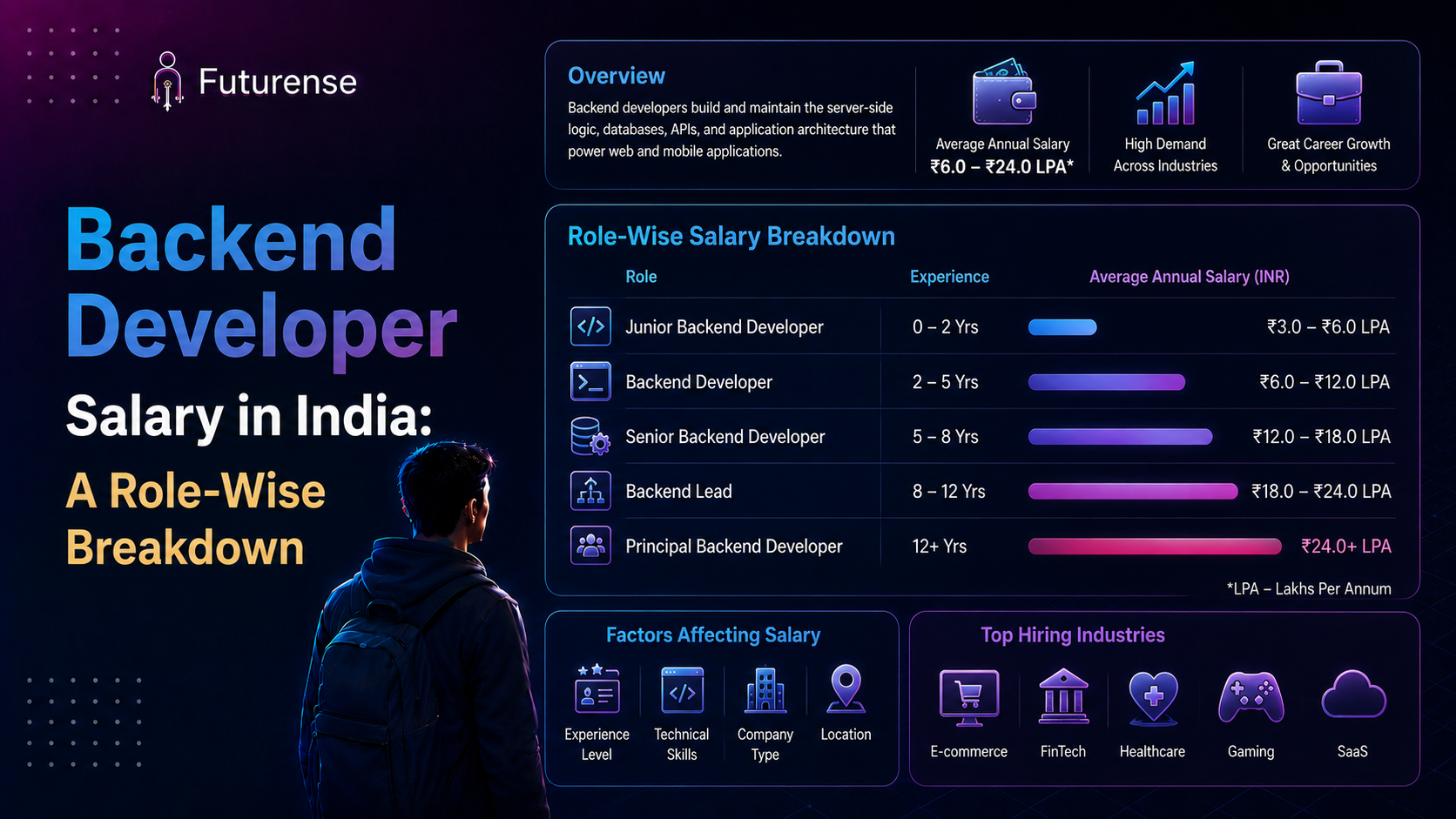


Backend Developer salaries in India range from roughly ₹4 LPA for freshers to ₹50 LPA or more at the senior level, with the specific tech stack you work in shifting that range as much as experience does. A Node.js developer with AWS experience and a Java developer working on legacy enterprise systems can land in genuinely different pay bands even at similar seniority, this guide breaks down why, role by role.
Backend Developer Salary in India by Experience Level
PayScale's India-specific data for this role, broken out by career stage, shows a wide and revealing spread.
The mid-career range is especially wide, and that's not noise, it reflects the same employer-type split that shows up across most Indian tech salaries: a backend developer at a traditional IT services firm sits toward the lower end of that range, while one at a product company or GCC, especially with in-demand skills, can sit at the very top of it or beyond.
This same pattern, a modest, tight range at entry level widening dramatically by mid-career, is common across most Indian tech roles, and it reflects a simple reality: early in a career, most engineers are still building foundational skills regardless of employer, so pay stays relatively clustered. By mid-career, the gap between an engineer who's built genuinely differentiated skills (modern stack, cloud, distributed systems) and one who hasn't becomes visible in compensation, and it compounds meaningfully from there.
Backend Developer Salary by Tech Stack (Java vs Python vs Node.js vs Golang)
Not all backend work pays the same, and the specific language and framework ecosystem you work in matters more than most junior developers initially expect.
Java remains the dominant backend language at large enterprises, banks, and traditional IT services firms in India, offering high job volume and stable, if not always top-of-market, compensation. It's a reliable, high-demand starting point, but tends to plateau closer to the middle of the broader backend salary range unless paired with modern framework and cloud experience. This isn't a knock on Java as a language, it's a reflection of where Java roles are concentrated: large, established organizations with standardized pay bands rather than the higher-variance, higher-ceiling product-company market.
Python (commonly with Django or FastAPI) has grown quickly alongside the broader AI and data ecosystem, and backend developers fluent in Python often find themselves well-positioned for roles that blend traditional backend work with AI-adjacent responsibilities, a combination increasingly in demand and often compensated at a premium over generalist Java roles. A backend engineer who can also support model-serving infrastructure or data pipeline work, rather than staying purely within traditional API development, is positioned for a genuinely different, higher-paying category of role.
Node.js is heavily favored at startups and product companies building fast-moving, JavaScript-centric stacks, and developers who can work across both frontend and backend using the same language often command a real premium for that flexibility alone. A live job posting for a Backend Developer role built on Node.js, Python, or Golang, requiring microservices architecture and cloud experience, listed a pay range of ₹15-20 LPA even at a mid-sized company, well above the general mid-career average.
Golang commands some of the strongest compensation among backend-specific languages, precisely because it's in high demand for high-performance, scalable systems but has a meaningfully smaller talent pool than Java or Python in the Indian market, a scarcity premium that shows up directly in offers. Engineers willing to invest in learning Golang specifically, even as a second language alongside a more established one, often find it opens doors to roles that simply aren't accessible with Java or Python alone.
The Skills That Push You Into a Higher Band
Beyond the specific language, a few skills consistently separate higher-paid backend developers from the broader market.
- Cloud platform experience (AWS, Azure, GCP) is one of the clearest, most measurable premiums available. PayScale's data shows early-career backend developers with AWS skills averaging around ₹8 LPA, compared to roughly ₹5-5.1 LPA for peers with more generic skill listings like JavaScript or MySQL alone, a difference of 30-40% at the same career stage
- Microservices architecture experience signals readiness for the kind of distributed, scalable system design most product companies and larger enterprises are actively building toward, as opposed to maintaining a single, monolithic application that doesn't require the same coordination and design discipline
- Database skills beyond basic CRUD operations, query optimization, schema design, and comfort with both SQL and NoSQL systems, are consistently listed as core requirements in higher-paying postings, not just a nice-to-have. An engineer who can explain why a particular indexing strategy improved query performance demonstrates a meaningfully deeper skill than one who can only describe basic table operations
- API design and security fundamentals, building and securing APIs that other teams and external partners depend on is a genuinely higher-responsibility skill than internal-only feature work, and compensation tends to reflect that. Understanding authentication patterns, rate limiting, and how to design an API that other engineering teams can integrate with reliably is a distinct, valuable skill separate from writing endpoint logic alone
- Testing and observability practices, engineers who build systems with genuine test coverage and monitoring built in from the start, rather than as an afterthought, are increasingly differentiated from those who only write code that works in the immediate, narrow sense
Backend vs Full Stack Developer Pay
It's a natural question: does specializing in backend specifically pay more or less than the broader full-stack track? Our Full Stack Developer Salary guide shows full-stack developers earning roughly ₹4-12 LPA at entry level, ₹10-22 LPA at mid-level, and ₹22-35 LPA or more at the senior level, a range that overlaps significantly with backend-specific pay rather than clearly exceeding it.
The practical takeaway: breadth (full-stack) and depth (backend specialist) both have real market value, and the choice between them is less about which pays more in the abstract and more about which kind of work you actually want to do, and which specific companies you're targeting. Product companies building complex, high-scale backend systems often value deep backend specialization highly; smaller teams and startups often value the flexibility a full-stack developer brings instead.
How to Actually Grow Your Salary
The clearest lever isn't simply years of experience, it's moving deliberately toward the higher-value combination of skills: a modern stack (Node.js, Python, or Golang rather than Java alone), genuine cloud platform experience, and microservices or distributed systems exposure. A developer who spends years maintaining a legacy Java monolith without picking up any of these adjacent skills will see meaningfully slower salary growth than one who actively builds toward this combination early.
Switching employers, particularly from a traditional IT services or enterprise environment into a product company or GCC, tends to produce a larger jump than internal promotions alone, a pattern that holds broadly across Indian tech salaries. Building a visible portfolio project that demonstrates real system design thinking, not just CRUD endpoints, but a genuinely scalable, well-architected backend system, does more to open doors into that higher band than certifications alone.
TL;DR
- Freshers (0-2 yrs): ₹4-6 LPA
- Early-career (2-4 yrs): ₹6-10 LPA
- Mid-career (4-8 yrs): ₹10-25 LPA, with real variance by employer type
- Senior (8+ yrs): ₹25-50 LPA+
- Cloud skills (AWS, Azure, GCP) add a meaningful premium, early-career backend developers with AWS experience average roughly 30-40% more than peers without it
- Tech stack matters: Node.js and Python/Django roles at product companies often command higher offers than equivalent Java roles at traditional enterprise or IT services firms
- See our Full Stack Developer Salary guide for how backend-specific pay compares to the combined front-end-plus-back-end track
What is the average Backend Developer salary in India?
It varies significantly by experience: roughly ₹4.6 LPA average at entry level, ₹6 LPA at early-career, and ₹15.3 LPA average at mid-career, though the mid-career range spans widely from ₹3.5 LPA to ₹50 LPA depending on employer type and skill stack.
Which backend tech stack pays the most in India?
Golang and Node.js roles at product companies tend to command the strongest compensation, reflecting both genuine scarcity (Golang specifically) and startup/product-company demand (Node.js). Java remains the highest-volume, most stable option but tends to plateau closer to the market middle without additional modern-stack or cloud skills.
How much does AWS experience increase a Backend Developer's salary?
Early-career backend developers with AWS skills average around ₹8 LPA, compared to roughly ₹5-5.1 LPA for peers with more generic skill sets, a difference of 30-40% at the same experience level.
Do Backend Developers earn more than Full Stack Developers in India?
The ranges overlap significantly rather than one clearly exceeding the other. Full-stack developers earn roughly ₹4-12 LPA at entry level up to ₹22-35 LPA+ at senior level, comparable to backend-specific pay. The better question is which type of work and company fits your goals, not which pays more in the abstract.
What skills matter most for a higher Backend Developer salary?
Cloud platform experience (AWS, Azure, GCP), microservices architecture, strong database design skills beyond basic queries, and API design and security fundamentals consistently separate higher-paid backend developers from the broader market.
Is Python or Java better for backend development salary in India?
Python, particularly when paired with growing AI-adjacent responsibilities, has been trending toward a premium over generalist Java roles, though Java still offers the highest job volume and remains a stable, reliable starting point, especially at large enterprises and IT services firms.


PG Diploma in AI-ML & Agentic AI Engineering
IIT Gandhinagar
India's First Residential PG Diploma Inside an IIT Campus