

Java has been a backbone of enterprise software for over two decades, and it's still one of the most in-demand skills in Indian tech hiring from banking cores to e-commerce backends to Android apps. Naturally, one of the first things anyone considering this path wants to know is simple: what does a Java Developer actually earn in India?
The honest answer is: it depends heavily on experience, city, company type, and whether you've picked up modern skills like Spring Boot, microservices, and cloud deployment alongside core Java. This guide breaks down real 2026 salary ranges across every career stage, explains what actually moves the number, and shows you where the ceiling is for engineers who keep leveling up.
Search Intent Behind This Query
"Java Developer Salary in India" is a classic informational query with a strong commercial-investigation undertone. Most searchers fall into one of three groups: students or freshers deciding whether to specialize in Java, working developers benchmarking their current pay before a negotiation or job switch, and career-changers evaluating whether Java development is worth the time investment.
None of them are ready to "buy" anything yet they want accurate, current numbers first. That means this content needs to lead with real figures and context, not a sales pitch.
Java Developer Salary in India: Quick Overview
These are indicative market ranges based on current industry hiring patterns; actual offers vary by company tier, location, and specific skill stack.
Java Developer Salary by Experience Level
Fresher Java Developer Salary (0–1 Years)
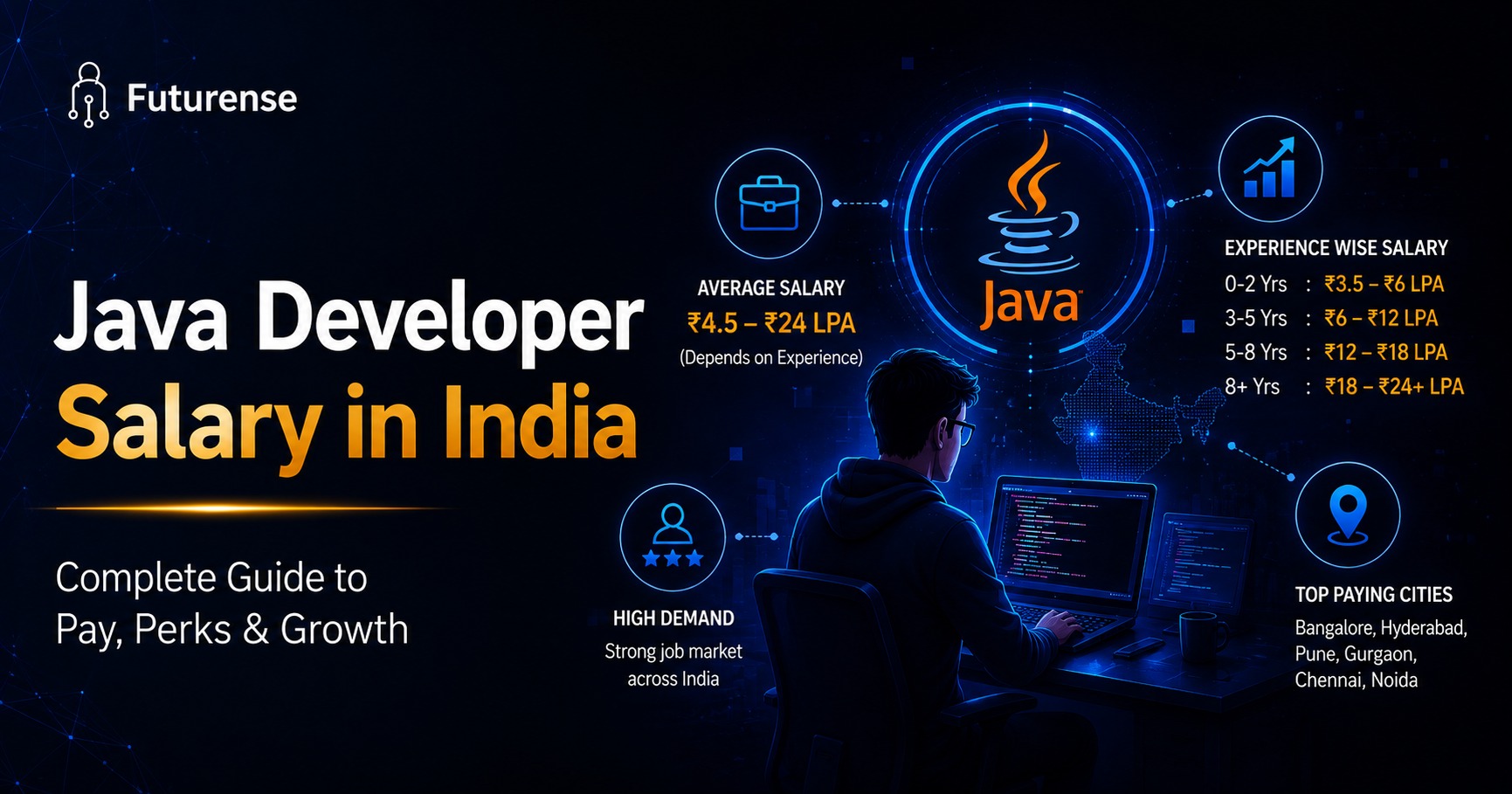
Entry-level Java developers in India typically start between ₹3.5 LPA and ₹6 LPA. Product-based companies and well-funded startups tend to pay toward the higher end of this range, while service-based IT companies often start closer to the floor.
At this stage, the differentiator isn't years of experience; it's whether a candidate can demonstrate real project work: a working Spring Boot application, a REST API built from scratch, or contributions to an open-source repository carry far more weight than certifications alone.
Junior Java Developer Salary (1–3 Years)
Once a developer has a year or two of production experience, salaries move into the ₹5 LPA to ₹9 LPA range. This is typically when engineers move beyond basic CRUD applications into understanding design patterns, database optimization, and framework-level debugging.
Developers who pick up Spring Boot, Hibernate, and basic cloud deployment (AWS or Azure) during this window tend to see faster jumps than those who stay purely core-Java focused.
Mid-Level Java Developer Salary (3–6 Years)
Mid-level Java developers earn between ₹8 LPA and ₹16 LPA, with wide variance based on whether they've branched into system design, microservices architecture, or DevOps-adjacent skills.
This is also the stage where many developers start specializing in backend architecture, distributed systems, or transitioning into related high-paying tracks. It's worth comparing this to broader benchmarks like the Software Developer Salary in India guide, since Java sits within a wider band of backend and full-stack compensation trends.
Senior Java Developer Salary (6–10 Years)
Senior Java developers command ₹14 LPA to ₹28 LPA, and this is where technical leadership starts to matter as much as coding ability. Ownership of system architecture, mentoring junior engineers, and the ability to make trade-off decisions on scalability and performance are what push offers toward the top of this range.
Engineers at this stage who've also picked up cloud-native and containerization skills tend to out-earn peers who've stayed purely on-premise focused.
Lead / Architect-Level Java Developer Salary (10+ Years)
At the top end, Lead Engineers, Java Architects, and Engineering Managers with deep Java expertise can earn ₹25 LPA to ₹55 LPA or more, especially at product companies, fintech firms, and global capability centers.
Compensation at this level increasingly includes RSUs or ESOPs at larger tech companies, on top of base pay. Many engineers at this stage transition into broader technical leadership roles, similar in trajectory to the paths outlined in How to Become a Cloud Architect, since enterprise Java systems and cloud architecture increasingly overlap.
Java Developer Salary by City in India
Location remains one of the biggest salary levers in Indian tech hiring:
- Bengaluru is the highest-paying market overall, driven by product companies and GCCs (Global Capability Centers); expect a 15–25% premium over the national average.
- Hyderabad is strong for both product and enterprise Java roles, with major GCC hubs from banking and healthcare firms.
- Pune a traditional enterprise Java stronghold, particularly in fintech and manufacturing-adjacent software.
- NCR (Delhi/Gurugram/Noida) competitive salaries, especially in fintech, consulting, and product startups.
- Chennai steady demand from BFSI and enterprise software firms, generally slightly below Bengaluru/Hyderabad averages.
- Tier-2 cities growing GCC and remote-first hiring is narrowing the gap, though average salaries still trail metro hubs by roughly 10–20%.
Remote and hybrid roles have also compressed some of this city-based variance in the past two years, since companies increasingly benchmark pay to role and skill level rather than office location alone.
What Actually Moves a Java Developer's Salary Higher
Company Type
Product-based companies and unicorn startups typically pay 20–40% more than traditional IT services firms for the same experience level, because they're hiring for ownership and long-term system impact rather than staff-augmentation billing rates. Global Capability Centers (GCCs) of multinational firms often sit between the two, offering strong pay with more structured career ladders.
Framework and Ecosystem Depth
Core Java knowledge is table stakes. What separates a ₹9 LPA offer from a ₹14 LPA offer at the same experience level is usually depth in Spring Boot, microservices design, Kafka or messaging systems, and containerization with Docker and Kubernetes. Developers who stop at core Java and JDBC top out earlier than those who build toward distributed, cloud-native systems.
Cloud and DevOps Exposure
Java developers who can deploy, monitor, and scale their own services on AWS, Azure, or GCP rather than handing that off entirely to a separate ops team are increasingly paid at a premium. This overlap between backend engineering and infrastructure is a growing theme across Indian tech hiring generally, not just in Java-specific roles.
System Design and Architecture Skills
The jump from mid-level to senior compensation is rarely about writing more code faster it's about being trusted to make architectural decisions: how a service should be partitioned, how to handle scale, how to design for failure. This is the single biggest lever for salary growth in the 3–8 year experience band.
Certifications and Formal Upskilling
While project experience carries the most weight, structured, IIT-backed upskilling in adjacent areas cloud engineering, AI-enabled development, or applied data science can meaningfully accelerate a Java developer's trajectory into higher-paying architecture and platform roles. This is particularly relevant for developers looking to move into hybrid AI-and-backend roles, an area covered in guides like AI Engineer vs Data Analyst for those weighing adjacent specializations.
Java Developer vs Other Backend and Full-Stack Roles
Java isn't the only path to a strong backend salary in India, and it's worth understanding where it sits relative to other stacks. JavaScript-based backend roles (Node.js within MEAN or MERN stacks) often start slightly lower than Java at the entry level but can converge quickly with strong system design skills, a comparison worth reviewing in MEAN Stack vs MERN Stack for Web Development.
For developers deciding which language ecosystem to specialize in early on, it also helps to understand how typed, compiled languages like Java compare to dynamically typed alternatives, a distinction explored in TypeScript vs JavaScript.
Compared to newer, AI-specific roles, core Java development still commands strong, stable demand because most large-scale enterprise systems banking cores, insurance platforms, logistics backbones are Java-based and aren't going anywhere soon.
That said, Java developers who layer in AI-adjacent skills increasingly out-earn peers who stay purely backend-focused, since enterprises are retrofitting AI capabilities directly into existing Java systems rather than building everything from scratch.
How to Increase Your Java Developer Salary
- Move beyond CRUD applications. Build and showcase systems that involve caching, message queues, and distributed transactions not just basic API endpoints.
- Get comfortable with cloud deployment. Being able to own a service from code to production on AWS or Azure is a direct salary lever.
- Learn system design deliberately. This is the single highest-leverage skill for crossing from mid-level to senior compensation bands.
- Specialize in a high-demand adjacent area. Fintech-grade security, high-throughput messaging (Kafka), or AI-integrated backend systems all command premiums.
- Benchmark before you negotiate. Compare your offer against current market data including broader references like the Software Developer Salary in India and AI Developer Salary in India guides so any negotiation is grounded in real numbers, not guesswork.
How Futurense Helps Java Developers Level Up
Salary growth for Java developers increasingly depends on skills that sit just outside traditional core-Java training cloud-native architecture, AI-enabled applications, and system design at scale.
Futurense's IIT and IIM-backed programs, including tracks in AI Engineering on Cloud and AIOps and applied AI and data science, are built for exactly this kind of career acceleration, helping working engineers move from execution-focused roles into the architecture and platform-ownership positions that pay significantly more.
Enterprises looking to build this capability across their teams can also explore AI Skilling for Enterprise Teams, while companies hiring for these roles can review Hire AI-Ready Talent On Day One.
Final Thoughts
A Java Developer's salary in India isn't fixed by the language alone, it's shaped by how far a developer moves beyond writing code into owning systems: designing for scale, deploying to the cloud, and making architectural trade-offs under real constraints. The fundamentals of Java remain in steady demand, but the biggest pay jumps go to developers who keep building on top of that foundation rather than treating it as a finished skill set.
Q: What is the average Java Developer salary in India in 2026?
Across all experience levels, the blended average sits roughly between ₹8 LPA and ₹12 LPA, though this varies significantly by city, company type, and specific skill depth.
Q: Do Java Developers earn more than Python Developers in India?
Salaries for both are broadly comparable at similar experience levels; the bigger differentiator is usually the domain (fintech and enterprise systems favor Java, while AI/ML-heavy roles favor Python) rather than the language itself.
Q: Is Java still worth learning in India in 2026?
Yes. Java remains the backbone of enterprise banking, insurance, logistics, and large-scale transactional systems in India, and demand for experienced Java developers, especially those with cloud and microservices skills, remains strong and stable.
Q: How much can a Java Developer earn after 10 years of experience?
Senior architects and technical leads with deep Java expertise can earn ₹25 LPA to ₹55 LPA or more at product companies and GCCs, often with additional equity components at larger tech firms.
Q: Which skills increase a Java Developer's salary the fastest?
Spring Boot and microservices expertise, cloud deployment (AWS/Azure), system design ability, and messaging systems like Kafka are the strongest salary levers beyond core Java knowledge.


Advanced PG Certificate in AI Engineering on Cloud and AIOps
IIT Roorkee
Engineer AI Systems for Top Enterprises, with the Most Critical Skills of the Decade