


Why This Comparison Is Genuinely Confusing
Both fields use data to solve business problems, both increasingly involve AI tools in day-to-day work, and job postings for each frequently borrow language from the other which is exactly why students and professionals land on this comparison in the first place. As AI transforms the workplace, a genuinely common question has emerged: what's the difference between business analytics and AI, and which educational or career path actually fits your goals?
Before comparing the two directly, it's worth being clear on what Applied AI actually means as a discipline our guide to Applied AI covers the hands-on, systems-building side of AI that this comparison sets against Business Analytics. If you're also weighing Data Science as a third option in this decision, our broader comparison of AI/ML vs Data Science is a useful companion read.
What Is Business Analytics?
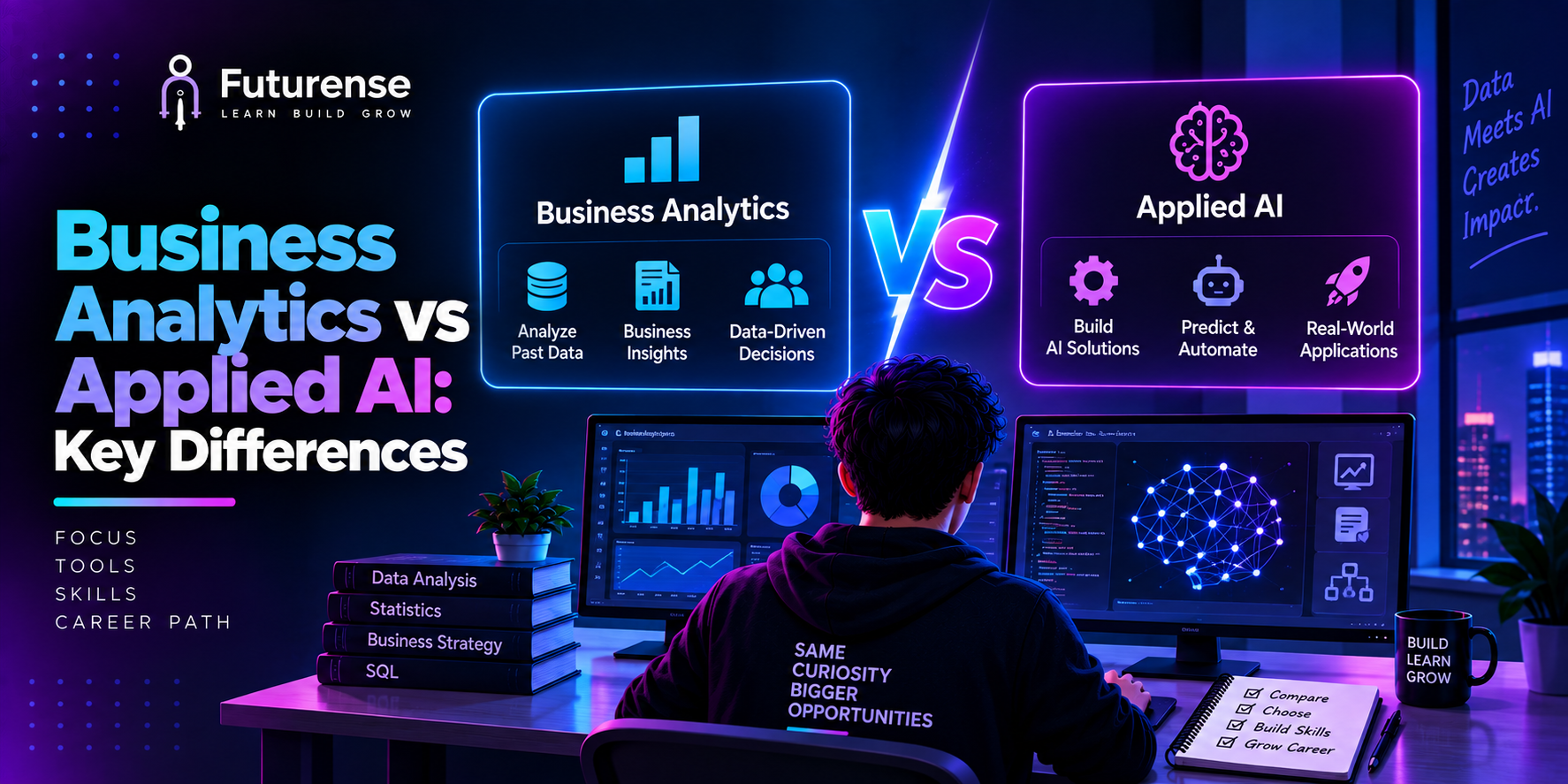
Business Analytics is the practice of collecting, interpreting, and applying data to guide business decisions statistical analysis, forecasting, and data interpretation used to improve strategy across functions like marketing, supply chain, and finance. The discipline emphasizes business acumen and data interpretation over deep technical model-building, prioritizing the ability to translate numbers into a decision a leadership team can actually act on.
A useful way to frame the role Business Analytics plays: data analytics is the technical foundation, while business analytics is the strategic application one finds the "what," the other decides "so what" and "now what." A Business Analyst isn't typically the person building the predictive model from scratch; they're the person who knows which question to ask of the data and how to translate the answer into a decision.
What Is Applied AI?
Applied AI focuses on building, deploying, and operationalizing AI systems to solve real, specific business problems taking existing AI models and capabilities and putting them to work inside an actual product or workflow, rather than researching new algorithms from first principles. Where Business Analytics interprets data to inform a human decision, Applied AI builds systems that can act on data more directly automating a prediction, a recommendation, or an entire workflow step that previously required a person to review and decide.
Applied AI sits closer to engineering than Business Analytics does, though it's distinct from pure AI research: the goal isn't inventing new machine learning techniques, it's applying proven AI capability to solve a concrete business problem reliably in production.
Business Analytics vs Applied AI: The Core Distinction
The clearest framing comes down to time allocation: the real difference between these fields is how they split their time between people and data. Business Analytics spends more of its time on the people side stakeholder conversations, translating a business question into an analysis plan, and presenting findings persuasively. Applied AI spends more of its time on the data and systems side building, testing, and deploying a working AI system that performs a task reliably without a person driving each individual decision.
Neither field is "more technical" or "less technical" in an absolute sense both require real data literacy. The difference is what that technical skill is used for: Business Analytics uses it to produce an insight a person acts on; Applied AI uses it to produce a system that acts.
Business Analytics vs Applied AI: Side-by-Side Comparison
Where the Two Fields Genuinely Overlap
Both fields have grown closer together as AI has become embedded across business curricula and workplace tooling rather than staying siloed as a specialist topic. There is real overlap between the two, but also important differences and increasingly, employers are looking for professionals who can bridge both the technical and business skill sets rather than staying purely on one side.
This overlap shows up concretely in how newer academic programs are structured: some business analytics and AI master's programs now offer parallel tracks explicitly one concentration for applying analytics and AI within specific industries (marketing, healthcare, supply chain), and a separate concentration for building AI-powered solutions others will use. That structural split mirrors the Business Analytics vs Applied AI distinction almost exactly, which is a useful signal that the industry itself increasingly treats these as adjacent but genuinely distinct specializations, not synonyms.
Skills Comparison: What Each Field Actually Requires
Business Analytics requires strong statistical reasoning, comfort with data visualization and business intelligence tools, and just as importantly the communication skill to translate a technical finding into a decision a non-technical stakeholder can act on confidently. Our explainer on data visualization and business intelligence covers the toolset this discipline relies on most heavily.
Applied AI requires genuine programming ability, a working understanding of machine learning concepts and how to apply pretrained or fine-tuned models to a specific problem, and the systems literacy to actually deploy and maintain an AI-powered feature in production not just prototype it in a notebook. AI-focused programs generally demand stronger programming skills and mathematics upfront, while business analytics prioritizes business acumen and data interpretation from the start, which is why the two paths tend to attract genuinely different kinds of learners even when both end up working closely with AI tools day to day.
Salary and Career Outcomes
Compensation for both fields reflects the difference in technical depth required, though the gap is narrower than many assume, particularly at the entry level. Business Analytics and Data Science-adjacent entry salaries in India commonly fall in the ₹5–9 lakh range for Business Analyst-type roles, with AI/ML-adjacent technical roles starting somewhat higher given the steeper technical bar to enter.
At the growth-trajectory level, the two fields diverge more clearly: AI-focused master's programs show notably stronger projected job growth (in the mid-30% range through the late 2020s in several sources) compared to business analytics-focused growth (closer to 9–23% depending on the specific study), reflecting how fast AI-specific roles are expanding relative to traditional analytics. That said, business analytics offers strong, durable demand of its own, particularly at smaller consulting firms and in industries like finance and healthcare that manage large volumes of operational and customer data. For a broader view of how education choices affect this trajectory, our guide on how an MBA in Business Analytics puts you ahead covers the business-leadership route into this field specifically.
Which Path Should You Choose?
Choose Business Analytics if you enjoy talking to people, mapping how work actually happens inside an organization, and translating business needs into clear, actionable recommendations and you'd rather influence a decision through analysis and communication than build the system that automates it. This path rewards strong communication skills and genuine curiosity about how businesses run, more than deep programming ability.
Choose Applied AI if you enjoy building writing code, working with AI models and frameworks, and shipping a working system that performs reliably without a human reviewing every output. This path demands comfort with statistics and machine learning concepts and a willingness to keep learning as techniques evolve quickly, but rewards that investment with a faster-growing, higher-ceiling technical career track.
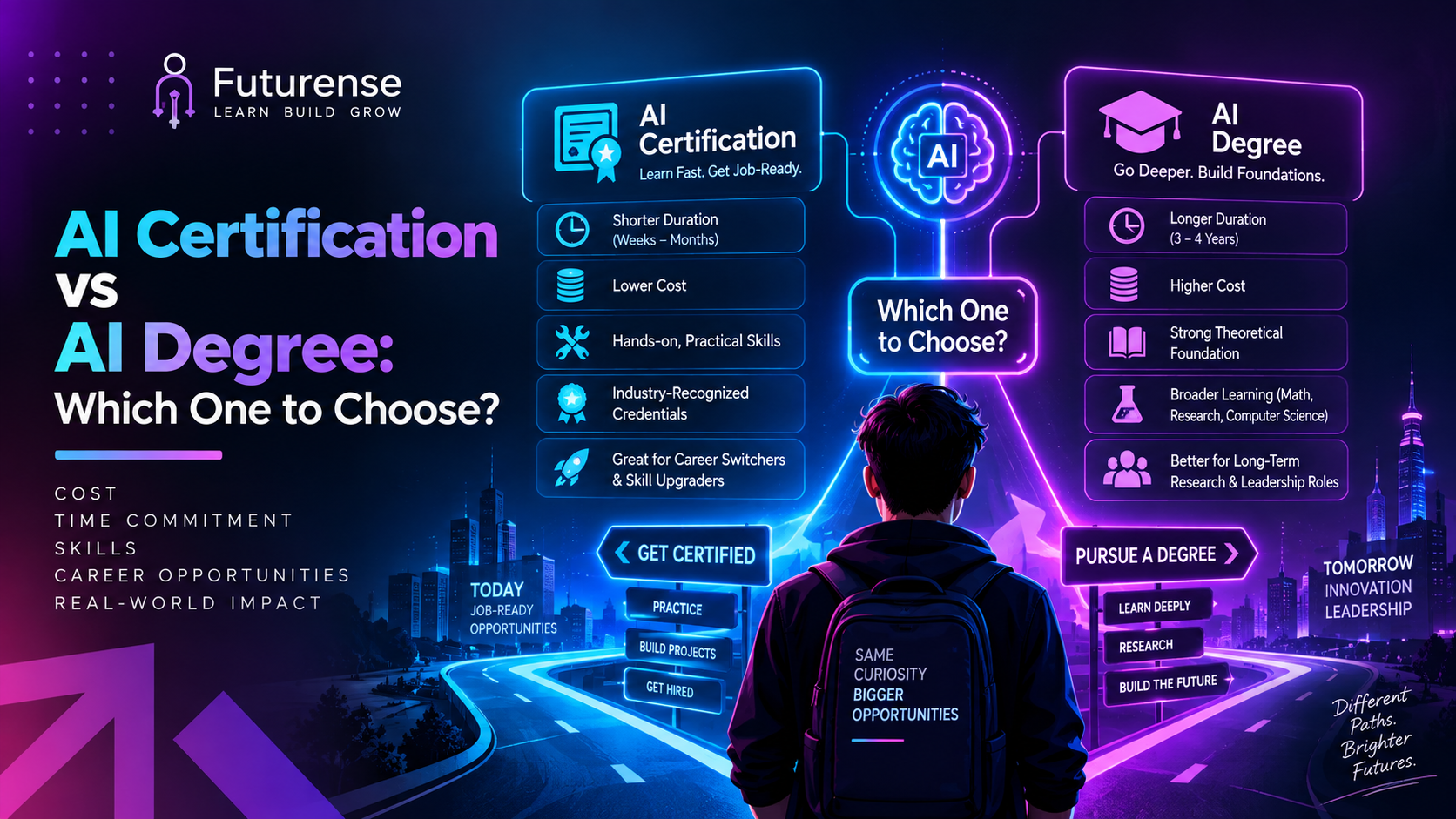
If you're specifically drawn to the business-leadership side of AI rather than either pure discipline, our guide on MBA in Artificial Intelligence covers a hybrid path worth considering. And once you've picked a direction, our comparison of AI Certification vs AI Degree is the natural next read for deciding how to credential into it. For readers choosing the Applied AI path specifically and wanting hands-on, deployment-focused training, Futurense's PG Certificate in Forward Deployed AI Engineering with IIT Roorkee is built around exactly that combination of applied AI skill and real production deployment experience. Our broader guide on how to start a career in AI is a good starting point if you're still clarifying direction before committing to either path.
TL;DR: Business Analytics interprets data to help leaders make better decisions it finds the "what" and answers "so what" and "now what." Applied AI builds and deploys systems that act on data directly, automating decisions and predictions at scale rather than just informing them. The real difference comes down to how each field splits its time between people and data Business Analytics leans toward people, strategy, and communication; Applied AI leans toward building, deploying, and maintaining technical systems.
What is the main difference between Business Analytics and Applied AI?
Business Analytics interprets data to inform decisions made by people, focusing on strategy, forecasting, and communication. Applied AI builds and deploys AI systems that can act on data more directly, automating predictions or decisions rather than just informing them.
Do I need to know how to code for Business Analytics or Applied AI?
Applied AI requires genuine programming ability, typically in Python, along with applied machine learning knowledge. Business Analytics requires strong statistics and data-handling skills but generally has a lower coding bar, with many roles reachable through SQL and business intelligence tools rather than full programming fluency.
Which pays more: Business Analytics or Applied AI?
At entry level, pay is fairly close, with Business Analyst roles in India commonly in the ₹5-9 lakh range. Applied AI and AI-adjacent technical roles tend to start somewhat higher and show faster long-term salary and job growth, reflecting the steeper technical skill barrier and stronger current demand for AI-specific expertise.
Can I switch from Business Analytics to Applied AI, or vice versa?
Yes, and it's a common transition given the shared foundation in data literacy. Moving from Business Analytics to Applied AI typically requires building real programming and applied machine learning skills, while moving the other way requires developing stronger stakeholder communication and business-strategy skills.
Which field is growing faster: Business Analytics or Applied AI?
Applied AI and AI-specific roles are currently showing faster projected growth in most sources, reflecting the broader AI adoption wave across industries. Business Analytics remains a strong, durable field with steady demand, particularly in consulting, finance, and healthcare.
Is Applied AI just Data Science with a different name?
Not quite. Applied AI focuses specifically on putting existing AI capabilities to work on real business problems and deploying them reliably in production, while Data Science is a broader field that also includes deeper statistical modeling, experimentation, and research-oriented work. Applied AI sits closer to engineering; Data Science sits between engineering and research.


MBA with AI for Working Professionals
IIM Sirmaur
India’s first AI-native MBA, designed for tech & non-tech professionals.