


Why This Decision Deserves More Than "It Depends"
"It depends" is technically true and practically useless. The better framing: the right answer depends on three specific things your current position, your career destination, and your timeline not on which credential sounds more impressive. This article works through each of those factors concretely rather than leaving you with a shrug.
If you've already decided a full degree is the right path and just need to pick among AI degree types, our guide on which degree is best for AI picks up exactly where this article leaves off. This piece is scoped one level higher: certification versus degree as categories, before you narrow down within either one.
What an AI Certification Actually Is
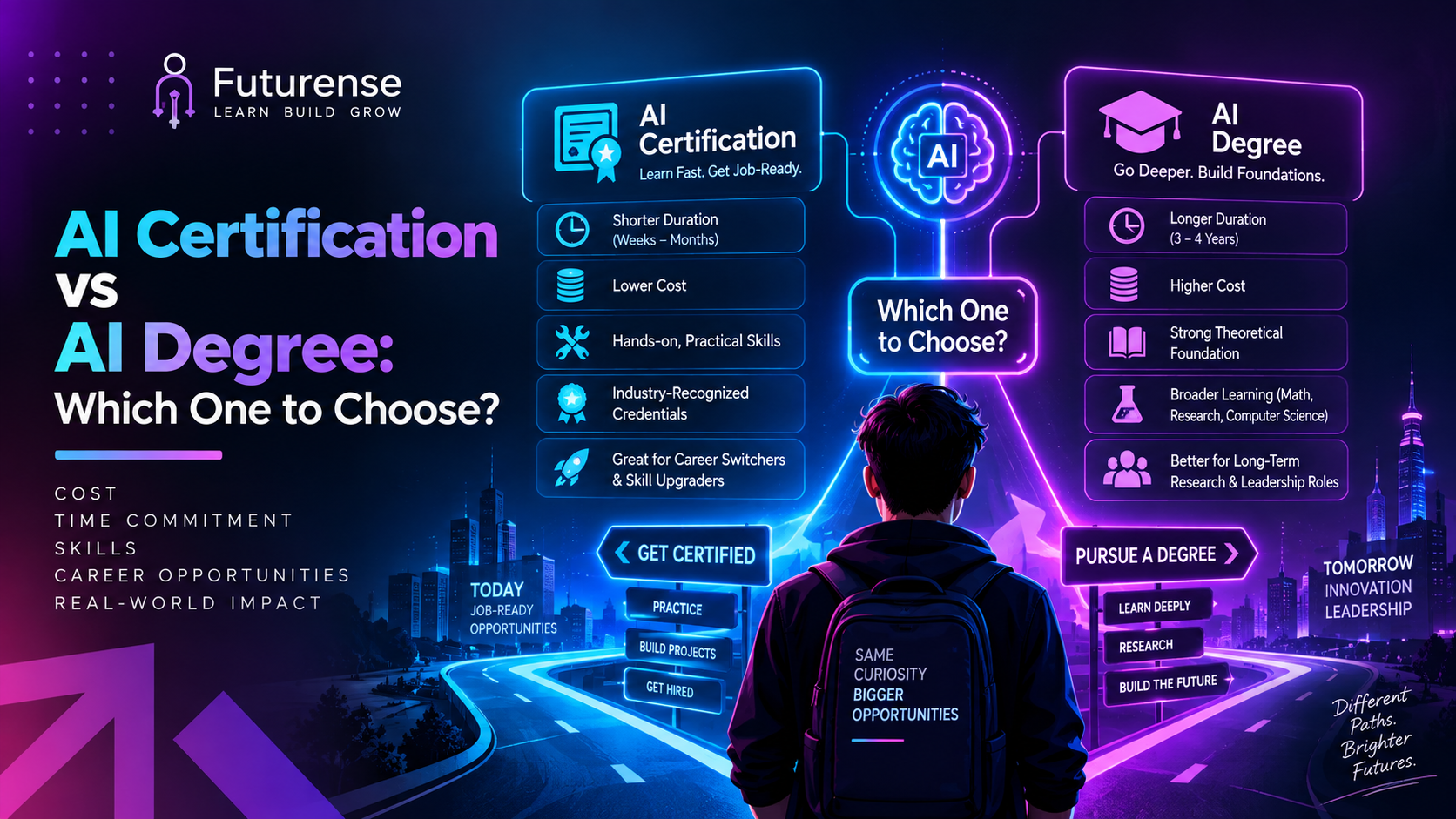
An AI certification is a structured learning credential that proves you understand specific AI concepts, tools, or technologies unlike a full university degree, certifications are shorter, career-focused, and skill-oriented, typically completed in weeks to months rather than years. Options from major cloud providers and dedicated ed-tech platforms tend to carry real recognition with employers, particularly when they involve hands-on project work rather than multiple-choice testing alone.
The appeal is speed and focus: you're not paying for four years of general education alongside your AI coursework you're paying specifically for the AI skill layer, which makes certifications a strong fit for professionals adding AI capability on top of existing domain expertise.
What an AI Degree Actually Is
An AI degree whether a bachelor's, master's, or specialized postgraduate program provides comprehensive theoretical knowledge, research opportunities, and typically requires two to four years of study, covering foundational theories, advanced algorithms, and often a thesis or capstone project. Degree programs go deeper into the "why" behind AI systems, not just the "how," and typically include collaboration with faculty on original research or advanced coursework a shorter program simply doesn't have time to cover.
The trade-off is equally real: significantly more time and money invested before you're job-market-ready, and less flexibility to pivot mid-way if your career goals shift.
AI Certification vs AI Degree: Side-by-Side Comparison
What the Salary Data Actually Shows
It's worth being precise here rather than waving at "degrees pay more" as a vague truism. AI master's degree holders are reported to be roughly 25% more likely to secure advanced roles than certificate holders, with an average salary gap of around 30% between the two groups a real, measurable premium at the graduate-degree end specifically, not just a general sense that "more education is better." Median AI degree-holder salaries are also reported in the range of roughly $120,000 in mature markets, reflecting the ceiling effect advanced roles carry.
That said, the certification path isn't a consolation prize financially either for career switchers specifically, certifications typically offer a faster return on investment precisely because the time-to-earning gap is so much shorter, even if the ultimate ceiling sits somewhat lower than a graduate degree's. The right way to read this data: degrees win on ceiling, certifications win on speed-to-ROI, and which one matters more depends entirely on your timeline and current financial position.
Where Employers Actually Land on This Question
The honest, if slightly unsatisfying, answer: it varies meaningfully by role level and industry, and employer sentiment has shifted noticeably in the certification's favor over the past two years. Employers increasingly care less about whether a candidate has a four-year AI degree and more about whether they can actually build AI-powered solutions a real shift driven by how fast practical AI tooling has moved relative to how slowly formal curricula update. Employers hiring for many AI roles show no strong systematic preference between an associate-level credential and a certificate, focusing instead on demonstrated skills and hands-on project experience over the credential type itself.
That shift isn't universal, though. Employers in heavily regulated sectors like finance and healthcare still prioritize degrees for compliance and credibility reasons specific to those industries, while degrees generally retain an edge for mid- and senior-level roles that require advanced theoretical grounding or original research capability the kind of depth a shorter certification format structurally can't provide.
The Hybrid Path Most People Actually Should Take
The smartest move, according to nearly every credible source on this question, is combining both rather than treating it as a binary choice and this is genuinely the most useful, actionable insight in the whole debate, not a hedge. For someone already working in a domain marketing, finance, operations, healthcare pairing that existing expertise with a focused AI certification creates a combination companies specifically want: people who understand AI and understand a specific domain, which is a genuinely rarer and more valuable profile than an AI generalist alone.
For students or early-career professionals with more runway, a credentialed postgraduate certificate something with real institutional backing, sitting between a short bootcamp and a full multi-year degree often captures much of a degree's credibility signal without the full time and cost commitment. Our guide to IIT certificate courses covers this middle tier in more depth, and if you're unsure how a postgraduate diploma or certificate compares structurally to a full degree, the difference between a diploma and a degree clears up that distinction directly.
If you're specifically weighing a graduate-level AI degree, which master's degree is best for AI careers is the right next read. If a certification-first path fits your situation better, our Gen AI certification guide and our comparison of best Agentic AI courses in India are strong starting points for choosing a specific, credible program rather than a generic one.
How to Actually Decide
Start with an honest answer to three questions. First, what's your current position do you already have domain expertise and general technical comfort, or are you starting AI knowledge essentially from zero? Second, what's your destination are you targeting a research-heavy or senior technical role that genuinely needs deep theoretical grounding, or a practical, applied role where demonstrated project skill matters more? Third, what's your actual timeline and financial runway can you realistically commit two to four years and the associated cost, or do you need to be job-market-competitive within months?
If you answered "some domain expertise already, applied role, need speed" lean certification, ideally one with real institutional credibility and hands-on project work. If you answered "starting from scratch, research or senior technical target, have the runway" a degree is the more defensible investment. And if you're not certain yet, our broader guide on how to start a career in AI is a good place to clarify your direction before committing to either credential path. For readers wanting a middle path that pairs real institutional depth with a shorter, more focused timeline than a traditional degree, Futurense's PG Certificate in Forward Deployed AI Engineering with IIT Roorkee is built around exactly that combination
TL;DR: For most people, the choice isn't really either/or it's about sequencing. An AI certification is almost always the better first move if you already have domain expertise in another field (marketing, finance, healthcare, operations) and want to add a high-demand technical layer quickly. A full AI degree makes more sense if you're starting from scratch, want research depth, or are targeting roles in regulated industries that still weight formal credentials heavily. Certifications are faster, cheaper, and more targeted; degrees are broader, more theoretical, and open more doors at the senior and research end of the field.
Is an AI certification enough to get a job, or do I need a degree?
For many practical, applied AI roles, a strong certification with real hands-on project work is enough to be competitive, particularly if you already have domain expertise or prior technical experience. For research-heavy or senior technical roles, and in regulated industries like finance and healthcare, a degree still carries meaningfully more weight.
Do AI degree holders really earn more than certificate holders?
Yes, on average, particularly at the master's degree level AI master's graduates are reported to be around 25% more likely to land advanced roles than certificate holders, with an average salary gap of roughly 30% between the two groups. Certifications, however, typically offer a faster return on investment given the much shorter time commitment.
Can I combine an AI certification with a non-AI degree?
Yes, and this is actually the path most sources recommend as the strongest overall strategy. Pairing existing domain expertise (in marketing, finance, healthcare, or another field) with a focused AI certification creates a combination that's often more valuable to employers than an AI generalist background alone.
How long does it take to complete an AI certification versus an AI degree?
AI certifications typically take a few weeks to under a year, depending on depth and format. AI degrees typically require two to four years of full-time study, including foundational and advanced coursework and often a thesis or capstone project.
Which is better for a career switch into AI: a certification or a degree?
For most career switchers, a certification is the better first move, since it delivers a faster return on investment and lets you test the field before committing to a longer, more expensive degree program. A degree becomes the stronger choice if you're switching specifically into a research-oriented or highly technical specialization.
Do employers in India prefer AI degrees or certifications?
It varies by role and sector, similar to global trends. Indian employers in applied, product-focused AI roles increasingly value demonstrated project skills and credible certifications, while research-oriented roles, and employers in regulated sectors, tend to still weight formal degrees more heavily, particularly from recognized institutions like the IITs.


B.S/B.Sc in Applied AI & Data Science
IIT Jodhpur
Be a Part of India’s First Advanced AI Regular Degree with the Best Minds at IIT