
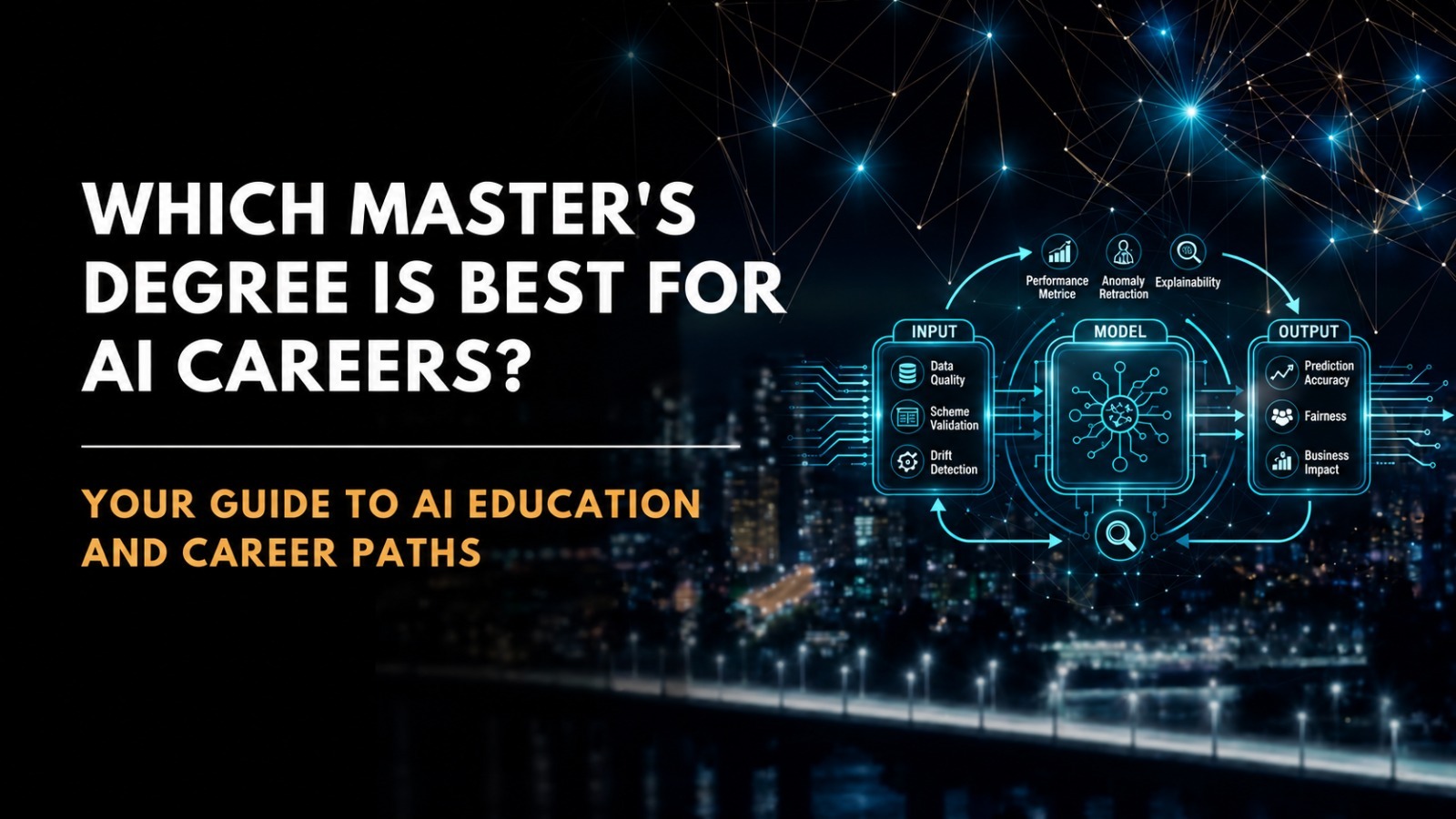


There's no single "best" master's degree for an AI career; the right one depends on whether you want to research AI, build AI products, or apply AI systems inside real companies.
A thesis-driven MS in Artificial Intelligence or Computer Science suits research and applied-scientist roles; an MTech in AI or Data Science (in India) suits structured, GATE-eligible technical roles; an MS/MSc in Data Science suits analytics-heavy roles; and an applied PG program or certification suits people who already have a technical degree and want job-ready skills fast, without a full two-year commitment.
If that sounds like more nuance than you expected, that's the point most "best AI masters degree" rankings compare universities, not the actual decision in front of you: which type of degree matches the AI career you actually want. That's what this guide breaks down.
Do You Actually Need a Master's Degree for an AI Career?
For research-oriented roles (AI research scientist, applied scientist at a frontier lab), a master's is close to a hard requirement, and many of these roles expect a PhD. For engineering-heavy roles (ML engineer, AI engineer, data engineer working on AI pipelines), a strong bachelor's degree plus a demonstrable project portfolio can get you in the door, especially at startups a master's accelerates the process rather than gatekeeping it.
For applied, deployment-facing roles, employers usually care more about your ability to ship working systems in messy, real-world conditions than which degree you hold; a bachelor's plus an applied program is often a faster, cheaper path than a full research master's.
The honest answer: a master's degree buys you credibility, a stronger technical foundation, and in research roles access you can't easily get otherwise. It doesn't automatically buy you a job. Pair whichever path you choose with real projects.
The Main Master's Degree Paths for AI Careers
Every "AI masters" search eventually funnels into one of these five paths. Here's how they actually differ.
MS in Artificial Intelligence
This is the most direct, research-heavy path dedicated to AI programs now numbering in the hundreds globally, a sharp jump from a handful just five years ago, reflecting how fast the field has professionalized.
These programs concentrate on machine learning theory, deep learning, natural language processing, and increasingly AI ethics and governance. If your goal is an applied scientist or research engineer role at a frontier AI lab, this is usually the most direct route but it also assumes you're comfortable with heavy math and, often, a thesis or publication expectation.
MS/MTech in Computer Science with an AI Specialization
A broader computer science master's with AI electives gives you more optionality than a dedicated AI degree you graduate credible for software engineering, systems, cloud, and AI roles rather than only AI-specific ones.
This matters if you're not 100% certain AI is your permanent specialization, or if you want a safety net in case the AI job market tightens before you graduate.
MS/MSc in Data Science
If your interest in AI is really an interest in working with data pipelines, experimentation, predictive modeling, business analytics a data science master's is often the better technical fit than a pure AI degree, and typically has a shorter on-ramp since it leans less on deep theoretical math.
MTech in AI/Data Science
For students staying in India, MTech remains the structured, GATE-eligible route, commonly pursued at IITs, IIITs, and NITs. It's more practice- and coursework-oriented than a thesis-heavy MS abroad, and it's typically the faster, lower-cost route to a strong Indian tech-industry role though it carries less weight than an international MS if your goal is to work abroad or pursue a PhD.
MBA with an AI/Tech Focus
Worth naming because it's genuinely underrated for one specific career track: AI product management and technical leadership. If you already have engineering depth and want to move toward strategy, an AI-focused MBA can be a stronger lever than a second technical master's.
Applied PG Programs and Certificates
This is the fastest-growing category, and the one most standard "best AI masters" rankings skip entirely. These are shorter, project-based programs built for people who already have a bachelor's degree (often in a technical field) and want deployment-ready skills without committing two years and significant tuition to a second full master's. They're a particularly strong fit if you're targeting applied, customer-facing engineering roles, where employers weigh your ability to deploy real systems under real constraints far more heavily than your degree title.
MS vs MTech for AI Careers: Which Should You Choose in India?
This is the single most common version of this question, so it deserves its own breakdown.
Choose MS (abroad or research-focused): If you want international exposure, are drawn to research or a future PhD, and can invest in a higher upfront cost for potentially higher long-term earning power, especially at global AI labs and product companies.
Choose MTech (India): If you want a faster, lower-cost route to a strong Indian tech role, prefer a structured curriculum over open-ended research, and are comfortable with GATE-based admission.
Neither is a wrong answer MS tends to win on global career optionality, MTech tends to win on cost and time-to-ROI within India. If you're weighing this specifically because you want to work in applied, deployment-heavy AI roles rather than research, it's worth explicitly comparing both against a third option: an applied PG program that skips the 2-year commitment entirely. More on that below.
Which Master's Degree Fits Which AI Career Path
Working backward from the job you want is usually more useful than starting from the degree name.
If you're unsure which of these paths actually fits you, it's worth researching what applied, deployment-facing AI roles actually demand day to day before assuming a research-heavy master's is the default answer for a meaningful share of AI-adjacent roles, it isn't.
Cost, Duration, and ROI: What Each Path Actually Costs You
Beyond curriculum fit, cost and time-to-ROI are usually the deciding factor once two options seem equally credible on paper.
- MS abroad (AI/CS/Data Science): highest cost, 1.5–2 years, strongest global optionality, slowest time-to-first-paycheck
- MTech in India: moderate cost, 2 years, strong within-India ROI, GATE-gated admission
- MBA with AI focus: moderate-to-high cost, 1–2 years, best ROI if you're already technical and moving toward leadership, weak ROI if used as a first technical credential
- Applied PG program/certificate: lowest cost, 3–12 months, fastest time-to-job, strongest ROI specifically for applied/deployment roles, weakest fit if your target role genuinely requires research depth
The pattern worth noticing: cost and duration scale roughly with how research-oriented the path is, not with how employable it makes you for applied engineering roles. A two-year, high-cost MS isn't automatically the safer bet if the role you actually want values deployment experience over research depth.
Do You Need a Full Master's, or Would an Applied Program Get You There Faster?
If you already hold a technical bachelor's degree and your target role is applied building, deploying, and stabilizing AI systems inside real companies rather than researching new architectures, a full second master's degree may not be the most efficient path. This is exactly the gap applied PG programs and certificates are built to close.
Applied PG certificates built around a recognized academic partner are designed for people in this exact position: technically capable, not looking to spend two years and a research thesis to get there, and aiming specifically at deployment-facing AI roles rather than research ones. They pair applied, project-based training with an academic credential, without the full time and cost commitment of a traditional master's.
This isn't the right substitute for everyone if your target role genuinely requires research depth (AI research scientist, PhD track), a full master's remains the more direct route. But if you're evaluating "best master's degree for AI careers" because you assumed a full master's was your only option, it's worth first confirming your target role actually needs one.
How to Choose the Right Master's Degree for Your AI Career Goals
Work through these four questions in order they eliminate options faster than comparing university rankings does.
- Do you want to research AI, or apply it? Research → MS/PhD. Apply → keep reading.
- Do you need international mobility, or are you building your career in India? International → MS abroad. India-focused → MTech or an applied program.
- Is your bottleneck technical depth, or deployment/product experience? Technical depth → MS/MTech. Deployment experience → applied PG program or certificate.
- Can you commit two years and the associated cost, or do you need to be job-ready faster? Two years, fine → traditional master's. Faster → applied/certificate route.
Most people land on a clear answer within these four questions. The ones who don't are usually genuinely early-career and would benefit from projects and internship experience before committing to any master's degree at all degree choice matters less when you don't yet know which AI career track excites you.
TL;DR
- There's no single "best" AI master's degree; the right one depends on whether you're targeting research, engineering, product, or deployment-facing roles.
- MS in AI/CS suits research and applied-scientist paths; MTech (India) suits structured, cost-effective technical roles; MSc Data Science suits analytics-heavy AI work; an AI-focused MBA suits product/leadership tracks.
- A full master's isn't always necessary for applied, deployment-facing AI roles, a bachelor's plus a shorter applied PG program or certificate can be a faster, lower-cost route in.
- Work backward from the specific AI career you want before comparing degree names or university rankings.
Do I need a master's degree for an AI career?
Not always. Research-oriented AI roles typically require one (and often a PhD), but applied roles like ML engineering, data engineering, and other deployment-facing AI roles can be reached with a strong bachelor's degree, real projects, and increasingly a shorter applied PG program instead of a full master's.
Which is better for AI careers, MS or MTech?
Neither is universally better. MS tends to offer stronger international career optionality and research access; MTech in India tends to offer faster, lower-cost ROI for technical roles within the Indian job market. The right choice depends on whether you're optimizing for global mobility or in-country speed.
Can I get an AI job with just a bachelor's degree?
Yes, particularly for engineering-heavy and deployment-facing roles at startups and applied-AI companies, provided you can show real project work. Research-scientist roles remain the exception where a master's or PhD is close to mandatory.
Is a master's in data science or a master's in AI better for a career?
It depends on what you enjoy day to day. Data science leans toward statistics, experimentation, and business analytics; AI leans toward deep learning theory and model architecture. If you're unsure, data science is generally the shorter, more broadly applicable on-ramp.
How long does a master's degree in AI typically take?
Most MS and MTech programs in AI, computer science, or data science run 1.5 to 2 years full-time. Applied PG programs and certificates aimed at deployment-focused roles typically run 3 to 12 months.
Is an MBA useful for an AI career?
Yes, specifically for AI product management or technical leadership tracks, provided you already have technical depth from a prior degree or work experience. It's a weaker choice as a first technical credential if you're starting from a non-technical background.


PG Diploma in AI-ML & Agentic AI Engineering
IIT Gandhinagar
India's First Residential PG Diploma Inside an IIT Campus

.avif)