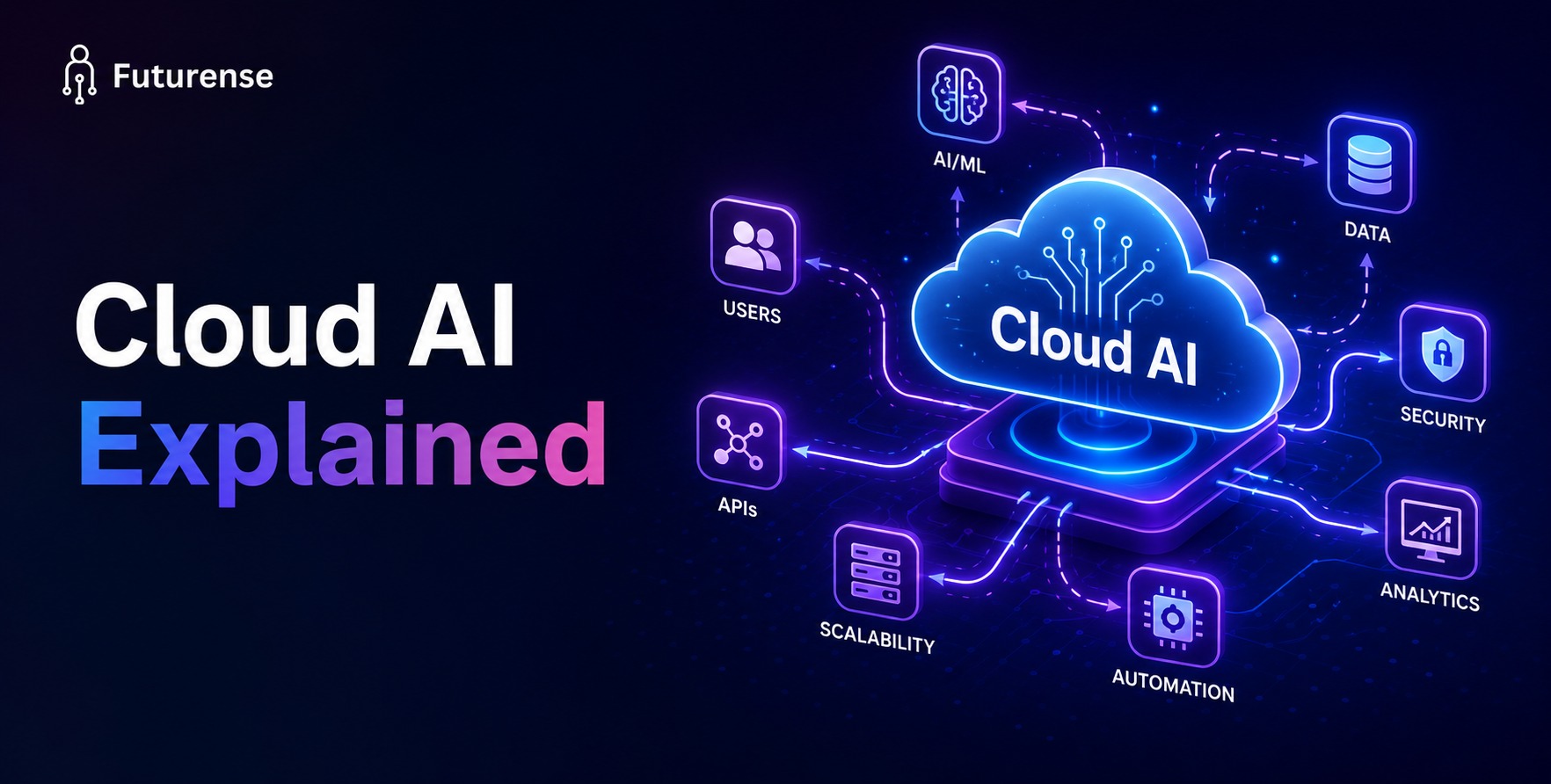


Cloud AI is the delivery of artificial intelligence capabilities like natural language processing, image recognition, prediction, and automation through remote servers accessed over the internet, instead of hardware you own and maintain yourself. Rather than buying GPUs and building infrastructure from scratch, a business connects to a cloud platform like AWS, Google Cloud, or Microsoft Azure and uses AI models, tools, and compute power on demand.
Think of it the way you think about electricity. You don't generate your own power at home, you plug into the grid and use what you need. Cloud AI works the same way: you plug into a cloud provider and use AI capabilities on demand, paying only for what you consume.
This guide covers how cloud AI actually works, how it compares to running AI on your own hardware, what the major platforms offer, and what a career in this space looks like.
What Is Cloud AI, and Why Does It Matter Now?
Cloud AI combines two things that used to be separate: cloud computing's on-demand infrastructure, and artificial intelligence's data-hungry, compute-intensive workloads. Before cloud AI became mainstream, running a serious AI model meant buying and maintaining your own servers and GPUs was expensive, slow to scale, and out of reach for most smaller companies.
Cloud AI removed that barrier. A startup with no hardware budget can now call an API and get the same underlying model quality as a company that spent millions on infrastructure. That shift is a big part of why AI adoption accelerated so sharply over the past few years.
The market reflects that shift. Global cloud infrastructure spending crossed $119 billion in a single quarter by late 2025, and by 2026, most new cloud applications are being built AI-native by default designed from the start around models, agents, and orchestration layers rather than having AI bolted on later.
If you want the underlying infrastructure concepts first, our guide on cloud computing models covers IaaS, PaaS, and SaaS before you go deeper into the AI layer built on top of them.
How Does Cloud AI Actually Work?
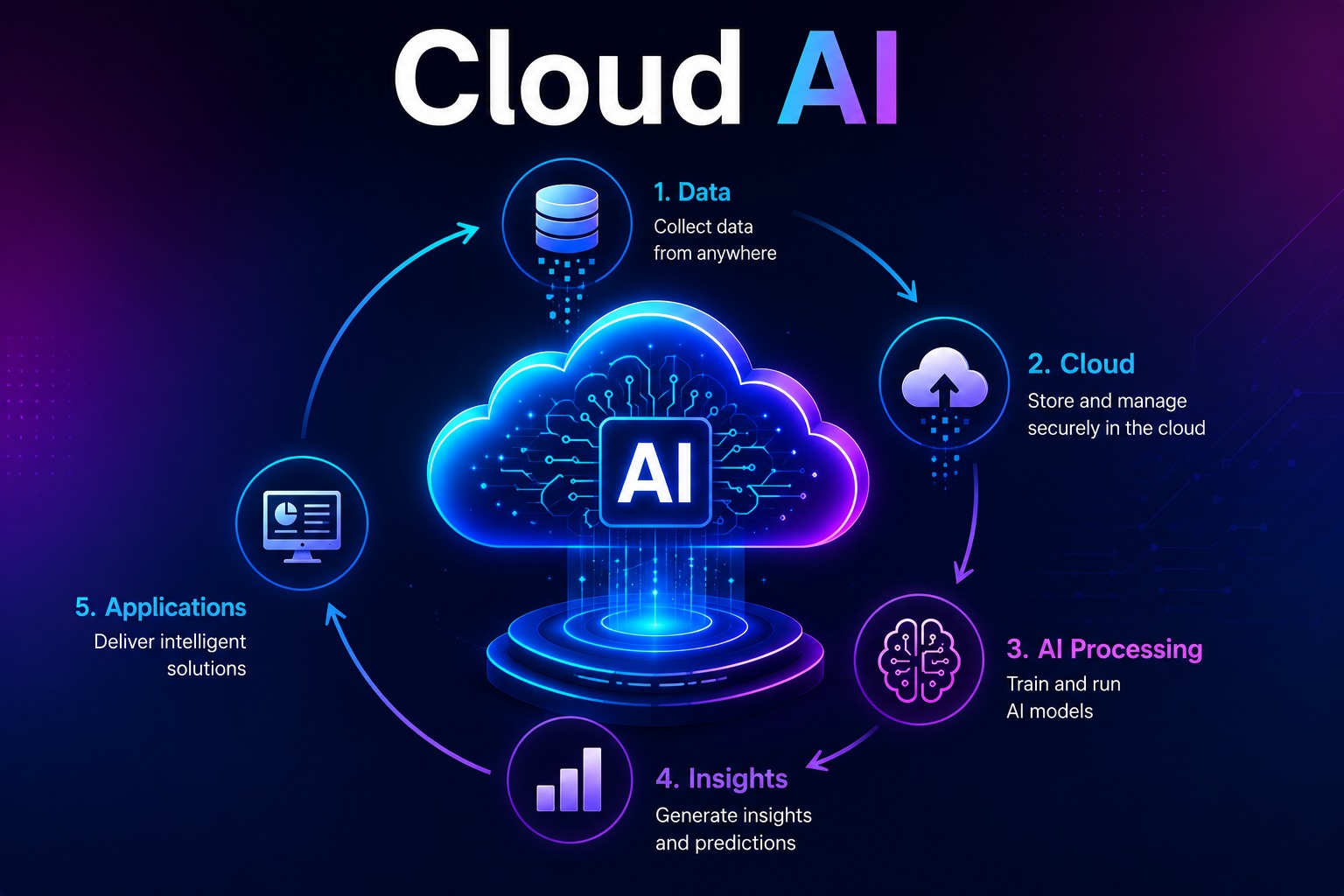
Underneath the marketing language, cloud AI is a stack of a few distinct layers working together.
- Data storage and pipelines cloud object storage and data pipelines that feed raw data into the system, cleaned and formatted for training or inference
- Compute, usually GPU-based the processing power that trains models and runs them once deployed, provisioned on demand instead of sitting idle in your own data center
- Pre-trained or custom models foundation models available through the provider, or your own models trained on your data using the provider's tools
- APIs and SDKs the interface your application actually calls to get a prediction, a generated response, or a classification back
An application doesn't need to know or care where the model physically runs. It sends a request, the cloud provider's infrastructure handles the heavy computation, and a result comes back usually in milliseconds.
AI-as-a-Service and Machine Learning as a Service
Two terms come up constantly in this space, and they're worth distinguishing. AI-as-a-Service (AIaaS) refers to ready-made AI capabilities translation, image recognition, chatbots that you consume through an API without building or training anything yourself.
Machine Learning as a Service (MLaaS) goes a layer deeper: it gives you the tools to train and deploy your own custom models on the provider's infrastructure, rather than just consuming a pre-built capability. Most real cloud AI usage blends both a pre-built model for a common task, and a custom-trained one for something specific to your business.
Benefits of Cloud AI
Cloud AI's rapid adoption isn't accidental; it removes several real barriers that used to keep AI out of reach for most organizations.
- Lower upfront cost - There's no need to buy racks of GPUs before you know whether a use case even works. Pay-as-you-go pricing means you spend against actual usage, not projected capacity.
- Faster time to market - Pre-trained models and managed infrastructure mean a team can go from idea to working prototype in days instead of the months it used to take to provision and configure hardware.
- Elastic scalability - Compute scales up automatically during peak demand and back down when it's not needed; a spiky workload that would require significant over-provisioning on-premise just becomes a usage-based cost in the cloud.
- Access to frontier models - Cloud platforms give smaller teams the same access to state-of-the-art foundation models that well-funded labs use, closing a gap that used to separate large companies from everyone else.
- Reduced maintenance burden - Providers handle hardware failures, security patching, and infrastructure upgrades, freeing engineering time for building the actual product instead of babysitting servers.
The Major Cloud AI Platforms in 2026
Three providers dominate this space, and each has taken a genuinely different strategic bet.
AWS - AWS centers its AI strategy on choice and flexibility through Amazon Bedrock, a platform that gives developers API access to foundation models from multiple providers rather than betting on one. Want Anthropic's Claude? It's on Bedrock. Prefer Meta's Llama or Mistral instead? Also on Bedrock. This model-agnostic approach means teams aren't locked into a single model vendor.
Google Cloud - Google Cloud holds a smaller market share than AWS but is growing faster, posting strong year-over-year revenue growth driven by its AI-first architecture. Google builds everything from custom chips to end-user applications around AI, which shows up in Vertex AI consistently performing well for data-heavy and AI-native workloads specifically.
Microsoft Azure - Microsoft Azure leans heavily on its deep OpenAI partnership through Azure AI, making it a natural fit for enterprises already standardized on Microsoft's broader ecosystem Office, Teams, and Windows infrastructure that many large organizations already run on.
Cloud AI vs. On-Premise AI: Which Should You Actually Use?
This is the question every organization eventually has to answer, and the honest answer is: it depends on what you're optimizing for.
Cloud AI wins on:
- Scalability near-infinite compute available on demand, ideal for spiky or unpredictable workloads
- Cost efficiency pay-as-you-go pricing that aligns spend with actual usage, especially valuable for startups
- Managed infrastructure the provider handles maintenance, updates, and hardware refreshes
On-premise AI wins on:
- Data control sensitive data never leaves the organization's own network, which matters enormously for finance, healthcare, and government
- Latency real-time applications can perform faster without a round-trip to a remote data center
- Customization full control over model behavior and infrastructure configuration without a provider's constraints
A growing number of enterprises don't pick one exclusively. A hybrid approach keeping sensitive data and mission-critical workloads on-premise while sending large-scale training and non-sensitive analytics to the cloud has become the default operating model for organizations balancing both needs, with over 70% of organizations now running some form of hybrid cloud.
Real-World Cloud AI Examples You Already Use
Cloud AI isn't an abstract enterprise concept; most people interact with it daily without noticing.
- Streaming recommendations - When Netflix or Spotify suggests something you actually want, that's cloud AI analyzing behavioral data at a scale no local device could handle.
- Traffic prediction - Real-time traffic estimates in navigation apps come from AI processing millions of live data points on cloud infrastructure, not a calculation happening on your phone.
- Voice assistants - Every time a voice assistant understands a spoken request, that audio is typically processed by cloud-based natural language models, not the device itself.
- Fraud detection - Banks and payment platforms run real-time cloud AI models that flag suspicious transactions in the moment, not after the fact.
What Cloud AI Providers Actually Handle for You
Part of what makes cloud AI appealing is everything a provider quietly takes off a team's plate. Cloud platforms typically bundle in encryption, authentication, authorization, and firewall protections by default security infrastructure a smaller company would otherwise have to build and maintain entirely on its own.
Established providers also carry industry certifications and compliance accreditations that would be expensive and slow for an individual organization to obtain independently. That's a real, underrated part of the value: a startup using AWS or Google Cloud inherits a baseline of security posture that would otherwise take a dedicated security team months to build from scratch.
The tradeoff is dependency. Relying on a provider's security and compliance posture means trusting that posture which is exactly why highly regulated industries often keep their most sensitive workloads on-premise even while using cloud AI for everything else.
Cloud AI Governance and Cost Management
Two challenges show up in nearly every serious cloud AI deployment, and they're worth understanding before treating cloud AI as a purely technical decision.
Governance and security - AI adoption inside cloud environments is now accelerating faster than governance frameworks can keep up, according to recent industry research meaning many organizations are running AI workloads with more visibility and compliance gaps than they'd like. Standardized identity and access management, along with observability across every cloud environment in use, has become essential rather than optional.
Cost management - Cloud AI's pay-as-you-go model cuts both ways. Training large models in the cloud can get expensive fast, and hidden costs data egress fees, storage I/O, idle compute, cross-region transfers add up in ways that are easy to underestimate. AI cost management, particularly GPU utilization and token-based billing, has become one of the most in-demand skills for teams running production AI workloads.
The Future of Cloud AI
A few shifts are already shaping where cloud AI goes next, worth knowing if you're evaluating this space for the long term rather than just the current moment.
Agentic, AI-Native Applications
Agentic, AI-native applications are becoming the default rather than the exception new cloud applications are increasingly designed from the ground up around models, autonomous agents, and orchestration layers, rather than having AI added on afterward.
Sovereign and Regional Cloud Offerings
Sovereign and regional cloud offerings are expanding as more countries introduce data residency requirements, giving organizations region-specific options that didn't exist a few years ago.
Edge-Cloud Hybrid Architectures
Edge-cloud hybrid architectures are maturing to handle latency-sensitive AI workloads locally while still relying on the cloud for heavier training and less time-sensitive processing, narrowing one of cloud AI's biggest traditional weaknesses.
Building a Career in Cloud AI
Cloud AI roles are growing meaningfully faster than traditional IT roles, and the skill combination this space rewards is genuinely distinct from either pure cloud engineering or pure AI/ML work alone.
Three things matter most for breaking into this field:
- Core cloud fundamentals - Comfort with at least one major provider's ecosystem compute, storage, networking, and identity management is the foundation everything else builds on.
- AI/ML literacy - Understanding how models are trained, deployed, and monitored, even without deep research-level ML expertise, is what separates a cloud AI practitioner from a general cloud engineer.
- MLOps discipline - Deploying a model once is easy. Keeping it monitored, cost-controlled, and performing well in production over time is where most of the real, ongoing work actually lives, a discipline that borrows heavily from what DevOps actually is, applied specifically to machine learning systems.
Roles in this space typically fall under titles like AI Engineer, Cloud Engineer, or MLOps Engineer, and compensation reflects the specialized skill combination for context on where these roles land financially, see our guides on cloud engineer salary in India and AI engineer salary in India.
If you want structured, hands-on training that covers this exact skill combination, Futurense's Advanced PG Certificate in AI Engineering, Cloud & AIOps is built specifically around cloud-native AI engineering and operations.
TL;DR
- What it is: AI capabilities delivered over the internet through a cloud provider, instead of on infrastructure you own
- Major platforms: AWS (Bedrock), Google Cloud (Vertex AI), Microsoft Azure (Azure AI) each with a different core strategy
- Cloud AI vs. on-premise: cloud wins on scalability and cost-efficiency; on-premise wins on data control and compliance for highly regulated industries
- How it works: a stack of data storage, compute (often GPU-based), pre-trained or custom models, and APIs that applications call
- Common examples: recommendation engines, voice assistants, fraud detection, and traffic prediction all run on cloud AI today
- Career angle: cloud AI roles span AI engineer, cloud engineer, and MLOps positions, and are growing faster than general IT roles
What is cloud AI in simple terms?
Cloud AI means using artificial intelligence tools and models through a cloud platform over the internet, instead of installing and running AI infrastructure on your own local hardware similar to how you use electricity from a grid instead of generating your own power.
Is cloud AI better than on-premise AI?
Neither is universally better cloud AI wins on scalability and cost efficiency, while on-premise AI wins on data control and compliance for highly regulated industries. Many organizations now run a hybrid model that uses both, depending on the workload.
What are the main cloud AI platforms?
The three dominant platforms are AWS (via Amazon Bedrock), Google Cloud (via Vertex AI), and Microsoft Azure (via Azure AI), each taking a different strategic approach to model access and integration.
What is the difference between AIaaS and MLaaS?
AI-as-a-Service (AIaaS) provides ready-made AI capabilities you consume through an API without building anything yourself. Machine Learning as a Service (MLaaS) goes further, giving you tools to train and deploy your own custom models on the provider's infrastructure.
Do I need a machine learning background to work in cloud AI?
Not necessarily a deep research background, but working literacy in how models are trained, deployed, and monitored is essential combined with solid cloud fundamentals on at least one major platform and an understanding of MLOps practices.


Advanced PG Certificate in AI Engineering on Cloud and AIOps
IIT Roorkee
Engineer AI Systems for Top Enterprises, with the Most Critical Skills of the Decade.