

AI in cybersecurity is a genuine double-edged sword: the same underlying technology that powers faster threat detection and automated incident response is also being used by attackers to write more convincing phishing content, automate reconnaissance, and generate malware variants faster than signature-based defenses can keep up. Understanding AI's role in cybersecurity means understanding both sides of that equation, not just the vendor pitch about smarter defense tools.
This shift is also opening up genuinely new career paths. Security teams increasingly need professionals who understand both classical cybersecurity fundamentals and how AI systems can be attacked, defended, and deployed responsibly, a skill combination that's still relatively rare and increasingly well-compensated.
If you want the deeper technical picture of AI's broader role in cybersecurity, that's worth a companion read. This guide focuses specifically on three things: the real threats AI is enabling, the defenses that are actually working, and where the career opportunities sit for anyone looking to specialize at this intersection.
How AI Is Changing the Threat Landscape
AI-powered cyber attacks aren't a future risk. They're already changing how quickly and convincingly attacks can be executed, even when the underlying attack techniques themselves aren't new.
Generative AI is making phishing and social engineering more convincing: Attackers no longer need strong English writing skills or deep familiarity with a target organization to craft a believable phishing email. Generative AI can produce grammatically flawless, contextually plausible messages at scale, and can be used to clone a specific person's writing style from publicly available samples, making targeted spear-phishing attacks harder for both humans and traditional filters to catch.
AI accelerates reconnaissance and vulnerability discovery: Attackers are using AI tools to scan for exposed systems, analyze codebases for exploitable vulnerabilities, and prioritize targets faster than manual reconnaissance ever allowed. This compresses the window defenders have to patch known vulnerabilities before they're exploited.
Deepfakes and voice cloning enable a newer category of social engineering: AI-generated audio and video are increasingly used in business email compromise-style attacks, impersonating executives on calls or in voice messages to authorize fraudulent transactions, a threat category that didn't meaningfully exist in a cybersecurity awareness training program five years ago.
Malware and evasion techniques are becoming AI-assisted: AI can help generate polymorphic malware variants designed to evade signature-based detection, and some research has explored AI's potential role in automating parts of exploit development, though this remains a more contested and less mature capability than AI-assisted phishing or reconnaissance.
Agentic AI introduces new, less understood risks: As agentic AI systems, AI that can autonomously take multi-step actions, become more common in both attack and defense contexts, they introduce a genuinely new risk category: an AI agent with too much autonomy or too little oversight can be manipulated or can make consequential mistakes at a speed and scale manual processes never could.
How AI Strengthens Cybersecurity Defenses
The same capabilities driving new threats are also powering meaningfully better defenses, and this is where the bulk of current enterprise AI cybersecurity investment is actually going.
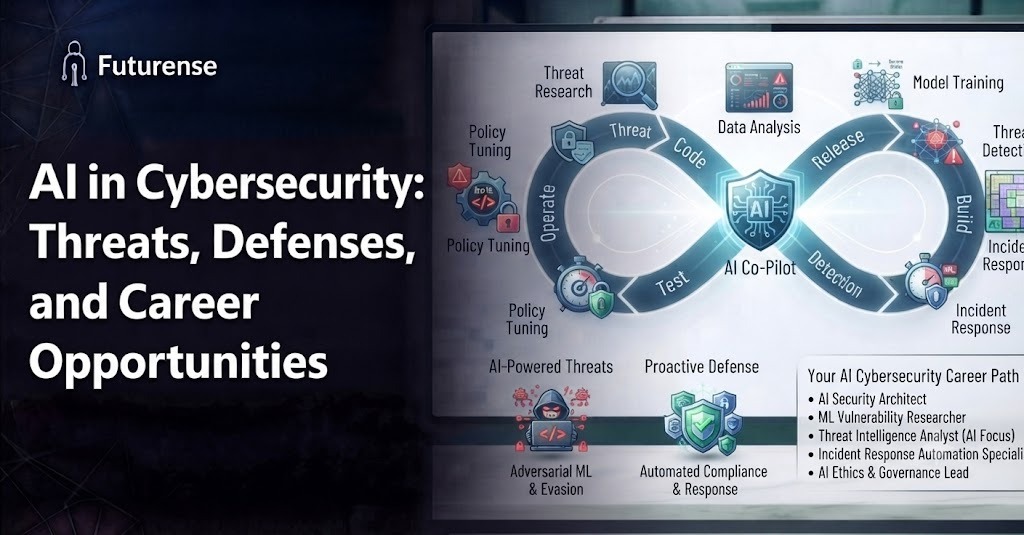
Faster, more accurate threat detection: Machine learning models trained on network traffic and endpoint behavior can flag anomalies far faster than manual monitoring or static rule-based systems, and can adapt to new attack patterns without requiring a human to write a new detection rule for every variant.
Automated incident response: AI-driven security orchestration tools can automatically contain a compromised endpoint, revoke suspicious credentials, or isolate affected network segments within seconds of detecting an anomaly, dramatically cutting the time between detection and containment, a metric that directly correlates with breach cost and impact.
Reduced alert fatigue through better prioritization: Security operations centers are notoriously overwhelmed by alert volume. AI models that can accurately distinguish genuine threats from noise let human analysts focus their attention where it actually matters, addressing one of the most persistent, unglamorous problems in practical cybersecurity operations.
Generative AI as a defensive copilot: Generative AI in cybersecurity is increasingly used to help analysts summarize incidents, draft response documentation, and even generate secure code suggestions during development, extending the same shift-left thinking behind DevSecOps into AI-assisted tooling specifically.
Predictive threat intelligence: AI models trained on threat intelligence data can help security teams anticipate likely attack vectors based on emerging patterns, shifting some security work from purely reactive to genuinely predictive, though this capability is still maturing and works best as an input to human decision-making, not a replacement for it.
The Risks and Limitations of Relying on AI in Cybersecurity
It's worth being honest about where AI in cybersecurity currently falls short, since overselling its capabilities is itself a security risk.
False positives and false negatives remain a real problem: AI models are only as good as their training data, and security threats evolve faster than most training datasets can be refreshed, which means AI-driven detection systems still miss novel attack patterns and still generate false alarms that erode analyst trust over time.
Adversarial attacks specifically target AI models: Attackers have developed techniques to deliberately fool machine learning-based detection systems, crafting inputs designed to evade classification. This creates a security challenge specific to AI systems themselves, protecting the AI defense tools from being attacked isn't optional, it's a growing subfield of its own.
Over-reliance on automation can create blind spots: Fully automated response systems that act without sufficient human oversight can make costly mistakes at machine speed, and organizations that treat AI security tooling as a replacement for skilled analysts, rather than an augmentation of them, tend to discover the gaps the hard way.
AI systems themselves need to be secured: As organizations deploy more AI models and agentic systems, those systems become attack surfaces in their own right, vulnerable to data poisoning, model theft, and prompt injection attacks, a security discipline that barely existed as a distinct specialty a few years ago and is now one of the fastest-growing areas within cybersecurity.
Career Opportunities at the Intersection of AI and Cybersecurity
This threat-and-defense dynamic is creating genuinely new roles, not just adding "AI" as a buzzword to existing cybersecurity job titles.
AI security engineer / ML security specialist: Professionals who understand both machine learning systems and security principles well enough to secure AI models themselves against adversarial attacks, data poisoning, and model theft. This is one of the more scarce, high-value specializations in the current market.
AI-augmented SOC analyst: Security operations analysts who can effectively work alongside AI-driven detection and response tools, understanding both when to trust automated recommendations and when to override them, are increasingly valued over analysts who rely purely on manual triage or purely on automation without judgment.
Threat intelligence analyst with AI fluency: Professionals who can interpret AI-generated threat intelligence, validate its accuracy, and translate it into actionable defense strategy, bridging the gap between raw model output and real organizational decision-making.
AI governance and compliance specialist: As regulation around AI use in security-sensitive contexts matures, organizations increasingly need people who understand both the technical and regulatory dimensions of deploying AI responsibly in security operations.
If you're building toward one of these roles, it helps to start from a solid grounding in what cybersecurity actually covers and the CIA triad in cybersecurity, confidentiality, integrity, and availability, before layering AI-specific skills on top, since AI security work is ultimately an extension of classical security principles applied to a new class of system.
How to Build a Career at the AI-Cybersecurity Intersection
A practical path into this space combines cybersecurity fundamentals with genuine, hands-on AI literacy, not just familiarity with AI buzzwords.
- Get solid on core cybersecurity fundamentals first. Understanding network security, threat modeling, and incident response processes is the foundation everything else builds on. The best cybersecurity courses and certifications are a reasonable starting point if you're building this from scratch.
- Build genuine machine learning literacy. You don't need to become an ML researcher, but understanding how models are trained, what makes them vulnerable to adversarial manipulation, and how to evaluate an AI security tool's actual accuracy versus its marketing claims is increasingly essential.
- Get hands-on with AI-driven security tools. Most major security platforms (SIEM, SOAR, EDR tools) now have AI-assisted capabilities built in. Practical experience operating these tools, not just reading about them, is what differentiates candidates in this space.
- Specialize in AI security specifically if you want the scarcest, highest-value skill set. Learning how adversarial attacks against ML models work, and how to defend against them, positions you in one of the genuinely underserved specializations in cybersecurity right now.
- Consider a structured program if you want to build this skill combination deliberately. IIT Roorkee's PG program in AI, GenAI, and Cybersecurity is built specifically around this exact intersection, combining foundational security training with applied AI and generative AI skills.
Compensation reflects this scarcity. Cybersecurity salary in India has climbed steadily as demand has grown, and professionals who can credibly speak to both AI and security fundamentals are increasingly commanding a premium over those with only one half of that skill set.
TL;DR
AI is transforming cybersecurity on both sides of the attack-defense equation. Attackers are using AI to create more convincing phishing attacks, accelerate reconnaissance, generate malware variants, and exploit emerging technologies such as deepfakes and autonomous AI agents.
At the same time, defenders are using AI for threat detection, automated incident response, alert prioritization, predictive threat intelligence, and security analysis. This is creating new career opportunities for professionals who combine cybersecurity fundamentals with AI and machine learning skills, particularly in AI security, ML security, AI-augmented SOC operations, threat intelligence, and AI governance.
How is AI used in cybersecurity?
AI is used in cybersecurity for both attack and defense. On the defense side, it powers faster threat detection, automated incident response, and reduced alert fatigue through better prioritization. On the attack side, it's used to craft more convincing phishing content, accelerate reconnaissance, and generate malware variants designed to evade detection.
What are the biggest AI-powered cyber threats right now?
The most significant current threats include AI-generated phishing and social engineering content, deepfake and voice-cloning-enabled fraud, AI-accelerated vulnerability scanning and reconnaissance, and adversarial attacks specifically designed to fool AI-based security detection systems.
Can AI fully replace human cybersecurity analysts?
No. AI significantly speeds up detection, triage, and response, but fully automated systems without human oversight can make costly mistakes, and AI models themselves remain vulnerable to manipulation. The strongest security operations combine AI-driven tooling with skilled human judgment, not one in place of the other.
What jobs exist at the intersection of AI and cybersecurity?
Emerging roles include AI security engineers who secure machine learning systems themselves, AI-augmented SOC analysts, threat intelligence analysts with AI fluency, and AI governance and compliance specialists, all of which require genuine literacy in both security and AI fundamentals.
Is a career in AI and cybersecurity worth pursuing?
Yes. This is a genuinely growing specialization, since the number of professionals who understand both security fundamentals and how AI systems work and fail is still relatively small compared to demand, which tends to support both job availability and compensation.
Do I need a machine learning background to work in AI-driven cybersecurity roles?
Not necessarily a formal ML background, but you do need genuine working literacy in how AI models are trained, deployed, and attacked. Many professionals in this space build that AI literacy on top of an existing cybersecurity foundation rather than starting from a pure ML career track


PG Certificate Program in AI/GenAI Powered Cybersecurity
IIT Roorkee
Become the GenAI-native cyber defender every system needs with CEC IIT Roorkee Faculty.

.avif)