
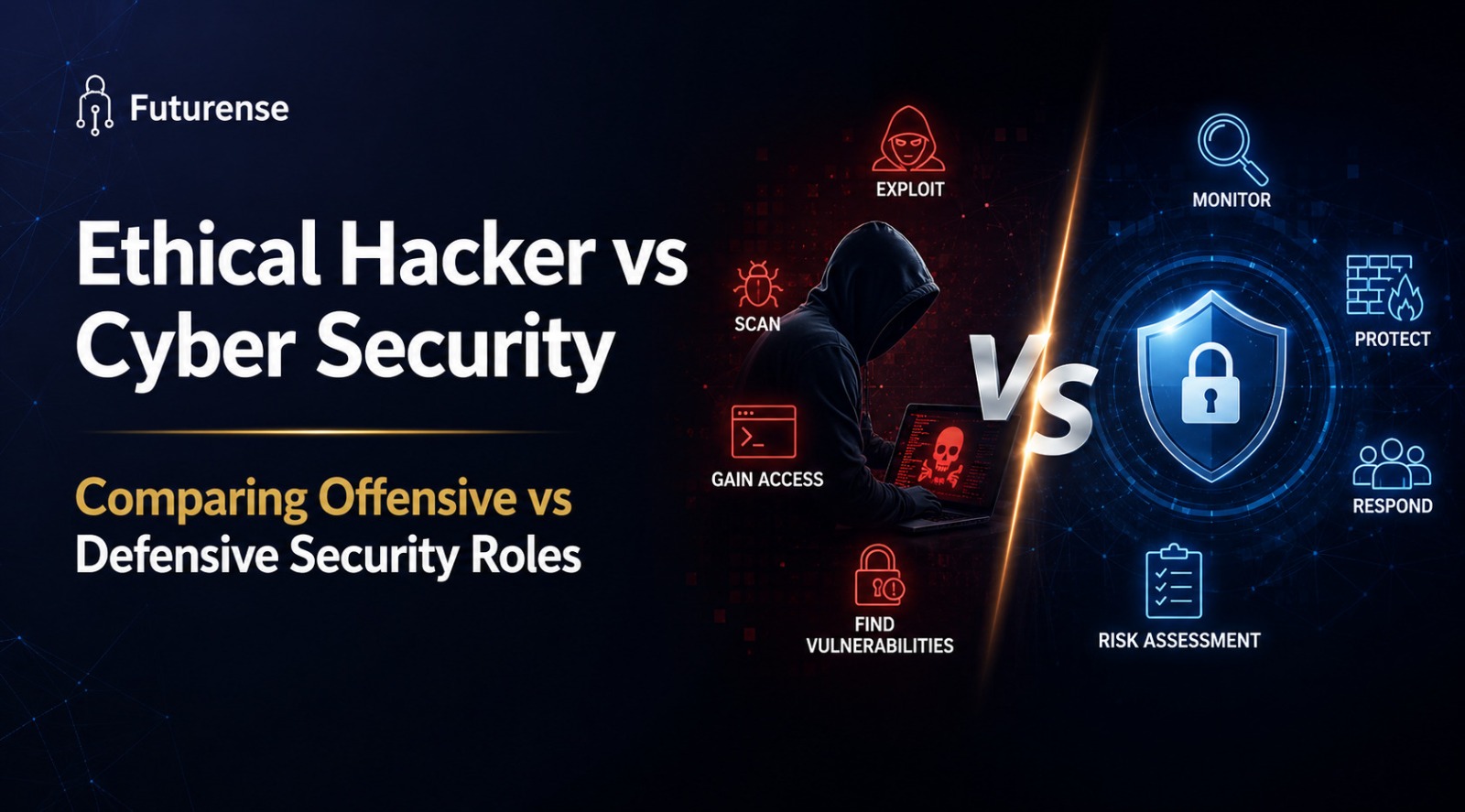


Ethical hacker vs cyber security is a comparison that trips people up because the two things are not the same category. Cyber security is a field. Ethical hacking is a job inside that field. Asking which is better is close to asking whether medicine is better than surgery.
That distinction matters practically, not just semantically. It changes which certification you buy, which interviews you can pass, and which of the two career ladders you are actually standing on.
Cyber security is the discipline of protecting systems, networks, applications, and data from unauthorised access, disruption, and theft. It spans defence, detection, response, governance, and compliance. Ethical hacking is the authorised practice of simulating real attacks against those same systems to find exploitable weaknesses before a malicious actor does. Every ethical hacker works in cyber security. Most cyber security professionals are not ethical hackers.
This guide breaks down what each role does day-to-day, the skills and tools that separate them, what they pay in India, which certifications hiring managers actually check for, and a decision framework for choosing between them.
Why "Ethical Hacker vs Cyber Security" Is a Category Error
Search this phrase and you will find a dozen articles listing "top 10 differences" as if these were two competing careers. That framing is why so many candidates arrive at interviews confused.
- Defensive security: SOC monitoring, incident response, threat hunting, digital forensics
- Offensive security: penetration testing, ethical hacking, red teaming, exploit development
- Governance, risk, and compliance (GRC): policy, audit, regulatory frameworks, risk assessment
- Security engineering and architecture: building secure systems, identity management, cloud security
- Application and product security: secure code review, DevSecOps, threat modelling
Ethical hacking lives in the second box. So when someone asks about the difference between cyber security and ethical hacking, the honest answer is that one contains the other. The useful version of the question is different: should I build a career in offensive security or defensive security?
What a Cyber Security Professional Actually Does Day-to-Day
Defensive work is continuous. There is no engagement start date and no report deadline. The systems are always live and the adversary never announces themselves.
A typical week for a security analyst at an Indian enterprise or GCC involves triaging alerts from a SIEM platform such as Splunk, IBM QRadar, or Microsoft Sentinel, investigating whether flagged behaviour is a genuine intrusion or noise, escalating confirmed incidents, patching vulnerabilities surfaced by scanners, reviewing access requests, and tuning detection rules so tomorrow's alerts are cleaner than today's.
At more senior levels the work shifts toward architecture and governance: designing zero-trust access models, mapping controls to frameworks like ISO 27001 and the NIST Cybersecurity Framework, and answering to regulators. In India that increasingly means CERT-In incident reporting timelines, the Digital Personal Data Protection Act 2023, and sector rules from the RBI and SEBI.
The organising principle behind all defensive work is the CIA triad in cyber security: confidentiality, integrity, and availability. Every control a defender implements is protecting at least one of those three properties.
What an Ethical Hacker Actually Does Day-to-Day
Offensive work is project-shaped. An engagement has a scope document, a legal authorisation, a time box, and a deliverable.
An ethical hacker, often titled penetration tester or VAPT analyst in India, receives a defined target such as a web application, an internal network segment, a mobile app, or a cloud environment. They then attempt to compromise it using the same techniques a criminal would, but within agreed rules of engagement, and document every finding with reproduction steps, business impact, and remediation guidance.
The report is the product. An ethical hacker who finds a critical vulnerability but cannot explain its business impact to a non-technical stakeholder has done half the job.
The Five Phases of an Ethical Hacking Engagement
- Reconnaissance - Gathering information about the target through passive sources (public records, DNS, employee footprints) and active probing.
- Scanning and enumeration - Mapping live hosts, open ports, running services, and software versions to identify potential entry points.
- Gaining access - Exploiting a discovered weakness to obtain a foothold, whether through injection flaws, misconfiguration, weak credentials, or a known CVE.
- Maintaining access and escalation - Establishing persistence and escalating privileges to demonstrate how far a real attacker could travel.
- Analysis and reporting - Clearing artefacts, documenting the attack chain, and delivering prioritised remediation guidance to the defensive team.
The Three Types of Hackers
The word "hacker" carries baggage, so the industry distinguishes three categories.
- White hat hackers operate with explicit authorisation and are the professionals this article discusses.
- Black hat hackers attack illegally for profit or disruption.
- Grey hat hackers probe systems without permission but usually disclose what they find rather than exploit it, which is still legally risky in India under the Information Technology Act.
Ethical Hacking vs Cyber Security: Side-by-Side Comparison
Skills and Tools: Where the Two Paths Diverge
Both paths sit on the same foundation. Networking (TCP/IP, DNS, HTTP, routing), operating system internals for Linux and Windows, at least one scripting language (Python is standard), and cloud fundamentals across AWS or Azure are non-negotiable for either.
After that foundation, the toolchains split.
Defensive tooling - SIEM platforms (Splunk, QRadar, Microsoft Sentinel), EDR and XDR (CrowdStrike, SentinelOne, Defender), vulnerability management (Qualys, Tenable), IAM and PAM systems, SOAR automation, and forensic suites.
Offensive tooling - Kali Linux as the working environment, Nmap for network mapping, Burp Suite for web application testing, Metasploit for exploitation, Wireshark for traffic analysis, Nessus and OpenVAS for scanning, plus Hashcat and John the Ripper for credential attacks.
The deeper difference is cognitive. Defenders think in coverage: what have I not protected? Attackers think in exceptions: what one thing did they forget? Both are learnable, but most people find one noticeably more natural than the other, and that instinct is a better career signal than any aptitude test.
Ethical Hacker vs Cyber Security Salary in India
Entry pay is close. The divergence happens at five years and beyond.
Three things worth knowing before you read too much into the table. First, offensive specialists command a premium at senior levels because the supply of genuinely skilled red teamers in India is thin.
Second, defensive careers scale higher at the very top, because the CISO track runs through governance and architecture rather than exploitation. Third, bug bounty income is real but wildly inconsistent and should be treated as upside, not salary
Cyber Security vs Ethical Hacking: Which Is Better for You?
There is no universally better option. There is a better fit, and it comes down to four honest questions.
Do you want breadth or depth?
Cyber security offers many adjacent moves: analyst to engineer to architect, or analyst to GRC to compliance leadership. Ethical hacking is narrower and deeper. You get very good at one thing.
How do you handle ambiguity?
Defensive work has runbooks, escalation paths, and defined severity levels. Offensive work often begins with a target and nothing else. If an unstructured problem energises you, that is a signal.
How much do job availability and geography matter?
India's SOC and security operations market is large and hiring across Bengaluru, Hyderabad, Pune, NCR, and Chennai. Dedicated penetration testing roles are concentrated in a smaller set of consultancies, product companies, and large BFSI teams. Defence is the safer first job in almost every case.
What is your entry point?
Almost nobody starts as a red teamer. The common path is two to three years in defensive or general security work, building system knowledge, then moving into offensive security once you understand how real environments actually fail. Attacking systems you have never had to defend is a fast route to shallow findings.
How AI Is Changing Ethical Hacking and Cyber Security
AI is transforming both ethical hacking and cybersecurity, but it isn't replacing security professionals it is changing what employers value.
For ethical hackers, AI can automate tasks like reconnaissance, vulnerability scanning, and basic reporting. However, identifying complex attack paths, exploiting business logic flaws, and understanding real-world risks still require human expertise.
On the defensive side, AI is helping security teams detect threats faster, prioritize alerts, and automate incident response. This allows cybersecurity professionals to spend less time on routine monitoring and more time handling advanced threats and strengthening security.
A new area is also emerging: securing AI systems. As businesses adopt AI, demand is growing for professionals who can protect applications from threats such as prompt injection, model poisoning, and AI-specific vulnerabilities. Developing these skills can provide a strong career advantage in the years ahead.
TL;DR
- Ethical hacking is not the opposite of cyber security. It is one specialised function inside it.
- Cyber security is the whole field of protecting systems, networks, and data. Ethical hacking is the offensive practice of legally breaking into those systems to find weaknesses before criminals do.
- A cyber security professional defends continuously. An ethical hacker attacks on a schedule, writes a report, and hands it back to the defenders.
- In India, entry salaries are broadly similar (₹4 LPA to ₹7 LPA), but senior offensive specialists such as red teamers pull ahead of generalist analysts, while security architects and CISOs top both.
- Cyber security has roughly ten times more open roles. Ethical hacking has fewer roles but a steeper skill premium.
- Pick defence if you like systems, process, and steady progression. Pick offence if you like puzzles, tooling, and proving things break.
Is ethical hacking part of cyber security?
Yes. Ethical hacking is a branch of cybersecurity that focuses on finding and fixing security vulnerabilities by legally testing systems. While ethical hacking is part of cybersecurity, cybersecurity also includes areas like threat detection, incident response, governance, and compliance.
What is the main difference between cyber security and ethical hacking?
Cyber security is defensive and continuous, aimed at protecting systems, networks, and data at all times. Ethical hacking is offensive and project-based, aimed at breaking into a defined target within an authorised scope and reporting what was found. Defenders are measured on breaches prevented, ethical hackers on vulnerabilities discovered.
Which pays more in India, ethical hacking or cyber security?
At the entry level, both careers offer similar salaries. However, experienced ethical hackers can earn more in specialized offensive security roles, while senior cybersecurity professionals in leadership positions typically have the highest long-term earning potential.
Which is better for a beginner, cyber security or ethical hacking?
For most beginners, cybersecurity is the better place to start. It offers more entry-level job opportunities and helps you build a strong foundation in networking, systems, and security before moving into ethical hacking.
Do I need a degree to become an ethical hacker in India?
No. Ethical hacking hiring weighs demonstrable skill and certifications more heavily than degrees. OSCP, CEH, capture-the-flag rankings, and documented bug bounty findings carry real weight with hiring managers. A computer science degree helps with campus placement and with enterprise HR filters, but it is not a hard requirement.


PG Certificate Program in AI/GenAI Powered Cybersecurity
IIT Roorkee
Become the GenAI-native cyber defender every system needs with CEC IIT Roorkee Faculty.


.avif)