


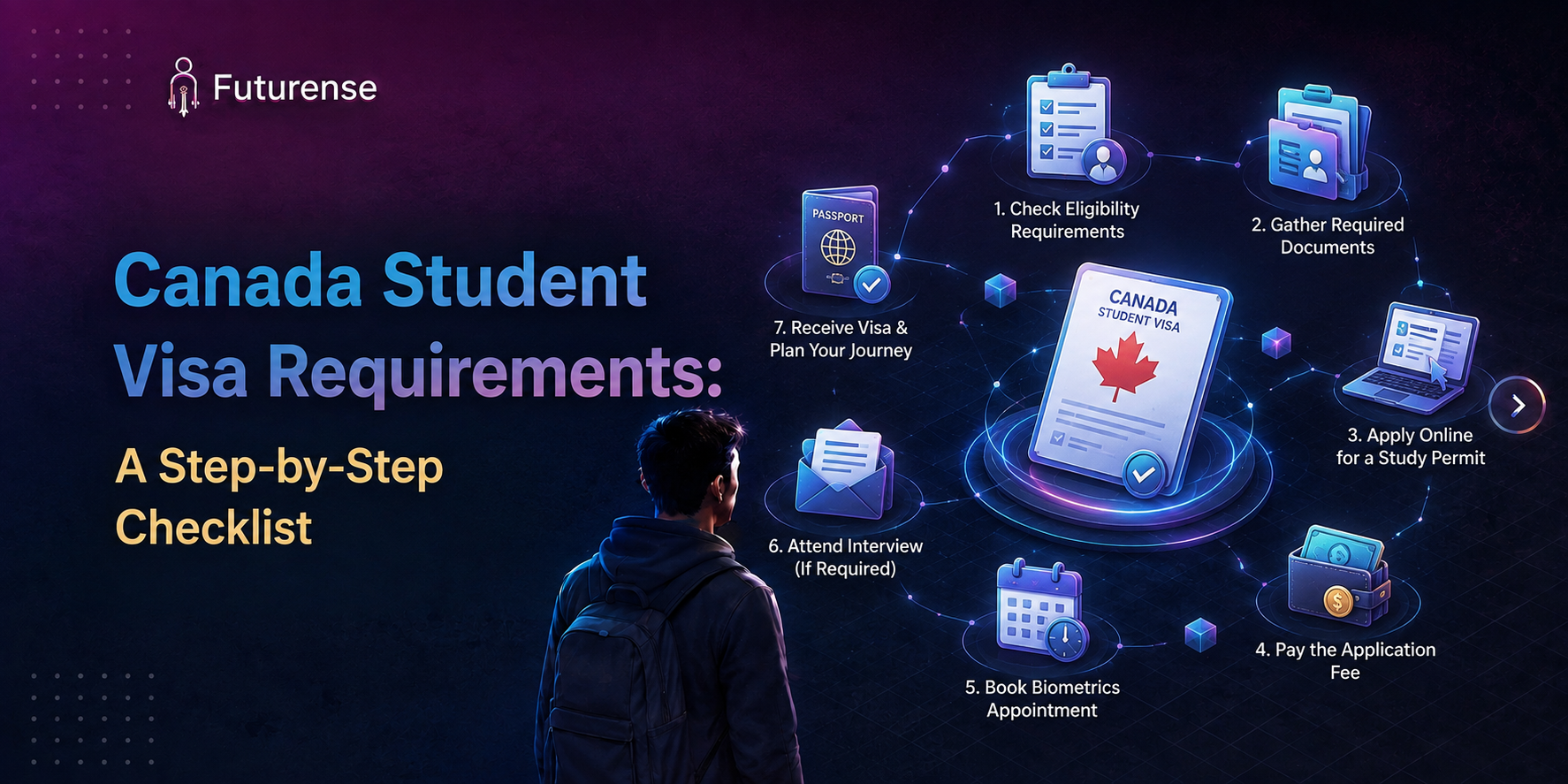


Canada's student visa process looks meaningfully different than it did even two years ago. A national cap on study permits, a new mandatory attestation letter, a nearly-doubled financial requirement, and the permanent closure of the fast-track Student Direct Stream have all reshaped what applicants actually need to prepare. This checklist reflects the current, 2026 process, not the older rules still floating around in outdated guides.
Study Permit, Not "Visa": A Quick Terminology Note
Canada's official document authorizing study is called a study permit, issued by Immigration, Refugees and Citizenship Canada (IRCC). "Student visa" is the term most people search for and use casually, and in some cases a visitor visa or Electronic Travel Authorization (eTA) is issued alongside the study permit to allow entry, but the permit itself, not a separate "visa," is what actually authorizes studying in Canada. This guide uses both terms interchangeably where it matches common usage, but it's worth knowing the precise term when reading official government guidance directly.
This distinction isn't just a technicality, it matters practically when you're searching for help or troubleshooting an application. Immigration lawyers, official government pages, and application portals almost always use "study permit" specifically, while general search results, consultancy websites, and casual conversation default to "visa." If you're ever unsure whether a piece of advice or a service applies to your situation, checking whether it's using the precise term is a quick, reliable signal of how current and accurate that source actually is.
What Changed: Why This Isn't the Same Process as a Few Years Ago
Several structural changes rolled out between January 2024 and January 2026, and together they represent the most significant tightening of Canada's international student program in years.
- A national cap on study permits, introduced in January 2024 and recalibrated annually since, limits how many applications IRCC processes each year
- The Provincial or Territorial Attestation Letter (PAL/TAL) became mandatory for most applicants, confirming a spot within your province's specific allocation under that cap
- Financial proof requirements nearly doubled, moving well beyond the older ~$10,000 CAD figure many outdated guides still cite
- The Student Direct Stream (SDS) was permanently closed in November 2024, along with the Nigeria Student Express, removing the faster-processing pathway many Indian applicants previously used
- A new January 2026 exemption removed the PAL requirement specifically for master's and doctoral students at public Designated Learning Institutions (DLIs), students at private institutions still need one
The practical result: the application itself now requires more upfront preparation and higher financial documentation than it did before 2024, and the fast-track option many applicants relied on no longer exists. Anyone working from a guide, a consultancy's advice, or even their own memory of a friend's application from three or four years ago should treat that information as unreliable until checked against current figures, the gap between the old process and the current one is large enough that outdated advice can genuinely derail an otherwise strong application.
The Complete Document Checklist
Step-by-Step: How to Actually Apply
- Get an offer of admission from a Designated Learning Institution. Only DLIs are eligible to host international students under the current system.
- Request your PAL or TAL (unless exempt) through your institution once you've accepted your offer. Your school submits this on your behalf; it typically takes a few weeks.
- Arrange your proof of funds, whether through a Guaranteed Investment Certificate (GIC), bank statements from the past four months, scholarship documentation, or a sponsor's financial affidavit.
- Submit your study permit application online through the IRCC portal, including your LOA, PAL/TAL, and financial documentation.
- Complete biometrics at your nearest VFS Global centre.
- Attend any required interview or provide additional documentation if requested by IRCC.
- Receive your Port of Entry (POE) letter upon approval, which you present alongside your passport when you arrive in Canada.
Proof of Funds: The Numbers That Matter
For applications submitted on or after September 1, 2025, a single applicant outside Quebec must show CAD $22,895 for living expenses for the first year, not including tuition or transportation costs, which are shown separately. This figure scales with family size: $28,502 for two people, $35,040 for three. Quebec applicants follow separate provincial figures.
A Guaranteed Investment Certificate remains an accepted way to demonstrate this, but it's worth knowing it no longer provides any processing-speed advantage, since the Student Direct Stream that previously rewarded GIC use with faster processing has been closed. IRCC accepts bank statements, GICs, scholarship letters, or a sponsor's affidavit with supporting financial documents, the goal is demonstrating you can genuinely support yourself without needing to work illegally or leave the program mid-year.
The Provincial Attestation Letter, Explained
The PAL is a province- or territory-issued document confirming that your specific study permit application fits within that region's share of Canada's national cap. Without one, unless you fall into an exempt category, IRCC returns your application rather than reviewing it on its merits.
Your Designated Learning Institution requests the PAL on your behalf once you've accepted your offer. Availability depends on your institution's remaining allocation for that intake cycle, not on your personal qualifications, which means applying early in the cycle genuinely matters. Several provinces exhausted their allocations well before the end of the intake year in 2025, leaving later applicants without a path forward until the next cycle opened.
Because the PAL is issued at the institutional level rather than granted individually based on merit, choosing a school with a strong track record of securing allocations, and applying as early as your institution allows within the intake cycle, has become a genuinely strategic decision in a way it wasn't before this system existed. Two equally qualified applicants can have very different outcomes purely based on how early in the cycle their institution submitted the PAL request on their behalf, which is worth factoring into how you plan your application timeline overall, not just your document preparation.
What Happens After You Get Your Permit
A study permit alone doesn't authorize you to work after graduation, that requires a separate application for a Post-Graduation Work Permit (PGWP), which can allow up to three years of work experience depending on your program length. From there, many graduates pursue permanent residency through Express Entry's Canadian Experience Class or a Provincial Nominee Program, though it's worth being realistic: not every program or PGWP outcome leads cleanly to permanent residency under current rules, so the specific program and institution you choose matters for this longer-term path, not just for the study permit itself.
This is worth thinking through before you even apply for the study permit, not after you arrive. A program at an institution with a strong PGWP eligibility track record and genuine alignment with in-demand occupation categories sets up a meaningfully stronger path toward permanent residency than a program chosen purely for admission ease or lower tuition. Given how much preparation the study permit stage alone now requires, it's worth treating the whole journey, permit, program of study, PGWP, and eventual PR pathway, as one connected decision rather than four separate hurdles to clear one at a time.
TL;DR
- The correct term is study permit, not visa, though "Canada student visa" is the common search term
- Provincial or Territorial Attestation Letter (PAL/TAL) is now mandatory for most applicants, confirming your spot within Canada's national cap. As of January 1, 2026, master's and doctoral students at public institutions are exempt
- Proof of funds requirement: CAD $22,895 for a single applicant outside Quebec (effective September 2025), on top of tuition and travel costs
- The Student Direct Stream was permanently closed in November 2024; all applicants, including from India, now go through the standard process
- IRCC has set 309,670 study permit application spaces for 2026, once a province's allocation is used up, no more attestation letters issue until the next intake
Is a Canada student visa the same as a study permit?
Not technically. The study permit is the official document authorizing study in Canada, issued by IRCC. "Student visa" is common informal language for the same general process, and in some cases a visitor visa or eTA accompanies the permit for entry purposes, but the permit itself is what authorizes studying.
Is the Student Direct Stream still available for Indian applicants?
No. IRCC permanently closed the Student Direct Stream in November 2024. All applicants, including from India, now apply through the standard study permit process.
How much money do I need to show for a Canada study permit in 2026?
A single applicant outside Quebec must show at least CAD $22,895 in living expenses for the first year, in addition to tuition and travel costs, effective for applications submitted on or after September 1, 2025.
Do all applicants need a Provincial Attestation Letter?
Most do. As of January 1, 2026, master's and doctoral students at public Designated Learning Institutions are exempt. Students at private institutions, and most other applicants, still need one.
What happens if my province runs out of attestation letter allocations?
No further PALs are issued for that province until the next intake cycle opens. This is why applying early in the cycle matters more under the current system than it did before the cap was introduced.
Does a Guaranteed Investment Certificate still speed up processing?
No. A GIC is still accepted as valid proof of funds, but it no longer provides faster processing, since that advantage was tied specifically to the Student Direct Stream, which has been closed.


Your Second Chance At the IIT Dream
IIT Course
Build an AI-first career with IIT-powered degrees, industry mentorship,and real-world learning.

.avif)
.avif)
.avif)