

Artificial intelligence is now the heart of every enterprise. Despite huge investments, perfectly working demos and announcements, most of them don't deliver the business value needed. Besides, many fail before deployment.
AI implementation failure, AI product abandonment, and leadership management are a few reasons behind this. Yet the reality is huge. Let's check the details.
Enterprise AI Failure Rate: What's the Reality?
The UC Berkeley Professional Education College of Education's GenAI study found that despite $30-40 billion of enterprise investment, 95% of organizations had seen zero return for their AI initiatives.
But failure does not mean that the model cannot work.
Rather:
- The model often works well in isolated tests
- Models succeed in controlled environments
- Accuracy metrics perform well when executed well
But when enterprises integrate the solution into real workflows, the initiative often halts, users don't adopt, or it quietly becomes obsolete due to a lack of attention. All this is the main obstacle to enterprise AI.
Reasons for Corporate AI Implementation Failure
Most of the enterprises think that AI fails if data isn't clean, the model isn't accurate, or the technology is complex.
But in reality, the reasons are organizational.
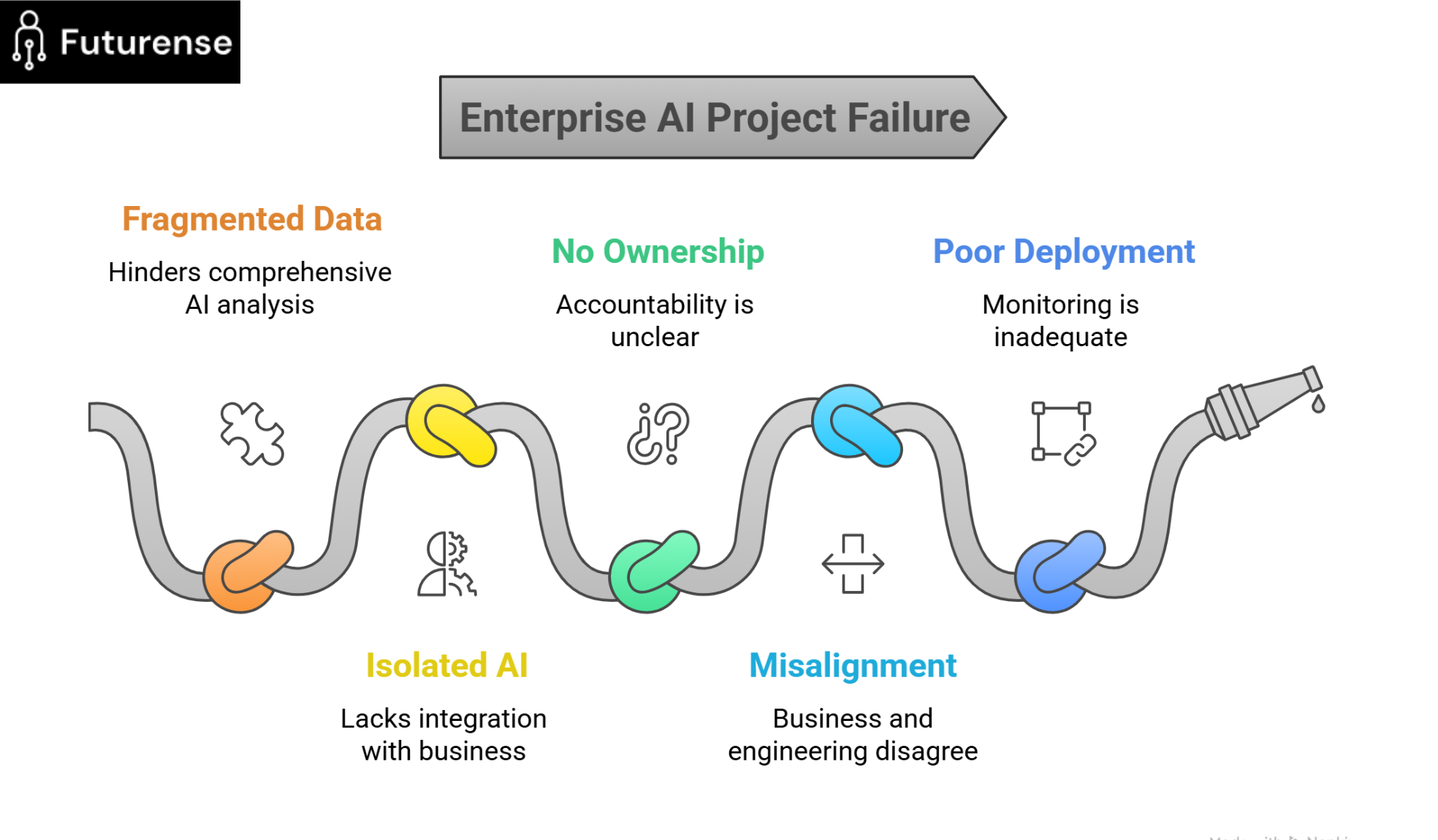
- Legacy Systems and Fragmented Data Infrastructure: AI cannot thrive in environments where data resides in siloed systems, workflows depend on spreadsheets, or the integration needs months of approvals.
- AI Built in Isolation: Teams build advanced AI models without workflow mapping, operational requirements, and user context. As a result, it works technically but fails to work for end-users.
- Lack of Ownership: AI projects fall into the grey zone of product, engineering, data science, and operations. When no team is responsible for adoption or outcomes, the project collapses during the last stage.
The Cost of Misalignment Between Engineering & Business
Another major reason for companies’ AI projects' failure is misalignment. Engineering teams and business teams frequently operate with different priorities, varied timelines, and distinct definitions of success.
What Engineering Optimize For:
- Accuracy
- Model performance
- Technical elegance
- Experimentation freedom
What Business Optimizes For
- ROI
- Customer impact
- Predictable delivery
- Compliance and stability
Why Misalignment Between Engineering and Business is Costly?
When both perspectives drift apart, enterprises experience:
- Months of engineering effort are spent on features that no one uses.
- Cloud computing bills pile up with no returns.
- Delayed product launches.
- AI initiatives are abandoned after management loses confidence.
- Teams are burnt out by unclear expectations.
Hence, a technically strong solution that does not solve business problems would be regarded as a failure, like AI projects.
AI Enterprise Solutions Fail at the “Last Stage”
Most of the AI implementation Indiatimes fail during rollout instead of experimentation. It happens because of the following reasons:
- Real-World Data Mismatch: AI models built using clean datasets fail when messy enterprise data is introduced.
- Human-in-the-Loop Blind Spots. Most of the AI systems need human monitoring for customer service approvals, manual corrections, subject-matter validation, and more. But most companies don't design models around this need, hence the adoption breaks.
- Compliance and Risk Bottlenecks: Security, auditability, and reliability standards slow the deployment process and increase risk.
- No Monitoring & Feedback Mechanism: AI needs continuous tracking, retraining, and model drift detection. Without it, the models degrade quickly, which leads to abandonment.
Prompt Engineering Limitations: Why AI Companies Fail Despite Good Models
The rapid growth of LLMs has created a myth that prompt engineering can fix business issues.
But in reality:
- Prompts cannot replace product strategy
- Prompts don’t solve messy data pipelines
- Prompts cannot manage compliance, guardrails, or system integration
Hence, enterprises cannot rely on non-deterministic outputs for critical operations.
Thus, many companies fail as they underestimate the zeal needed to build AI systems and not just AI interfaces.
AI Leadership Failure: The Most Underestimated Reason
Technology doesn’t fail automatically; instead, it's the leadership that causes the collapse.
This is because a failed leadership causing AI failure looks like:
- Treating AI as a side experiment, not a business initiative
- No clear ownership between product, engineering, and data
- Expecting certainty from probabilistic systems
- Poor communication of AI goals and KPIs
- No change-management planning
Instead, AI maturity needs a leadership that understands feasibility, risk, experimentation cycles,, and long-term transformation. Hence, most enterprises fail at this stage instead of model development.
Why Traditional Product & Engineering Structures Don’t Work for AI?
AI development is non-linear, and requirements keep changing with data. Even the results are probabilistic instead of deterministic. Thus, development cycles involve model drift and need real-time evaluation apart from continuous monitoring for AI products.
Hence, traditional workflows like rapid agile, feature-first roadmaps, and early locking of requirements don't work.
How Forward Deployed Engineers (FDEs) Reduce Time-to-Value for Enterprises?
The time from AI investment to a measurable business impact is known as time-to-value. Here's where most AI projects fail because time-to-value is too long and excessively fragmented.
One of the strongest solutions that companies employ to solve this problem is the Forward Deployed Engineer (FDE) model.
FDEs solve the problem as they work directly with business stakeholders, customers, engineers, and data science teams for the task.
Their role includes:
- translating unstructured business needs into technical requirements
- validating feasibility early
- building prototypes in real environments
- reducing cycles of rework
- ensuring AI integrates into existing workflows
- shortening iteration loops from months to days
This significantly reduces the time-to-value, which is one of the most crucial KPIs for company AI success.
What Successful AI Companies Do Differently?
Enterprises that are versatile in delivering AI success follow the principles below:
- Align AI initiatives with business KPIs from day one
- Invest early in data readiness
- Build cross-functional AI pods (product + engineering + data)
- Use iterative release cycles instead of big-bang launches (repetitive releases instead of all at once)
- Deploy FDEs or similar hybrid roles
- Focus on adoption and workflow optimization
- Measure impact instead of just model accuracy
Thus, AI models become a real business solution strategically instead of a failure.
Final Thoughts
Companies fail AI projects due to organizational gaps instead of algorithmic limitations. So to achieve success, companies have to fix structural misalignment, ownership gaps, leadership expectations, execution models, and workflow integration.
Plus, roles like FDEs with strong cross-functional leadership are needed in modern work environments. With the correct implementation method, AI would deliver real-world value faster, but the models remain non-usable.
FAQs: Corporate AI Implementation Failure
Why do most enterprise AI projects fail?
Most enterprise AI projects fail due to organizational issues, not model accuracy. Common reasons include poor workflow integration, lack of ownership, misalignment between business and engineering teams, and weak deployment planning.
How do successful companies avoid AI project failure?
Successful companies align AI with business KPIs, invest in data readiness, deploy cross-functional teams, monitor models continuously, and focus on adoption instead of just accuracy.
Why do AI projects fail at the deployment stage?
AI projects often fail during deployment due to compliance constraints, integration complexity, lack of human-in-the-loop design, and absence of performance monitoring after launch.
Can prompt engineering fix enterprise AI problems?
No. Prompt engineering improves interaction with models but cannot fix data pipelines, system integration, compliance requirements, or product strategy gaps.
How do successful companies avoid AI project failure?
Successful companies align AI with business KPIs, invest in data readiness, deploy cross-functional teams, monitor models continuously, and focus on adoption instead of just accuracy.
How do Forward Deployed Engineers help AI projects succeed?
Forward Deployed Engineers shorten time-to-value by working directly with stakeholders, validating feasibility early, integrating AI into real workflows, and accelerating iteration cycles.


PG Certificate Program in Forward Deployed AI Engineering
IIT Roorkee
Become the Engineer Who Makes AI Work Inside Client Stacks