


If you've searched for "data scientist salary in India," you've probably come across salary figures ranging from ₹5 LPA to ₹50 LPA. That can be confusing, especially if you're trying to understand what you can realistically expect to earn.
The truth is, there isn't a single answer. A data scientist's salary depends on several factors, including experience, skills, location, company, industry, and educational background. In 2026, expertise in Artificial Intelligence (AI) and Generative AI (GenAI) has also become a major factor influencing compensation.
In this guide, you'll find a detailed breakdown of data scientist salaries in India by experience level, city, company, industry, and skill set. We'll also look at approximate monthly in-hand salaries, compare traditional data science roles with AI-specialized roles, and explore the key factors that can help you earn a higher salary in this rapidly evolving field.
Data Scientist Salary in India 2026: Quick Summary
Before the detail, here is the fast overview.
The national average sits at approximately ₹11–12 LPA. But averages flatten the picture significantly. Keep reading for what the numbers actually mean at your stage.
Data Scientist Salary Per Month: What Actually Lands in Your Account
Most articles talk in LPA. Most professionals think in monthly take-home.
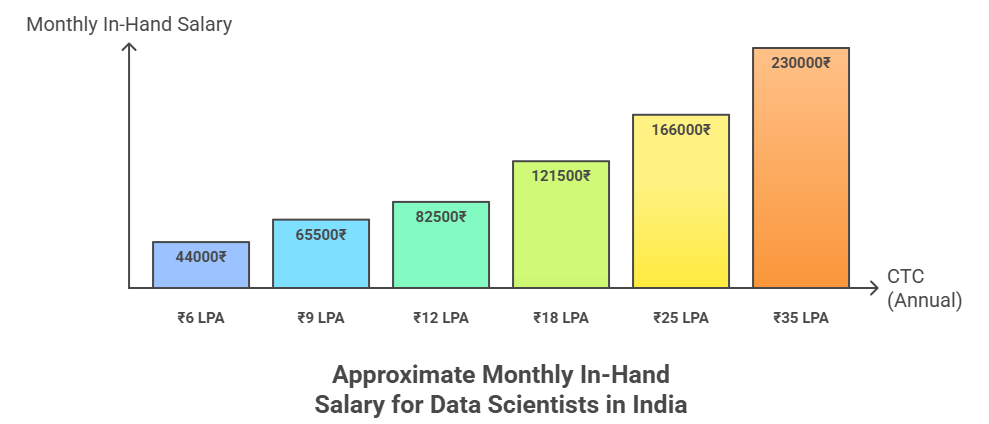
Here is a practical breakdown of approximate in-hand salary for common CTC ranges, after standard deductions (PF, professional tax, income tax under the new regime):
Note: Actual in-hand varies based on your tax regime choice, variable pay structure, and HRA component. These are approximate figures.
Also worth knowing: many companies in 2026 include a variable component of 10–20% of CTC. That means your base is lower than the headline number. Always ask what percentage of the CTC is fixed versus variable when evaluating an offer.
Data Scientist Salary by Experience Level
Fresher Data Scientist Salary in India (0–1 Year)
Starting salaries vary more for freshers than any other level.
The college you come from matters significantly at this stage.
- IIT, NIT, and top-tier college graduates at product companies: ₹12–20 LPA
- Tier 2 and 3 college graduates at IT services firms: ₹4.5–8 LPA
- General market average for freshers: ₹6–9 LPA
What gets you to the higher end as a fresher? Strong Python and SQL fundamentals, a portfolio of real projects (not just college assignments), internship experience, and increasingly, any hands-on exposure to ML or GenAI tools.
Junior Data Scientist Salary (1–3 Years)
This is where salaries start to diverge meaningfully based on the skills you have built.
Professionals who spent their first 1 to 3 years building practical skills in machine learning, model deployment, and data engineering see faster salary growth than those who stayed in support or reporting roles.
- Average range: ₹8–14 LPA
- With strong ML or cloud skills: ₹14–18 LPA
- At product companies or MNCs: higher end of the range
Mid-Level Data Scientist Salary (4–6 Years)
Mid-level is where the real earnings acceleration happens in India.
At this stage, employers expect you to work independently, lead smaller projects, and mentor juniors. Those who also have specialisations in deep learning, NLP, or MLOps command significantly more.
- Average range: ₹12–22 LPA
- With specialisation (NLP, computer vision, MLOps): ₹18–28 LPA
- At top product companies: ₹22–35 LPA
Senior Data Scientist Salary (7–10 Years)
Senior roles involve leading teams, owning outcomes, and connecting data science work to business impact.
At this level, company type is the single biggest variable. The same 8 years of experience earns very differently at an IT services firm versus a FAANG company or a funded startup.
- Average range: ₹20–35 LPA
- At top-tier MNCs and product companies: ₹35–50 LPA
- AI/GenAI specialized roles: ₹40–60+ LPA
Lead and Principal Data Scientist Salary (10+ Years)
At the top of the individual contributor track, compensation includes significant stock and variable components.
- Average range: ₹30–60 LPA
- Head of Data Science at major companies: ₹60 LPA–₹1 Cr+
- Includes ESOPs, performance bonuses, and sometimes profit sharing
Data Scientist Salary by City in India
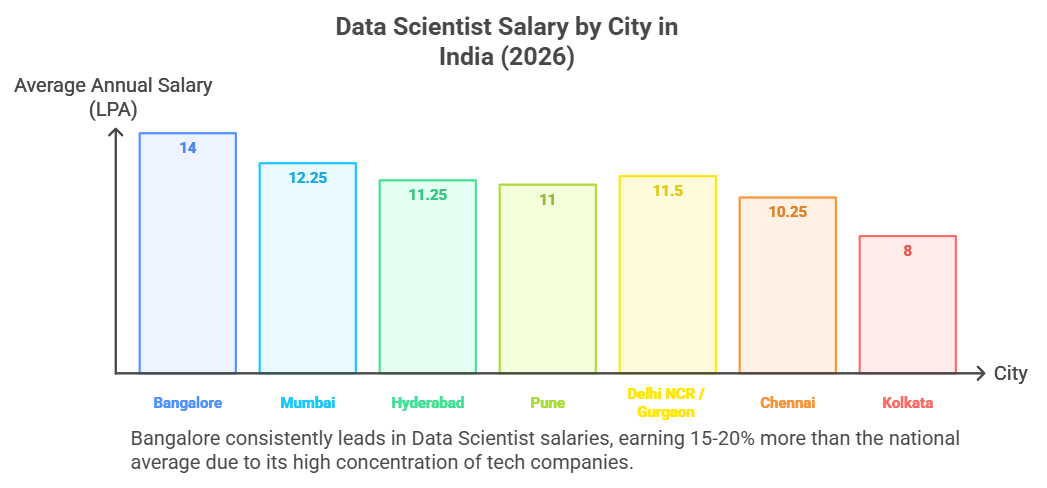
Location remains one of the most significant factors in what you actually get paid.
Bangalore consistently leads. It has the highest concentration of product companies, startups, and MNC R&D centres in India. Data scientists there earn roughly 15–20% more than the national average.
One important note: higher city salaries do not always mean higher purchasing power. Mumbai salaries are 5–10% above average, but Mumbai cost of living is significantly higher than Bangalore or Hyderabad. Pune is increasingly competitive as a data science hub with a lower cost of living.
Data Scientist Salary by Company in India
Company type is arguably the most important salary variable after experience level.
MAANG and Global Tech Companies
Google, Amazon, Microsoft, Meta, Apple, Flipkart, and Walmart Global Tech pay the highest total compensation in India.
These numbers include base, variable, and stock components. Base salaries alone are significantly lower.
Indian Unicorns and Product Companies
Paytm, Swiggy, Zomato, PhonePe, CRED, Zepto, and similar companies pay competitively for data science talent, especially at mid and senior levels.
- Range: ₹15–40 LPA depending on level and specialisation
MNCs and Consulting Firms
Deloitte, Accenture, IBM, McKinsey, and similar firms offer structured growth but generally pay less than pure product companies for equivalent roles.
- Range: ₹10–28 LPA
IT Services Companies
TCS, Infosys, Wipro, HCL offer stable employment with clear progression but compensation trails product companies significantly.
- Range: ₹5–15 LPA
The general rule: Product companies pay 2 to 3 times more than IT services companies for the same role and experience level. Switching from a services background to a product company is one of the fastest ways to increase a data scientist salary in India.
Data Scientist Salary for Freshers in India Without Experience
Freshers without prior work experience can expect an average data scientist salary in India of ₹5.5–8 LPA. However, candidates with strong projects, internships, or hands-on skills in Python, SQL, Machine Learning, and Generative AI often secure packages between ₹8–12 LPA. Graduates from top institutes like IITs and NITs joining product-based companies may receive ₹10–15+ LPA.
Average Salary for Freshers Without Experience
The GenAI Premium: Why AI-Specialized Data Scientists Earn More
This is the most important salary trend in India for 2026.
A two-tier salary structure has emerged.
Traditional data scientists who work on standard ML models, dashboards, and analytics earn one salary band. Data scientists with hands-on skills in Generative AI, Large Language Models, MLOps, and agentic AI earn significantly more.
The premium is real and measurable.
According to multiple salary platforms and industry reports, AI-specialized data scientists command 25–40% higher salaries than generalist data scientists with equivalent experience.
Here is what that looks like in practice:
The skills driving this premium include:
- GenAI and LLMs: Building, fine-tuning, and deploying large language models. This is the single highest-value skill category in 2026.
- MLOps: Knowing how to deploy, monitor, and scale models in production. Building a model is one skill. Running it reliably at scale is another.
- Agentic AI: Designing and working with AI agent systems. A fast-growing area with very limited talent supply.
- Cloud ML Platforms: AWS SageMaker, Google Vertex AI, Azure ML. Enterprise adoption of cloud ML is accelerating demand for these skills.
- NLP and Computer Vision: Deep specialisations that command consistent premiums.
Data Scientist vs Data Analyst vs ML Engineer: Salary Comparison
These roles are often confused. Here is how they compare on salary.
Data scientists generally earn more than data analysts but slightly less than ML engineers at equivalent experience levels. The distinction is narrowing in 2026 as both roles increasingly require deployment and production skills.
Skills That Pay More & How to Grow Your Data Scientist Salary
Your skill stack is the single most controllable factor. Here's what matters at each level:
- Foundation: Python, SQL, Statistics, Pandas, NumPy, Tableau/Power BI
- Advanced: ML, Deep Learning, TensorFlow, PyTorch, Spark/Hadoop, AWS/GCP/Azure
- Premium (2026): GenAI, LLM fine-tuning, MLOps, LangChain/CrewAI, NLP at scale
- Cloud certs (AWS ML Specialty, GCP ML Engineer, Azure AI) can add a 15–25% salary bump.
What high-earning data scientists do differently:
- Specialize - Healthcare DS or FinTech ML pays more than generic analytics. Go deep, not wide.
- Build a portfolio - Real GitHub projects beat generic certificates. Document the problem, tools, and business outcome.
- Switch companies every 2–3 years - Expect 30–50% jumps vs. 8–15% internal increments.
- Negotiate on impact, not tenure - Show what your model saved or earned, not how long you've been there.
- Add GenAI/LLM skills - Highest demand, lowest supply. The pay gap vs. generalists will keep widening through 2027–28.
- Target product companies - Same role, same experience = 2–3x more than IT services. Switching from services is one of the best ROI moves you can make.
TL;DR - Data Scientist Salaries in India
- By experience: Freshers earn ₹6–9 LPA (~₹42K–63K/month), junior (1–3 yrs) ₹8–14 LPA, mid-level (4–6 yrs) ₹12–22 LPA, senior (7–10 yrs) ₹20–35 LPA, and lead/principal (10+ yrs) ₹30–60+ LPA.
- City matters: Bangalore pays the most (15–20% above average), followed by Mumbai and Delhi NCR. Kolkata is well below average at ₹7–9 LPA.
- Company type is the biggest variable: Product companies (Google, Amazon, Flipkart) pay 2–3x more than IT services firms like TCS/Infosys for the same role.
- The GenAI premium is real: AI/GenAI-specialized data scientists earn 25–40% more than generalists. An LLM Engineer earns ₹20–35 LPA vs. ₹12–18 LPA for a generalist with the same experience.
- How to earn more: Specialize (don't generalize), switch companies every 2–3 years (30–50% jumps vs. 8–15% internal hikes), build a visible portfolio, and add GenAI/LLM skills to your stack.
- Bottom line: The ₹5–50 LPA range is all real. But where you land depends on your college, company type, city, and most importantly in 2026, whether you have AI/GenAI skills or not.
FAQs: Data Scientist Salary in India
What is the average data scientist salary in India?
The average data scientist salary in India in 2026 is approximately ₹11–12 LPA. However, this figure covers a very wide range. Entry-level roles start at ₹6 LPA and senior AI-specialized positions at top companies can exceed ₹60 LPA. Experience, skills, city, and company type all significantly affect where you land within this range.
What is the data scientist salary per month in India?
For the average salary of ₹12 LPA, the approximate monthly in-hand amount is ₹80,000–₹85,000 after standard deductions. At ₹6 LPA, in-hand is approximately ₹42,000–₹46,000 per month. At ₹25 LPA, it is approximately ₹1,60,000–₹1,72,000 per month. Actual in-hand varies based on your company's pay structure and your chosen tax regime.
What is the data scientist fresher salary in India?
The average fresher data scientist salary in India ranges from ₹6–9 LPA for the general market. IIT and NIT graduates joining top product companies can earn ₹12–20 LPA. Freshers joining IT services companies typically start at ₹4.5–7 LPA. Strong Python skills, a project portfolio, and any hands-on ML or GenAI experience push starting salaries toward the higher end.
Which company pays the highest data scientist salary in India?
Among top employers, Amazon, Google, Microsoft, Flipkart, and Walmart Global Tech offer the highest total compensation packages for data scientists in India. Amazon's total compensation for data scientists in India ranges from ₹42 LPA to ₹152 LPA depending on level, including stock. Google pays ₹27–70 LPA. These figures include base, variable, and equity components.
Is data science still a good career in India in 2026?
Yes. Demand continues to outpace supply, particularly for professionals with AI and GenAI skills. The field is evolving rapidly, which means those who upskill consistently will see strong salary growth. Entry-level competition has increased, but mid and senior-level professionals with specialised skills face very favourable market conditions.
Does GenAI knowledge increase data scientist salary in India?
Yes, significantly. AI-specialized data scientists earn 25–40% more than generalist data scientists at equivalent experience levels. Skills in LLM deployment, GenAI frameworks, MLOps, and agentic AI are among the highest-demand, lowest-supply capabilities in the Indian market in 2026. Professionals with these skills are in a separate, higher salary tier.


B.S/B.Sc in Applied AI & Data Science
IIT Jodhpur
Be a Part of India’s First Advanced AI Regular Degree with the Best Minds at IIT