%20in%20AI.png)


LLM full form in AI is Large Language Model. An LLM is an artificial intelligence model trained on large amounts of text to understand, process, and generate human-like language.
While businesses are greatly adopting AI-based tools, the internet is filled with queries like “LLM full form in AI”. As they play a crucial role in one of the major technologies today, that is Gen AI, they help automate workflows, generate content at scale, and are reshaping how organizations use data and interact with information.
While you would be curious to know many things like LLM full form in AI, how LLMs work, their role in Gen AI, and more, this article has covered them all.
LLM Full Form in AI: What Is a Large Language Model?
LLM stands for Large Language Model. It is a type of AI system that is trained on large text datasets, which understand, interpret, and generate natural language. They rely on Deep Learning techniques to identify patterns in language and to predict the next word in a sequence. Thus, they are able to generate human-like text responses later.
The “large” in Large Language Model refers to the scale of the model and the number of parameters it contains, which can range from millions to billions or more. Parameters are numerical values learned during training that help the model identify patterns and relationships in data.
In machine learning, LLMs are deep learning models designed primarily for natural language processing (NLP) tasks. Unlike traditional NLP systems built for specific tasks, LLMs can perform multiple language-related tasks using the same underlying model.
Some of them include answering questions, generating code, translation, summarization, and even writing content. LLMs are quite flexible, hence they are foundational models for many AI tasks.
What Is LLM in AI?
A Large Language Model (LLM) is an AI model trained on large amounts of text data, such as books, articles, websites, and other text sources. During training, the model learns statistical patterns and relationships between tokens, words, phrases, and concepts.
So, whenever you enter a prompt, the model predicts the most probable sequence of words that is suitable based on its training. Using this method, LLMs can perform various tasks like
- Engaging in human-like conversations
- Answering questions of any level
- Summarizing documents
- Writing explanations and code
- Analyzing text, etc.
Most of the LLMs now use a transformer architecture, which is a neural network design that effectively analyzes relationships between words in long sequences of text.
Moreover, transforms let models analyze the context of all sentences at once instead of processing the words singly. Hence, LLMs made using transformer architecture are robust as compared to earlier NLP systems.
What Is LLM in Generative AI?
Generative AI is a type of AI that creates new content instead of analyzing existing data. Hence, systems can generate new text, images, videos, audio, code, and similar content in response to prompts.
In such an environment, LLMs are the brain or the main engine that powers text-based Gen AI systems.
Some of the popular types of Gen AI models are:
- Image generation models
- Audio generation models
- Video generation models
- Text generation models
LLMs belong to text generation models that generate human-like text and power conversational AI systems.
For example, ChatGPT uses GPT-based LLM for text generation, while chatbots at companies use it for responding to customer enquires.
How Large Language Models Work?
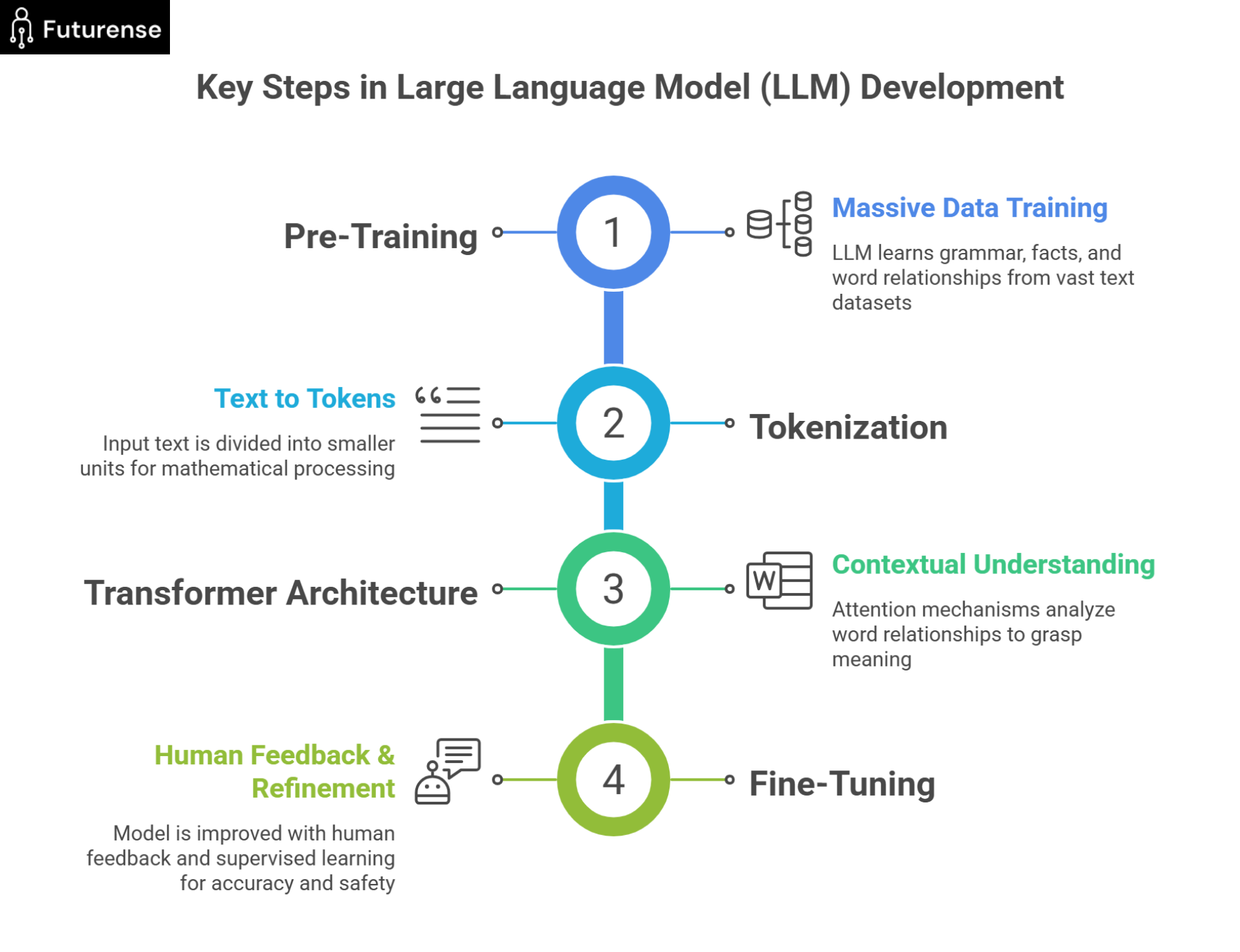
While LLMs are quite intelligent, they work by predicting the next token, like a word, in a sequence. It consists of four stages, mainly which include:
- Pre-Training
In the pre-training phase, massive text datasets of billions of words train a model. This lets it learn grammar, facts, reasoning matters, and understand relationships between concepts.
- Transformer Architecture
The Transformer architecture uses an attention mechanism in which models identify which words in a sentence are most relevant to each other.
Such a capability of tracking relationships in long text sequences lets them understand context and generate coherent responses.
- Tokenization
Tokenization means converting text into smaller units called tokens. With it, models can process text more efficiently and generate language mathematically.
- Fine-Tuning
After pre-training, LLM models are refined based on supervised training and human feedback. Thus, it improves accuracy, safety, and relevancy in real-world applications.
Applications of LLMs
Enterprises and agencies are greatly integrating LLMs into their software and digital platforms. This lets them process natural language in a way that's useful across various industries.
Some of the most common applications of it include:
- AI chatbots for customer service
- AI coding assistants that help developers write code
- Document summarization tools that help with research and business analysis
- Knowledge assistants that search internal company data
- Language translation systems
- Content generation tools that help with marketing and communications
.png)
Firms are adopting them on a large scale. Thus, Gen AI adoption has increased globally, wherein the majority of the organizations are now experimenting with or are deploying AI-powered systems in business functions.
McKinsey estimated in its 2023 analysis that generative AI could add $2.6 trillion to $4.4 trillion annually in economic value across industries, driven in part by increased productivity and automation of knowledge work.
Thus, LLMs are basic to every enterprise AI infrastructure.
Limitations and Challenges of LLMs
Despite the huge capabilities of LLMs, they do have shortcomings that organizations should manage effectively.
They include:
- Hallucinations: LLMs often give incorrect information that looks correct.
- Bias in training data: As LLMs learn from large datasets, they create biases that can be present in the training data.
- Increased computational cost: Training and running large models require huge computing resources.
- Data privacy concerns: Organizations should ensure that sensitive information is not exposed during model usage.
Hence, addressing these challenges needs careful design, monitoring, and responsible AI governance.
Why Learning LLM Development Is Becoming Important?
As organisations are increasingly adopting Gen AI systems, the demand for professionals who understand LLM development is also increasing quickly.
So, companies are hiring specialists who are capable of building and deploying AI systems with technologies like:
- Large language models
- Retrieval-augmented generation (RAG) pipelines
- AI agents and automation tools
- Enterprise AI infrastructure
Thus, various roles are emerging in the LLM sector, which include:
- LLM engineer
- Generative AI developer
- AI systems architect
- AI application engineer
Professionals building real-world generative AI applications can benefit from skills in LLM architectures, RAG pipelines, AI agents, evaluation, and enterprise-scale deployment.
So, those willing to learn building domain-specific LLMs, SLMs, and production-ready RAG systems can specialize through a PG Certificate in AI-Driven LLM, SLM & Agentic RAG Development. Both graduates and professionals can enroll in it, as this initiative by IIT Jammu will provide hands-on training on tools and frameworks that are used to develop modern AI apps.
Future of Large Language Models
Large language models are advancing rapidly. The future seems bright where AI systems will include:
- Agentic AI systems to perform complex multi-step tasks automatically.
- Multimodal models that understand text, videos, and images simultaneously.
- Domain-specific LLMs that are well-trained to work in FinTech and healthcare.
- Smaller Language Models customized to work effectively on enterprise infrastructure.
The demand for LLMs is increasing across enterprises with huge projects for future growth. This is because businesses are increasingly adopting AI-driven systems for automation and decision-making.
As they are capable and can be widely deployed, LLMs will shape the future of AI-driven applications.
Conclusion
LLMs or Large Language Models are one of the most intelligent innovations in AI. They learn from large text datasets and use transformer-based architecture to understand and generate responses in human language accurately.
They now fuel many Gen AI tools that have applications in everyday workflows like AI assistants, coding tools, and automation systems.
Understanding what is LLM in AI and how they work is important to understand because organizations are increasingly adopting it. As technology is advancing, professionals with expertise in LLM architectures, deployment pipelines, and AI system integration can capitalize on huge packages in the long run.
Frequently Asked Questions (FAQs)
What is the full form of LLM in AI?
The full form of LLM in AI is Large Language Model. It is a type of artificial intelligence model trained on massive text datasets to understand, generate, and analyze human language.
What is LLM in AI?
An LLM (Large Language Model) is an AI system that uses deep learning and transformer architecture to process natural language and generate human-like text responses.
What is LLM in generative AI?
In generative AI, LLMs act as the core engine for text-based AI systems. They generate content such as conversations, articles, code, and summaries by predicting the next word in a sequence.
Is ChatGPT NLP or an LLM?
ChatGPT is a Large Language Model (LLM) that belongs to the broader field of Natural Language Processing (NLP). LLMs like GPT are advanced NLP models trained on massive text datasets to understand and generate human-like language.


PG Certificate in AI-Driven LLM, SLM & Agentic RAG Development
IIT Jammu
Learn to Build Domain-Specific LLMs, SLMs & Production-Ready RAG Systems

.avif)
.avif)