


AI is no longer just answering questions.
It is now taking actions, making decisions, and completing tasks on your behalf.
That shift is powered by AI agents. And understanding them is quickly becoming essential for anyone working in tech, product, or business in 2026.
This guide covers everything you need to know. What AI agents are, how they work, the different types, real-world examples, and where they are heading next.
What Is an AI Agent?
An AI agent is a system that can observe its environment, make decisions, and take actions to achieve a specific goal.
The key word is "act."
Most software tools wait for you to tell them what to do. An AI agent can figure out the next step on its own.
Here is a simple way to think about it:
Calculator: Gives you an answer
Chatbot: Responds to your question
AI Agent: Decides what to do next and takes action
That ability to reason in steps and act independently is what separates AI agents from earlier software.
Why AI Agents Matter Now
Software has historically been passive. You input something. It outputs something.
AI agents change that dynamic.
With advances in large language models (LLMs) and automation frameworks, AI agents can now:
- Perform multi-step tasks without constant human input
- Interact with external tools, APIs, and databases
- Make decisions based on context, not just rules
- Adjust their approach based on feedback
This is why AI agents are at the center of products like AI copilots, autonomous workflows, and intelligent assistants that are entering enterprise software in 2026.
AI is no longer just generating content. It is executing tasks.
How AI Agents Work
Every AI agent operates on a continuous loop. It is often called the perceive-decide-act cycle.
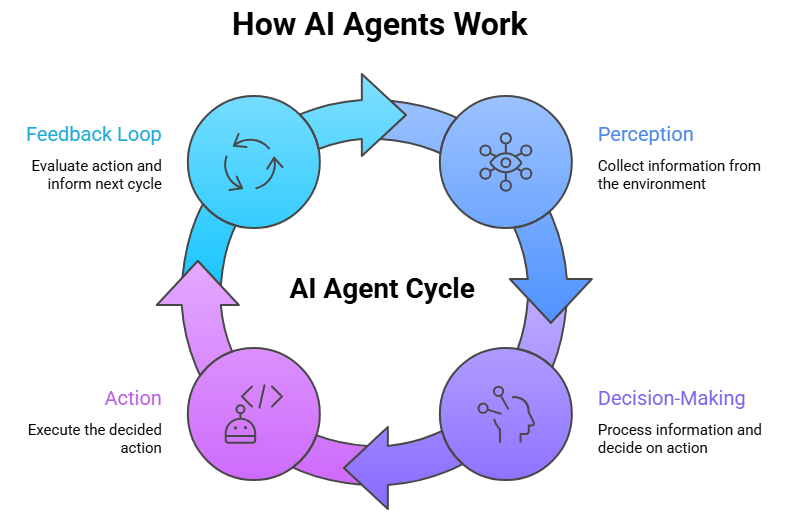
Here is how each stage works:
- Perception (Input)
The agent collects information from its environment.This could be user input, live data from an API, sensor readings, documents, or system logs. The agent does not act on assumptions. It acts on what it observes.
- Decision-Making (Reasoning)
The agent processes what it has perceived and decides what to do next.This is where the intelligence lives. Depending on the agent's design, this reasoning could involve predefined rules, machine learning models, or a large language model interpreting context and generating a plan.
- Action (Execution)
The agent takes action based on its decision.This could mean generating a response, calling an external API, updating a database, sending a notification, or triggering another workflow.
- Feedback Loop (Learning and Iteration)
The agent evaluates the outcome of its action.Did it achieve the goal? If not, what needs to change? This feedback informs the next cycle and allows the agent to handle complex, multi-step tasks over time.This loop is what makes AI agents fundamentally different from static software. They do not just respond once. They keep going until the task is done.
5 Types of AI Agents
Not all AI agents work the same way. They are classified by how they make decisions.
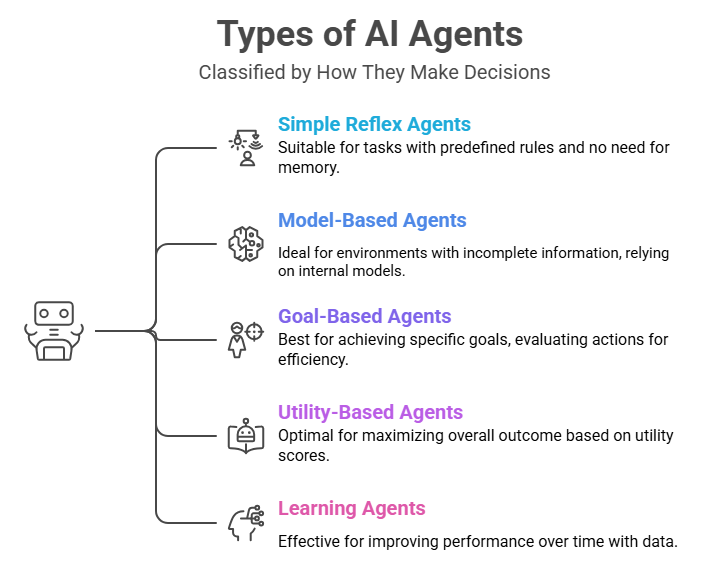
1. Simple Reflex Agents
These agents follow predefined rules. They react directly to inputs without any internal memory or reasoning.
How they decide: If input X, then do Y.
Real-world example: A spam filter that moves emails to junk based on keywords.
Limitation: They cannot handle situations their rules do not anticipate.
2. Model-Based Agents
These agents maintain an internal model of their environment. They use that model to make decisions even when they cannot directly observe everything.
How they decide: Based on current input plus a stored understanding of how the world works.
Real-world example: Navigation systems that reroute based on traffic conditions they have not directly observed yet.
Limitation: Only as good as the accuracy of their internal model.
3. Goal-Based Agents
These agents act specifically to achieve a defined goal. They evaluate different possible actions and choose the one most likely to get them to the target.
How they decide: What action moves me closest to my goal?
Real-world example: Route planning systems finding the fastest path between two points.
Limitation: Can struggle when goals conflict or change mid-task.
4. Utility-Based Agents
These agents go beyond goals. They choose the action that produces the best overall outcome based on a utility function, essentially a score for how good an outcome is.
How they decide: Which action gives me the highest utility score?
Real-world example: Algorithmic trading systems that evaluate dozens of variables to optimise returns.
Limitation: Defining the right utility function is complex and can lead to unintended behaviour.
5. Learning Agents
These agents improve over time. They learn from feedback and past experience to make better decisions in the future.
How they decide: Based on patterns learned from historical data and outcomes.
Real-world example: Recommendation engines like those used by Netflix and Spotify.
Limitation: Require large amounts of good quality data to learn effectively.
Real-World Examples of AI Agents
AI agents are already deployed across industries. Here are the most common applications today:
- Virtual Assistants and Chatbots: Customer service agents that handle queries, route tickets, and resolve issues without human involvement. Modern versions go far beyond scripted responses.
- AI Copilots: Tools like GitHub Copilot assist developers by suggesting code, spotting errors, and generating documentation. These are agents that perceive your codebase and act within it.
- Recommendation Systems: Platforms like Amazon and YouTube use learning agents to continuously observe behaviour and serve relevant content or products.
- Autonomous Trading Systems: Financial platforms use utility-based agents to analyse markets, identify patterns, and execute trades faster than any human analyst could.
- Automated Research and Workflow Agents: Newer AI tools can search the web, summarise documents, write reports, and take actions across multiple tools in a single workflow, with minimal human input.
- Cybersecurity Agents: Security operations centres are increasingly using AI agents to monitor networks, detect anomalies, and trigger automated responses to threats in real time.
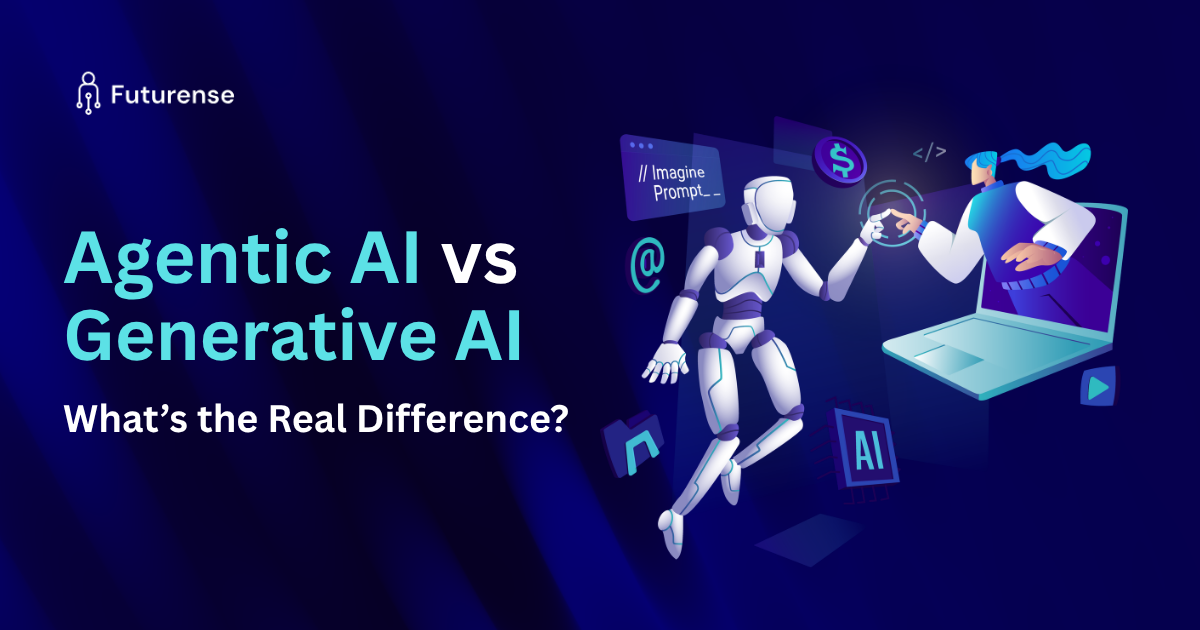
AI Agents vs Generative AI: What Is the Difference?
AI agents and generative AI terms are often used interchangeably. They are not the same thing.
Generative AI is often the reasoning engine inside an AI agent. But an agent does more than generate. It acts.
AI Agents vs Agentic AI: What Is the Difference?
This distinction is more subtle but important.
AI agents are individual systems built to complete specific tasks.
Agentic AI refers to systems where multiple agents collaborate, plan across longer horizons, and execute complex workflows together.
Think of it this way. An AI agent is a single specialist. Agentic AI is a coordinated team of specialists working toward a shared objective.
As workflows become more complex, the industry is moving from individual agents toward full agentic systems.
Challenges and Limitations of AI Agents
AI agents are powerful, but they are not without problems. Understanding the limitations is part of using them responsibly.
- Reliability: Agent outputs can be inconsistent across similar tasks. This is a significant issue in high-stakes environments.
- Hallucinations: When powered by LLMs, agents can generate confident but incorrect information. This becomes dangerous when agents are taking real-world actions based on that output.
- Unpredictable behaviour: In complex environments with many variables, agent behaviour can become difficult to predict or control.
- Security risks: Agents connected to real systems, databases, and APIs create new attack surfaces. A compromised agent can cause significant damage.
- Lack of common sense: Agents optimise for what they are told to optimise for. They do not inherently understand nuance, ethics, or context beyond their training.
This is why human oversight remains critical, especially as agents are given more autonomy in enterprise environments.
The Future of AI Agents
The trajectory is clear. AI agents are becoming more capable, more autonomous, and more deeply integrated into how work gets done.
Here is where the field is heading:
- Multi-agent collaboration: Multiple specialised agents working together on a single complex task, each handling its own area of expertise.
- Longer planning horizons: Agents that can plan and execute across days or weeks, not just single sessions.
- Deeper tool integration: Agents that are natively embedded into business software, operating in the background as a constant layer of intelligent automation.
- Self-improving systems: Agents that identify their own gaps, seek new information, and update their behaviour without human prompting.
According to McKinsey's research on AI and automation, the integration of agentic AI into enterprise workflows is one of the most significant near-term productivity opportunities across industries.
How to Get Started with AI Agents
If you want to move from understanding AI agents to actually working with them, here is a practical starting path:
- Build your AI fundamentals - Understand how machine learning and LLMs work before jumping into agent frameworks.
- Learn how APIs work - Agents interact with external systems through APIs. This is non-negotiable knowledge.
- Explore agent frameworks - Tools like LangChain, AutoGPT, and CrewAI are widely used starting points.
- Run small experiments - Build a simple agent that completes a real task. Even a basic workflow agent teaches you more than hours of reading.
- Study failure modes - Understanding where agents break is as important as understanding how they work.
The learning path moves from understanding to building to applying. Each stage compounds the next.
If you are serious about building real-world AI systems, a structured agentic AI course can help you move from experimentation to production-ready skills much faster.
Key Takeaways
- An AI agent is a system that can perceive its environment, make decisions, and take action to achieve a goal.
- Agents operate on a continuous loop: Perceive, Decide, Act, Learn.
- There are five main types: Simple Reflex, Model-Based, Goal-Based, Utility-Based, and Learning agents.
- AI agents are already deployed in customer service, finance, cybersecurity, software development, and more.
- Generative AI creates content. AI agents use AI to take action.
- Agentic AI is the next evolution, where multiple agents work together on complex, long-horizon tasks.
- Limitations including hallucinations, unpredictability, and security risks mean human oversight is still essential.
FAQs: AI Agents
What is an AI agent in simple terms?
An AI agent is a system that observes its environment, makes a decision, and takes an action to achieve a goal. Unlike a basic chatbot that only responds to questions, an AI agent can plan and execute multi-step tasks independently.
What are the main types of AI agents?
The five main types are Simple Reflex agents, Model-Based agents, Goal-Based agents, Utility-Based agents, and Learning agents. They differ in how they make decisions, ranging from simple if-then rules to continuous learning from data.
How are AI agents different from ChatGPT?
ChatGPT is a generative AI model. It creates text based on your prompt. An AI agent uses a model like ChatGPT as its reasoning engine but goes further by taking actions, calling tools, and completing multi-step tasks without requiring a new prompt for every step.
What are real examples of AI agents?
Real examples include GitHub Copilot for software development, algorithmic trading systems in finance, recommendation engines on Netflix and Amazon, AI-powered customer service bots, and security monitoring systems in cybersecurity operations centres.
Are AI agents safe?
AI agents carry real risks, including hallucinations, unpredictable behaviour, and security vulnerabilities when connected to live systems. Human oversight, clear boundaries on what agents can access, and regular evaluation of agent behaviour are essential safeguards.
What is the difference between AI agents and agentic AI?
An AI agent is a single system built to complete a specific task. Agentic AI refers to systems where multiple agents collaborate on complex, long-horizon objectives. Agentic AI is the next evolution beyond individual agents.


PG Certificate in Building Professional Agentic AI with AIOps
IIT Jammu
Design, Deploy, and Operate AI Agents that Actually Work in Production

%20in%20AI.png)