

Quick Summary
- What it is: A clear breakdown of agentic AI vs generative AI, including how AI agents fit into the ecosystem.
- Primary focus: Understanding what is generative AI, what is agentic AI, and how they differ in real-world applications.
- Key insight: Generative AI creates content, AI agents execute predefined tasks, while agentic AI autonomously plans and completes multi-step workflows.
- Best for: Students and professionals evaluating AI career paths, upskilling decisions, and future roles in agentic AI systems.
From being a simple rule-based system and content generation to an autonomous action system, AI has come a long way. People often confuse Generative AI, AI agents, and Agentic AI. While these three sound identical, they are not interchangeable and are designed to perform distinct tasks.
According to McKinsey reports, 78% of the enterprises have deployed GenAI, but 80% report it hasn’t been a meaningful addition due to its generative-only nature.
What is Generative AI?
Generative AI, or GenAI, is a type of AI model trained extensively on large datasets that learns to generate patterns to produce similar content. This content can be anything: text, images, videos, audios, codes. While on the surface it looks like GenAI is creating something, it’s just repeating a pattern it was trained on.
GenAI cannot perform real-world actions. It mainly works as a reactive model that waits for a human prompt, processes it, and produces an output.
Real-world Use Cases of GenAI
- Customer service teams can generate draft email responses to save time on repetitive replies
- Designers can generate mock assets to create a foundation or get new ideas
- Developers can generate code snippets for repetitive functions throughout the project
- Marketing teams can use GenAI to generate SEO content, to check punctuation, etc.
What it can’t do
- Make independent API calls or browse the web unless specific functionality is implemented
- Send an email, book a ticket, or call you a cab
- Cannot chain its own tasks or create a workflow without prompting through each step
- Cannot answer questions requiring real-time data
While these use cases of Gen AI highlight the strengths of generative AI, they also reveal its limitations, especially when it comes to executing tasks independently, which is where agentic AI comes in.
What is An AI Agent?
An AI agent can perform specific tasks automatically with the help of predefined instructions and external tools. It combines a large language model (LLM) with access to tools like APIs, databases, search features, etc.
Unlike traditional agents, which are strictly rule-based and highly predictable, with minimal adaptability, Modern AI agents are LLM-powered and can handle complex tasks while still operating within defined boundaries. On top of that, unlike GenAI, AI agents can take external actions apart from generating text responses.
How AI Agent Works?
User provides a task -> the agent makes relevant API calls / uses relevant tools -> It generates and processes the result -> Provides Output
- An AI Agent cannot decide its own goals; those are to be defined by the developer or the user. This can be done by modifying the preset requests the agent goes through before answering every prompt.
- In Modular systems, each agent is tied to a defined function, and to answer a query, multiple such agents are combined to provide a comprehensive output.
- While it has more freedom than GenAI models, it still cannot go beyond preset rules.
Real-world use cases of AI Agent
- A customer support AI agent that can look up the latest order status in the database
- Airline AI agents that manage flight modifications automatically in case your flight is cancelled or extremely delayed
What is Agentic AI?
Agentic AI is a type of AI that can execute complex actions with minimal human interaction, including reasoning, planning, and carrying out multi-step actions. Unlike the previous two AI types we discussed, Agentic AI is not specifically bound to specific commands; it can determine its own strategies and goals while staying relevant to the query and task.
Agentic AI is proactive, meaning it doesn’t have to wait for a prompt during each step; it can create its own workflow and execute the concerned tasks.
If you’re looking to build real-world skills in autonomous systems, enrolling in a agentic AI course can help you understand how multi-agent workflows, memory, and planning systems are implemented in production environments.
Agentic AI vs AI Agents
An AI agent is one agent that can perform one human-defined task. On the other hand, Agentic AI is a collection of agents collaborating on a dynamic task, each with its own strategy to provide the best possible output.
Agentic AI has its own persistent memory; it can learn from past actions throughout multiple sessions. It can create passive workflows to delegate tasks and divide resources where needed. In short, it not only knows how to perform a predefined thing, but it also decides what to do next.
Technical Components
- Planning Module: It breaks a complex high-level task into smaller, manageable steps, creating an efficient task flow.
- Memory: Can be broken down into short-term and long-term memory. It remembers past actions and general instructions and applies the same to future tasks. It also learns from its past mistakes and adapts accordingly.
- Tools: Agentic AI depends on multiple tools for each task. It can range from multiple API calls, web searches, database reads and writes, to code execution.
- Multi-agent coordination: Multiple specialized agents work through different parts of the task simultaneously to provide timely and accurate output
Agentic AI vs Generative AI vs AI Agents
How Do They Work Together?
While on paper it might look like GenAI and Agentic AIs are competing to be the more useful AI, that’s not the case at all. On the other hand, Agentic AI itself uses GenAI as one of its crucial tools.
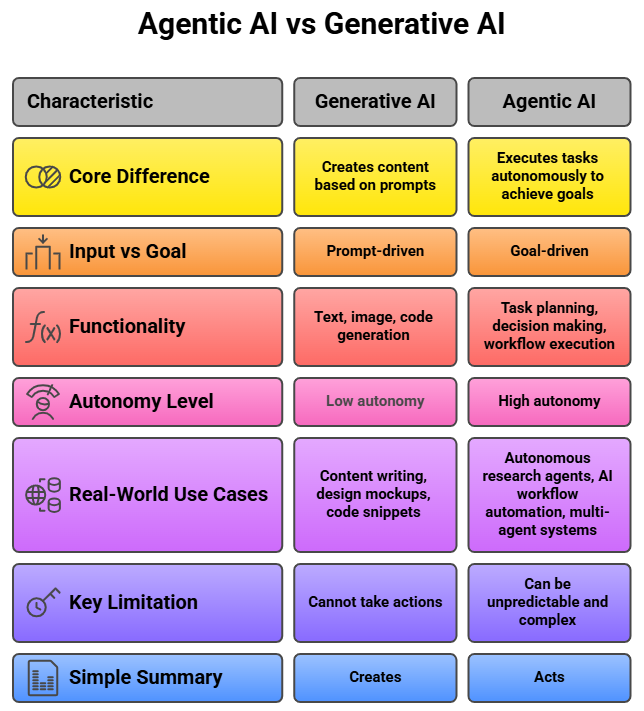
Rather than being independent tools for distinct purposes, these AI models are creating an evolutionary chain where:
- GenAI: Acts as the foundation by providing language understanding and generation capability
- AI Agents: Use tool integration and prompt engineering in addition to GenAI to help with predefined tasks
- Agentic AI: Uses AI agents with multi-agent collaboration with persistent memory and dynamic planning autonomously
Limitations of Generative AI, AI Agents, and Agentic AI
GenAI
- Hallucinations: GenAI often hallucinates about being correct and can confidently provide wrong answers.
- Cannot provide real-time data
- Highly dependent on prompt quality, it can provide two completely different answers for differently stated prompts
- No memory across different sessions, it cannot adapt or learn from its mistakes, and will keep repeating them unless specifically trained otherwise
- It cannot perform actions, even as simple as editing a text file
AI Agents
- Brittleness: Can easily break if the task provided is outside its predefined scope
- It cannot handle changing goals; it is made to perform on a set of rules that it cannot easily override without crashing
Agentic AI
- Unpredictable behaviour: It performs unnecessary tasks if it thinks it’s relevant.
- Coordination failure: Multiple agents can easily fall into a conflict or a continuous loop, causing a task flow crash
- Security concerns: An autonomous AI can make autonomous mistakes as well, which is difficult to predict and fix
TL; DR
Each type of AI was best in its own time period. Each type has had its prime. But AI is evolving faster than we predict. While industries can still make use of different types of AIs according to their specific needs, highly advanced AI is still experimental due to its autonomous and unpredictable behaviour.
It is predicted that in the next 3-5 years, digital systems will need to be set up for AI agents to manage multi-agent ecosystems.
FAQs: Agentic AI vs Generative AI
What is the difference between generative AI and agentic AI?
Generative AI focuses on creating content such as text, images, or code based on prompts, but it cannot take independent actions. Agentic AI, on the other hand, can plan, reason, and execute multi-step tasks autonomously with minimal human input. In short, generative AI produces outputs, while agentic AI completes tasks end-to-end.
Is ChatGPT generative or agentic AI?
ChatGPT is primarily a generative AI system because it generates text-based responses based on prompts. However, when integrated with tools, APIs, or workflows, it can function as part of an AI agent or even within an agentic AI system.
Is agentic AI built on generative AI?
Yes, agentic AI is typically built on top of generative AI models like large language models (LLMs). It uses generative AI for understanding and generating responses, while adding layers like planning, memory, tool usage, and multi-agent coordination to enable autonomous action.
What are some real-world examples of agentic AI?
Examples of agentic AI include autonomous coding assistants, AI research agents, multi-agent business workflows, and frameworks like AutoGen that can plan and execute complex tasks with minimal human intervention.
Can generative AI become agentic AI?
Generative AI alone cannot become agentic AI, but it can be extended with tools, memory, and planning systems to form agentic AI. In most modern systems, generative AI acts as the core engine within agentic architectures.
Which is better: agentic AI or generative AI?
Neither is universally better. Generative AI is ideal for content creation and idea generation, while agentic AI is better suited for complex, multi-step task execution. The best choice depends on the use case and level of automation required.


PG Certificate in Building Professional Agentic AI with AIOps
IIT Jammu
Design, Deploy, and Operate AI Agents that Actually Work in Production

.avif)