


With artificial intelligence reshaping industries so quickly, it’s natural to start wondering how you can stay relevant in this fast-changing job market. Machine Learning Engineer is one of those roles that shows up at the top of the list, and a few of the many reasons include powering recommendation engines and building real-world predictive models. Let us explore why this role is gaining momentum. And how to become a machine learning engineer?
What Is a Machine Learning Engineer and What Do They Do?
To put in simple words, a Machine Learning Engineer (MLE) focuses on turning data science research into real, usable products that work with minimal human intervention. As industries increasingly embrace artificial intelligence, the MLE role has become far more visible and essential. From agriculture and finance to e-commerce, technology, and even complex fields like healthcare, MLEs act as the bridge between innovation and execution, helping organizations automate processes, reduce manual effort, and operate more efficiently at scale.
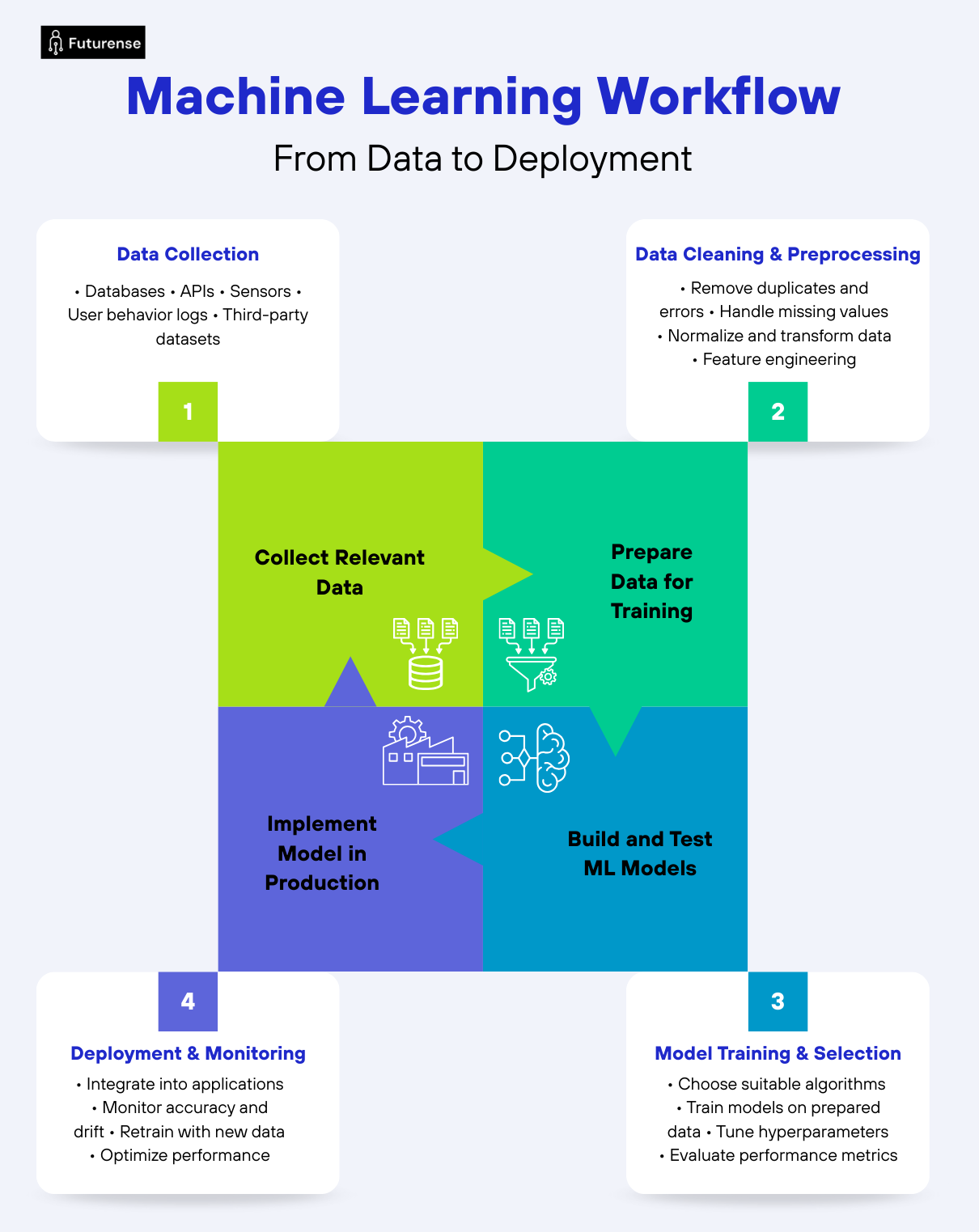
Machine Learning Workflow
Machine learning follows a structured workflow that transforms raw data into intelligent predictions. It involves collecting and preparing data, training models, and deploying them into real-world applications. Continuous monitoring ensures models stay accurate and reliable over time.
What does a Machine Learning Engineer do in various industries?
Key Skills Required to Become a Machine Learning Engineer
Exploring a career as a Machine Learning Engineer requires expertise in filtering various factors as an individual. This industry requires users to meet real industry expectations that require research analysis, execution, and deployment. Emergence of AI in the field of MLE requires polishing as well as increasing the chances of clear interruption of knowledge that is above and beyond, but why? AI makes it convenient for users to understand the process, and it is efficient, but that is not enough. While tools and automation have made learning easier, strong outcomes still depend on hands-on practice, decision-making, and real human context, especially when your work affects people directly. Let’s explore what these skillsets and roadmap varying different levels of entry.
Technical skills
- Programming & Software Basics: Python, SQL, data structures, algorithms, Git, clean and scalable code
- Machine Learning & Deep Learning: Supervised and unsupervised learning, core ML algorithms, basic deep learning models
- Mathematics & Statistics: Linear algebra, probability, statistics, model evaluation metrics
- Data Handling & Feature Engineering: Data cleaning, preprocessing, feature creation, Pandas, NumPy
- ML Tools, Deployment & Cloud Basics: Scikit-learn, TensorFlow or PyTorch, model deployment, cloud fundamentals
Non-Technical Requirements for Machine Learning Engineer
Current working industries are far-reaching, as they need employees who are not just proficient with technical skills but who also have non-technical skills. It is considerable that an employee has to work with numerous other internal teams to communicate and collaborate to get finish product. These non-technical skills as a Machine Learning Engineer help the companies to evaluate your skill sets and looking upside on efficiency progress. You can eliminate this competition by having a certain number of skill sets as follows:
- Problem-Solving & Critical Thinking – Making a difference in MLE roles requires employees to have a polished skillset on solving problems and as well deal with critical queries. Sometimes it’s the critical thinking that can solve the toughest problem.
- Communication Skills – As various teams are involved in developing a single project, communication is the key to deploying it smoothly.
- Collaboration & Teamwork – The employee must be capable of working in a team and collaborating with users internally and externally. This helps in efficiency and smooth transition from the seed project to a fully functioning product.
- Business & Domain Understanding – Each business requires in-depth research and varies in terms of deployment and requirements. A business point of view helps in generating both financial growth for companies, and domain understanding helps in user-intent problem-solving.
- Adaptability & Continuous Learning – In the fast-moving market with competition everywhere, it is not just a requirement but a necessity to boost continuous learning and adapting to the latest technology. The mindset of a Machine Learning Engineer has to be profound by understanding this. Upskilling motivates and encourages employees to build confidence.
Machine Learning Engineer Salary in India & Job Market Outlook
The demand for data-driven solutions pushes the demand for Machine Learning Engineers in India. The strong tech ecosystems mainly cover Bengaluru, Hyderabad, Delhi NCR, and Mumbai, offering Machine Learning Engineer jobs in the AI sector, making them prominent hubs. The AI ML Engineer salary in India varies as per experience and region, as well segregates job and work profiles accordingly. The following is the outlook of the Machine Learning Engineer job market in India.
Here’s an overview of the state-wise demand for Machine Learning Engineers in India, along with the major tech companies driving hiring in each region.
Final Words
Machine Learning Engineering continues to stand out as one of the most prominent careers in India. People who are looking forward in pursing career in the ML market have the scope to explore a vast market. As discussed earlier, the emergence of AI has made it both convenient and competitive for people to look in-depth at technologies, industries, competitive salaries, and real-world contexts. Whether you’re a student starting fresh or a professional planning a career switch, building the right skills and hands-on experience can open doors to long-term growth.
FAQs: Machine Learning Engineer
What does a machine learning engineer do?
A machine learning engineer builds, trains, and deploys AI models that help systems learn from data. Their work includes preparing datasets, selecting algorithms, improving model accuracy, and integrating machine learning solutions into real applications like recommendation engines, fraud detection, and predictive analytics.
What is needed to become a machine learning engineer?
To become a machine learning engineer, you need programming skills (Python, SQL), knowledge of machine learning algorithms, mathematics and statistics fundamentals, data handling skills, and experience with ML tools and deployment platforms. Practical project experience is also highly important.
Is machine learning a high-paying job?
Yes, machine learning is considered a high-paying technology career due to strong demand across industries. Salaries typically increase with experience, technical expertise, and domain knowledge, especially in AI-driven sectors like fintech, healthcare, and cloud technology.
What is the ML engineer's salary?
Machine learning engineer salaries vary based on experience and location. In India, entry-level roles usually start around ₹4–8 LPA, mid-level professionals earn ₹10–18 LPA, and senior engineers can earn ₹25 LPA or more depending on expertise and company.


Advanced Engineering Program in Applied AI, ML with Context Engineering
IITM Pravartak
Become the Context Engineer every AI & ML team needs to design scalable, business-driven workflows.


.avif)