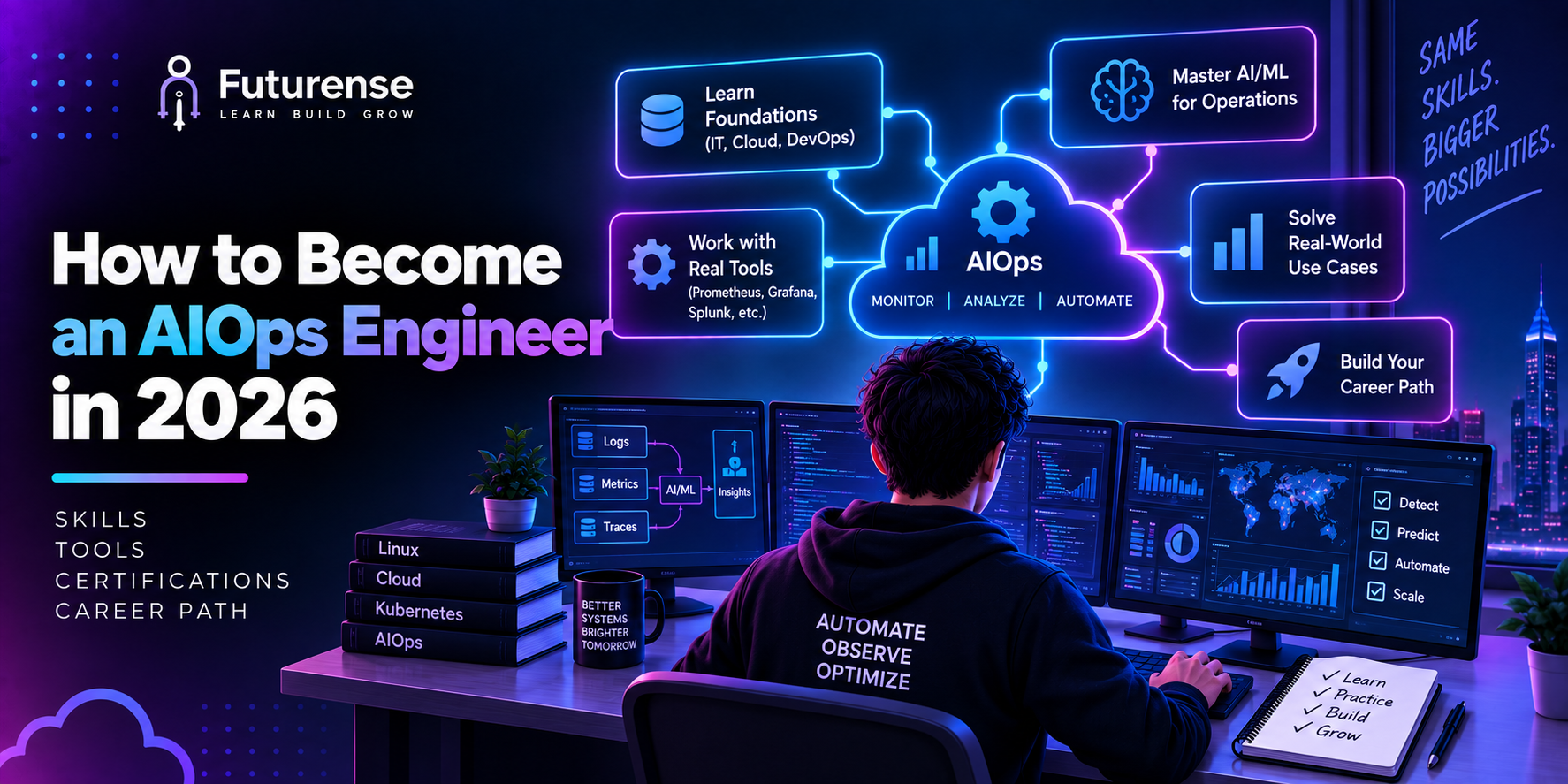


An AIOps Engineer applies machine learning and AI to IT operations, automating anomaly detection, root cause analysis, and incident remediation across increasingly complex, distributed infrastructure. This guide skips the conceptual explainer (our AIOps: What It Is, How It Works, Tools & Careers guide covers that in full) and goes straight to the practical path: the skills, tools, and realistic timeline for actually becoming one.
What an AIOps Engineer Actually Does Day to Day
Beyond the formal definition, the practical, daily work centers on a few recurring activities: building and tuning anomaly-detection models against operational data (logs, metrics, traces), investigating and improving root-cause-analysis accuracy when the system flags an incident, integrating AI-driven insights into existing monitoring and alerting pipelines, and increasingly, working with generative AI layered on top of traditional AIOps platforms to summarize incidents and suggest remediation steps.
This isn't a purely data-science role. Strong AIOps Engineers understand both the machine learning side (what makes an anomaly-detection model actually reliable at scale) and the operations side (what a false positive actually costs a team in alert fatigue, and why a technically accurate model that fires too often is a practical failure regardless of its precision on paper).
A useful way to picture the day-to-day: an AIOps Engineer might spend a morning investigating why an anomaly-detection model missed a genuine incident overnight, tracing the root cause back to a shift in normal traffic patterns the model hadn't been retrained on, then spend an afternoon tuning alert thresholds to reduce false positives a different team has been complaining about, and close the day reviewing how a new generative AI summarization feature performed on a recent incident, whether its automated write-up actually helped the on-call engineer or introduced confusing noise. The work is genuinely a blend of machine learning engineering and operational judgment, in roughly equal measure, not one masquerading as the other.
The Realistic Entry Points Into This Role
Very few people become AIOps Engineers as a first job. The realistic paths into this role start from an adjacent background:
From DevOps. This is the most common and most natural path. DevOps engineer roles have grown significantly in recent years, and the introduction of AI and AIOps skills specifically creates a meaningful compensation premium above standard DevOps pay at the senior level, a real, direct incentive to build this skill set on top of an existing DevOps foundation rather than starting over.
From Site Reliability Engineering (SRE). SRE work already centers on monitoring, incident response, and reliability at scale, the same operational context AIOps automates and enhances. The gap to close is primarily the machine learning layer, not the operational fundamentals.
From a monitoring or observability-focused role. Engineers already deep in tools like Prometheus and Grafana have a genuine head start, since AIOps platforms typically build on top of, or integrate directly with, this exact tooling layer.
Starting cold, without one of these adjacent backgrounds, is possible but meaningfully harder, since so much of what makes an AIOps model actually useful depends on operational judgment that's difficult to develop without first having spent real time in a traditional operations or DevOps context.
Skills You Need to Build
Machine learning fundamentals, applied specifically to operational data. Understanding anomaly detection, time-series forecasting, and clustering techniques matters more here than deep expertise in, say, computer vision or NLP, the data shapes AIOps actually works with are logs, metrics, and traces, not images or free text. Getting genuinely comfortable with how these techniques behave on noisy, real-world operational data, rather than clean academic datasets, is a distinct and important part of this foundation.
Cloud infrastructure fluency. AWS, Azure, or GCP experience is close to a baseline expectation, since the infrastructure AIOps monitors and automates typically runs on one or more of these platforms. This includes practical familiarity with how these platforms structure their own native logging and monitoring services, since AIOps work frequently means integrating with, or building on top of, that existing infrastructure rather than replacing it entirely.
Programming, primarily Python. Most AIOps tooling and custom model work happens in Python, and comfort building and integrating ML pipelines is a core, practical requirement, not an optional nice-to-have. This includes comfort with the specific libraries commonly used for time-series and anomaly-detection work, not just general Python programming ability.
Understanding of DevOps and CI/CD fundamentals. AIOps doesn't replace DevOps practice, it enhances it, and teams that jump straight to AIOps without solid DevOps foundations tend to find that AI optimizing a broken process just produces a faster broken process. Building genuine DevOps competency first, or alongside AIOps-specific skill, matters, and skipping this foundation is one of the more common reasons early attempts at AIOps implementation underdeliver.
Generative AI literacy, increasingly. As AIOps platforms incorporate generative AI for incident summarization and remediation suggestions, familiarity with how LLMs are being layered into traditional operations tooling is becoming a real, growing differentiator. This doesn't require deep LLM training expertise, but it does require understanding how to evaluate whether an AI-generated incident summary is actually trustworthy enough to act on, a genuinely different skill than building the underlying model.
The Tools to Learn
A concrete, practical toolset worth building real, hands-on experience with: Prometheus and Grafana for the monitoring and visualization layer most AIOps platforms integrate with or build on top of, and ML-observability-specific tools like Seldon and Evidently AI for the model-monitoring layer specifically relevant to AI-driven operations work. Kubernetes experience is also consistently valuable, given how much modern infrastructure AIOps monitors runs on containerized, orchestrated systems.
Rather than trying to learn every tool in this space superficially, building genuine, demonstrable depth with two or three of these, ideally the ones most relevant to whatever cloud platform or monitoring stack you're already working with, is a stronger use of preparation time than shallow exposure to a long list.
A useful way to build genuine depth rather than surface familiarity: set up a real, working Prometheus and Grafana monitoring stack against a genuine application, even a small personal project, and then deliberately build an anomaly-detection layer on top of the metrics that stack collects. This kind of hands-on, end-to-end project demonstrates far more real competency in an interview than being able to list the tool names on a resume, and it forces you to encounter the same practical friction, noisy data, false positives, tuning tradeoffs, that defines real AIOps work day to day.
A Realistic Timeline
For someone already working in DevOps or SRE, 6 to 12 months of focused, deliberate skill-building, layering machine learning fundamentals and AIOps-specific tooling onto an existing operational foundation, is a realistic timeline to become genuinely competitive for AIOps-specific roles. This assumes consistent, structured effort, not passive exposure, actually building projects that apply anomaly detection or root-cause-analysis techniques to real or realistic operational data, not just reading about the concepts.
For a genuine career changer without an adjacent DevOps, SRE, or monitoring background, the timeline extends meaningfully longer, since foundational operational judgment takes real time in the field to develop, and skipping that foundation tends to produce a candidate who understands the AI layer but lacks the operational context to apply it well.
Certification: Worth It or Not?
A structured certification program can genuinely compress this timeline compared to piecing together preparation from scattered blog posts and documentation, particularly one that covers cloud-native AI infrastructure and AIOps together as a connected discipline rather than as separate, disconnected topics. This is worth weighing specifically against the alternative of self-directed learning: a structured path saves real time coordinating what to learn and in what order, though it doesn't substitute for the hands-on, applied project work that ultimately demonstrates real competency to an employer.
Salary Expectations
AI and AIOps skills create a real, measurable compensation premium above standard DevOps salaries specifically at the senior level, reflecting genuine scarcity in the combined skill set, deep operational judgment plus applied machine learning, that this role actually requires. This premium tends to widen with seniority rather than staying flat, since the judgment and architectural decision-making AIOps work demands at a senior level is harder to develop, and therefore scarcer, than the foundational skills alone.
TL;DR
- Entry points: most AIOps Engineers come from DevOps, Site Reliability Engineering (SRE), or a monitoring/observability-focused background, not a cold start
- Core skills to build: machine learning fundamentals applied to time-series and log data, cloud infrastructure (AWS, Azure, GCP), and the specific tools AIOps platforms are built on
- Tools worth learning directly: Prometheus, Grafana, and ML-observability platforms like Seldon and Evidently AI
- Realistic timeline: 6-12 months of focused skill-building for someone already in DevOps or SRE; longer for a genuine career-changer
- AI and AIOps skills create a real compensation premium above standard DevOps pay at the senior level
What background do you need to become an AIOps Engineer?
Most AIOps Engineers come from DevOps, Site Reliability Engineering, or a monitoring and observability-focused background. Starting without one of these adjacent foundations is possible but meaningfully harder, since operational judgment is difficult to develop without direct field experience.
What skills matter most for an AIOps career?
Machine learning fundamentals applied to operational data (anomaly detection, time-series analysis), cloud infrastructure fluency, Python programming, and solid DevOps and CI/CD foundations, since AIOps enhances existing operational practice rather than replacing the need for it.
What tools should I learn to become an AIOps Engineer?
Prometheus and Grafana for monitoring and visualization, ML-observability tools like Seldon and Evidently AI, and Kubernetes given how much modern infrastructure runs on containerized systems.
How long does it take to become an AIOps Engineer?
For someone already in DevOps or SRE, 6 to 12 months of focused, deliberate skill-building is realistic. Career changers without an adjacent background should expect a meaningfully longer timeline.
Is a certification necessary to become an AIOps Engineer?
Not strictly necessary, but a structured program covering cloud infrastructure and AIOps together can meaningfully compress the preparation timeline compared to self-directed learning from scattered sources.
Does AIOps pay more than standard DevOps roles?
Yes, AI and AIOps-specific skills create a real compensation premium above standard DevOps pay, particularly at the senior level, reflecting the genuine scarcity of the combined operational and machine learning skill set.


Advanced PG Certificate in AI Engineering on Cloud and AIOps
IIT Roorkee
Engineer AI Systems for Top Enterprises, with the Most Critical Skills of the Decade.