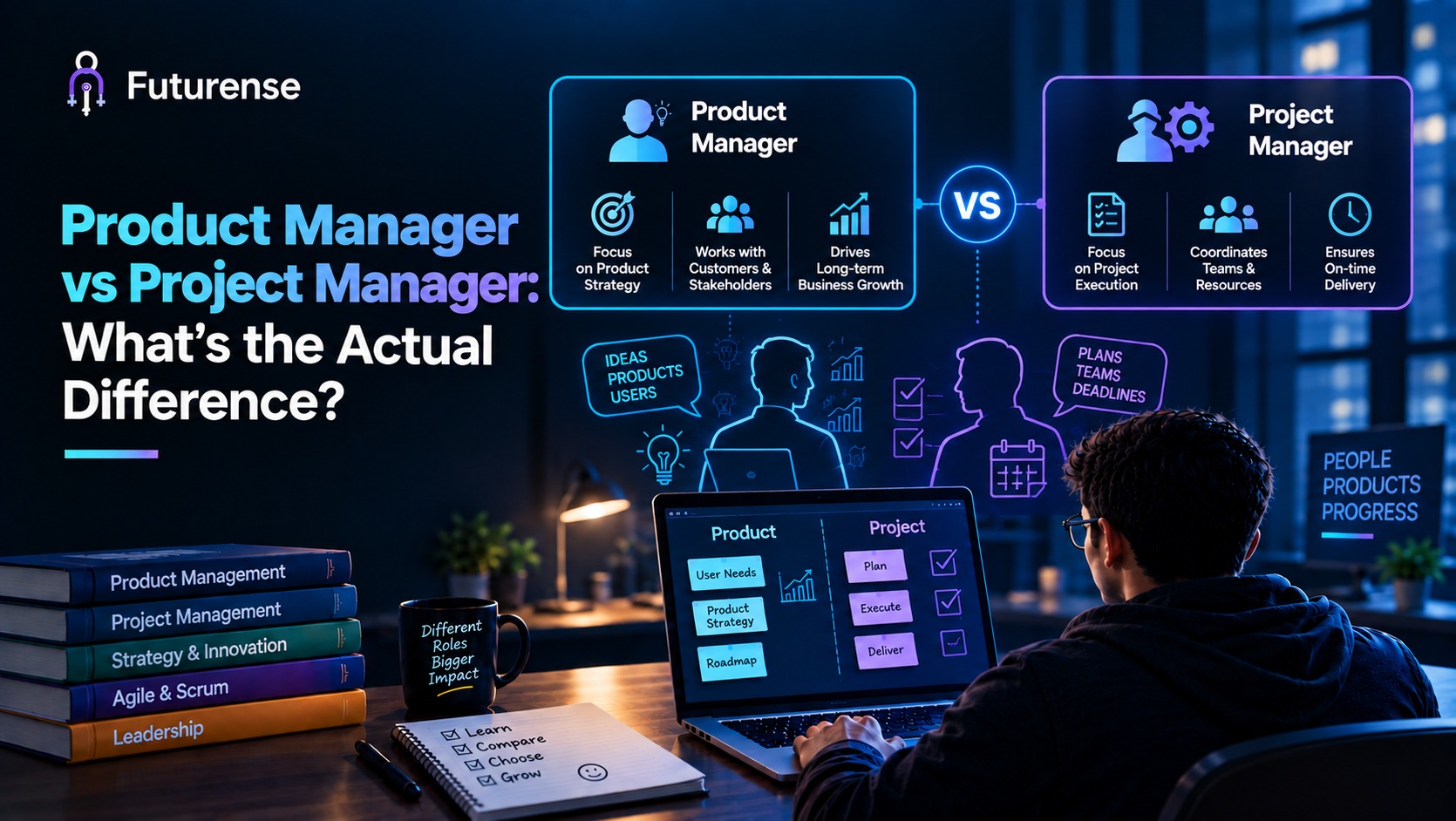


The titles sound like variations of the same job, and in smaller companies, they sometimes genuinely are one person wearing both hats. That overlap is exactly why the confusion persists. In a Product Manager vs Project Manager comparison, both roles work with cross-functional teams, manage stakeholders, track progress against goals, and get evaluated on whether something important gets delivered. The difference isn't in how important the work is, it's in what specific question each role exists to answer.
Our guide on what a product manager actually does covers the role definition in more depth if you want the full picture before this comparison; this article focuses specifically on where it diverges from Project Management.
What Does a Product Manager Do?
A Product Manager is responsible for a product's vision, strategy, and overall success deciding what should be built, for whom, and why it matters to the business. The role sits at the intersection of business goals, customer needs, and technical feasibility, and unlike a project, a product typically has no fixed end date; the PM's job continues as long as the product exists and needs to keep evolving.
Core Product Manager responsibilities include market and user research, roadmap planning, feature prioritization, defining requirements, and aligning engineering, design, and marketing around a shared direction. A Product Manager doesn't usually write the code or design the interface, they decide what needs to exist and why, then work with the teams who build it.
What Does a Project Manager Do?
A Project Manager is responsible for a project's execution managing the scope, timeline, budget, and resources required to deliver a specific, defined outcome. Where a product has no fixed end date, a project does: it's a series of tasks with a clear beginning, end, and defined resources, and the Project Manager's job is fulfilled once that specific project is delivered on time, within scope, and within budget.
Core Project Manager responsibilities include creating project schedules and budgets, coordinating tasks across teams, identifying and mitigating risks, and tracking progress against a defined plan. A Project Manager may work on projects that contribute directly to a product's success, but they aren't accountable for whether the product itself succeeds in the market only for whether their piece of the work got delivered as planned.
Product Manager vs Project Manager: The Core Distinction
The cleanest framing, echoed consistently across how both roles are described in practice: Product Managers are focused on the what and why, while Project Managers are focused on the how and when. A Product Manager identifies whether a new feature should exist at all and what problem it solves for the customer. A Project Manager figures out how to actually get that feature built and shipped on a specific timeline with the resources available.
Put another way: Product Managers are strategic and outward-facing thinking about market fit, competitive positioning, and long-term product direction. Project Managers are operational and inward-facing thinking about task sequencing, resource allocation, and near-term delivery risk. Neither is "more important" than the other; they're accountable for different parts of the same outcome.
Product Manager vs Project Manager: Side-by-Side Comparison
Where the Two Roles Genuinely Overlap
It's worth being honest about the overlap, because that's exactly where job postings and org charts blur the two together. Both roles lead cross-functional teams without necessarily having direct authority over the people on them. Success in either job depends heavily on influence and communication rather than formal reporting lines.
Both work against clearly defined success metrics and manage multiple stakeholders with competing priorities. And in smaller companies or startups, a single person frequently does carry both sets of responsibilities under one title, simply because there isn't enough dedicated headcount to split the function.
The overlap is also why lateral moves between the two are common. Many of the underlying skills organization, stakeholder communication, data literacy, the ability to keep multiple moving pieces aligned transfer directly, which is part of why professionals in either role often find the other a realistic next step rather than a completely different career.
Skills Comparison: What Each Role Actually Requires
A Product Manager needs strong market and user research skills, the judgment to prioritize ruthlessly among competing feature requests, comfort with product analytics and data-driven decision-making, and enough technical fluency to work credibly with engineering without necessarily being able to code.
Increasingly, Product Managers also need a working understanding of AI and data products specifically, since that specialization is growing faster than general product management right now.
A Project Manager needs deep planning and scheduling discipline, budget and resource management skills, risk identification and mitigation ability, and the organizational rigor to track many moving dependencies without letting anything slip.
Formal methodology knowledge Agile, Scrum, or traditional PMI-style waterfall planning carries more direct weight in Project Management than in Product Management, where the emphasis sits more on judgment and prioritization than on process adherence.
Both roles share real ground in communication and stakeholder management; the ability to keep a room of people with different priorities moving in the same direction is close to a universal requirement across both jobs.
Product Manager vs Project Manager Salary in India
Compensation is one of the clearest points of actual divergence between the two roles, particularly at senior levels, even though entry-level pay often looks deceptively similar.
Product Manager salaries in India typically start around ₹7–15 LPA for early-career roles (often titled Associate Product Manager), rising to ₹18–30 LPA at the mid-career Product Manager level, and reaching ₹32–55 LPA or more for Senior Product Managers with AI Product Manager roles specifically now averaging around ₹30 LPA and the top 10% crossing ₹80 LPA, reflecting how fast that specialization is growing relative to general product management. See our detailed Product Manager salary in India guide for the full breakdown by experience, company tier, and city.
Project Manager salaries in India generally run somewhat lower at comparable experience levels roughly ₹6–9 LPA at entry level, ₹12–25 LPA at mid-career, and ₹25–40 LPA at senior levels, though this varies meaningfully by industry, with IT services, finance, and construction project management often paying differently than tech-product-focused project roles.
Some data sources show the gap narrowing at the very top of both career ladders, particularly where a Project Manager moves into Program or Portfolio Management, but the broad pattern across most sources is consistent: Product Management carries a meaningfully higher senior-level ceiling, largely because it's tied more directly to product revenue and strategic outcomes rather than delivery execution alone.
Career Path: Where Each Role Actually Leads
A Product Manager's career path typically progresses from Associate Product Manager to Product Manager, Senior Product Manager, Group Product Manager or Director of Product, and eventually VP of Product or Chief Product Officer, a trajectory that stays close to product strategy and market outcomes even as scope increases.
A Project Manager's career path typically moves from Project Coordinator or Junior Project Manager to Project Manager, Senior Project Manager, and then into Program Manager or Portfolio Manager roles overseeing multiple projects or entire portfolios rather than product outcomes directly. Some Project Managers also move into Technical Program Manager (TPM) roles, which sit closer to engineering execution at scale, particularly at larger technology companies.
Neither path is a dead end if you change direction later. The overlap in core skills communication, prioritization, stakeholder management makes a Project Manager moving into Product Management, or vice versa, a realistic transition rather than a complete career restart, though the Project-to-Product move usually requires deliberately building market and strategy judgment that pure execution experience doesn't automatically provide.
Which Role Should You Choose?
Choose Product Management if you're energized by ambiguity figuring out what should exist in the first place, why it matters to a customer, and how to make a case for it against competing priorities and you're comfortable being measured on outcomes you don't fully control alone, like whether the market actually adopts what you built. Our guide on how to become a product manager lays out the concrete paths in, including the routes most realistic for career changers and internal transfers.
Choose Project Management if you're energized by structure and execution, the satisfaction of taking a defined scope and reliably delivering it on time and on budget, coordinating people and resources without necessarily owning the strategic "why" behind the work.
If you're specifically drawn to the applied AI side of product work rather than either role as traditionally defined, Futurense's Advanced Certificate Program in AI-Powered Product Design and Management with IITM Pravartak is built around exactly that intersection, and the Executive Program in Forward Deployed AI Product Management with IITM Pravartak goes further into building and shipping real AI products end to end.
TL;DR:
A Product Manager owns the what and why deciding what gets built and why it matters to the business and the customer. A Project Manager owns the how and when coordinating the timeline, budget, and resources to actually deliver it. The roles frequently work side by side on the same initiative but answer to different success metrics: a Product Manager is judged on whether the product succeeds in the market; a Project Manager is judged on whether the project shipped on time, in scope, and on budget.
Is a Product Manager the same as a Project Manager?
No. A Product Manager owns a product's vision, strategy, and market success with no fixed end date, while a Project Manager owns the execution of a specific, time-bound project with the scope, timeline, budget, and resources needed to deliver it.
Can a Project Manager become a Product Manager?
Yes, and it's a fairly common transition given the overlap in core skills like stakeholder management and organization. The main gap to close is usually market and strategic judgment learning to define what should be built and why, not just how to deliver a defined scope.
What certifications matter for each role?
Project Managers commonly pursue PMP (Project Management Professional) or CAPM certifications, which carry real weight with employers. Product Managers more often pursue certifications like CSPO (Certified Scrum Product Owner) or Product School credentials, though real case studies and portfolio work typically matter more than certifications alone in Product Management hiring.
Do Product Managers and Project Managers work together?
Yes, frequently. On larger initiatives, a Product Manager may define what should be built and why, while a Project Manager coordinates the timeline and resources to deliver it; the two roles complement rather than compete with each other in this setup.
Which role is a better career choice: Product Manager or Project Manager?
Neither is better. Product Management suits people who enjoy strategy and ambiguity, while Project Management suits those who prefer structured execution. Product Managers generally have a higher senior-level salary ceiling in India, while Project Managers remain in steady demand.


Advanced Certificate Program in AI-Powered Product Design and Management
IITM Pravartak
Become the AI-first product leader every company needs.