

The artificial intelligence landscape is evolving at a breakneck pace. As enterprises shift from experimenting with large language models (LLMs) to deploying production-grade, autonomous systems, the job market has matured into distinct, specialized career paths.
If you are looking to break into the tech industry or upskill, you’ve likely run into two highly discussed roles: Prompt Engineer and AI Engineer.
While both work directly with generative AI, their foundational frameworks, technical depths, day-to-day operations, and financial ceilings are vastly different. Choosing the wrong path can lead to a career plateau, whereas choosing the right one can maximize your market value.
This comprehensive guide breaks down the core differences between a Prompt Engineer vs. AI Engineer, analyzing their syllabus, required skill sets, real-world projects, salaries, and long-term career trajectories.
Defining the Roles: Understanding the Core Focus
To understand the macro differences between these positions, we must look at how they interact with AI systems.
What is a Prompt Engineer?
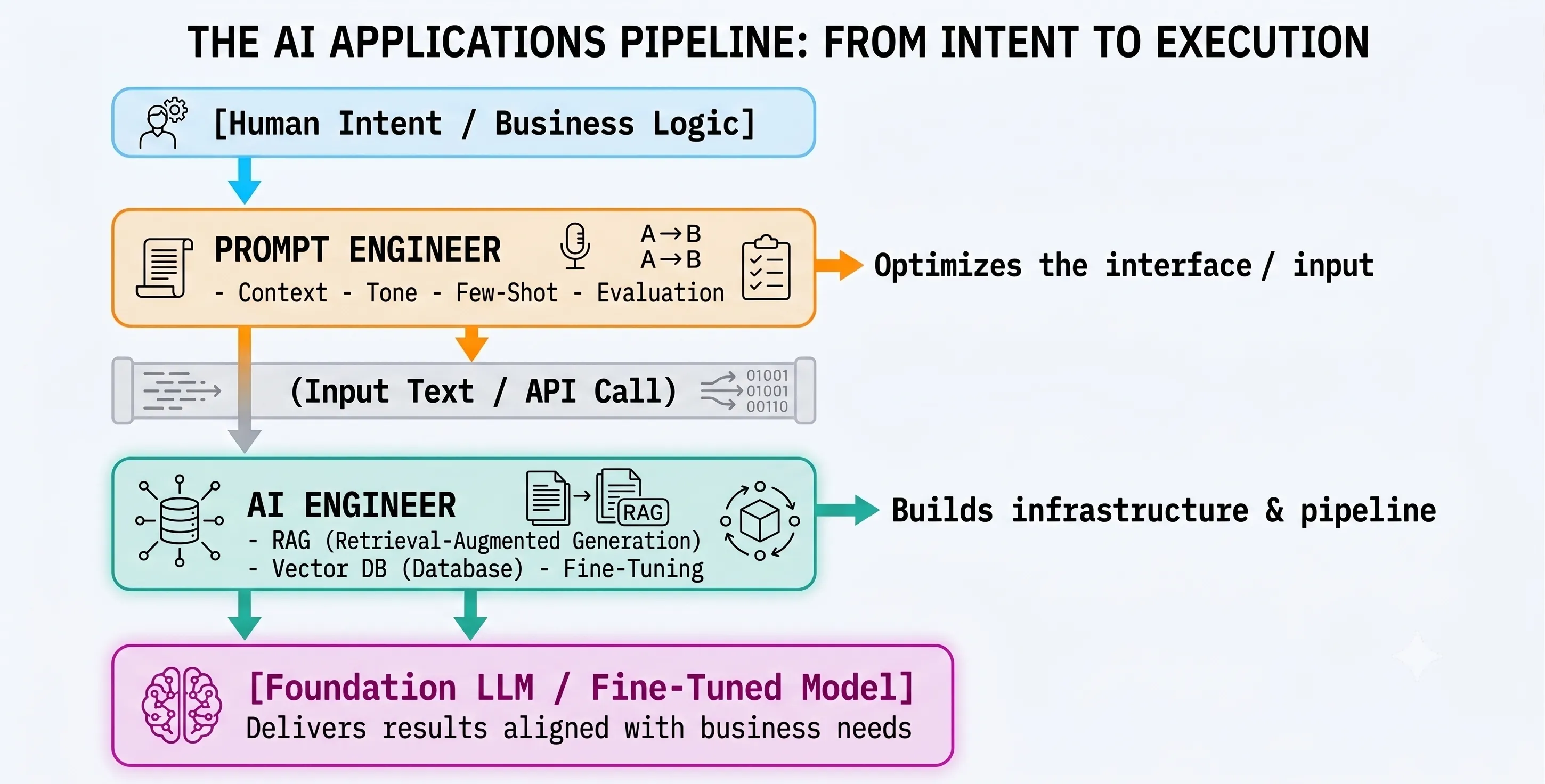
A Prompt Engineer acts as the bridge between human intent and machine execution. They specialize in the art and science of structuring inputs (prompts) to guide LLMs into generating accurate, safe, context-aware, and highly deterministic outputs. This role focuses on behavioral alignment, contextual formatting, and natural language optimization.
What is an AI Engineer?
An AI Engineer is a software engineering specialist who builds, deploys, and maintains the full stack infrastructure powering AI applications. Instead of just interacting with an existing AI model via a user interface, an AI Engineer writes code to connect models to data pipelines, orchestrates retrieval-augmented generation (RAG) architectures, optimizes inference latency, manages vector databases, and deploys scalable AI applications.
Why Prompt Engineering Matters
In the early days of generative AI, critics labeled prompting as a temporary hack or a transient trend. However, as enterprise-grade applications roll out across data-sensitive sectors like finance, legal tech, and healthcare, companies have realized a fundamental truth: data is useless if the model cannot interpret or process it reliably.
Why Prompt Engineering Matters comes down to three operational requirements: predictability, safety, and cost reduction.
- Deterministic Quality in a Probabilistic System: LLMs are inherently probabilistic; they guess the next most likely word. A Prompt Engineer implements structured systems (like XML tagging or JSON formatting) to ensure an LLM returns data in the exact format required by downstream software code, eliminating random formatting failures.
- Mitigating Vulnerabilities: Prompt Engineers design safety guardrails to protect customer-facing chatbots from prompt injection attacks, jailbreaks, and hallucinations, ensuring corporate alignment and compliance.
- Maximizing Context Efficiency: Token consumption translates directly to enterprise API costs. Proper prompt compilation reduces token waste, significantly cutting operational cloud expenditures.
Syllabus: What You Need to Study
If you were to enroll in a university specialization, a technical bootcamp, or structured prompt engineering courses, your learning paths would look quite different depending on which role you target.
The Prompt Engineering Syllabus
The curriculum for a Prompt Engineer prioritizes linguistic precision, structural logic, model psychological dynamics, and systematic evaluation framework design.
- Module 1: Foundations of Natural Language Interaction
- Tokenization mechanics and context window management.
- Temperature, Top-P, and frequency penalty configurations.
- Module 2: Advanced Prompting Methodologies
- Zero-shot, Few-shot, and Chain-of-Thought (CoT) prompting.
- Directional Stimulus, ReAct (Reasoning and Acting) frameworks, and Tree-of-Thoughts (ToT).
- Module 3: Structural System Design
- Structured formatting architectures (JSON, YAML, Markdown, XML).
- System vs. User message separation and role profiling.
- Module 4: AI Safety & Red Teaming
- Prompt injection prevention, adversarial testing, and jailbreak defense.
- Content filtering alignment and output formatting validation.
- Module 5: LLM Evaluation and Benchmarking
- Setting up golden datasets for prompt testing.
- Automated evaluation metrics using programmatic judges (e.g., LLM-as-a-Judge, Ragas).
The AI Engineering Syllabus
The curriculum for an AI Engineer is anchored heavily in software engineering, applied mathematics, cloud computing, data architectures, and model orchestration frameworks.
- Module 1: Foundations & Programming
- Advanced Python scripting, Object-Oriented Programming (OOP), asynchronous execution.
- Linear Algebra, Probability, Calculus (Gradients, Backpropagation mechanics), and Statistics.
- Module 2: Core Machine Learning & Deep Learning
- Supervised/Unsupervised learning architectures (Scikit-Learn).
- Neural Networks, Convolutional Networks (CNNs), and Transformer Architectures (Self-Attention mechanism).
- Module 3: Generative AI System Orchestration
- API integration patterns (OpenAI, Anthropic, Hugging Face Hub).
- Orchestration frameworks: LangChain, LlamaIndex, and LangGraph for stateful, multi-agent workflows.
- Module 4: Data Engineering & Vector Infrastructures
- SQL database querying and ETL data pipeline automation.
- Vector databases setup and tuning (Pinecone, ChromaDB, Weaviate, Milvus).
- Advanced Retrieval-Augmented Generation (RAG) implementation (Hybrid search, re-ranking, parent-child retrieval).
- Module 5: Fine-Tuning & Model Optimization
- Parameter-Efficient Fine-Tuning (PEFT), LoRA, and QLoRA architectures.
- Quantization frameworks (GGUF, AWQ) to improve inference latency.
- Module 6: MLOps & Production Deployment
- Containerization using Docker and orchestration through Kubernetes.
- Exposing models via high-performance REST APIs (FastAPI).
- Model monitoring tools (MLflow, Weights & Biases, Grafana).
Day-to-Day Projects: What You Will Build
To better understand what each professional does, let's look at the actual projects they are tasked with building in an enterprise setting.
Typical Prompt Engineering Projects
- Corporate Tone Voice Aligner: Designing system instructions and few-shot examples for an enterprise LLM to read raw customer support logs and reply in a consistent corporate brand voice.
- Chatbot Defense Layer: Building a strict system prompt framework that filters user inputs to block system data leaks or malicious attempts to alter the chatbot's instructions.
- Automated Evaluation Suites: Creating a test bank of 500 edge-case user queries to run automatically through prompt optimization tools, ensuring prompt modifications don't cause performance drops elsewhere.
Typical AI Engineering Projects
- Enterprise Production-Grade RAG Pipeline: Connecting a company’s internal document storage repository (PDFs, Notion pages, SQL databases) to an embedding pipeline, chunking the text intelligently, loading it into a vector database, and providing semantic answers via an LLM API.
- Local LLM Deployment: Fine-tuning an open-weight model like Llama 3 or Mistral on proprietary financial data using LoRA, optimizing it via quantization, and hosting it securely inside an on-premise cloud server using Docker and FastAPI.
- Autonomous Multi-Agent Workflow: Designing a system of specialized AI agents where one agent crawls news web pages, another agent cross-checks information with an internal database, and a third agent compiles an automated marketing performance report.
Career Trajectory and Salaries
The job market split cleanly into distinct compensation and seniority tiers. Standalone prompting roles have shifted toward specific product operational domains, while technical engineering roles have experienced a massive surge in market value.
The Prompt Engineering Career Path
- Entry-Level: Junior Prompt Engineer / Content Aligner (Accessible to non-traditional or linguistic backgrounds).
- Average Salary: ₹5L – ₹12L LPA (India) / $80k – $100k (Global)
- Mid-Level: LLM Evaluation Specialist / Prompt Optimization Lead.
- Average Salary: ₹12L – ₹25L LPA (India) / $100k – $140k (Global)
- Senior-Level: Conversation Designer / GenAI Product Specialist / AI Safety Lead.
- Average Salary: ₹25L – ₹40L+ LPA (India) / $150k – $250k+ (Global)
Market Note: Standalone prompting roles without programming skills face a visible salary plateau. Many post-2025 positions are actively evolving into broader product operations, AI safety red-teaming, or UX conversational design roles.
The AI Engineering Career Path
- Entry-Level: Junior AI Engineer / Associate GenAI Developer.
- Average Salary: ₹8L – ₹16L LPA (India) / $80k – $110k (Global)
- Mid-Level: AI Engineer / Applied AI Developer / RAG Architect.
- Average Salary: ₹18L – ₹35L LPA (India) / $110k – $180k (Global)
- Senior-Level: Senior AI Systems Engineer / MLOps Lead / AI Architect.
- Average Salary: ₹35L – ₹60L+ LPA (India) / $200k – $500k+ (Global)
Skill Progression: To smoothly transition from an entry-level developer to a high-earning Lead Architect, an engineer must actively master advanced Retrieval-Augmented Generation (RAG), programmatic model fine-tuning (LoRA/QLoRA), and automated MLOps deployment pipelines.
Which Career Path Should You Choose?
Choose Prompt Engineering if:
- You come from a non-traditional technical background (e.g., linguistics, marketing, technical writing, product management).
- You excel at logical communication, system testing, conceptual problem-solving, and creative instruction writing.
- You want to break into the artificial intelligence sector quickly with a lower technical barrier to entry.
Pro-Tip: If you choose this path, do not stay static. Use prompt engineering as your entry point into tech, and immediately start learning Python, basic API architectures, and evaluation tools to future-proof your career.
Choose AI Engineering if:
- You already possess a background in computer science, software engineering, or data analytics.
- You enjoy writing backend code, building architecture pipelines, interacting with data tables, and deploying scalable software systems.
- You want a highly resilient career path with a high salary ceiling and deep engineering longevity.
Conclusion
The choice between a Prompt Engineer vs. AI Engineer comes down to your current technical baseline and long-term career aspirations. Prompt engineering is an excellent entry gateway into the AI universe, focusing heavily on human-to-computer communication.
AI engineering, on the other hand, is a deeper software engineering discipline that focuses on infrastructure, scaling, data workflows, and application deployment.
For maximum career resilience, the ultimate sweet spot lies in combining both worlds: building deep, programmatic AI engineering skills while maintaining an intuitive, sharp understanding of prompt design and model psychology.
1. Can I become a Prompt Engineer without knowing how to code?
Yes, you can break into entry-level prompt engineering and QA evaluation roles without advanced coding knowledge. These positions rely heavily on structural logic, precise communication, and red-teaming skills. However, to advance past the initial salary tier, mastering foundational Python and API integrations is highly recommended.
2. Is Prompt Engineering becoming obsolete because of auto-prompting?
No, the standalone title is simply evolving. While basic prompts can be optimized by models themselves using frameworks like DSPy, human domain experts are still required to build golden test datasets, design complex system guardrails, structure multi-agent logic, and ensure corporate safety compliance.
3. What programming languages should an AI Engineer learn?
Python remains the absolute gold standard language for AI engineering due to its robust ecosystem of libraries (PyTorch, Hugging Face, Scikit-Learn, FastAPI). Additionally, learning SQL for data engineering workflows is highly valuable, while C++ is utilized in high-performance computing, hardware acceleration, and robotics.
4. Do I need a Master's or Ph.D. degree to work as an AI Engineer?
No. While research-heavy roles (like an AI Research Scientist developing new base neural architectures) require a doctoral or advanced degree, an Applied AI Engineer focuses on using existing models to build software applications. A strong public portfolio on GitHub, completed projects demonstrating RAG setup or API deployments, and industry experience are highly valued by tech recruiters.


B.S/B.Sc in Applied AI & Data Science
IIT Jodhpur
Be a Part of India’s First Advanced AI Regular Degree with the Best Minds at IIT

.avif)