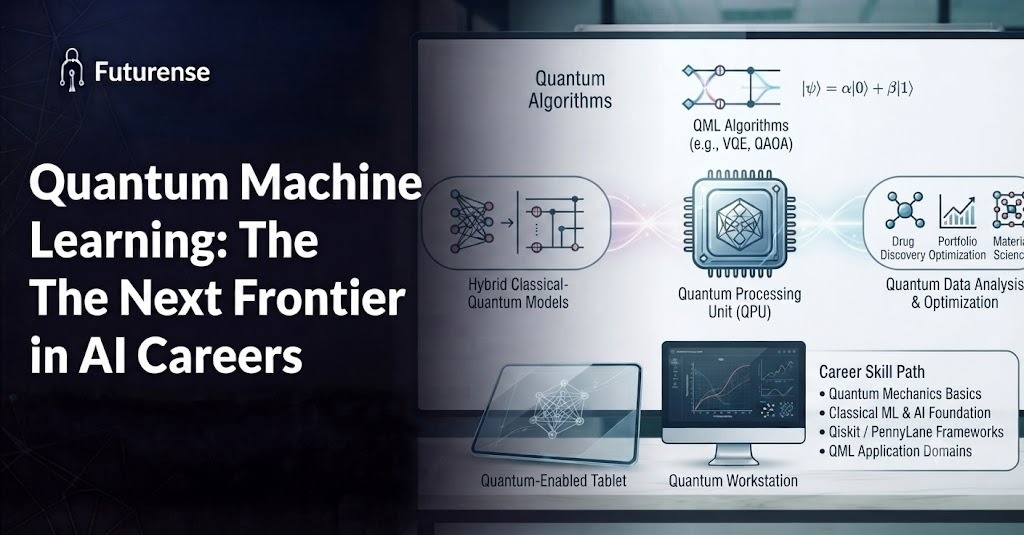


Quantum machine learning (QML) combines quantum computing with machine learning to explore whether quantum algorithms can solve certain problems faster or more efficiently than classical computers can.
It's still a research-heavy field, most practical AI workloads today run better on classical hardware, but it's also one of the few genuinely new frontiers opening up in AI careers, and the people who build early expertise in it are positioning themselves for roles that barely existed five years ago.
If classical AI already feels overwhelming, quantum machine learning isn't a replacement for it. It's an extension. You still need a solid grounding in machine learning algorithms and how models are trained; QML adds a layer on top, using quantum computers to represent and process data in ways classical systems structurally can't.
This guide covers what quantum machine learning actually is, where it's realistically useful today, what a QML career path looks like, and how to start building toward it without needing a physics PhD first.
What Is Quantum Machine Learning?
Quantum machine learning uses quantum computing techniques, like superposition and entanglement, to perform machine learning tasks. Instead of representing data as classical bits (0 or 1), QML represents information as qubits, which can exist in multiple states simultaneously.
This gives quantum computers a theoretical advantage for certain types of computation, particularly problems involving huge, high-dimensional datasets or complex optimization landscapes that scale poorly on classical hardware.
The key word is theoretical. Quantum computers with enough stable qubits to outperform classical systems on real-world ML problems are still limited, and most of today's QML research runs on small-scale quantum hardware or on classical simulators of quantum systems.
That doesn't make the field a dead end, it makes it an early-stage frontier, closer to where classical machine learning itself was a couple of decades ago, before the computer and tooling caught up to the theory.
How Quantum Machine Learning Differs From Classical Machine Learning
Classical machine learning trains models using data represented in binary bits, processed through algorithms run on CPUs, GPUs, or TPUs.
Quantum machine learning uses qubits and quantum circuits, which can represent exponentially more information per unit than classical bits, at least in principle, and can perform certain mathematical operations, like specific types of linear algebra used heavily in ML, more efficiently.
In practice, this means QML isn't trying to replace every classical ML use case. It's targeting a narrower set of problems where quantum properties offer a genuine computational edge: certain optimization problems, quantum chemistry simulations (which is arguably QML's strongest current use case, since simulating quantum systems is a task quantum computers are naturally suited for), and specific pattern-recognition tasks involving very high-dimensional data.
Real Applications of Quantum Machine Learning Today
Quantum machine learning applications are still emerging, but a few areas have moved past pure theory into active experimentation by real companies and research labs.
Drug discovery and molecular simulation: Quantum computers are a natural fit for simulating molecular and chemical interactions, since molecules themselves behave according to quantum mechanics. Pharmaceutical and biotech companies are among the earliest serious adopters of QML for exactly this reason.
Financial modeling and portfolio optimization: Quantum algorithms have shown early promise for certain classes of optimization problems relevant to portfolio risk analysis and fraud detection, where classical approaches hit computational walls as the problem size grows. It's worth noting this is also one of the highest-CPC keyword areas in the QML space, a signal that financial services firms are actively investing research budgets here.
Materials science: Similar to drug discovery, simulating how new materials behave at a quantum level is a task where quantum computers have a structural advantage over classical simulation.
Generative quantum AI: Recent research has explored using quantum computers to help train or enhance classical generative models, an area that extends a lot of the same thinking behind deep learning applications into quantum-augmented territory.
Pattern recognition in high-dimensional data: Some of the most promising near-term QML results involve classification tasks on datasets where the number of features is very large, a scenario where quantum representations may offer a genuine edge over classical dimensionality-reduction approaches.
Why Quantum Machine Learning Is a Genuine AI Career Frontier
Most AI careers today center on classical machine learning: building and deploying models using well-established tools and frameworks. Quantum machine learning sits at the intersection of two fields, quantum computing and AI, that are each individually in high demand, and the overlap between them is still a small, specialized talent pool.
That scarcity is exactly what makes it a career frontier rather than just an academic curiosity. Companies like IBM, Google, and a growing wave of quantum computing startups are actively hiring for QML research and engineering roles, and job titles in this space (quantum ML researcher, quantum algorithms engineer, quantum software developer) are still new enough that there isn't a standardized career ladder yet, which means early movers have real room to define what these roles become.
Compare this to how competitive general machine learning engineer roles have gotten. AI engineer salaries in India and comparable markets have climbed as the field matured and the applicant pool grew alongside it.
QML today looks a lot like classical ML looked a decade ago: high demand relative to supply, genuinely hard to break into without real technical depth, and a field where the people building expertise now are positioning themselves ahead of where the market is clearly heading.
Skills You Need to Build a Career in Quantum Machine Learning
QML careers realistically require a combination of skills from three areas, and most people entering the field are stronger in one or two of these than all three at once.
Classical machine learning fundamentals: You need a solid grasp of machine learning algorithms, model training, and how to evaluate model performance before quantum concepts will make practical sense. If you're starting from scratch, understanding how to become an AI engineer is a reasonable first step before layering quantum concepts on top.
Quantum computing fundamentals: This includes linear algebra (a much heavier requirement than most classical ML roles demand), quantum circuit design, and familiarity with quantum programming frameworks like Qiskit (IBM), Cirq (Google), or PennyLane, which are currently the most widely used tools for building and testing QML models.
Domain expertise in a target application area: Because QML's strongest near-term use cases are narrow (drug discovery, materials science, financial optimization), having domain knowledge in one of these areas alongside your technical skills makes you significantly more hireable than generalist QML knowledge alone.
You don't need a physics PhD to start, but you do need genuine comfort with the math, particularly linear algebra and probability, that underlies both quantum mechanics and machine learning.
How to Start a Career in Quantum Machine Learning
A practical path into QML looks less like a single course and more like a sequence of deliberate steps.
- Get solid on classical ML first: Understand supervised and unsupervised learning, how a machine learning engineer approaches model development, and get comfortable with Python-based ML tooling before adding quantum concepts on top.
- Learn quantum computing fundamentals: Free resources from IBM Quantum and Google's Cirq documentation are genuinely strong starting points, and both are built by teams actively shipping quantum hardware and tools, not just theorizing about it.
- Get hands-on with a QML framework: PennyLane in particular is designed specifically to bridge classical ML frameworks (like PyTorch and TensorFlow) with quantum circuits, making it one of the more approachable entry points for someone coming from a classical ML background.
- Contribute to open research or open-source QML projects: Given how early-stage this field is, contributing to open-source quantum ML libraries or published research is a realistic way to build a visible track record, since formal QML job postings are still relatively rare compared to classical ML roles.
- Target adjacent roles first if direct QML roles aren't available yet: Quantum computing companies hire far more classical software and ML engineers than pure QML specialists right now. Getting into the industry through an adjacent role, then specializing internally as QML opportunities open up, is a realistic and common path.
Is Quantum Machine Learning Worth Learning Right Now?
Here's the honest, unhyped answer: quantum machine learning is not going to replace classical machine learning as your primary career skill set anytime soon, and treating it that way would be a mistake.
But as a specialization layered on top of solid classical ML and AI engineering skills, it's one of the more genuinely differentiated bets available in AI careers today, precisely because the field is still small enough that meaningful expertise is rare and valuable.
If you're early in your AI career, prioritize classical ML and AI engineering fundamentals first. If you already have those fundamentals solid and you're looking for a genuine edge, or you're drawn to research-adjacent, frontier-technology work, quantum machine learning is a legitimate, forward-looking specialization to start building toward now, while the talent pool is still thin.
TL;DR
Quantum Machine Learning (QML) combines quantum computing with machine learning to explore whether quantum systems can solve certain ML problems more efficiently than classical computers. While QML is still an emerging, research-heavy field, it has potential applications in drug discovery, materials science, financial optimization, and high-dimensional data analysis.
For careers, QML is best viewed as a specialization on top of classical AI/ML, not a replacement for it. Aspiring QML professionals should build strong foundations in machine learning, Python, linear algebra, probability, quantum computing, and QML frameworks such as Qiskit, Cirq, and PennyLane
Quantum Machine Learning FAQs
What is quantum machine learning in simple terms?
Quantum machine learning combines quantum computing with machine learning, using quantum properties like superposition to process certain types of data and computations more efficiently than classical computers can, particularly for problems involving very large or high-dimensional datasets.
Is quantum machine learning a good career choice?
It's a genuine emerging frontier with a small, high-demand talent pool, which makes it a strong long-term specialization for AI professionals. It's best approached as a specialization built on top of solid classical machine learning and quantum computing fundamentals, not as a first career skill.
Do I need a physics degree to work in quantum machine learning?
Not necessarily, but you do need strong comfort with linear algebra, probability, and quantum computing fundamentals. Many people enter QML from a computer science or machine learning background and build quantum knowledge on top, rather than starting from a physics degree.
What companies hire for quantum machine learning roles?
IBM, Google, Microsoft, and a growing number of dedicated quantum computing companies like IonQ, Rigetti, and PennyLane's parent company Xanadu are among the organizations actively investing in quantum machine learning research and hiring for related roles.
What is the difference between quantum computing and quantum machine learning?
Quantum computing is the broader field of building and programming computers that use quantum mechanical properties. Quantum machine learning is a specific application of quantum computing focused on using those properties to improve or accelerate machine learning tasks.
Is quantum machine learning actually useful yet, or is it still just research?
It's genuinely somewhere in between. Most practical AI workloads still run better on classical hardware today, but specific applications, particularly drug discovery, materials science, and certain optimization problems, have moved from pure theory into active experimentation by real companies, even if large-scale practical deployment is still emerging.


Advanced Engineering Program in Applied AI, ML with Context Engineering
IITM Pravartak
Become the Context Engineer every AI & ML team needs to design scalable, business-driven workflows.

.avif)