


Quick Summary
What is VLSI engineering: A field focused on designing semiconductor chips used in modern electronics
VLSI jobs: Include design engineer, verification engineer, physical design engineer, and more
Is VLSI a good career: Yes, due to high demand, strong salaries, and long-term growth potential
Key skills: Verilog, CMOS fundamentals, EDA tools, and chip design flow
Best for: Electronics and ECE engineers aiming for core engineering and semiconductor roles
VLSI, also known as Very Large Scale Integration, deals with the process of designing and fabricating integrated circuits (ICs). Today, these chips are everywhere in mobile phones, medical devices, defense systems, etc.
The Government of India is constantly pushing its India Semiconductor Mission (ISM), while even the global supply chain stands in India’s favor.
Is VLSI a good career? While the numbers point towards a hard yes, the answer still depends on how much effort you are willing to put in.
What Is VLSI Engineering?
VLSI engineering refers to the process of designing and developing integrated circuits by combining thousands to millions of transistors on a single chip.
The core process of VLSI engineering is:
Design > Verify > Optimize > Layout > Manufacture
Through this workflow, a VLSI engineer has multiple jobs to handle throughout multiple stages, including:
- Using hardware description logic, design logic circuits
- Developing and conducting verification tests to look for any design bugs before the chip goes to fabrication
- Optimize the chip for the best power efficiency and performance
- Preparing blueprints and physical layouts for a semiconductor factory to manufacture the chips
All modern chips, including CPUs, GPUs, Modems, RAM, and embedded controllers, are designed using VLSI. VLSI designing is crucial, as you can’t fix bugs through a simple software update; the bugs are physical and permanent.
Is VLSI a Good Career in India?
A VLSI career in India is lucrative, but not easy to enter. It’s a high-barrier and highly rewarding field.
The following are some of the advantages:
- Semiconductor demand is increasing globally
- India is investing heavily in chip design and manufacturing
- Skilled VLSI engineers are relatively scarce
- Compensation grows significantly with experience
However, the field needs strong fundamentals in electronics, patience to build domain expertise and a hands-on exposure to the workflow
VLSI has a steeper learning curve compared to Software roles. But once you gain the experience, the growth curve is exponential.
VLSI Career in India: Opportunities, Demand, and Growth
The demand for VLSI engineers in India has grown steadily over the last few years. As semiconductor companies expand their operations and the government continues to invest in chip manufacturing, career opportunities in this field are increasing across both design and product development.
Several factors are driving this growth:
- Government initiatives such as the India Semiconductor Mission (ISM).
- Expansion of global semiconductor companies in cities like Bengaluru, Hyderabad, Chennai, and Noida.
- Rising demand for chips used in AI, electric vehicles, 5G networks, consumer electronics, and IoT devices.
- Increasing investments in semiconductor design, testing, packaging, and manufacturing.
For engineers, this means more opportunities across roles such as RTL design, verification, physical design, DFT, and validation. While the field requires strong fundamentals in electronics and continuous upskilling, it also offers good long-term career growth and competitive salaries.
If you are interested in chip design and want to work in the semiconductor industry, building a VLSI career in India can be a practical choice, especially as the country's semiconductor ecosystem continues to expand.
Why are VLSI Careers Growing in India?
India’s semiconductor push is not theoretical. It is backed by policy, infrastructure, and global demand. The India Semiconductor Mission (ISM) has accelerated its investments in:
- Semiconductor fabrication units (fabs)
- ATMP (Assembly, Testing, Marking, Packaging) facilities
- OSAT units
At the same time, global semiconductor industries are expanding their design centers in India.
This creates a structural demand for engineers in areas like chip design, verification, physical implementation, testing and validation, etc.
Despite having a large number of engineering graduates, India still faces a shortage of industry-ready VLSI professionals. The gap is not in numbers but in practical skills.
VLSI Jobs and Roles in India
The VLSI job market is divided into specialized roles based on different stages of chip development.
1. VLSI Design Engineer
A VLSI design engineer creates digital circuit designs using HDL (hardware design languages) such as Verilog or SystemVerilog.
This role involves RTL designing, logic implementation, and functional architecture development.
A VSLI Design Engineer is the entry point in the VLSI field for most freshers, as it's the core foundation of VLSI.
2. Verification Engineer
A verification engineer is responsible for any design or functional flaws before manufacturing starts. Their responsibilities include writing testbenches, validating design functionality, and running simulations
Verification is one of the most demanded VLSI roles due to its importance in reducing functional design flaws.
3. Physical Design Engineer
A Physical Design Engineer focuses on translating logical designs into manufacturable physical layouts.
The work profile of a physical design engineering includes Chip Placement and routing, power analysis, and layout verification. Physical design engineers work closely with manufacturing units to make sure the end product gets fabricated as intended.
4. Analog / Mixed Signal Engineer
Signal engineers design circuits that handle real-world signals, such as amplifiers, ADC/DAC systems, and Radio-Frequency (RF) components.
This is a highly specialized and technically intensive field.
5. DFT (Design for Testability) Engineer
DFT engineers ensure that chips can be tested effectively after manufacturing. This includes creating testing workflows and algorithms to automate the testing.
They work on scan chains, ATPG (Automatic Test Pattern Generation), and fault detection mechanisms
Skills Required for VLSI Engineers
To be a skilled VLSI engineer, strong fundamentals and heavy practical exposure are crucial. Knowing the basics or even moderate-level information is almost the bare minimum to stand in the market.
Technical Skills Needed for VLSI
- Logic design for digital electronics
- Verilog/ SystemVerilog fluency
- CMOS fundamentals
- Timing analysis and optimization
- Deep understanding of VLSI design flow
- familiarity with EDA tools (Cadence, Synopsys)
- scripting (Python or TCL for automation)
Non-Technical Skills Needed for VLSI
- attention to detail
- debugging ability
- problem-solving mindset
- ability to work with complex systems
Unlike many software roles, VLSI work often involves long debugging cycles. Persistence is critical.
VLSI Engineer Salary in India
The VLSI engineer salary in India depends on experience, specialization, and company type, with higher growth compared to many IT roles.
- Freshers (0-2 years): ₹3-6 LPA
Entry-level VLSI roles often require additional training or certifications due to a lack of market-driven, specialized degrees
- Mid-Level (3-6 years): ₹8-20 LPA
Engineers with hands-on experience are usually in-demand and get lucrative offers based on their specialization
- Senior Engineers (7+ years): ₹25-50+ LPA
Senior professionals working on advanced complex systems are offered high salaries and are in extremely high demand.
Salary further depends on specialization (verification, physical design, analog), company (product-based vs service-based), and project complexity. Compared with general IT roles, VLSI offers slower entry but stronger long-term growth.
Challenges in a VLSI Career
Just like every field, a VLSI career has some challenges, like:
- Steep Learning Curve: VLSI is not easy to master. The learning curve is steep but rewarding.
- Limited Entry-Level Opportunities: Companies often prefer candidates with work experience and exposure, making it difficult for general freshers to enter the field.
- Tool Access: EDA tools are expensive and not widely affordable for students
- Specialization Requirement: VLSI gets more and more lucrative as you go on specializing in the field of your choice. Being a general VLSI engineer might not be the best option if you’re looking for a steeper growth curve.
These challenges make structured preparation important as it's extremely difficult to tackle these on your own.
How to Start a Career in VLSI?
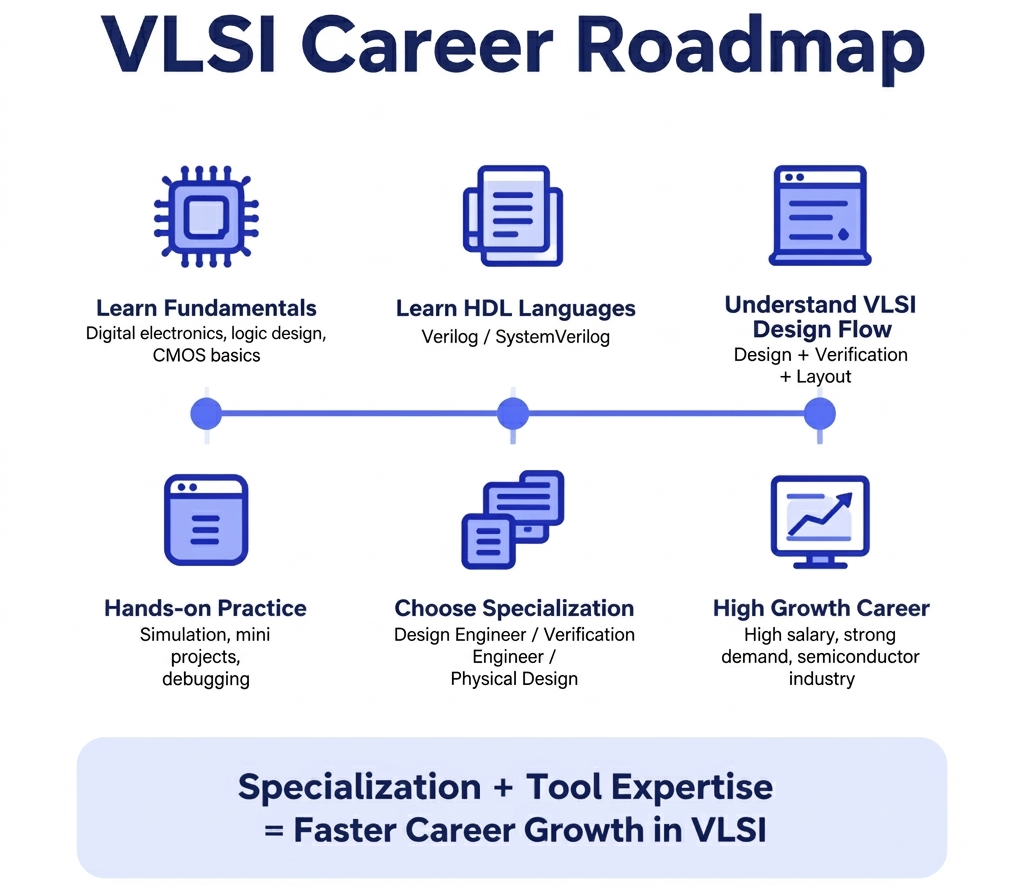
A practical roadmap for entering the field includes:
- Build strong fundamentals in digital electronics
- Learn Verilog/SystemVerilog
- Understand the VLSI design flow
- Practice simulation and design projects
- Gain exposure to industry tools
- Focus on a specialization (design, verification, or physical design)
Self-learning VLSI is often not enough due to limited tool access and complex workflows, and the importance of structured learning paths becomes clearer when explored through a VLSI course guide.
Why Do Structured VLSI Programs Matter?
One of the biggest downsides of VLSI careers is the gap between academic learning and industry requirements. Most university programs focus heavily on theory, while real-world VLSI jobs require hands-on experience with tools, workflows, testing, and debugging.
Structured programs help bridge this gap by combining fundamentals with practical exposure. For instance, advanced programs like the M.Tech in VLSI Design (IIT Jammu) focus on deep technical expertise, including chip design, verification, and industry-level workflows used in semiconductor companies.
At the same time, newer programs such as an AI-enabled VLSI design certification are emerging to align with modern industry needs, where chip design increasingly intersects with AI-driven systems and hardware acceleration.
These programs are particularly useful for engineers looking to enter VLSI roles, transition from software to core engineering, or build specialization in high-demand areas like verification and physical design.
Future Scope of VLSI Careers
The future of VLSI is closely tied to the growth of the semiconductor industry and other various factors, such as the growth of AI, Machine learning hardware, Electric Vehicles, IoT, embedded systems, and advanced communication technologies.
As chip demand increases, the need for skilled VLSI engineers will continue to grow. Unlike many saturated IT roles, VLSI remains a specialized field with long-term relevance.
TL;DR
- VLSI career in India offers strong long-term growth in the semiconductor industry
- VLSI engineering requires strong fundamentals, practical skills, and specialization
- Entry is challenging, but experienced professionals earn high salaries
- Demand for VLSI jobs is rising due to chip design and manufacturing growth
FAQs: VLSI Career
Is VLSI a good career in India?
Yes, VLSI is a good career in India due to the growing semiconductor industry, government initiatives, and high demand for skilled engineers. While entry is competitive, long-term growth and salary potential are strong.
What are the different VLSI jobs available?
Common VLSI jobs include VLSI design engineer, verification engineer, physical design engineer, DFT engineer, and analog/mixed signal engineer. Each role focuses on a different stage of chip development.
What is the salary of a VLSI engineer in India?
The VLSI engineer salary in India ranges from ₹3–6 LPA for freshers, ₹8–20 LPA for mid-level professionals, and ₹25–50+ LPA for senior engineers, depending on specialization and experience.
What skills are required for a VLSI engineer?
Key skills include digital logic design, Verilog/SystemVerilog, CMOS fundamentals, timing analysis, and familiarity with EDA tools like Cadence and Synopsys. Strong problem-solving and debugging skills are also essential.
How can I start a career in VLSI?
To start a VLSI career, build strong fundamentals in electronics, learn HDL languages, understand the design flow, work on projects, and gain exposure to industry tools. Specializing in a specific domain improves job prospects.
Why are VLSI jobs in high demand?
VLSI jobs are in high demand due to the rapid growth of the semiconductor industry, increasing use of electronics, and expansion of chip design centers in India.


Executive PG Certification in AI-Enabled VLSI Design
IIT Kharagpur
Architect the Silicon of Tomorrow: From Low-Power RTL to AI-Optimized GDSII.