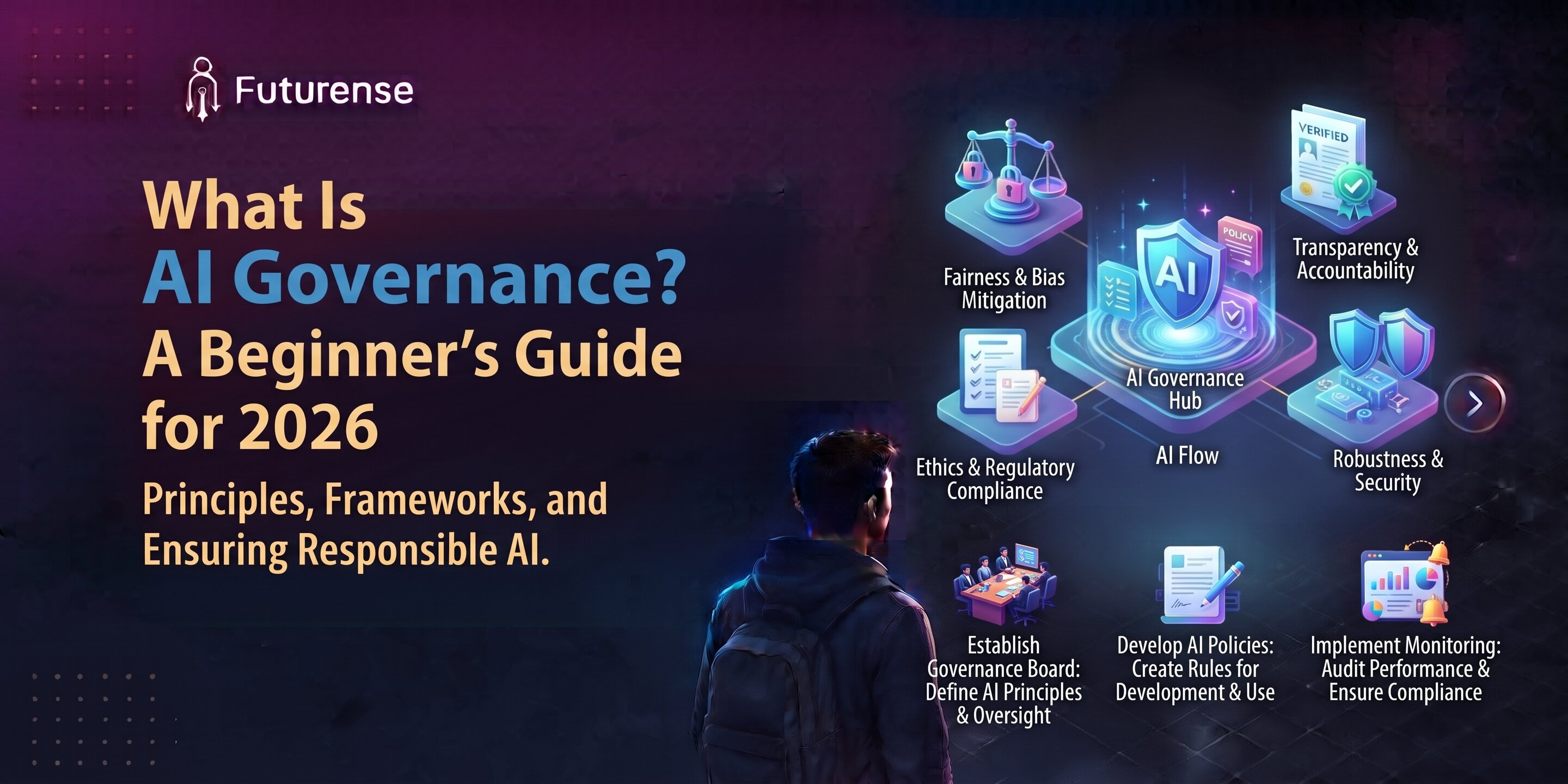


What Is AI Governance? A Beginner's Guide for 2026
AI governance, in plain terms, is the set of policies, processes, and controls organizations use to make sure AI systems are safe, fair, accountable, and compliant with the law, before and after they're deployed. If you've heard the term thrown around in job postings or news headlines and wondered what it actually means in practice, this guide starts from zero and builds up.
Why AI Needs Its Own Governance Discipline
Traditional software governance assumes a system behaves predictably: the same input produces the same output, and you can test every path through the code. AI systems, especially large language models, break that assumption. The same prompt can produce different outputs. A model can be accurate on most inputs and confidently wrong on others, with no obvious warning sign. It can absorb and repeat biases present in its training data without anyone deciding to put them there.
That unpredictability is exactly why AI needs governance as its own discipline, not just an extension of general IT governance. You can't fully test an AI system's behavior in advance the way you'd test traditional software, so governance has to focus on continuous oversight, monitoring, and accountability structures instead of a one-time pre-launch checklist.
The Core Framework: NIST's Four Functions
The most widely referenced framework for thinking about AI governance comes from the U.S. National Institute of Standards and Technology (NIST), and it organizes the work into four functions that are worth memorizing, since most other frameworks and internal company policies map back to some version of this structure.
Each function feeds the next. Governance without mapping specific risks is just paperwork. Mapping without measurement is guesswork. Measurement without a management response means known risks just sit there, documented but unaddressed.
What Are You Actually Governing Against?
Beginners often picture AI governance as a response to a single, dramatic failure scenario. In practice, the real risks are more varied and often less dramatic.
Bias and unfair outcomes: An AI model trained on historical data can absorb and amplify existing biases, in hiring, lending, or content moderation, without anyone explicitly programming that outcome. Governance exists to catch this before it causes real harm to real people.
Hallucination and inaccuracy. Language models can produce confident, well-formatted, completely incorrect information. In a customer-facing or decision-support context, this isn't a minor bug, it's a governance failure if nothing catches it before it reaches a user who trusts the output.
Privacy and data leakage. AI systems trained on or given access to sensitive data can inadvertently expose it, through a poorly scoped prompt, an overly permissive integration, or a model that memorized training data it shouldn't have.
Security vulnerabilities. AI systems introduce new attack surfaces, prompt injection, data poisoning, model extraction, that traditional security governance wasn't built to address. Our AI in Cybersecurity guide covers this specific intersection in depth.
Lack of accountability. When an AI system makes a consequential decision, denying a loan, flagging a transaction as fraudulent, who's actually responsible if it's wrong? Governance exists specifically to make sure that question has a clear, documented answer before the system ever goes live, not after something goes wrong.
The Regulations Shaping This Right Now
AI governance isn't just a best-practice framework anymore, it's increasingly a legal requirement, and the regulatory landscape is moving fast enough that it's worth understanding the current state directly rather than relying on outdated headlines.
The EU AI Act, the world's first comprehensive AI-specific regulation, entered into force in August 2024 with a phased implementation timeline. Prohibitions on certain AI uses and baseline AI literacy obligations have applied since early 2025, and rules for general-purpose AI models have applied since August 2025. The timeline for high-risk AI systems specifically has shifted meaningfully: a 2026 simplification amendment (the "Digital Omnibus") pushed obligations for most high-risk, use-based AI systems from the original August 2026 deadline to December 2027, with product-regulated high-risk systems (like AI in medical devices) now due by August 2028.
It's worth knowing, too, that regulatory readiness on the ground has lagged the law itself: as of mid-2026, fewer than half of EU member states had fully staffed the national authorities responsible for enforcing the Act, a real gap between what the law requires and what's actually being actively enforced right now.
Outside the EU, the regulatory picture is more fragmented, the United States has relied more on sector-specific guidance and executive-branch policy than a single comprehensive law, and India's approach so far has leaned on existing frameworks like the IT Act and the Digital Personal Data Protection Act rather than a dedicated AI-specific statute. This fragmentation is itself a reason AI governance expertise is valuable: organizations operating across multiple markets need people who can navigate genuinely different rules in different jurisdictions, not just one set of requirements.
Core Practices, Explained Simply
Strip away the framework names and legal language, and effective AI governance comes down to a handful of consistent practices.
- Document decisions, not just outcome: Why a model was chosen, what data trained it, what testing was done, all of this needs to be written down at the time, not reconstructed later when a regulator or a customer asks.
- Build in human oversight for consequential decisions: Full automation is rarely appropriate for high-stakes decisions. Knowing exactly where a human needs to review or approve an AI system's output is a core governance decision, not an afterthought.
- Test for bias and fairness deliberately: This doesn't happen by accident. It requires structured evaluation against specific fairness criteria, not just checking whether the model produces plausible-looking output.
- Maintain audit trails: Being able to reconstruct what a system did, and why, after the fact is essential both for regulatory compliance and for genuinely learning from mistakes.
- Treat governance as continuous, not a one-time gate: An AI system's behavior can drift over time as real-world data changes. Governance that stops at launch misses exactly the failures that show up months later.
Who Owns AI Governance? (It's Not Just Legal)
A common beginner misconception is that AI governance belongs entirely to a legal or compliance team. In practice, it's a genuinely cross-functional discipline. Legal and compliance teams understand regulatory requirements. Engineers understand what's technically feasible to monitor and control. Product teams understand the actual business context a system operates in. Data scientists understand the model's real behavior and limitations.
Effective AI governance requires all of these perspectives working together, which is exactly why "AI governance and compliance specialist" has emerged as its own distinct role, bridging the technical and regulatory sides rather than sitting purely on one side or the other.
Getting Started: A Beginner's Path
If AI governance is new territory for you, a sensible learning order avoids trying to absorb everything at once.
Start with the foundations of what AI systems actually are and how they behave, you can't meaningfully govern something you don't understand technically, even at a conceptual level. From there, get familiar with the NIST framework specifically, since it's the most widely referenced starting point and most other frameworks build on similar logic. Read the EU AI Act's actual structure, even a summary version, since it's the most comprehensive regulation currently shaping how global companies approach this space. Finally, look at how AI governance intersects with your specific area of interest, security, healthcare, finance, since the practical application looks meaningfully different across industries even though the underlying principles stay consistent.
Is This Worth Learning Right Now?
Short answer: yes, and the trend line points toward this mattering more, not less. As AI adoption scales across regulated industries, and as more jurisdictions introduce their own versions of AI-specific regulation, organizations need people who understand both the technical and regulatory sides of deploying AI responsibly. This is increasingly treated as a distinct, valuable skill set rather than something absorbed as a side responsibility by an existing legal or engineering team.
TL;DR
- AI governance = the rules, processes, and oversight that make AI systems safe, fair, and accountable, not just technically functional
- The most widely used framework, NIST's AI Risk Management Framework, organizes governance into four functions: Govern, Map, Measure, Manage
- Real regulation already exists and is actively changing: the EU AI Act is the flagship example, though its high-risk system deadlines were recently pushed from August 2026 to December 2027 and August 2028 under a 2026 simplification amendment
- Core risks it addresses: bias, hallucination, privacy violations, security vulnerabilities, and lack of accountability when something goes wrong
Frequently Asked Questions
What is AI governance in simple terms?
AI governance is the set of policies, processes, and oversight structures organizations use to make sure AI systems are safe, fair, accountable, and legally compliant, both before and after deployment, not just a one-time check before launch.
What is the NIST AI Risk Management Framework?
It's the most widely referenced framework for AI governance, organizing the discipline into four functions: Govern (policies and accountability), Map (understanding specific risks), Measure (testing against those risks), and Manage (responding when risks are identified)
Is the EU AI Act still relevant if the deadlines were delayed?
Yes. Prohibitions and baseline AI literacy obligations have applied since early 2025, and general-purpose AI model rules since August 2025. Only the high-risk system deadlines were pushed back, to December 2027 and August 2028, not the entire regulation.
Does India have its own AI governance law?
Not a dedicated, comprehensive AI-specific statute as of 2026. India's current approach leans on existing frameworks like the IT Act and the Digital Personal Data Protection Act, though this is an actively evolving area.
Is AI governance a good career path?
Yes, and demand is growing as AI adoption scales in regulated industries. It rewards people who combine genuine technical AI literacy with regulatory and business understanding, a combination that's still relatively scarce in the current job market.
Do I need a legal background to work in AI governance?
Not necessarily. While legal and compliance knowledge helps, many effective AI governance professionals come from technical or product backgrounds and build regulatory literacy on top of that foundation, since understanding how AI systems actually behave is just as important as understanding the law governing them.


Advanced Engineering Program in AI Agent Workflows and Agentic Systems Development
IITM Pravartak
Orchestrate and scale strategies trusted by the enterprise AI teams