

What Is AI in Supply Chain Management?
AI in supply chain management is the use of machine learning, optimisation algorithms and related techniques to improve planning, sourcing, production, transport, warehousing and returns. It turns historical and real-time data into predictions and recommended actions.
Three families of techniques do most of the work:
- Machine learning predicts: demand next week, delivery delay risk, likely equipment failure.
- Optimisation decides: the cheapest feasible set of routes, the best order quantities, the right production schedule.
- Generative AI and agents assist: summarising disruptions, answering planners' questions, drafting supplier emails and triggering follow-up steps.
Prediction without optimisation tells you what will happen. Optimisation without prediction plans for a world that no longer exists. Strong systems combine both.
Why Supply Chains Suit AI
Supply chains have the ingredients AI needs: many repeated decisions, lots of structured data, measurable outcomes, and costly errors. Forecasts that are slightly wrong cause stockouts or excess stock. Routes that are slightly inefficient burn fuel every day. Small percentage gains compound across thousands of items and trips.
They are also volatile. Demand shifts, ports clog, suppliers fail, and weather interrupts roads. Humans struggle to re-plan quickly across so many moving parts. Software can re-run a plan in minutes.
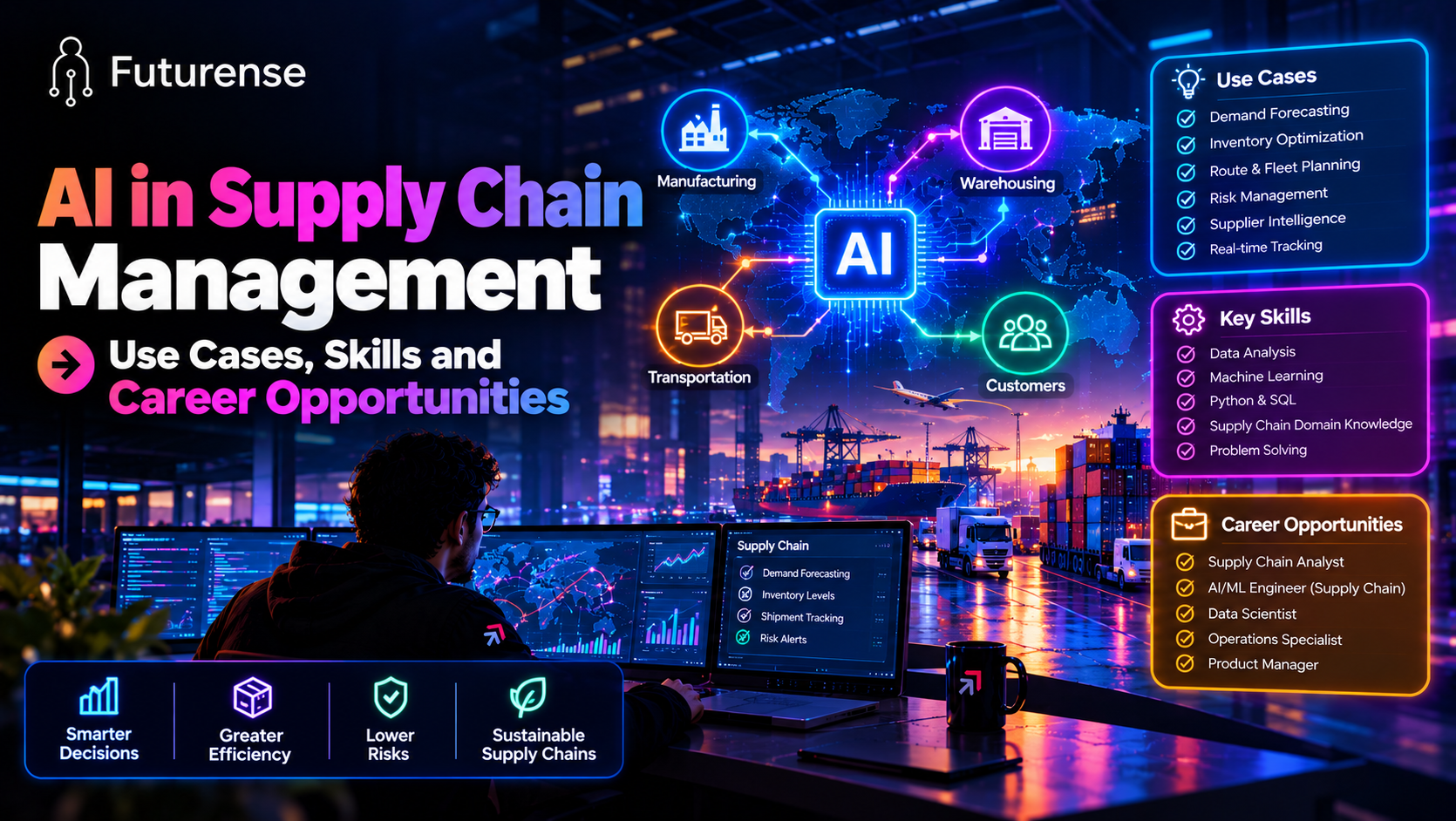
Key Use Cases of AI in Supply Chain Management
Demand forecasting
Demand forecasting predicts how much of each product customers will buy, where and when. Classic statistical methods work well on stable items. Machine learning helps where many related products, promotions, prices and seasonality interact.
The DeepAR paper by Salinas, Flunkert and Gasthaus trained a recurrent neural network across many related time series and reported accuracy improvements of around 15% over state-of-the-art methods on several real-world datasets, with retail demand forecasting as the motivating case. In the M5 forecasting competition, which used retail sales data, machine learning outperformed statistical methods, a result one later commentary in the International Journal of Forecasting described as strong evidence that complex methods can be more accurate than simple ones. The same commentary argued that the result may not repeat, since each competition has had a different winner. The practical lesson: test models against a simple baseline on your own data.
Inventory optimisation
Forecasts feed inventory policy. AI helps set safety stock and reorder points per item and location, balancing the cost of stockouts against the cost of holding stock. The output is a recommended order quantity, not just a prediction.
Route and logistics optimisation
Routing is a classic optimisation problem. Google's OR-Tools documentation defines the vehicle routing problem as finding the best routes for a fleet of vehicles visiting a set of locations, usually minimising total distance or cost, subject to constraints such as vehicle capacity and customer time windows. It also notes that solving time grows rapidly with problem size, so solvers often return good rather than provably optimal answers. Machine learning adds travel-time predictions and delay forecasts that make the plan more realistic.
Warehouse automation and robotics
Computer vision, robotic picking and autonomous mobile robots speed up storage, retrieval and sorting. AI also helps with slotting (where to store items), labour scheduling and quality inspection. To understand the technology underneath, see our guide to AI and robotics.
Supplier risk and procurement
Models can monitor supplier performance, financial signals, delivery history and external news to flag risk early. Procurement teams use AI to compare quotes, classify spend and extract terms from contracts.
Visibility and digital twins
A control tower brings shipment, inventory and order data into one view. A digital twin goes further and simulates the network so planners can test "what if" scenarios before acting. The idea is explained in detail in our guide to the digital twin in manufacturing.
Generative AI and agents
Large language models can answer planners' questions in plain language, summarise delays and draft communications. Agents go a step further and carry out multi-step tasks, such as checking stock, proposing a transfer and raising an approval request. If these terms are new, read what AI agents are and the wider explainer on agentic AI. Keep a human approval step for any action that spends money or commits to a customer.
The Data Foundation Matters More Than the Model
Many projects stall on data, not algorithms. The same product may have three codes across systems. Lead times may be recorded inconsistently. Stock counts in the warehouse system may differ from the finance system. Before modelling, teams need reliable item and location master data, consistent units, clean history and clear ownership.
India's National Logistics Policy 2022 includes the Unified Logistics Interface Platform, described as an open platform meant to connect developers and logistics companies. Programmes like this point towards more shared, digital logistics data, which is good news for AI projects, though you should check the official policy documents for details.
Challenges and Risks
- Poor data quality. Models inherit the errors in their inputs.
- Forecasts cannot see the future. Sudden disruptions, new products and one-off events break historical patterns.
- Black-box plans. Planners trust a recommendation more when they understand why it was made.
- Change management. A forecast that planners override every time delivers no value.
- Over-optimisation. A plan that is perfect on paper can be brittle when anything goes wrong.
- Security and privacy. Supplier and customer data need protection, and agents with system access need tight permissions.
A Worked Scenario: An FMCG Distributor in India
This is a hypothetical example to show how the pieces fit; the company and figures are invented.
A distributor supplies packaged foods to retailers across several Indian states from three warehouses. Planners use spreadsheets, stockouts happen on fast-moving items before festivals, and slow items pile up elsewhere.
Step 1: Fix the data. The team standardises product codes, merges sales from two systems and records the actual lead time from each supplier.
Step 2: Forecast. An analyst builds a baseline using last year's sales by week, then tests a machine learning model that adds festival dates, price changes and promotions. The model is adopted only for items where it beats the baseline on a held-out period.
Step 3: Optimise inventory. For each item and warehouse, the team sets reorder points from the forecast, lead-time variability and a target service level. Slow movers get lower stock.
Step 4: Plan routes. A routing solver groups deliveries by area and respects truck capacity and delivery windows.
Step 5: Keep humans in the loop. Planners see the forecast, the suggested order and the reason, and can override with a note. Overrides are reviewed monthly to improve the model.
Step 6: Measure. The company tracks forecast error, stockout rate, inventory days and delivery cost against the previous year.
Skills Needed for AI in Supply Chain Management
Domain knowledge is the differentiator. A data scientist who understands why safety stock exists will build better models than one who treats inventory as a column of numbers.
Career Opportunities
AI in supply chain does not have one job title. Typical roles include:
- Supply chain analyst or demand planner using analytics tools and forecasting models.
- Data analyst or business analyst in operations, logistics or retail. See AI data analyst job role and scope and the comparison of data analyst vs business analyst.
- Operations research or optimisation analyst building routing, scheduling and network models.
- Machine learning engineer or data scientist building and deploying forecasting and risk models. See how to become a machine learning engineer.
- Supply chain technology consultant helping companies adopt planning and visibility tools.
- Automation and robotics roles in warehouses and manufacturing.
Employers include manufacturers, retailers, e-commerce and quick-commerce firms, logistics providers, consumer goods companies and consulting firms. Titles and expectations vary widely, so read job descriptions closely. We have not quoted salary figures because published numbers vary by city, company and role; check current listings before planning around one.
If you are weighing a formal route, our guide to a master's in supply chain management covers the education side, and business analytics vs applied AI helps you choose between analytics-led and engineering-led paths. For the wider effect on work, see AI and automation.
How to Get Started
- Learn the basics of supply chain. Inventory, lead time, service level, transport modes.
- Get comfortable with data. SQL and Python first.
- Build a forecasting project. Use a public retail or sales dataset; always compare against a naive baseline.
- Try a routing or inventory model. An open-source solver is enough to learn the ideas.
- Write up your work. Explain the business decision, the method and the result in plain language.
- Add generative AI carefully. Build a small assistant over documents or shipment data, with human approval for actions.
Common Mistakes
- Starting with the model, not the decision. Ask which decision improves and who makes it.
- Skipping a baseline. Complex models must beat a simple one to earn their place.
- Ignoring data quality. Clean master data first.
- Forecasting without acting. A forecast helps only if it changes orders, routes or schedules.
- Over-trusting automation. Keep approvals and monitoring for high-impact actions.
- Neglecting the people. Planners who do not trust the system will work around it.
TL;DR:
AI in supply chain management means using machine learning, optimisation and, increasingly, generative AI to forecast demand, set inventory levels, plan routes, automate warehouses, spot supplier risk and handle exceptions. The biggest wins come from better decisions on data a company already holds. Careers sit at the meeting point of analytics, operations and engineering, so the most useful skills are SQL, Python, forecasting and optimisation basics, and a solid grasp of how goods actually move.
How is AI used in supply chain management?
AI is used to forecast demand, optimise inventory, plan routes, automate warehouses, monitor supplier risk, simulate networks with digital twins, and assist planners with generative AI and agents. Most value comes from better, faster decisions.
How does AI improve demand forecasting?
Machine learning can combine sales history with prices, promotions, seasonality and related products across many items at once. Research such as DeepAR reported around 15% accuracy gains over earlier methods on some datasets, but results vary, so always test against a simple baseline.
What skills do you need for AI in supply chain?
SQL, Python, forecasting, basic optimisation, machine learning and supply chain domain knowledge such as inventory and logistics. Communication matters too, because planners must trust and use the recommendations.
Can a supply chain professional move into AI?
Yes. Domain knowledge is a real advantage. Start with SQL and Python, build a forecasting or inventory project on a public dataset and learn the basics of machine learning and optimisation.
What jobs combine AI and supply chain?
Demand planner, supply chain analyst, data or business analyst, operations research analyst, machine learning engineer, supply chain technology consultant and automation roles in warehouses.
What are the challenges of AI in supply chains?
Poor data quality, unpredictable disruptions that history cannot capture, hard-to-explain recommendations, low user adoption, brittle over-optimised plans and security risks when agents can act in business systems.


PG Diploma and M.Tech. in Data Engineering
IIT Jodhpur
Become the Data Engineer every modern team needs with IIT Jodhpur Faculty & Industry Experts.