

What Is AI Red Teaming?
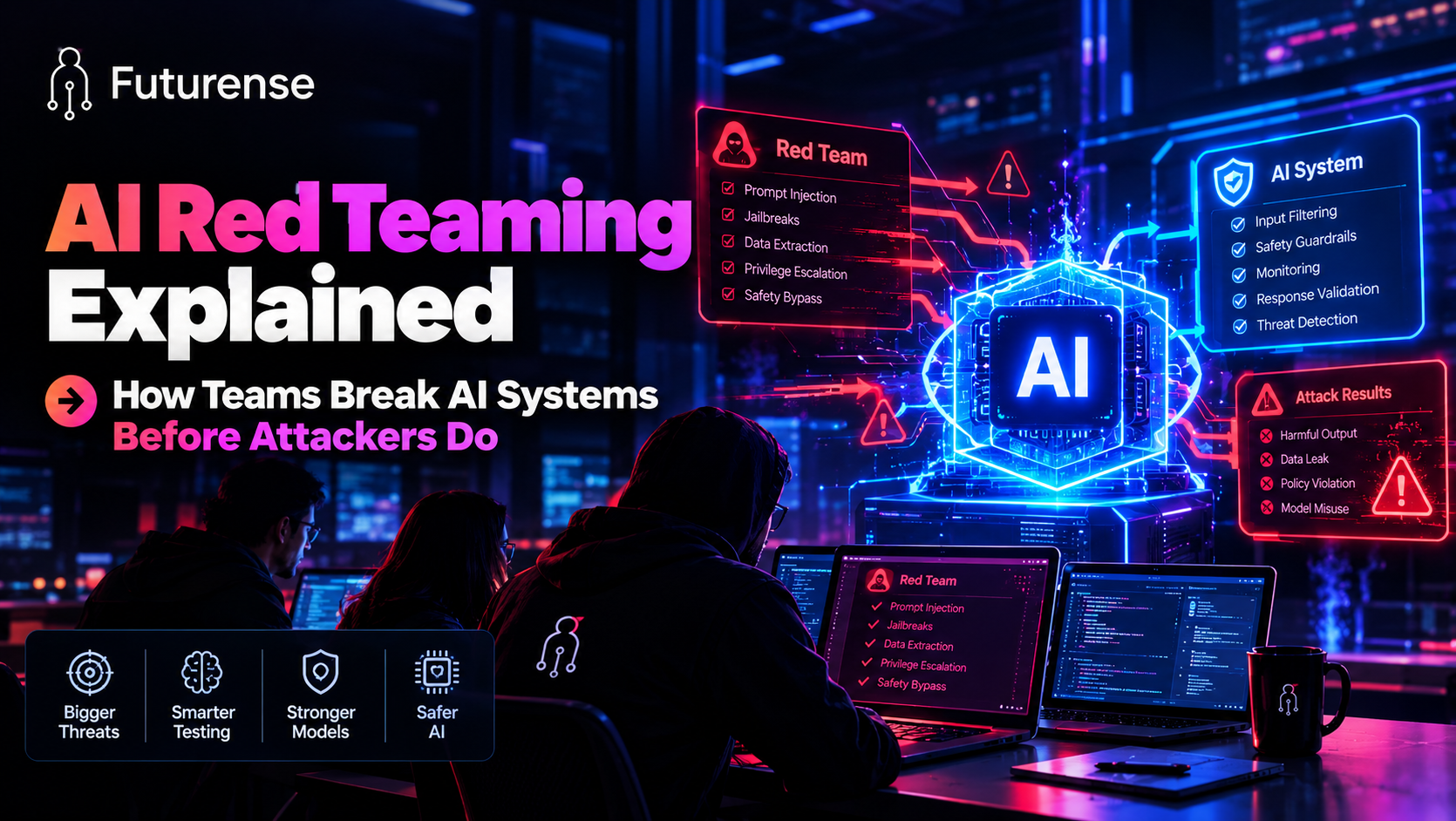
AI red teaming is a structured, authorised effort to make an AI system behave in ways its builders did not intend, so those weaknesses can be fixed before attackers or ordinary users trigger them. The targets include security failures, privacy leaks and harmful or misleading outputs.
The term comes from traditional security. NIST's glossary, citing the Committee on National Security Systems, describes a red team as a group authorised and organised to emulate a potential adversary's attack or exploitation capabilities, with the goal of improving security by showing the effects of successful attacks and which defences work. AI red teaming applies the same mindset to models, applications and agents.
Two recent publications show how mainstream the practice has become. In January 2025 the OWASP GenAI Security Project released a guide to generative AI red teaming aimed at security professionals, AI and machine learning engineers, and red team practitioners. And NIST's Generative AI Profile (NIST AI 600-1) refers to red-teaming repeatedly across its measurement actions.
How Is AI Red Teaming Different From Penetration Testing?
Penetration testing looks for flaws in code, configuration and infrastructure, which are usually deterministic. AI systems add a layer where the behaviour itself is the vulnerability.
Microsoft's paper on red teaming over 100 generative AI products makes two relevant points. First, breaking an AI system does not require computing gradients; simple prompting and ordinary attack techniques often work. Second, AI red teaming is different from safety benchmarking. A benchmark measures performance on a fixed set of questions. A red team hunts for the unknown failures a fixed set would miss.
Large language models also amplify existing security risks and introduce new ones, according to the same paper. If you are new to the underlying technology, start with what an LLM is.
What Do AI Red Teams Look For?
Findings fall into two families: security failures and responsible AI harms, the second of which Microsoft's authors call widespread but hard to measure.
Security failures
- Prompt injection. Hostile instructions hidden in user input or retrieved content that override the intended behaviour. This is the most discussed attack class, and we cover it fully in our guide to prompt injection.
- Jailbreaking. NIST describes it as manipulating prompts to circumvent output controls.
- Data leakage. NIST's profile suggests red-teaming to assess privacy issues such as training-data output and membership inference.
- Data poisoning. Tampering with training or retrieval data to bend behaviour. NIST lists prompt injection and data poisoning together as attacks to test resilience against.
- Tool and agent abuse. An assistant with access to email, databases or payment APIs can be tricked into using them. See what AI agents are and tool calling in LLMs for why this surface keeps growing.
Responsible AI harms
- Biased, discriminatory or demeaning outputs.
- Dangerous advice, for example in medical or financial settings.
- Confident falsehoods that users act on.
- Content that violates policy or law.
A good test plan covers both families, because a system can be perfectly secure and still hurt the people it serves.
How an AI Red Teaming Exercise Works
There is no single mandatory process, but most exercises follow a similar arc.
1. Understand the system and its deployment
Microsoft's first lesson is to understand what the system can do and where it is deployed. A customer-facing chatbot with no tools is a different risk from an internal agent that can send emails. Map the model, the prompts, the data sources, the tools, the users and the downstream effects of a bad output.
2. Build a threat model
Decide who might attack (a curious user, a fraudster, an insider) and what matters most: leaked records, wrong advice, financial loss. You cannot test everything, so the threat model sets priorities.
3. Create an attack library
Write test inputs across categories: direct and indirect prompt injection, role-play jailbreaks, requests for private data, multi-turn manipulation and tool-misuse scenarios. Start from public taxonomies, then add cases specific to your product.
4. Run the tests, manually and automatically
Humans bring creativity and context; automation brings volume.
5. Score and reproduce
Because outputs vary, run important attacks several times and record how often they succeed. A failure that appears one time in twenty still matters at scale.
6. Report with evidence
Each finding needs the exact input, the output, the conditions and the potential impact. Findings without reproduction steps tend to be ignored.
7. Fix and retest
Fixes are usually layered: tighter permissions, input and output checks, better prompts, retrieval filters, human approval for risky actions, sometimes model changes. Then run the same attacks again. A fix that is never retested is a hope, not a control.
8. Repeat
Models, prompts, data and tools change, and so do attackers. Microsoft's team lists "securing AI systems is never fully complete" among its lessons, which is why red teaming works best as a recurring practice, not a one-off audit.
Manual vs Automated AI Red Teaming
Human red teamers are good at novelty. They notice that a policy has a loophole, chain small steps into a larger exploit and judge cultural or contextual harm. Microsoft's lessons state that human involvement is crucial to AI red teaming.
Automation is good at coverage. A 2022 paper by Perez and colleagues proposed using one language model to generate test cases that expose harmful behaviour in another. Applied to a 280-billion-parameter chatbot, the approach found tens of thousands of offensive replies, according to the paper's abstract. The authors presented it as one useful tool among several, not a complete answer.
Microsoft's lessons reach a similar balance: automation helps cover more of the risk landscape, while people remain essential. Open tooling exists for this. Microsoft, for example, publishes PyRIT, an open automation framework for red teaming generative AI systems.
A practical split:
Frameworks and Standards Worth Knowing
You do not need to invent a method. Several public references give structure.
- NIST AI 600-1 (Generative AI Profile). Includes actions that call for red-teaming to test resilience against prompt injection and data poisoning, to assess privacy risk, and to quantify harms. It also asks that people running such exercises are not directly involved in developing the system, and that participants represent diverse user populations.
- OWASP GenAI Security Project. Publishes a generative AI red teaming guide, plus its widely used list of top risks for LLM applications.
- MITRE ATLAS. A knowledge base of adversary tactics and techniques against AI systems, useful for naming and organising attack paths.
- Your own governance process. Red teaming feeds into policy, approvals and monitoring. For the bigger picture, read what is AI governance.
A Worked Scenario: Red Teaming a Support Assistant
This is a hypothetical example to show the method; the company and findings are invented.
A lender launches an assistant that answers customer questions using internal policy documents and can create support tickets. Before launch, a small team runs a red teaming sprint.
Scope. The assistant reads policy PDFs, sees the customer's name and account tier, and can open tickets. It cannot move money.
Threat model. Priorities: leaking another customer's data, issuing false policy statements, and being tricked into opening or closing tickets.
Attacks tried. The team asks the assistant to ignore its rules, to role-play as an administrator, and to summarise a "customer email" that contains hidden instructions. They upload a policy document with injected text. They also ask boundary questions about loan eligibility to see whether it invents rules.
Findings.
- The hidden instructions in an uploaded document sometimes change the assistant's answers.
- In multi-turn chats, the assistant occasionally reveals internal ticket notes.
- On eligibility, it states a policy that does not exist about one time in several attempts.
Fixes. Retrieved text is marked as untrusted and stripped of instruction-like phrasing. Ticket notes are removed from the model's context. Eligibility answers must quote the source document or defer to a human. Ticket creation requires user confirmation.
Retest. The team reruns the same attack set, plus new variants, and records success rates before and after. Remaining issues are documented and monitored after launch using the practices in AI observability.
Common Mistakes
- Treating it as a one-off. A single audit goes stale the moment prompts, data or tools change.
- Testing the model, not the system. Many failures live in tools, permissions and retrieval, not the model alone.
- Relying only on benchmarks. They measure known questions, not unknown failures.
- Letting builders test their own work. NIST's profile calls for those running structured exercises to be independent of development.
- Ignoring probabilistic failures. A flaw that appears occasionally is still a flaw; measure rates.
- Skipping the harm side. Security-only testing misses bias and unsafe advice.
- No retest. Fixes need proof.
Red teaming also does not replace other controls. It finds problems; guardrails, access control, human review and monitoring reduce them.
Is AI Red Teaming a Career?
It is a growing specialisation, and the entry route is usually security or machine learning, not a dedicated degree. Useful foundations include:
- Security basics: how attacks are planned and reported. Our ethical hacking course guide and the comparison of ethical hacker vs cybersecurity are good starting points.
- A working understanding of LLMs, prompting, retrieval and agents.
- Python for scripting automated test harnesses.
- Clear writing, because findings must persuade engineers and managers.
For a broader view of security careers, see how to become a cybersecurity analyst and AI in cybersecurity. We have not included salary figures here because reliable India-specific data for this niche is thin; check current job listings before planning around a number.
TL;DR:
AI red teaming is the practice of deliberately attacking an AI system, as an adversary or a careless user might, to find security flaws and harmful behaviour before real users do. It goes beyond classic penetration testing because language models are probabilistic and fail in unexpected ways. A good exercise is scoped to a real system, mixes human creativity with automated testing, produces fixes that are retested, and never ends: Microsoft's own team says securing AI systems is never fully complete.
What is AI red teaming?
AI red teaming is a structured, authorised effort to attack an AI system the way an adversary or careless user might, in order to find security flaws, privacy leaks and harmful behaviour before release. Findings feed fixes, which are then retested.
How is AI red teaming different from penetration testing?
Penetration testing targets code, networks and configuration, where flaws are mostly deterministic. AI red teaming also targets model behaviour, which is probabilistic, and covers harms such as bias and misinformation as well as security. The same prompt may fail only some of the time.
What do AI red teamers test for?
They test for prompt injection, jailbreaks, data leakage, data poisoning, tool and agent misuse, and harmful or misleading outputs. The exact mix depends on what the system can do and who uses it.
Can AI red teaming be automated?
Partly. Research such as Perez et al. (2022) shows language models can generate large numbers of test cases, and open frameworks exist for automation. Human testers remain essential for novel attacks and contextual judgement, so most teams use both.
Is AI red teaming the same as safety benchmarking?
No. A benchmark scores a model on a fixed set of tasks. Red teaming actively searches for unknown failures in a real system, including the tools, data and permissions around the model.
How often should you red team an AI system?
Before launch, after significant changes to the model, prompts, data or tools, and on a regular schedule afterwards. Microsoft's team notes that securing AI systems is never fully complete, so treat it as a continuing process.


PG Certificate in AI-Driven LLM, SLM & Agentic RAG Development
IIT Jammu
Learn to Build Domain-Specific LLMs, SLMs & Production-Ready RAG Systems