

What a Computer Vision Engineer Actually Does
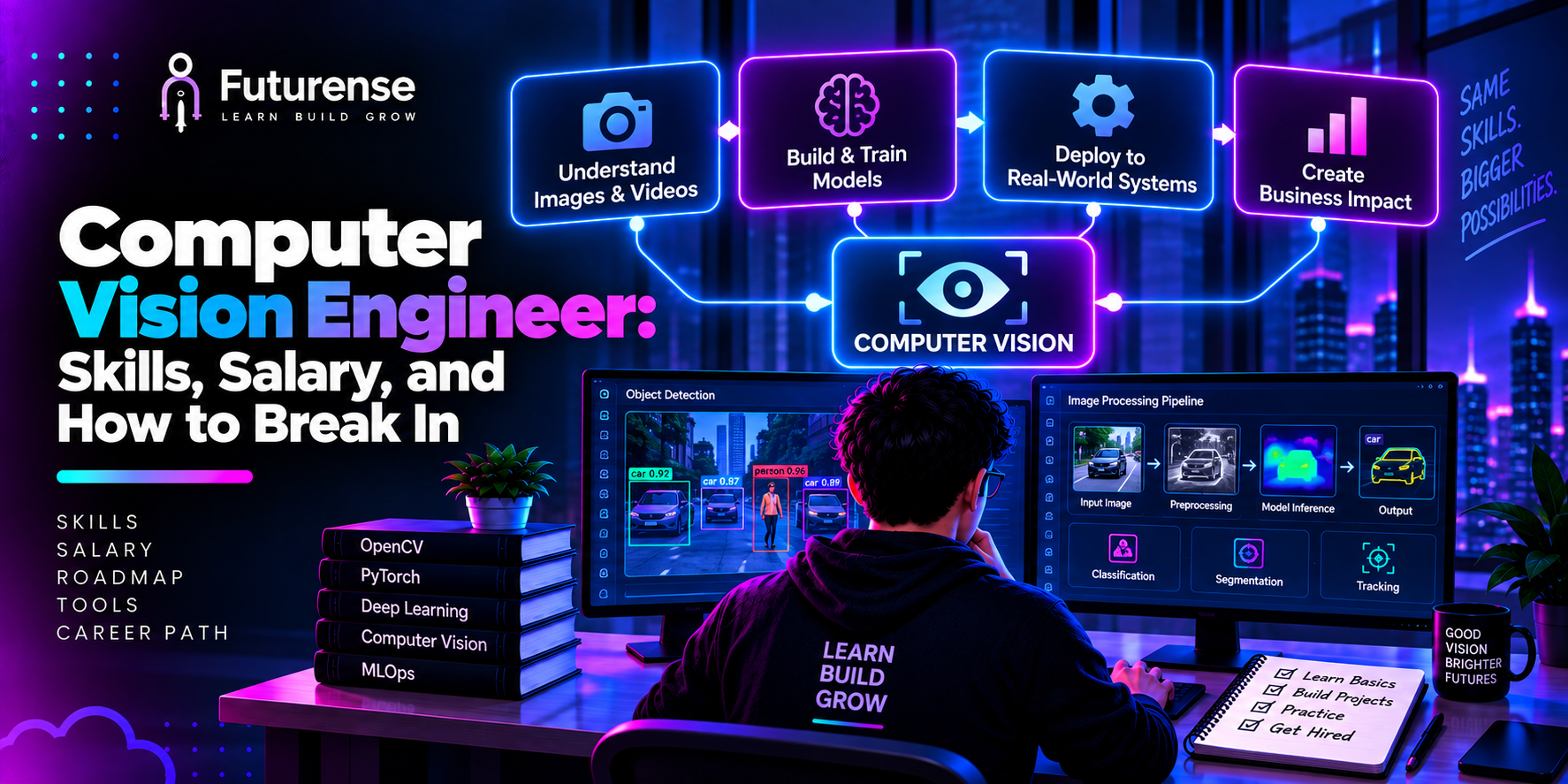
A computer vision engineer builds systems that extract meaningful information from images and video detecting and classifying objects, tracking movement, reading text, estimating depth, or recognizing faces and gestures. The work spans the full pipeline: collecting and annotating image data, designing or adapting a model architecture, training and evaluating that model, and deploying it into a real production system where it has to run reliably, often under real-time latency constraints.
This is a more specialized role than a general machine learning position understanding what computer vision actually is as a technology is useful background before going deeper into the career side, which our broader explainer, What Is Computer Vision?, covers in detail. This guide picks up specifically where that one leaves off: the skills, realistic salary expectations, and the actual path into the role.
Computer Vision Engineer vs. Machine Learning Engineer: Why the Distinction Matters
Computer vision is a specialization within the broader field of machine learning, not a separate discipline see our guide on how to become a Machine Learning Engineer for the general foundation this role builds on. The distinction that matters for career planning: a computer vision engineer needs deep, specific expertise in image data and the model architectures built for it (CNNs, vision transformers), image preprocessing and augmentation techniques, and the particular deployment challenges of vision systems like running inference fast enough for real-time video, or handling varied lighting and camera conditions reliably in the field.
In practice, many job postings blur the line between "computer vision engineer" and "machine learning engineer," but roles explicitly titled for computer vision typically expect this specialized depth rather than general ML breadth, and compensation (covered below) often reflects that added specialization.
The Skills You Need to Become a Computer Vision Engineer
Programming and Deep Learning Fundamentals
Strong Python skills are the baseline, alongside solid fundamentals in deep learning generally see our guide to Deep Learning vs Machine Learning if you need to build that foundation first. You can't specialize effectively into vision without first being comfortable with how neural networks are trained, evaluated, and debugged generally.
Convolutional Neural Networks (CNNs) and Vision Architectures
CNNs remain the foundational architecture for most computer vision work, and understanding how they actually extract spatial features from images not just how to call a pre-built model is essential; our deep-dive on CNN in Deep Learning covers this specifically. Increasingly, vision transformers (ViTs) are also expected knowledge, as they've become competitive with or superior to CNNs for many tasks.
Image Processing Fundamentals
Before data ever reaches a neural network, it typically needs preprocessing resizing, normalization, augmentation (rotation, flipping, color adjustment) to improve model robustness, and sometimes classical image processing techniques (edge detection, filtering) that remain genuinely useful even in a deep-learning-dominated field. OpenCV is the standard library for this work and is effectively a required tool in most computer vision roles.
Deep Learning Frameworks
Hands-on fluency with PyTorch and/or TensorFlow is expected, not optional our Deep Learning Frameworks roundup covers the broader landscape, but for computer vision specifically, familiarity with vision-specific libraries built on top of these frameworks (like torchvision) is a meaningful practical advantage.
Object Detection, Segmentation, and Tracking
Beyond basic image classification, most real computer vision jobs require familiarity with object detection (locating and labeling multiple objects in an image), segmentation (pixel-level classification), and tracking (following objects across video frames) distinct sub-problems, each with its own common architectures and evaluation metrics, that most entry-level CV roles expect at least working familiarity with.
Data Annotation and Dataset Management
Vision models are unusually data-hungry and sensitive to annotation quality in ways that aren't always obvious from the modeling side alone. Understanding how image datasets get labeled, the common annotation formats, and how label noise and class imbalance affect model performance is a practical skill that separates engineers who can only train a model from those who can actually make one work reliably on real-world data.
Model Deployment and Optimization
Vision models, especially for real-time applications, often need to be optimized and compressed to run within latency and hardware constraints whether that's a cloud inference endpoint or an edge device like a camera or embedded system. Skills like model quantization, pruning, and format conversion (ONNX, TensorRT) are increasingly expected for production-focused computer vision roles, not just research-oriented ones.
A Realistic Path: From Where You Are to Computer Vision Engineer
If you're coming from machine learning engineering: Your deep learning fundamentals transfer directly. Focus on building vision-specific depth work through CNN and vision transformer architectures deliberately, get genuinely hands-on with OpenCV and image preprocessing, and build 2–3 real vision projects (object detection, segmentation) rather than relying on tutorial-level image classification alone.
If you're coming from general software engineering: Build deep learning fundamentals first through structured study and real projects, then specialize into vision specifically. This is a longer path, typically 9–12 months of focused learning, since you're building two layers of new skill (deep learning generally, then vision specifically) rather than one.
If you're starting from a computer science or engineering background with limited ML exposure: Start with the fundamentals covered in our guide on how to become an AI Engineer, then narrow into computer vision once you have a working deep learning foundation trying to jump straight into vision-specific architectures without that base tends to produce a shallow, tutorial-dependent skill set that doesn't hold up in an interview or on the job.
Across all paths, a genuine portfolio of deployed or at least fully-trained vision projects not just notebook experiments matters significantly for landing a role, since computer vision hiring tends to weight demonstrable, inspectable project work heavily.
What Computer Vision Engineers Earn in India and Globally
Compensation for computer vision engineers in India varies by experience, specialization depth, and company type. Broadly, entry-level computer vision engineers can expect roughly ₹8–15 LPA, mid-level engineers with 2–5 years of specialized vision experience often earn ₹15–30 LPA, and senior computer vision specialists at global AI companies or in high-demand application areas (autonomous vehicles, medical imaging, AR/VR) can earn considerably more. For a direct comparison point against the broader ML engineering path, see our Machine Learning Engineer Salary in India guide computer vision specialization often commands a modest premium over general ML roles given the narrower, deeper skill bar.
TL;DR: Becoming a computer vision engineer means combining strong deep learning fundamentals with vision-specific skills convolutional neural networks (CNNs), image processing, object detection and segmentation, and hands-on experience with frameworks like PyTorch, TensorFlow, and OpenCV. Most engineers transition in from a machine learning or software engineering background over 6–12 months of focused, project-based learning. In India, computer vision engineer salaries typically range from ₹8–30 LPA depending on experience, with senior specialists at global AI companies earning considerably more.
What's the difference between a computer vision engineer and a machine learning engineer?
Computer vision is a specialization within machine learning focused specifically on image and video data. A computer vision engineer needs deep expertise in vision-specific architectures (CNNs, vision transformers), image processing, and deployment challenges unique to visual data, beyond general ML engineering skills.
How long does it take to become a computer vision engineer?
For engineers with an existing machine learning background, 6-9 months of focused, vision-specific learning is realistic. Starting from general software engineering with limited ML exposure typically takes 9-12 months, since deep learning fundamentals need to be built first.
Do I need to know OpenCV to become a computer vision engineer?
Yes, OpenCV is effectively a standard, expected tool in the field for image preprocessing and classical computer vision techniques, even in roles that are primarily deep-learning-focused.
Is computer vision engineer a good career path in India?
Yes, with strong demand particularly in application areas like autonomous systems, healthcare imaging, retail analytics, and manufacturing quality inspection. Specialized computer vision skills often command a salary premium over general machine learning roles.
What industries hire computer vision engineers the most?
Autonomous vehicles, healthcare and medical imaging, retail and e-commerce (visual search, inventory), manufacturing (quality inspection), security and surveillance, and augmented/virtual reality are among the strongest-demand application areas.
What's the earning potential for a computer vision engineer in India?
Broadly, entry-level roles start around ₹8-15 LPA, mid-level specialized engineers often earn ₹15-30 LPA, and senior specialists at global AI companies or in high-demand application domains can earn significantly more.


Executive PG Certification in AI-Enabled VLSI Design
IIT Kharagpur
Architect the Silicon of Tomorrow: From Low-Power RTL to AI-Optimized GDSII.