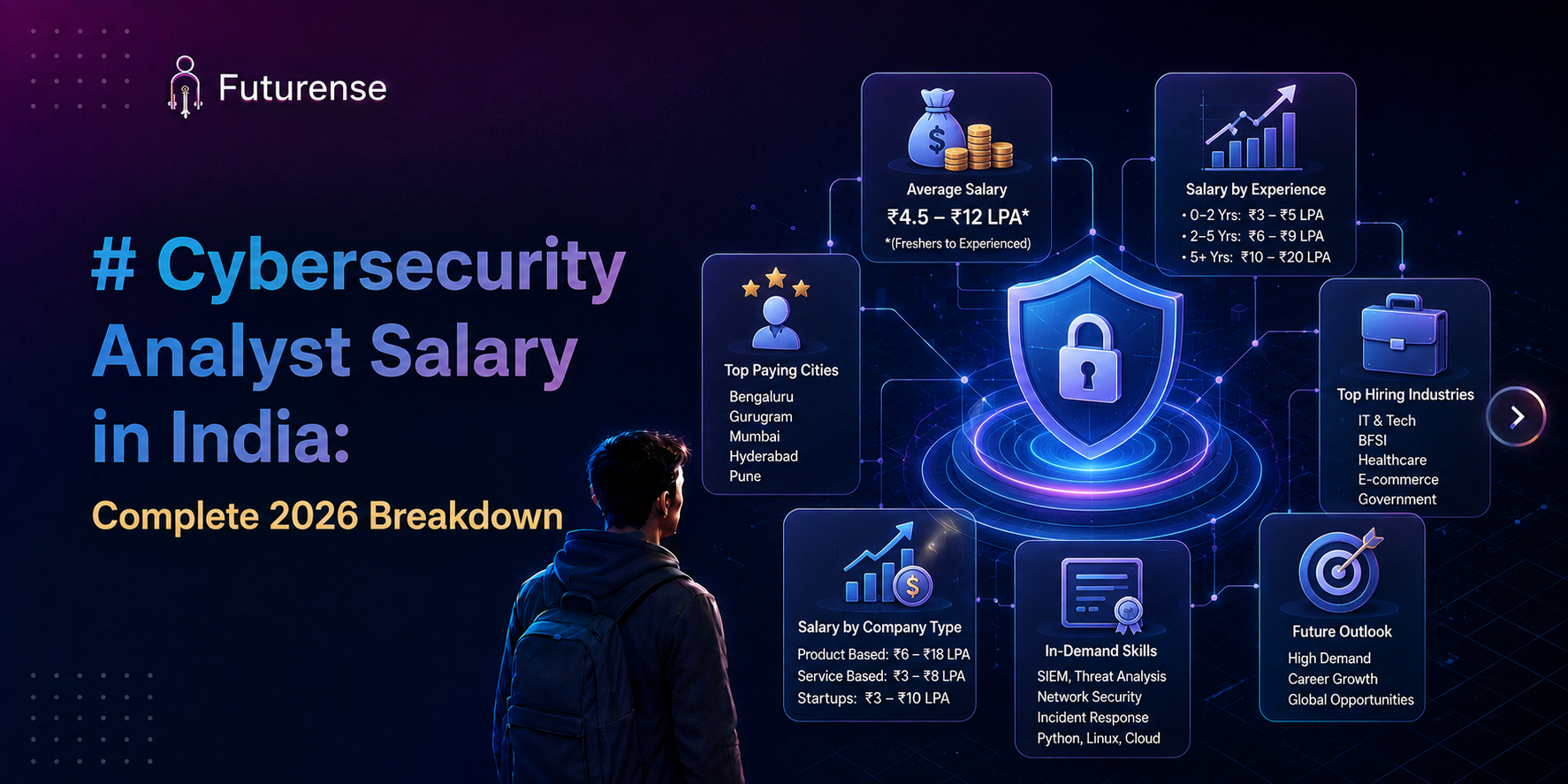


Cybersecurity Analyst salaries in India range from roughly ₹4 LPA for freshers to ₹48 LPA or more at top MNCs like Microsoft, with median total compensation sitting around ₹14.5 LPA across all experience levels. As with most tech roles, the headline "average" hides a wide spread driven by employer type, specialization, and certification, understanding where you actually sit in that range matters more than the single number most articles lead with.
Demand for this role has grown sharply in recent years, and shows no sign of slowing. India is among the most targeted countries globally for cyberattacks, and every organization with a meaningful digital footprint now needs people who can monitor, detect, and respond to threats. That demand hasn't been matched by supply, which is exactly why compensation at the senior and specialized end of this field has climbed faster than many adjacent IT roles.
Salary by Experience Level
Compensation data from PayScale and Levels.fyi, two independent sources, converges on a consistent picture once broken out by experience level.
Median total compensation across all experience levels sits at approximately ₹14.5 LPA per Levels.fyi's aggregated data, though this figure blends junior and senior professionals together, and shouldn't be read as a realistic target for someone just starting out.
Cybersecurity Analyst Salary by Employer Type
Employer type shifts this range as much as experience does. Microsoft is currently the highest-paying employer tracked for this role in India, with an average total compensation around ₹48.2 LPA, reflecting both the seniority of roles typically hired at that level and the general premium large, global tech companies pay over the broader market. Product companies and well-funded tech firms generally pay meaningfully above the market average tracked by broader aggregators like PayScale, which blend in a much larger sample of IT services and traditional enterprise roles paying closer to the ₹5-10 LPA range for comparable experience.
This mirrors a pattern that holds across most tech roles in India: the same job title can sit in genuinely different pay bands depending on whether the employer is a traditional IT services firm, a domestic enterprise, or a global product company or Global Capability Centre. A Cybersecurity Analyst at a large IT services firm handling routine SOC monitoring for multiple client accounts is doing genuinely different, and typically lower-paid, work than an analyst embedded within a single product company's security team, even when both hold the exact same job title on paper.
Global Capability Centres specifically have become an increasingly significant employer category for this role in India. As more multinational companies establish security operations centers domestically rather than outsourcing to third-party vendors, GCC-based analyst roles increasingly command compensation closer to the parent company's global bands than to traditional domestic IT services pay, another reason employer type deserves as much attention as years of experience when evaluating an offer.
The Skills and Certifications That Move the Number
Not all Cybersecurity Analyst work pays the same, and specialization within the role matters as much as tenure.
- SOC (Security Operations Center) analysis and incident response is the most common entry point, and while foundational, it typically commands the lower end of the range unless paired with deeper specialization over time. Most fresher and early mid-level roles fall into this category
- Cloud security skills (AWS, Azure, GCP security tooling) push compensation meaningfully higher, our Cloud Security Engineer roadmap shows this adjacent specialization reaching ₹28-50 LPA+ at the senior level, a notably higher ceiling than generalist analyst work
- Recognized certifications (CompTIA Security+, CEH, CISSP for senior roles) signal real competency to employers and are frequently a prerequisite for interview consideration at product companies and MNCs, not just a resume differentiator. Many job postings at this tier list a specific certification as a hard requirement rather than a nice-to-have
- AI-driven security and threat detection experience is an emerging premium area, as artificial intelligence increasingly shapes how threats get detected and mitigated at scale, experience with these tools is becoming a genuine differentiator rather than a nice-to-have
- Threat intelligence and forensics specialization sits toward the higher end of analyst-track work specifically, since it requires deeper investigative skill than routine monitoring and is in shorter supply relative to demand across the broader market
Cybersecurity Analyst vs Adjacent Security Roles
Security career paths branch meaningfully once past the entry level, and the titles aren't interchangeable in terms of pay. A typical progression looks like Security Analyst → Cloud Security Engineer or SOC Lead → Senior Security Engineer → Security Architect or Lead → CISO track, and each step tends to come with a real compensation jump, not just a title change. Many professionals also branch laterally into DevSecOps engineering, cloud compliance and governance, or AI-driven cybersecurity roles specifically, each with its own distinct pay trajectory worth researching separately rather than assuming "cybersecurity" is one uniform pay band.
At the very top of this trajectory, Chief Information Security Officer roles command compensation well beyond even senior individual-contributor security work, though reaching that level typically requires a decade or more of progressively broader security leadership experience, not purely technical depth. For most analysts early in their career, the more immediate and achievable decision point is which specialization to pursue in the first three to five years, since that choice shapes which of these later paths remains realistically open.
How to Actually Grow Your Salary
The clearest lever isn't simply accumulating years in a generalist analyst role, it's moving toward a specialization with a higher ceiling, cloud security specifically stands out as reaching a meaningfully higher senior-level range than generalist SOC work. Certifications matter, but they work best paired with real, demonstrable hands-on experience, employers and interviewers can generally tell the difference between a certification earned alongside genuine practical work and one earned in isolation.
Switching employers, particularly from a traditional IT services or domestic enterprise environment into a product company, global MNC, or GCC, tends to produce a larger jump than internal promotions alone, a pattern that holds broadly across Indian tech salaries, not just cybersecurity specifically. A well-timed move every two to three years, once genuine hands-on skill and a portfolio of real incident response or security project work is established, tends to compound into a meaningfully faster trajectory than waiting for internal raises within a single employer.
It's also worth building a visible, demonstrable track record beyond certifications alone. Documenting specific incidents handled, vulnerabilities identified, or security improvements implemented, even in general, non-confidential terms, gives an interviewer concrete evidence of real capability that a certification list alone can't provide, and it's frequently the deciding factor between two similarly credentialed candidates at the product-company and MNC tier specifically.
TL;DR:
Cybersecurity Analyst salaries in India range from ~₹4 LPA (freshers) to ₹48+ LPA (top MNCs like Microsoft), with median total comp around ₹14.5 LPA overall. The exact number depends heavily on:
- Employer type — IT services firms pay least (₹5-10 LPA range), product companies/MNCs/GCCs pay significantly more, often close to global pay bands.
- Specialization — generic SOC/incident response work sits at the lower end; cloud security (AWS/Azure/GCP), threat intelligence/forensics, and AI-driven threat detection command higher pay, with cloud security roles reaching ₹28-50+ LPA at senior levels.
- Certifications — CompTIA Security+, CEH, CISSP matter more as interview prerequisites (especially at MNCs) than as resume flair, and work best combined with real hands-on experience.
- Career path — progression typically goes Analyst → Cloud Security/SOC Lead → Senior Security Engineer → Architect/Lead → CISO, with real pay jumps at each step; lateral moves into DevSecOps or cloud governance are also common.
What is the average Cybersecurity Analyst salary in India?
Median total compensation sits around ₹14.5 LPA across all experience levels, though this blends junior and senior professionals together. A more useful benchmark is by experience level: ₹4-6 LPA for freshers, rising to ₹20-35 LPA at the senior level.
How much does a fresher Cybersecurity Analyst earn in India?
Freshers typically earn ₹4-6 LPA, with PayScale's entry-level average sitting at approximately ₹4.73 LPA. Hands-on lab experience and a recognized foundational certification (like CompTIA Security+) can improve fresher offers.
What is the highest-paying company for Cybersecurity Analysts in India?
Microsoft currently leads with an average total compensation around ₹48.2 LPA, reflecting both role seniority and the broader premium large global tech employers pay over the market average.
Does cybersecurity pay more than cloud security specifically?
Generally no, cloud security tends to have a higher senior-level ceiling (₹28-50 LPA+) than generalist Cybersecurity Analyst work, since cloud security requires a more specialized, currently scarcer skill set layered on top of core security fundamentals.
What certifications increase Cybersecurity Analyst salary the most?
CompTIA Security+ and CEH are common early-career signals, while CISSP and cloud-specific certifications (AWS SCS-C02, AZ-500) tend to matter more at the senior and specialist level, particularly for roles at product companies and MNCs.
What's the typical career path from Cybersecurity Analyst?
Security Analyst → Cloud Security Engineer or SOC Lead → Senior Security Engineer → Security Architect or Lead → CISO track, with many professionals branching into DevSecOps, cloud compliance, or AI-driven security specializations along the way.


PG Certificate Program in AI/GenAI Powered Cybersecurity
IIT Roorkee
Become the GenAI-native cyber defender every system needs with CEC IIT Roorkee Faculty.