

Why Data Pipelines Keep Breaking
Most broken pipelines share the same story. A software team renames a column, changes a data type, or stops sending a field. The change is reasonable for their service. Nobody tells the data team. The next morning a dashboard shows blanks, a revenue report is wrong, or a machine learning model quietly trains on garbage.
The root cause is rarely a bug in the pipeline. It is an unspoken assumption: the consumers assume the producer's data will keep its shape, and the producer doesn't know anyone depends on it. This is sometimes called schema drift, and it is expensive because the failure surfaces far from where the change was made, often hours or days later and in the hands of someone who didn't cause it.
Data contracts exist to make that assumption explicit and testable. If you are new to the field, it helps to first understand what data engineering is, since contracts sit at the boundary between the teams that create data and the pipelines that transform it.
What Is a Data Contract?
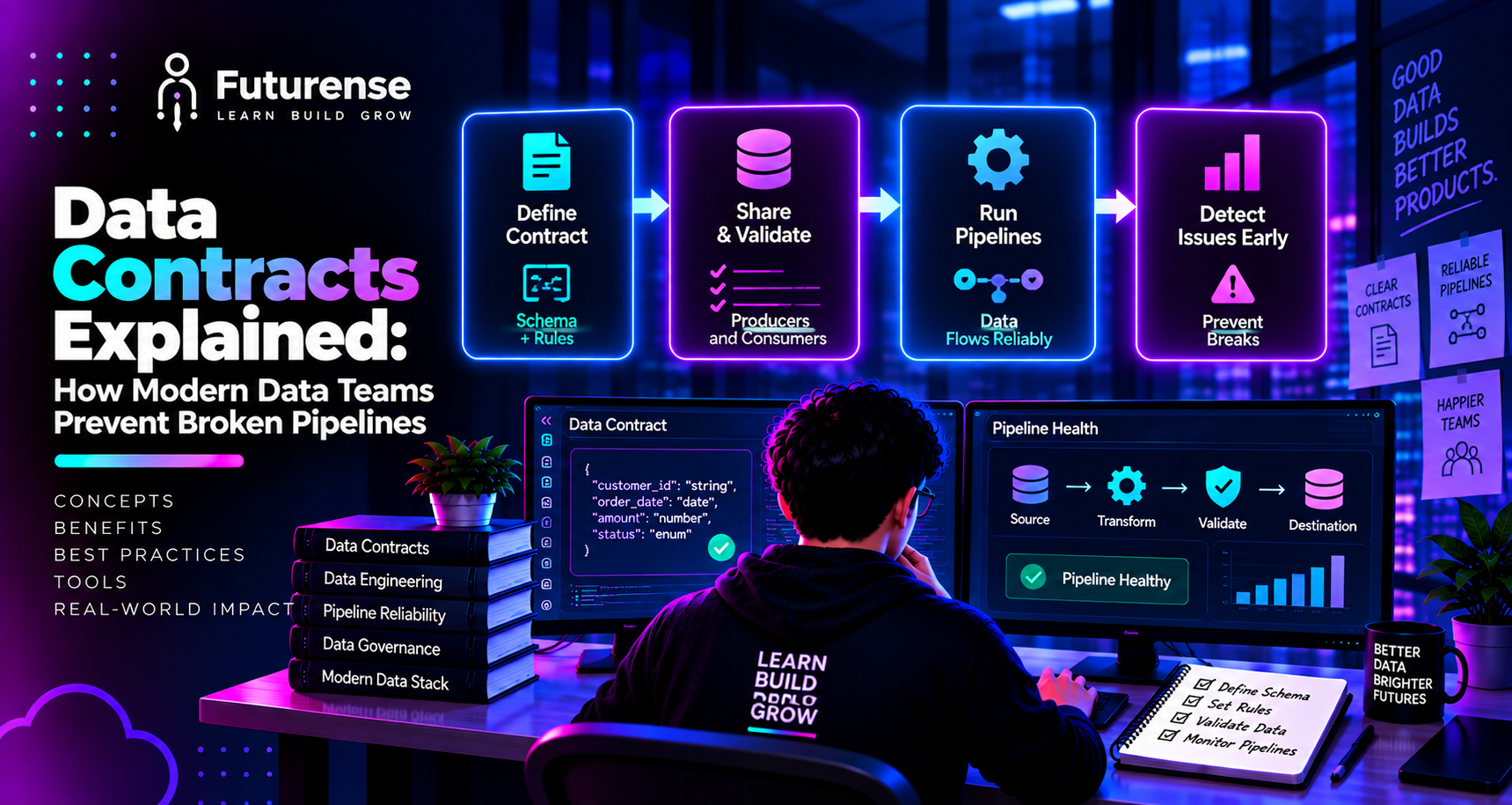
A data contract is a formal agreement between a data producer and its consumers that defines the structure, meaning, quality, and delivery expectations of a dataset, and is validated automatically. The best way to think of it is as an API agreement for data: the producer promises an interface, consumers build on it, and changes must follow rules.
One practitioner guide puts the standard bluntly: a contract that cannot be enforced is not a contract, it is documentation with good intentions. That distinction matters. A wiki page describing a table is documentation. A version-controlled specification that fails a deployment when violated is a contract.
Who Are Producers and Consumers?
- Producers are the teams or systems that create or publish the data: application engineers, upstream services, source system owners, or another data team.
- Consumers are everyone who depends on it: analysts, BI dashboards, data scientists, machine learning models, finance reports, other pipelines.
The producer commits to what they will deliver. The consumers state what they rely on. The contract is where those two lists meet.
What Goes Into a Data Contract
Contracts vary by team, but most include the same building blocks.
A Simple Example
Contracts are usually written in YAML or JSON so they can be version-controlled and read by tools. A minimal one might look like this:
yaml
dataset: orders
owner: payments-team
version: 1.2.0
schema:
- name: order_id
type: string
required: true
unique: true
- name: amount
type: decimal
required: true
- name: status
type: string
allowed_values: [created, paid, shipped, cancelled]
sla:
freshness: 1 hour
quality:
- amount >= 0
- fulfilled_at >= ordered_at
The exact syntax depends on the tool. Standards such as the Open Data Contract Standard (ODCS) aim to give teams a common format, but what matters most is that the contract is explicit, versioned, and machine-checkable.
How Data Contracts Prevent Broken Pipelines
A contract helps in three ways.
It catches breaking changes before they ship. When a producer changes a schema, the change is checked against the contract in the CI/CD process. If it removes a required field or alters a type, the build fails and the producer sees the problem immediately, rather than the consumer discovering it a day later.
It validates data at runtime. Even without schema changes, data can go bad: nulls appear, values fall out of range, a feed arrives late. Contract checks run against incoming data and can block it, quarantine it, or raise an alert before it propagates.
It creates clear ownership. When something breaks, the contract names who is responsible. This replaces the familiar blame game between data and engineering teams with a defined process for changes.
How Data Contracts Are Enforced
Enforcement is what separates a contract from documentation. Common approaches work in layers:
- CI/CD gates: schema and contract changes are validated in pull requests before deployment.
- Format-level enforcement: formats such as Avro, Protobuf, and Parquet carry schemas, and a schema registry (common in Kafka-based streaming) rejects incompatible changes.
- Transformation-layer contracts: tools like dbt let teams declare expected columns and types on models and fail builds that deviate.
- Data quality frameworks: tools such as Soda and Great Expectations run checks on data as it flows, covering freshness, null rates, uniqueness, and custom business rules.
- Catalog and governance platforms: these publish contracts, show lineage, and connect contracts to owners and consumers.
You rarely need all of these. Pick the layer closest to where problems actually start, which is usually the producer's deployment pipeline.
Data Contracts vs Data Quality Tests vs Observability
These ideas overlap and are often confused.
Contracts are preventive, tests are checks, and observability is detection. They work best together: contracts reduce the number of incidents, tests catch what slips through, and observability finds the unknown unknowns. The same layered thinking applies to machine learning systems, where AI observability plays the detection role. Contracts also support broader accountability for data used in AI, which connects to AI governance.
How to Implement Data Contracts Step by Step
You do not need a company-wide programme to start. A practical sequence:
- Pick one high-impact data flow. Choose a dataset that has broken before and feeds something visible, such as a revenue dashboard or a key model.
- Talk to both sides. Ask consumers what they actually depend on, and ask producers what they can realistically guarantee.
- Write the contract. Start small: schema, a few quality rules, freshness, and an owner.
- Store it in version control next to the code that produces the data, so changes are reviewed like any other change.
- Automate enforcement. Add a CI check for schema changes and a runtime check on the data.
- Define what happens on failure. Block, quarantine, or alert, and decide who responds.
- Plan for versioning. Agree how breaking changes are announced and how long old versions are supported.
- Monitor and expand. Track violations, learn from them, and extend to the next dataset.
One vendor case study reports that a travel company cut engineering workload by about half and improved data-user satisfaction after adopting contracts, though results vary and come from a vendor source. The more reliable benefit to expect is fewer surprise incidents and faster diagnosis when something does break.
A Worked Scenario: The Renamed Column
Picture an e-commerce company. The orders service stores amount, and a finance dashboard, a demand-forecasting model, and a weekly board report all read it through the warehouse. An engineer decides amount is ambiguous and renames it to order_total.
Without a contract, the change ships on Tuesday. The nightly pipeline runs, the column is missing, and the dashboard shows zeros on Wednesday morning. Finance raises a ticket, a data engineer spends half a day tracing the cause, and the model has already retrained on bad inputs.
With a contract, the rename fails the producer's CI check on Tuesday, because amount is a required field with three registered consumers. The engineer sees the message, adds order_total as a new field, keeps amount for a deprecation period, and notifies consumers through the versioning process. Nothing breaks, and the conversation happens before the change instead of after the incident.
Common Mistakes to Avoid
- Treating contracts as documentation. If nothing enforces the contract, it will drift out of date within weeks.
- Making contracts too strict. Over-specified contracts block safe changes and frustrate producers, who then route around them. Allow non-breaking additions.
- Starting with everything. Trying to contract every table at once stalls. Begin with the datasets that hurt most.
- Leaving producers out. If only the data team writes contracts, producers see them as someone else's problem. Ownership has to sit with the people who control the source.
- Ignoring semantics. A column can keep its name and type while its meaning changes. Contracts should capture business rules, not just structure.
- Confusing a contract with a data product. A contract is one part of a well-managed data product, not the whole of it.
- No change process. Without versioning and notice periods, even good contracts get bypassed in emergencies.
Why This Skill Matters for Your Data Career
Data contracts are a practical example of the shift from fixing pipelines to engineering reliability into them, and teams hiring data engineers and analytics engineers increasingly look for that mindset. Being able to explain how you would prevent a schema change from breaking a downstream model is a strong signal in design discussions, and it features in many data engineer interview questions.
If you are mapping out the path, the data engineer roadmap shows how skills such as SQL, orchestration, and data modelling fit together, and the data engineer salary in India guide covers what the role pays. It also helps to understand where the role ends and others begin; see data engineer vs data scientist. For structured learning, you can compare data engineering courses to find one that covers reliability and data quality alongside the fundamentals.
TL;DR: A data contract is a formal, enforceable agreement between the team that produces data and the teams that consume it. It spells out the schema, meaning, quality rules, freshness, and ownership of a dataset, and it is checked automatically so that a change upstream cannot silently break dashboards, models, and pipelines downstream. Data contracts move data quality from "find and fix after it breaks" to "prevent it at the source." This guide explains what they contain, how they are enforced, where teams go wrong, and how to start without overengineering.
What is a data contract?
A data contract is a formal agreement between a data producer and its consumers that defines a dataset's schema, meaning, quality rules, freshness, and ownership, and is validated automatically. It works like an API agreement for data.
How do data contracts prevent broken pipelines?
They check changes and data against the agreed rules before problems reach consumers. Schema changes that would break a downstream dependency fail in the producer's CI/CD process, and runtime checks block or flag bad data before it spreads.
What should be in a data contract?
Most contracts include the schema (fields, types, required or optional), semantic rules, quality checks, freshness or availability SLAs, an owner, governance details such as data sensitivity, and a versioning policy.
What is the difference between a data contract and a data quality test?
A data quality test checks whether data meets certain rules, usually after it has been produced. A data contract is the agreement that defines those rules and expectations between producer and consumer, and enforces them at the boundary, often before bad data is published.
Who owns a data contract: the producer or the consumer?
The producer owns and maintains it, since they control the source, but consumers help define what it must guarantee. Both sides should agree on the contract, and changes should follow a defined process.
Which tools are used for data contracts?
Teams commonly use YAML or JSON Schema for definitions, schema registries for streaming data, dbt for model contracts, and data quality tools such as Soda or Great Expectations for validation. The right choice depends on your stack and where failures start


PG Certificate in Building Professional Agentic AI with AIOps
IIT Jammu
Design, Deploy, and Operate AI Agents that Actually Work in Production