


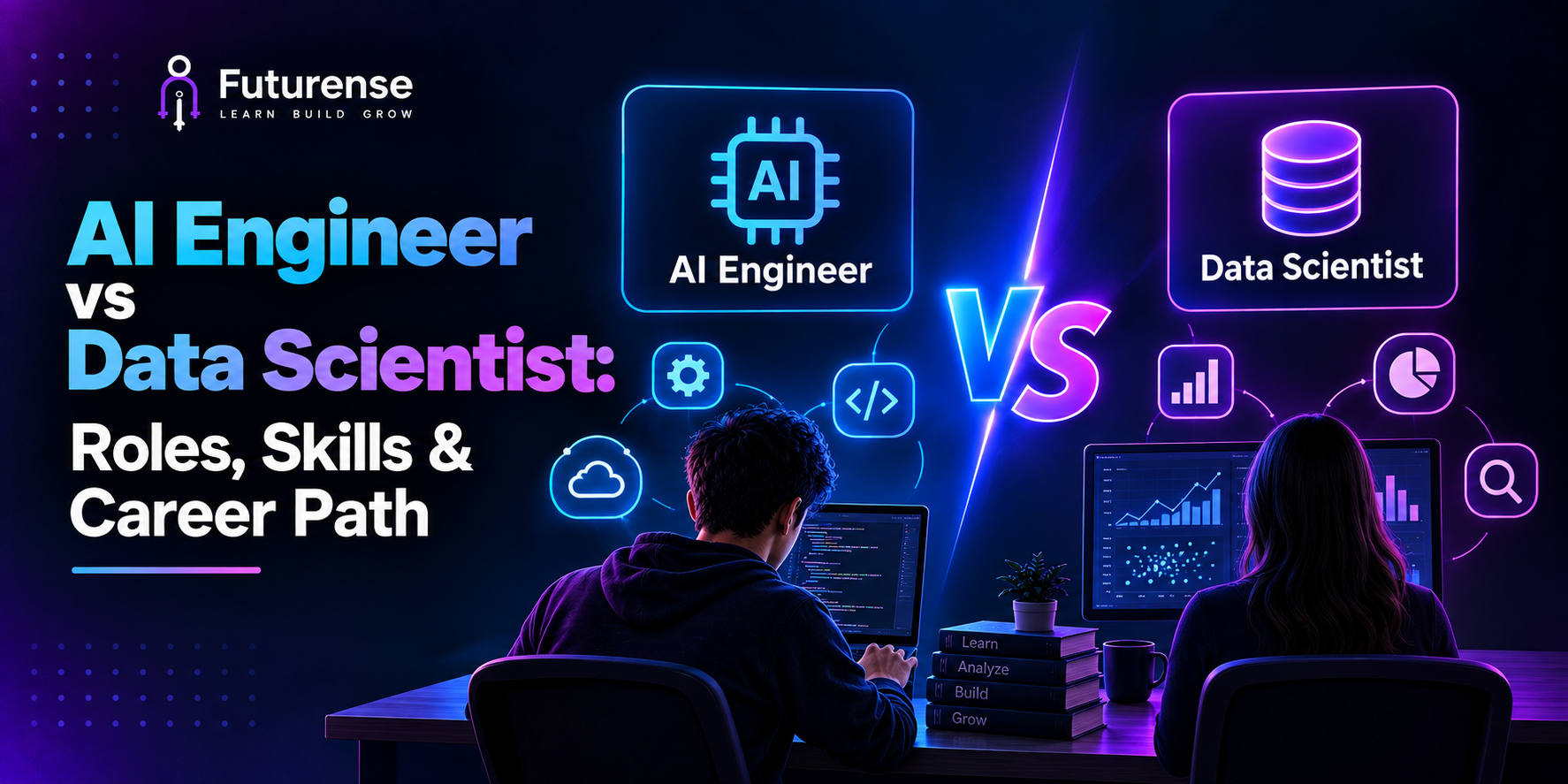


Why This Comparison Gets Confusing Fast
Job postings for these two roles increasingly blur into each other one company wants "a data scientist with machine learning expertise," another wants "an AI engineer with strong analytics skills." Generative AI tools and large-scale machine learning systems have pushed these fields closer together in recent years, and data scientists now build models while AI engineers now work with data more than they used to. That overlap is real, but it doesn't mean the two roles are interchangeable.
If you haven't yet compared the two fields at a broader level data science as a discipline versus AI/ML as a discipline our guide to AI/ML vs Data Science covers that foundational distinction; this article narrows down to the specific job-title comparison most readers are actually trying to resolve.
What Does an AI Engineer Do?
An AI Engineer designs, builds, and deploys AI-powered applications systems that use AI models, such as chatbots, retrieval-augmented generation (RAG) pipelines, and autonomous agents and ships them into production for real users. The role centers on using capable AI models to build reliable products, not on training new models from scratch or running open-ended experiments.
The output is shipped software: a working AI feature or application that users or other systems interact with directly, with the engineering discipline testing, deployment, monitoring, scaling that comes with owning something in production.
What Does a Data Scientist Do?
A Data Scientist collects, cleans, analyzes, and models data to answer specific business questions. The work involves statistical analysis, predictive modeling, experimentation, and visualization, with the goal of producing insights that inform decisions rather than shipping a product directly to end users.
The output is a decision, forecast, or recommendation supported by rigorous analysis not a piece of running software. A Data Scientist's model might predict customer churn or estimate demand, but turning that model into a live, user-facing system is typically someone else's job, often an AI or ML Engineer's.
AI Engineer vs Data Scientist: The Core Distinction
The clearest one-sentence framing: an AI Engineer ships AI products, while a Data Scientist ships the insights and models that inform decisions. That distinction decides almost everything else that follows how each role is measured, what tools each one lives in day to day, and where each career path leads.
Unlike Data Scientists, who often focus on experimentation, AI Engineers emphasize real-world AI integration, inference performance, workflow automation, and model scalability in live environments. A Data Scientist's best day ends with a compelling, well-supported answer to a question. An AI Engineer's best day ends with a system that works reliably for real users, at real scale.
AI Engineer vs Data Scientist: Side-by-Side Comparison
Where the Two Roles Genuinely Overlap
Both roles work with machine learning algorithms, Python, and a deep relationship with data, and in many organizations, AI Engineers and Data Scientists work closely together to build products customers actually use. A Data Scientist's model often becomes the thing an AI Engineer deploys and operationalizes; an AI Engineer's production system often generates the usage data a Data Scientist then analyzes to improve it further.
This overlap is also why career paths between the two are genuinely common in both directions professionals who enjoy statistics, experimentation, and explaining results tend to find data science clicks faster, while those who enjoy algorithms, building, and optimizing code often find AI engineering more natural early on. Either way, you can build toward the overlap over time rather than picking one lane forever.
Skills Comparison: What Each Role Actually Requires
An AI Engineer needs genuine software engineering depth on top of ML fundamentals comfort with production deployment, API design, vector databases, and increasingly, the specific frameworks used to build LLM-powered applications. Both roles require strong programming skills, but AI engineering demands deeper software engineering knowledge specifically, since the job includes shipping and maintaining a live system, not just producing a model or notebook.
A Data Scientist needs strong statistical and mathematical foundations, fluency in experimental design, and just as importantly the ability to communicate findings clearly to non-technical stakeholders. Data science requires advanced expertise in data visualization and storytelling, a skill that matters far less in a typical AI Engineer's day-to-day work, where the "audience" is often a system or an end user rather than a business stakeholder reviewing a slide deck.
If you're weighing where a Data Scientist role sits relative to a more junior, dashboard-focused title, our comparison of Data Scientist vs Data Analyst is a useful companion read, since the two are commonly confused for reasons similar to this comparison. And on the AI Engineer side, our guide to AI Engineer vs Data Analyst covers a different, equally common mix-up.
Salary Comparison: AI Engineer vs Data Scientist in India
At entry level, the two roles pay similarly companies are hiring for fundamentals and potential rather than specialization at this stage. Entry-level AI Engineer pay in India typically runs ₹6–13 LPA, close to the ₹5–12 LPA typical for entry-level Data Scientists.
The gap opens up from roughly year one through year six. AI Engineers in this band often reach ₹18–22 LPA, while Data Scientists at similar experience commonly sit closer to ₹14–16 LPA. This divergence happens at the ownership level: production-facing responsibility consistently commands a premium over experimentation-focused work. AI Engineers with strong production software engineering skills generally out-earn Data Scientists at equivalent seniority, since building reliable production systems is a scarcer skill than model experimentation alone sometimes described as a 30–50% "production premium" at comparable experience levels.
See our detailed AI Engineer salary in India and Data Scientist salary in India guides for the full breakdown by city, company type, and specialization. Worth noting: within data science itself, AI-specialized professionals particularly those with LLM fine-tuning and prompt engineering skills increasingly out-earn generalist data scientists by a wide margin, which somewhat narrows the gap for data scientists who deliberately specialize toward the AI-adjacent end of their own field.
Career Trajectory: Where Each Path Actually Leads
An AI Engineer's career typically progresses toward Senior AI Engineer, AI Architect, or AI Lead roles staying close to system design and production ownership even as scope increases. Our comparison of AI Architect vs AI Engineer covers exactly this next step in more depth. Some AI Engineers also move laterally into MLOps-focused roles as they gain deployment and infrastructure experience see our guide to AI Engineer vs MLOps Engineer for how that adjacent path compares.
A Data Scientist's career often evolves toward leadership or specialized research roles Lead Data Scientist, Data Science Manager, or increasingly, applied research positions focused on a specific domain like healthcare or finance. Neither trajectory is fixed: many professionals move between the two tracks over a career, particularly as AI-native product companies increasingly blend both skill sets into hybrid roles.
Which Path Should You Choose?
Choose AI Engineering if you're energized by building and shipping taking a capable model and turning it into something real users depend on, with all the production discipline that requires. You'll want to be comfortable owning uptime and reliability, not just model accuracy in a notebook. Our guide on how to become an AI Engineer lays out the concrete skill path.
Choose Data Science if you're energized by open-ended questions figuring out what's actually true in a dataset, designing the right experiment, and communicating a finding clearly enough that it changes a real business decision. This path rewards curiosity and rigor over deployment discipline, and tends to suit people who enjoy the "why" behind a number as much as the number itself.
TL;DR: An AI Engineer ships AI products LLM apps, agents, RAG pipelines, and the production infrastructure around them. A Data Scientist ships decisions running experiments, building statistical models, and answering business questions with data. Both work with data and machine learning, but their output, skill stack, and career trajectory diverge sharply once you look past the surface-level overlap.
What is the main difference between an AI Engineer and a Data Scientist?
An AI Engineer builds and deploys AI-powered products like chatbots, RAG systems, and AI agents into production, while a Data Scientist analyzes data to produce insights, forecasts, and recommendations that inform business decisions. AI Engineers ship software; Data Scientists ship decisions.
Which pays more: AI Engineer or Data Scientist, in India?
At entry level, pay is similar roughly ₹6–13 LPA for AI Engineers versus ₹5–12 LPA for Data Scientists. The gap widens significantly from years one to six, with AI Engineers commonly reaching ₹18–22 LPA versus ₹14–16 LPA for Data Scientists at similar experience, largely due to a production-ownership premium.
Do AI Engineers and Data Scientists use the same tools?
There's real overlap in Python and core machine learning concepts, but the day-to-day toolkits diverge. AI Engineers work heavily with vector databases, LLM frameworks like LangChain, and deployment infrastructure, while Data Scientists rely more on SQL, pandas, statistical modeling libraries, and visualization/dashboard tools.
Can a Data Scientist become an AI Engineer, or vice versa?
Yes, and it's a common transition in both directions given the shared foundation in Python and machine learning. A Data Scientist moving into AI Engineering typically needs to build production software engineering skills, while an AI Engineer moving into Data Science typically needs to strengthen statistical rigor and communication-focused analysis.Yes, and it's a common transition in both directions given the shared foundation in Python and machine learning. A Data Scientist moving into AI Engineering typically needs to build production software engineering skills, while an AI Engineer moving into Data Science typically needs to strengthen statistical rigor and communication-focused analysis.
Which role is better for someone who enjoys coding more than statistics?
AI Engineering is generally the better fit for someone who enjoys building and shipping software over statistical analysis, since the role centers on production engineering and system design rather than experimentation and modeling.
Is a Data Scientist role becoming less relevant because of AI Engineers?
No, but the field is shifting. Demand for both roles remains strong, and AI-specialized data scientists particularly those with LLM and prompt engineering skills are seeing some of the fastest salary growth within data science itself, rather than the role disappearing in favor of AI Engineering.


PG Certificate in Building Professional Agentic AI with AIOps
IIT Jammu
Design, Deploy, and Operate AI Agents that Actually Work in Production

.avif)