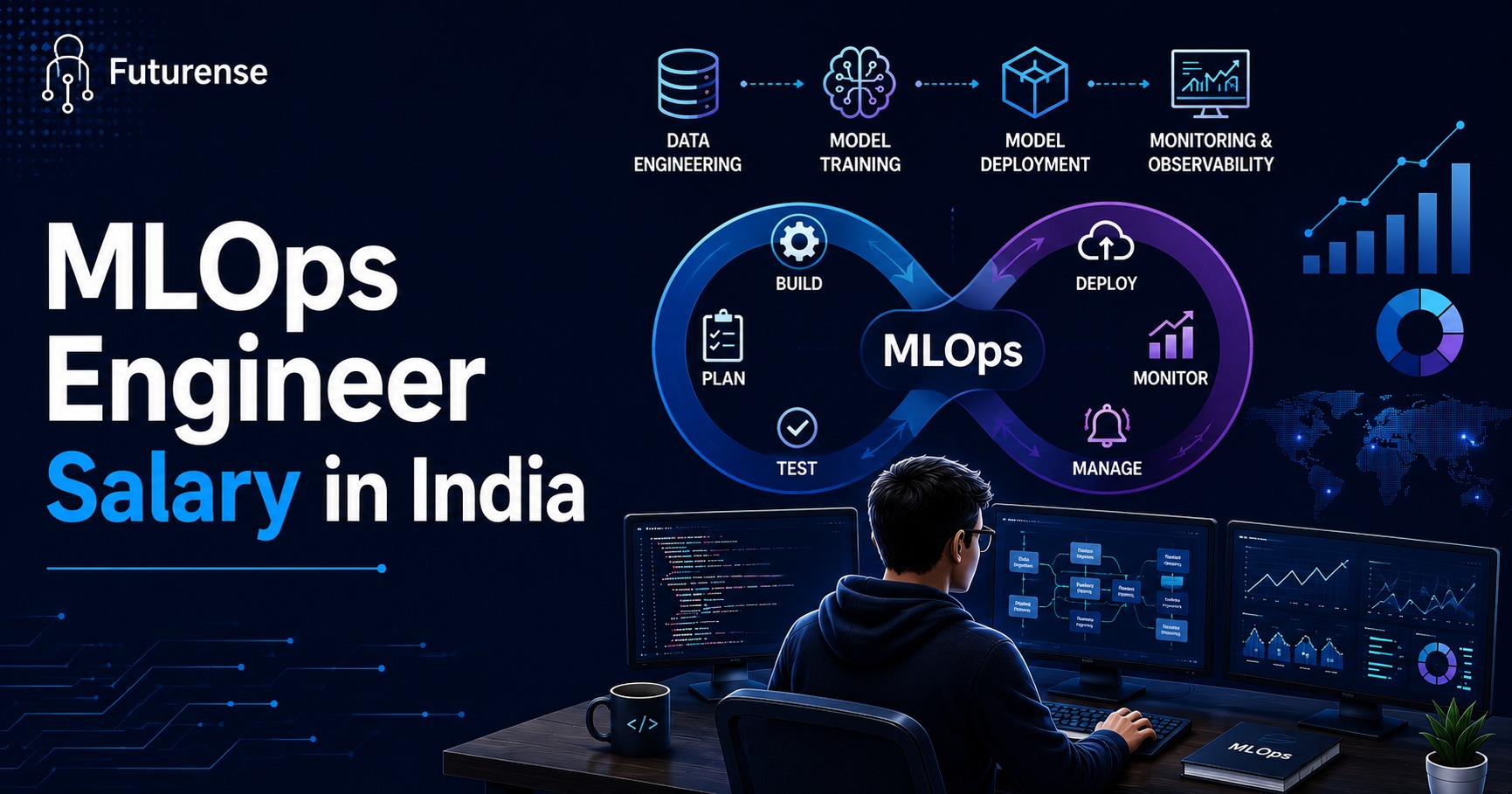


An MLOps engineer in India earns between ₹6 lakh and ₹35 lakh per annum (LPA) depending on experience, with the broad market average sitting around ₹12–16 LPA. Entry-level engineers (0–2 years) typically start at ₹6–10 LPA, mid-level engineers (2–5 years) earn ₹12–20 LPA, and senior MLOps engineers (5+ years) command ₹20–35 LPA, with specialists at top product companies and GCCs crossing ₹40–55 LPA. Bengaluru pays the highest average, followed by Hyderabad, Pune, and Mumbai.
What Does an MLOps Engineer Actually Do?
MLOps (Machine Learning Operations) is the discipline of applying DevOps-style automation, monitoring, and reliability practices to machine learning systems. An MLOps engineer takes a model out of a data scientist's notebook and turns it into something that runs reliably in production with versioning, automated retraining, rollback, and monitoring built in.
The day-to-day work includes building CI/CD pipelines for model deployment, managing experiment tracking and model versioning, setting up automated training and inference workflows, monitoring model performance and data drift in production, and improving inference speed and infrastructure cost. It sits squarely at the intersection of software engineering, cloud infrastructure, and applied machine learning which is also why the role pays a premium over adjacent titles.
If you're new to the term itself, our guide on MLOps breaks down the practice in more depth before you get into the numbers below.
MLOps Engineer Salary in India
Salary data on MLOps roles varies by source because the title is still relatively new and job boards classify it inconsistently. Pulling from Glassdoor India, found its job-board activity, and multiple 2026 industry salary guides gives a consistent picture once you average across sources.
A useful way to read this table: the floor moves up slowly, but the ceiling moves up fast. That gap between ₹10 LPA and ₹55 LPA isn't random; it's driven almost entirely by three things: which companies you're targeting, which city you're in, and which specific tools you can operate in production. The next three sections cover each one.
MLOps Engineer Salary by Experience Level
Entry-level (0–2 years): Most freshers move into MLOps from a DevOps, backend, or data engineering background rather than starting there directly, since the role assumes working knowledge of both ML and infrastructure. Starting pay at service companies runs closer to ₹6–7 LPA, while product-focused startups in Bengaluru or Hyderabad pay ₹8–10 LPA for the same experience band.
Mid-level (2–5 years): This is where MLOps pay pulls ahead of adjacent titles. Engineers who can independently own a deployment pipeline not just assist one typically see ₹12–20 LPA, with cloud certifications (AWS, Azure, or GCP) and hands-on Docker/Kubernetes experience pushing offers toward the top of that band.
Senior-level (5+ years): Senior MLOps engineers who own reliability, cost, and scale for production ML systems earn ₹20–35 LPA in the broad market. At top product companies and well-funded GCCs, that range runs 40–60% higher <cite index="25-4">a senior MLOps engineer at a well-funded Bangalore startup or a major GCC can command ₹38 lakh to ₹55 lakh</cite>. Some sources place the absolute senior ceiling for GenAI-adjacent MLOps specialists even higher: <cite index="8-3">recent reports show senior MLOps and GenAI specialist roles in India crossing ₹58–60 lakh per year</cite>.
MLOps Engineer Salary by City in India
Location remains one of the biggest levers on MLOps pay, though remote hiring by global companies has started to narrow the gap for engineers with strong production experience.
MLOps Engineer vs DevOps Engineer Salary: How the Two Compare
MLOps is frequently described as "DevOps for machine learning," which is directionally true but understates the pay gap. MLOps roles typically pay 10–25% more than equivalent DevOps roles at the same experience level, because they require ML-specific knowledge model versioning, feature stores, drift monitoring layered on top of standard infrastructure and CI/CD skills that a DevOps engineer already owns. If you're weighing the two paths, it helps to first understand what DevOps engineering actually involves before comparing where MLOps diverges from it.
The practical takeaway: an experienced DevOps engineer who picks up ML-specific tooling is often the fastest path into a well-paid MLOps role, rather than starting from a pure data-science background.
MLOps Engineer Salary vs Other AI and Tech Roles in India
MLOps sits in an interesting spot on the AI pay ladder; it pays more than general DevOps, is roughly comparable to Data Science at mid-level, and trails specialist AI/ML research roles at the very top end. If you're deciding between career paths, it's worth comparing this against Data Scientist salaries in India, AI Engineer salary in India, and Cloud Engineer salaries in India before picking a direction.
The pattern holds across most sources: roles that combine production ownership with ML-specific skill (MLOps, AI/ML Engineer) out-earn roles that are purely infrastructure-focused (DevOps, generic Cloud Engineer) at the same experience level. This is also why so much of the current hiring demand sits at the boundary between these roles. A related title worth understanding is Machine Learning Engineer, which overlaps with MLOps but leans more toward model-building than deployment ownership.
Skills and Certifications That Increase MLOps Engineer Salary
Not all MLOps skills move the needle equally. Based on current hiring patterns, these are the highest-leverage additions:
- Cloud platform depth (AWS, Azure, or GCP) an engineer with a real production cloud certification, not just a badge, is consistently the single biggest salary lever recruiters mention.
- Container orchestration (Docker, Kubernetes) table stakes for mid-level roles and above.
- ML-specific tooling hands-on experience with MLOps tools like Kubeflow, MLflow, and SageMaker separates candidates who've only read about MLOps from those who've actually run pipelines in production.
- CI/CD pipeline ownership being able to design, not just follow, a deployment pipeline.
- Model monitoring and drift detection increasingly a differentiator as companies move from pilot to production ML at scale.
- Domain exposure fraud detection and risk scoring (BFSI), recommendation systems (e-commerce), and diagnostic imaging (healthcare) all command industry-specific premiums on top of the base MLOps skillset.
An engineer who can point to AWS/Docker/MLflow experience with a real deployed system, rather than a course certificate alone, routinely moves 15–25% above the average band for their experience level.
Who Is Hiring MLOps Engineers in India
Hiring for MLOps in India currently clusters around four employer types, each with a different pay pattern. Startups often pay less in base salary but offset it with equity and faster ownership of real systems useful for building a portfolio quickly.
Enterprises and Global Capability Centres (GCCs) run more structured salary bands, so growth is steadier but slower. Product companies and MAANG-tier firms pay a clear premium because they hire selectively and expect end-to-end ownership from day one. IT services firms running outsourced MLOps projects for global clients sit in the middle moderate pay, but strong volume of openings.
Industry-wise, finance and banking (fraud detection, credit scoring), healthcare (diagnostic imaging, AI-driven triage), and e-commerce (recommendation and demand forecasting) tend to pay above the general market average because ML reliability is directly tied to revenue or risk in those sectors.
How to Build a Career Path Toward a Higher MLOps Salary
If you're already in software engineering, DevOps, or data engineering, the fastest route into a well-paid MLOps role isn't starting from scratch; it's layering ML-specific deployment skills onto infrastructure skills you likely already have.
The gap between a ₹10 LPA MLOps offer and a ₹25+ LPA one is rarely about knowing more ML theory; it's about being able to show you've deployed, monitored, and maintained real ML systems in production, on real cloud infrastructure, under real constraints.
That's the specific gap Futurense's Advanced PG Certificate in AI Engineering, Cloud & AIOps with IIT Roorkee is built to close combining cloud architecture, AIOps practices, and applied deployment work rather than theory-only ML coursework. If you're evaluating whether MLOps or a broader AI engineering path is the better fit, that's a reasonable next page to read.
What is the average MLOps engineer salary in India?
The average MLOps engineer salary in India is approximately ₹12–16 LPA across experience levels, with Glassdoor reporting a broad-market average near ₹16 LPA. The range runs from ₹6 LPA at entry level to ₹35 LPA or more at senior level, with specialist roles at top companies crossing ₹50 LPA.
How much do entry-level MLOps engineers earn in India?
Entry-level MLOps engineers (0–2 years) in India typically earn between ₹6 LPA and ₹10 LPA. Product-based startups in Bengaluru and Hyderabad tend to pay toward the higher end of that range, while service companies and smaller cities pay closer to ₹6–7 LPA.
Is MLOps engineer salary higher than DevOps engineer salary?
Yes. MLOps roles typically pay 10–25% more than equivalent DevOps roles at the same experience level, because MLOps requires ML-specific skills model versioning, drift monitoring, feature stores on top of the infrastructure and CI/CD knowledge a DevOps engineer already has.
Which skills increase an MLOps engineer's salary the most?
Cloud platform depth (AWS, Azure, or GCP) is consistently cited as the single biggest salary lever, followed by hands-on experience with tools like Kubeflow, MLflow, and SageMaker, container orchestration with Docker and Kubernetes, and the ability to independently design (not just follow) a CI/CD pipeline for ML models.
Which Indian cities pay MLOps engineers the highest salaries?
Bengaluru pays the highest average MLOps salaries in India, driven by its concentration of AI-first startups and global tech companies. Hyderabad follows closely due to its growing GCC and cloud ecosystem, with Pune, Chennai, and Mumbai offering strong but slightly lower compensation.
Is MLOps a good career in India in 2026?
Yes. As companies shift from experimental AI pilots to production-grade ML systems, MLOps has become one of the fastest-growing and best-paying roles in India's AI hiring market, with salaries growing 20–30% over the last two years and demand consistently outpacing the supply of engineers with real production experience.


Advanced PG Certificate in AI Engineering on Cloud and AIOps
IIT Roorkee
Engineer AI Systems for Top Enterprises, with the Most Critical Skills of the Decade.