

Software used to ship in quarterly cycles. Teams would write code for months, hand it off to operations, and wait for deployment. When things broke in production, blame followed the same siloed path the code did.
DevOps emerged to break that pattern. Today it is the dominant model for how engineering organisations build, deploy, and maintain software at scale. The global DevOps market is projected to grow from $10.4 billion in 2023 to $25.5 billion by 2028, and over 80 percent of organisations have already adopted some form of DevOps practice.
This guide explains what DevOps actually is, how its lifecycle works, what principles drive it, what a DevOps engineer does, and how AI is changing the field through AIOps.
What Is DevOps?
DevOps is a set of practices, tools, and a cultural philosophy that integrates software development (Dev) and IT operations (Ops) into a single, continuous workflow. The goal is to build, test, and release software faster, more reliably, and with fewer handoffs between teams.
The word DevOps, a compound of development and operations, signals the core idea: two functions that traditionally worked in opposition now share responsibility. Under a DevOps model, a team owns the entire lifecycle of a piece of software, from writing code to deploying it to keeping it running in production.
What makes DevOps distinctive is that it is not primarily a technology. It is a cultural shift. AWS defines it as "the combination of cultural philosophies, practices, and tools that increases an organisation's ability to deliver applications and services at high velocity." Microsoft frames it as "the union of people, process, and technology to continually provide value to customers." Both definitions put culture and process before tools, which is the correct order of priority.
The movement began around 2007 to 2008, when IT operations and software development communities pushed back against a model where developers and operations teams had separate objectives, separate leadership, and separate KPIs. Often they worked on separate floors. The result was siloed teams, long release cycles, botched deployments, and an inability to respond quickly to customer needs. DevOps was the answer.
What Are the Core Principles of DevOps?
The principles of DevOps are the cultural and operational commitments that make the practices actually work. Buying a CI/CD tool without internalising these principles produces faster pipelines but not a DevOps culture.
Collaboration and shared ownership: Dev and Ops teams share responsibility for the product across its entire lifecycle. A developer is accountable for how their code behaves in production. An operations engineer is involved in architectural decisions. Blame culture is incompatible with DevOps.
Automation: Every manual, repetitive step in the software lifecycle is a target for automation: testing, integration, deployment, infrastructure provisioning, and security checks. Automation reduces human error, increases consistency, and returns time to engineers for higher-value work.
Continuous improvement: DevOps teams operate in short iteration cycles and use each cycle to improve. They measure what matters, analyse failures without blame, and feed learnings back into the next iteration. This borrows from lean manufacturing and agile thinking.
Customer-centricity: Every engineering decision connects to a customer outcome. Short release cycles exist to respond to real user feedback faster, not to move fast for its own sake.
Continuous feedback: Feedback loops run at every stage: automated test results, deployment status, production monitoring, user analytics, and incident post-mortems. The faster feedback arrives, the faster problems get fixed and improvements get shipped.
As Atlassian summarises, DevOps is a mindset, a cultural shift where teams adopt new ways of working. The practices and tools are expressions of that mindset, not a substitute for it.
What Is the DevOps Lifecycle?
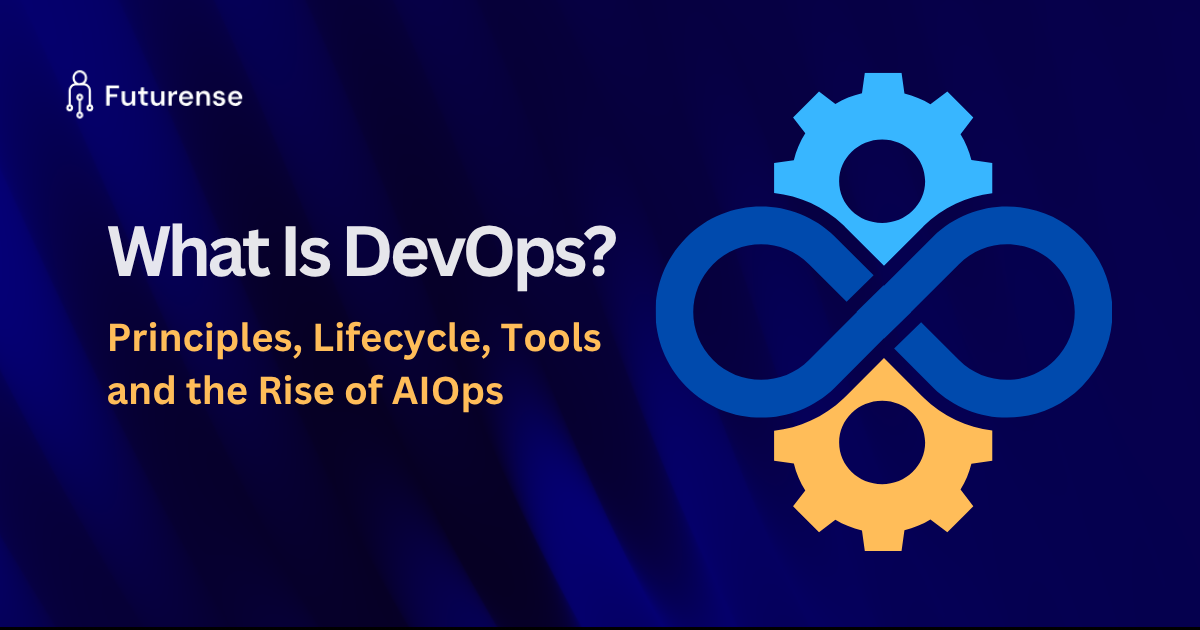
The DevOps lifecycle is represented as an infinity loop with eight phases. The loop is intentional: it has no end state. Teams move through phases continuously, improving with each iteration.

Plan: Teams define what to build, prioritise work, and break it into manageable tasks using backlogs, sprints, and Kanban boards.
Code: Developers write and review code using version control. Git is the universal standard. Agreed branching strategies reduce integration conflicts.
Build: The codebase is compiled, packaged, and turned into a deployable artefact. Build automation ensures this is fast and repeatable regardless of who triggers it.
Test: Automated tests run against every build. Unit, integration, performance, and security tests catch defects close to the point of introduction. Testing is continuous, not a gate at the end of the cycle.
Release: Validated builds are prepared for deployment. Release pipelines define the stages a change must pass before production, including approval gates and quality checks.
Deploy: Code moves to production in an automated, repeatable way. Strategies like blue-green deployments and canary releases allow gradual rollouts that reduce risk and make rollbacks fast.
Operate: Teams manage the running application: infrastructure provisioning, configuration management, scaling, and incident response. Infrastructure as Code (IaC) makes this repeatable and auditable.
Monitor: Telemetry, logs, metrics, and alerts give teams real-time visibility into system health and user behaviour. Monitoring is the feedback mechanism that restarts the loop with new insights.
Each phase relies on a distinct set of DevOps tools at each stage, chosen based on the team's stack, cloud strategy, and workflow maturity.
What Is a DevOps Engineer?
A DevOps engineer implements, maintains, and advocates for DevOps practices across an engineering organisation. The role sits at the intersection of software development and IT operations, requiring both technical depth and the interpersonal skills to break down silos between teams.
In practice, a DevOps engineer's core responsibilities include designing and maintaining CI/CD pipelines, managing cloud infrastructure using Infrastructure as Code, implementing container orchestration with Docker and Kubernetes, setting up monitoring and observability stacks, integrating security into pipelines (DevSecOps), and building internal platforms that make engineering teams more productive.
The role differs meaningfully from a software engineer. A software engineer focuses on building and refining the application itself. A DevOps engineer focuses on the systems, pipelines, and infrastructure that allow that application to be shipped, operated, and improved continuously. The two roles collaborate closely, though each carries distinct skills, responsibilities, and salary trajectories worth understanding before choosing a career path.
What Is Azure DevOps?
Azure DevOps is a cloud-based platform from Microsoft that provides integrated tools for the full software development lifecycle. It is not the same as DevOps the methodology. Azure DevOps is a product that teams use to implement DevOps practices.
Microsoft's official documentation describes it as a platform that includes "everything you need to plan work, collaborate on code, build applications, test functionality, and deploy to production."
Azure DevOps bundles five core services:
- Azure Boards: Work tracking, Kanban boards, sprint planning, and backlog management
- Azure Repos: Git repositories with branch policies and code review workflows
- Azure Pipelines: CI/CD pipelines for building, testing, and deploying to any platform or cloud
- Azure Test Plans: Manual and exploratory testing tools
- Azure Artifacts: Package management for Maven, npm, NuGet, and Python packages
Teams can use all five together or adopt only the services that fit their current toolchain. Azure DevOps integrates natively with GitHub, Visual Studio, and the broader Azure cloud ecosystem, making it the default choice for organisations on Microsoft infrastructure. Teams running it typically deploy across public, private, or hybrid cloud infrastructure depending on their data governance and scalability requirements.
For organisations outside the Microsoft ecosystem, comparable platforms include GitLab, GitHub Actions, and Atlassian's Jira and Bitbucket combination.
What Is a Common Misconception About Agile and DevOps?
The most persistent misconception is that Agile and DevOps are the same thing, or that one replaces the other. They are not the same. They are complementary, and most high-performing engineering teams use both.
- Agile is a project management and development philosophy. It governs how teams plan, prioritise, and deliver work in short iterative cycles called sprints. Agile is primarily a framework for the development side of the organisation: how do we decide what to build and build it collaboratively? DevOps is a broader cultural and operational model covering the entire lifecycle, including deployment, operations, and monitoring. DevOps asks a different question: how do we ship what we built reliably, and learn from how it performs in production?
- The second most common misconception is that DevOps means developers now handle operations work on top of everything else. That misreads the intent. DevOps is about shared ownership and collaboration, not task redistribution. A developer on a DevOps team does not manually provision servers. They use IaC tools and automated pipelines that the DevOps engineer has designed.
- A third misconception is that adopting DevOps tools equals adopting DevOps. Buying Jenkins and Kubernetes does not create a DevOps culture. The tools support the practices. The practices embody the principles. The principles require a genuine cultural shift in how teams take ownership and collaborate. In organisations where that cultural shift has not happened, DevOps tooling typically produces faster broken deployments, not faster reliable ones.

What Is AIOps and How Does It Relate to DevOps?
AIOps stands for Artificial Intelligence for IT Operations. It refers to using machine learning and AI to automate and augment the IT operations tasks that DevOps teams traditionally handle manually.
Where traditional DevOps monitoring requires engineers to triage alerts, analyse logs, and identify root causes manually, AIOps systems can correlate signals across thousands of metrics simultaneously, detect anomalies before they escalate into incidents, and suggest or implement remediation actions automatically.
AIOps is not a replacement for DevOps. It is the next layer on top of it. A team needs strong DevOps foundations, good observability tooling, clean data pipelines, and automated workflows before AIOps can add meaningful value. Teams that jump to AIOps without those foundations tend to find that AI optimising a broken process just produces a faster broken process. The practical ways DevOps teams are already using AI across CI/CD, monitoring, and self-healing systems go well beyond the foundational definition and are worth understanding separately.
DevOps vs Traditional IT: What Actually Changes?
The shift from traditional IT to DevOps changes almost everything about how software is delivered.
According to DORA research, teams with high DevOps maturity deploy 46 times more often and fix production issues 96 times faster than low-performing teams. These are not marginal gains. They represent a fundamental difference in how competitive technology organisations operate.
Why DevOps and AIOps Skills Matter for Your Career Right Now
DevOps is the top process framework among IT organisations today, used by 49 percent of those surveyed in recent industry research. DevOps engineer roles have grown 75 percent on Indeed and 50 percent on LinkedIn in recent years. The introduction of AI and AIOps skills is creating a meaningful premium above standard DevOps salaries at the senior level.
For engineers who want to work at the intersection of cloud, automation, and AI-driven operations, the Futurense AI Engineering on Cloud and AIOps course with IIT Roorkee covers this convergence directly, from DevOps fundamentals to AI-powered cloud engineering and AIOps implementation.
TL;DR
DevOps is a cultural and technical movement that merges software development and IT operations into a shared, continuous workflow. It is built on five core principles: collaboration, automation, continuous improvement, customer-centricity, and continuous feedback.
The DevOps lifecycle runs in an infinite loop through eight phases: Plan, Code, Build, Test, Release, Deploy, Operate, and Monitor. Each phase feeds back into the next.
Agile and DevOps are not the same thing. Agile governs how work is planned and built. DevOps governs how it is shipped and operated. Both are needed and work better together. Azure DevOps is a Microsoft platform for implementing DevOps practices. It is a product, not the methodology itself.
AIOps is the evolution that adds AI and machine learning to IT operations, automating monitoring, anomaly detection, and incident response at a scale humans cannot match manually. It does not replace DevOps. It is what DevOps grows into as AI becomes embedded in every layer of the engineering stack.
FAQs: DevOps Principles, Lifecycle and Tools
What is DevOps in simple terms?
DevOps is a way of working where software development and IT operations teams collaborate continuously instead of working in isolation. The goal is to ship software faster, more reliably, and with shorter feedback loops between building it and running it in production.
What is a DevOps engineer and what do they do?
A DevOps engineer bridges software development and IT operations. They design and maintain CI/CD pipelines, manage cloud infrastructure using automation and Infrastructure as Code, implement containerisation, set up monitoring and observability stacks, and build the internal platforms that help engineering teams ship faster and more reliably.
What are the core principles of DevOps?
The five core principles are collaboration and shared ownership across development and operations, automation of repetitive processes throughout the lifecycle, continuous improvement through short feedback loops, customer-centricity in every engineering decision, and continuous feedback from testing, monitoring, and user behaviour.
What is Azure DevOps and how is it different from DevOps?
Azure DevOps is a Microsoft product, not a methodology. It is a cloud-based platform with integrated tools for planning, coding, building, testing, and deploying software. DevOps is the broader cultural and operational philosophy. Azure DevOps is one of many platforms teams can use to implement that philosophy.
What is a common misconception about Agile and DevOps?
The most common misconception is that they are the same thing or that one replaces the other. Agile is a development and project management framework governing how work is planned and built in short iterative sprints. DevOps is a broader model covering the entire software lifecycle including deployment, operations, and monitoring. They are complementary and most high-performing teams use both.
What is AIOps?
AIOps stands for Artificial Intelligence for IT Operations. It uses machine learning to automate operations tasks such as anomaly detection, alert correlation, root cause analysis, and incident response. It is not a replacement for DevOps but an evolution of it, adding AI-driven intelligence to the monitoring and operations phases of the DevOps lifecycle.


Advanced PG Certificate in AI Engineering on Cloud and AIOps
IIT Roorkee
Engineer AI Systems for Top Enterprises, with the Most Critical Skills of the Decade.

.avif)