

Modern IT environments have scaled faster than the teams managing them. A single cloud-native application today can generate millions of log entries, metrics, and events per hour across distributed infrastructure spanning multiple clouds, containers, and microservices. The traditional model of engineers manually reviewing dashboards and triaging alert queues was never built for this scale.
AIOps was built for exactly this problem. Gartner coined the term in 2017, defining it as the use of machine learning and big data to automate IT operations processes. In the years since, it has moved from a niche capability to a foundational layer of how large-scale engineering organisations manage infrastructure.
What Is AIOps?
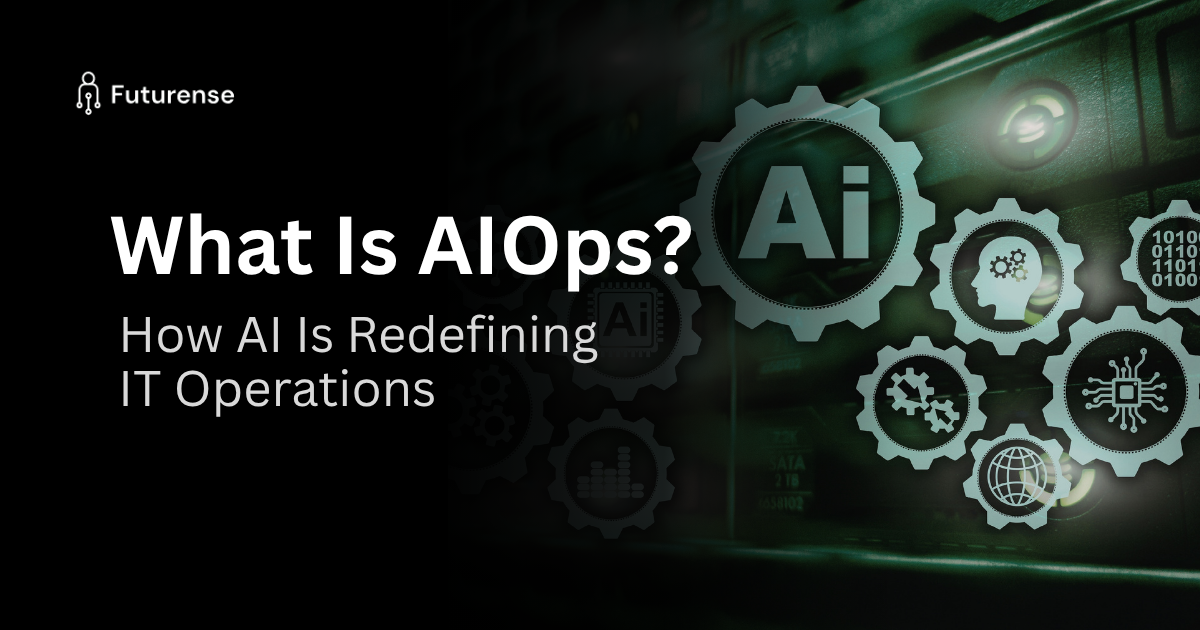
AIOps stands for Artificial Intelligence for IT Operations. It refers to platforms and practices that apply machine learning, statistical modelling, and increasingly generative AI to IT operations data, including logs, metrics, traces, events, and alerts, to automate detection, correlation, diagnosis, and remediation of operational issues.
The core value proposition is straightforward. Modern IT stacks generate more operational data than any human team can process manually. AIOps ingests that data continuously, finds patterns humans would miss, identifies the root cause of incidents faster, and in mature implementations, resolves common issues automatically without waiting for engineer intervention.
IBM defines AIOps as the application of AI and machine learning techniques to enhance and automate various aspects of IT operations, enabling computing systems to handle tasks that typically require human cognitive effort: perceiving, reasoning, learning, and problem-solving.
The shift AIOps represents is from reactive to proactive operations. Traditional IT operations wait for something to break. AIOps systems are designed to predict degradation before it becomes an outage, and increasingly, to fix it before any user notices.

How Does AIOps Work?
AIOps platforms operate across three functional layers that work in sequence.
- Data ingestion and normalisation is the foundation. The platform continuously collects telemetry from across the IT environment: logs from applications and servers, metrics from infrastructure components, traces from distributed services, events from monitoring tools, and alerts from existing observability platforms. Data arrives from disparate sources in inconsistent formats. The AIOps platform normalises it into a unified data model before analysis begins.
- ML-driven analysis is where the intelligence lives. Machine learning models run continuously against the ingested data stream, doing several things simultaneously. Anomaly detection identifies deviations from established baselines. Alert correlation groups thousands of related alerts from different monitoring tools into a single meaningful incident rather than creating a separate ticket per alert. Root cause analysis traces a symptom back through service dependencies to identify the underlying cause. Predictive analytics models look for patterns that historically precede failures, giving teams time to act before the outage happens.
- Action and remediation is the output layer. Depending on the platform's maturity and the organisation's configuration, AIOps can respond in three ways: surface insights on a unified dashboard for engineers to act on, trigger predefined automated playbooks for known incident types, or in the most advanced implementations, execute full autonomous remediation through agentic workflows that detect, diagnose, and fix without human intervention.
The quality of what AIOps can do is entirely determined by the quality of data going into it. Teams that try to implement AIOps on top of fragmented, poorly labelled telemetry find that the system produces noise rather than reducing it. Clean data pipelines and strong observability foundations are prerequisites, not optional extras.
AIOps vs DevOps vs MLOps: What Each One Actually Does
These three terms appear together constantly and get conflated regularly. They are not the same, they do not compete, and understanding what each one does makes all three easier to evaluate.
DevOps is a cultural and operational model focused on how software is built and delivered. It governs the development lifecycle through CI/CD pipelines, infrastructure automation, and collaboration between development and operations teams. DevOps is primarily concerned with shipping software reliably and fast. The principles and lifecycle of DevOps are the foundation that the other two build on top of.
AIOps applies AI and machine learning to managing the IT infrastructure that DevOps pipelines deploy into. It is not about software delivery. It is about keeping systems running, reducing incident response time, and predicting failures before they affect users. AIOps consumes the telemetry that DevOps-managed infrastructure generates and uses it to make operations smarter.
MLOps is a set of practices that applies DevOps-style automation to the machine learning model lifecycle. It governs how ML models are trained, validated, deployed, and monitored in production. MLOps is primarily a concern for data scientists and ML engineers. It intersects with AIOps only in that AIOps platforms often use ML models that benefit from MLOps practices, but the two operate in separate domains with separate teams.
The most important thing to understand is that these are parallel disciplines, not stages of a single maturity ladder. An organisation does not graduate from DevOps to AIOps. They run alongside each other, serving different functions for different teams.
Key AIOps Use Cases
AIOps is not a single-use technology. The same platform capability applies across a range of IT operations challenges.
Alert Noise Reduction
It is the most immediately valuable use case for most teams. Large environments can generate tens of thousands of alerts per day. The majority are duplicates, symptoms of a single underlying issue triggered across multiple monitoring tools. AIOps platforms correlate these into a single meaningful incident, reducing alert volume by 80 to 95 percent in mature deployments. Engineers stop managing alert queues and start managing actual incidents.
Predictive Incident Management
Use of historical patterns to identify infrastructure that is trending toward failure before it fails. An AIOps system that has been running for six months on a given environment begins to recognise the telemetry signatures that precede outages: specific combinations of CPU trending, memory pressure, and request latency that historically resolved in a service failure two hours later. It surfaces these signals in time for engineers to act.
Root Cause Analysis at Speed
Addresses one of the most time-consuming parts of incident response. In a distributed microservices environment, a single user-facing error can trace back through dozens of service dependencies. AIOps platforms map service topology and trace causality automatically, compressing what might take an experienced engineer an hour to diagnose into minutes.
Automated Remediation
Handles known incident types without engineer involvement. Server restarts, traffic rerouting during load spikes, cache flushes, and configuration rollbacks are all candidates for automated playbooks triggered when specific conditions are detected. This is not about replacing engineers. It is about reserving engineer attention for genuinely novel problems.
Capacity and Performance Optimisation
Uses AIOps analytics to identify inefficiencies in how infrastructure resources are provisioned and used, guiding decisions about scaling, rightsizing, and cost reduction across cloud environments.
Top AIOps Tools in 2026
The AIOps platform market is large and differentiated. The right tool depends on the organisation's infrastructure, cloud strategy, and the specific problems being prioritised.
According to PeerSpot's October 2025 rankings, Dynatrace holds the largest mind share at 20.8 percent, followed by Datadog at 17.1 percent. Forrester named Dynatrace a leader in its Q2 2025 Wave report for AIOps platforms.
For a full breakdown of the specific DevOps and observability tools that feed telemetry into AIOps platforms, the category guide covers the full stack from version control through monitoring.
AIOps and Cloud: Why Infrastructure Complexity Made This Necessary
AIOps adoption has accelerated directly alongside cloud adoption. On-premises infrastructure with a predictable set of servers and applications could, in principle, be monitored manually. A cloud-native application deployed across multiple regions, running hundreds of containerised microservices, scaling dynamically based on demand, and generating petabytes of operational data monthly cannot.
The public, private, and hybrid cloud models that most enterprises now operate across each generate their own telemetry streams, their own alert formats, and their own incident patterns. AIOps platforms are designed to ingest across all of them into a unified view, which is the only way monitoring remains operationally meaningful at scale.
Gartner predicted that by 2024, 40 percent of enterprises would be using AIOps for monitoring their applications and infrastructure. The actual adoption trajectory suggests that number has been met and continues to grow.
What Does a Career in AIOps Look Like?
AIOps careers sit at the intersection of IT operations, machine learning, and cloud engineering. Most professionals moving into AIOps roles come from SRE (Site Reliability Engineering), DevOps, or observability engineering backgrounds. The role involves less writing algorithms from scratch and more configuring, tuning, and managing AI-powered platforms and the data pipelines that feed them.
Common AIOps roles include AIOps Engineer, Observability Engineer, Platform Reliability Engineer, and AI-Integrated DevOps Engineer. At the senior level, roles like Director of IT Operations or VP of Platform Engineering increasingly require AIOps fluency as a core competency rather than a specialist skill.
The skills that matter most in an AIOps career:
- Strong foundation in DevOps practices and the CI/CD lifecycle
- Cloud infrastructure experience across at least one major platform (AWS, Azure, or GCP)
- Understanding of observability concepts: logs, metrics, traces, and distributed tracing
- Familiarity with machine learning fundamentals, particularly anomaly detection and time-series analysis
- Experience with AIOps or monitoring platforms (Dynatrace, Datadog, Splunk)
- Python or scripting skills for automation and pipeline management
AIOps salaries in India reflect the skills premium attached to the role. Mid-level AIOps engineers with three to five years of experience typically earn between 15 and 28 LPA. Senior engineers and architects with AIOps specialisation at product companies and global firms command 30 to 50 LPA and above.
The growing overlap between AI engineering and cloud operations is exactly why courses combining both are increasingly relevant. The Futurense AI Engineering Course with IIT Roorkee covers this convergence from DevOps foundations through AI-driven cloud engineering and AIOps implementation.
TL;DR
AIOps is the application of machine learning and AI to IT operations data to automate anomaly detection, alert correlation, root cause analysis, and incident remediation. It does not replace DevOps or MLOps. DevOps manages how software is built and delivered. AIOps manages how the infrastructure it runs on stays healthy. MLOps manages the lifecycle of machine learning models in production. All three are parallel disciplines.
The core AIOps value is scale. Modern IT environments generate more operational data than human teams can process manually. AIOps platforms ingest telemetry from across the entire stack, find what matters, and surface or act on it faster than any manual process can.
The top AIOps platforms in 2025 include Dynatrace, Datadog, Splunk, ServiceNow ITOM, and New Relic. Use cases span alert noise reduction, predictive incident management, automated root cause analysis, and self-healing infrastructure. AIOps adoption is growing with cloud complexity, and fluency in AIOps tools and concepts is becoming a baseline expectation for senior SRE, platform engineering, and DevOps roles.
Frequently Asked Questions: AIOps
What is AIOps in simple terms?
AIOps stands for Artificial Intelligence for IT Operations. It uses machine learning to analyse large volumes of IT data, such as logs, metrics, and alerts, to automatically detect problems, find their root cause, and in many cases fix them without manual intervention. The goal is to help engineering teams manage complex infrastructure at a scale and speed that would not be possible manually.
How is AIOps different from DevOps?
DevOps is a methodology for how software is developed and delivered, covering the CI/CD pipeline, automation, and collaboration between development and operations teams. AIOps is a set of platforms and practices for managing the IT infrastructure that software runs on, using AI to detect anomalies, correlate incidents, and automate operations. DevOps and AIOps serve different functions and are used together, not in place of each other.
What are the most widely used AIOps tools?
The leading AIOps platforms in 2025, by market adoption, include Dynatrace, Datadog, ServiceNow IT Operations Management, New Relic, BMC TrueSight, Splunk, Moogsoft, and BigPanda. The right tool depends on the organisation's infrastructure, cloud environment, and the specific operations challenges being addressed.
What are the main use cases for AIOps?
The most common use cases are alert noise reduction (correlating thousands of related alerts into a single incident), predictive incident management (identifying failing infrastructure before it causes an outage), automated root cause analysis (tracing a symptom back through distributed service dependencies), and automated remediation (resolving known incident types without engineer involvement).
Is AIOps a good career path in India?
Yes. Demand for AIOps-fluent engineers is growing alongside cloud adoption across every major industry in India. Mid-level AIOps engineers typically earn between 15 and 28 LPA, and senior specialists at product companies and global firms earn 30 to 50 LPA. Most professionals enter AIOps from DevOps, SRE, or cloud engineering backgrounds, which means it is a natural evolution for engineers already working in those areas rather than a career pivot requiring entirely new skills.
What skills do you need to work in AIOps?
A strong foundation in DevOps practices and the CI/CD lifecycle, cloud infrastructure experience on at least one major platform, understanding of observability concepts (logs, metrics, traces), familiarity with machine learning fundamentals particularly anomaly detection, hands-on experience with AIOps or monitoring platforms, and Python or scripting skills for automation and pipeline work.


Advanced PG Certificate in AI Engineering on Cloud and AIOps
IIT Roorkee
Engineer AI Systems for Top Enterprises, with the Most Critical Skills of the Decade.