

Are you curious to know the difference between Combinational and Sequential circuits? Well, both are a crucial part of digital systems, but combinational circuits are simpler as compared to sequential circuits. Here is all you need to know!
There are two primary categories of circuits in digital electronics, which are: Combinational circuits and Sequential circuits. Both of these are very distinct from each other and work in a different manner.
If you are someone who wants to create functioning circuits, then it becomes very important for you to know the difference between these two types of circuits. In this article, we will walk you through the functioning of these circuits while highlighting the difference between them. So, let’s first define a combinational circuit!
What are Combinational Circuits in Digital Electronics?
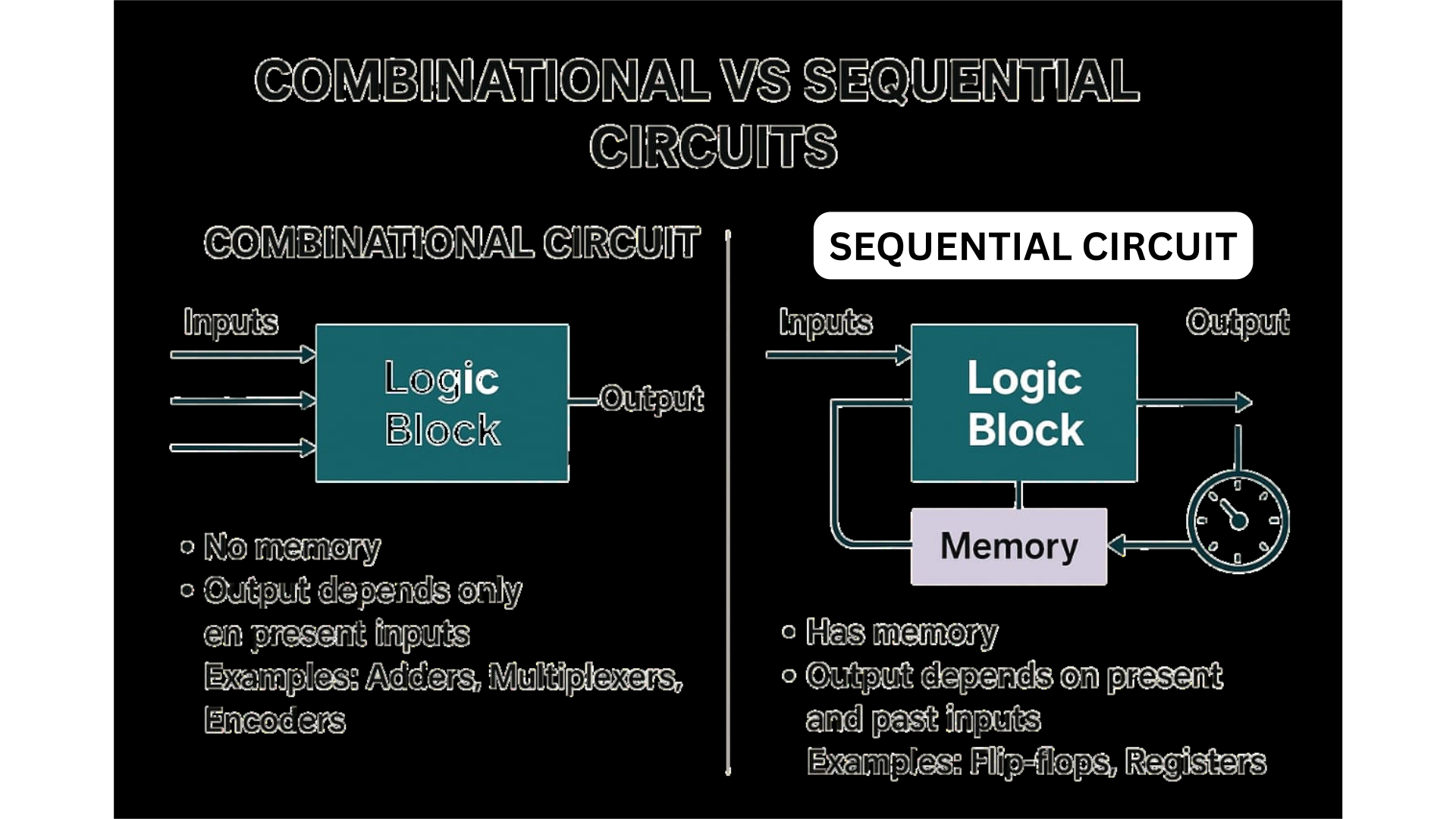
A combinational circuit is a type of electronic circuit that gives the outputs on the basis of current inputs only. The past inputs do not matter in this case, as the memory is not involved.
Characteristics of Combinational Circuits
The chief characteristics of a combinational circuit are as follows:
- No Memory Requirement: The output entirely depends on the present input. This circuit forgets every past input.
- Quick Response: As soon as you change the input, the output instantly gets calculated.
- Built with Logic Gates: Combinational circuits are made up of logic gates ( AND, OR, NOT).
- Function: These circuits help in performing operations like arithmetic (addition, subtraction) along with logical functions.
Combinational Circuits Examples
Combinational circuits play a crucial role in digital systems like calculators, microprocessors, digital watches, and computers. Some common examples of combinational circuits include:
- Comparators: These are circuits that are used to compare two binary numbers to check if they are equal or not.
- Code Converters: These include encoders and decoders. Encoders convert data from one format to another, while decoders convert binary to decimal or other formats.
- Arithmetic Circuits: These include Adders, Subtractors, and Arithmetic Logic Unit (ALU). Adders perform binary addition while subtractors perform binary subtraction. ALU is the core component of CPUs that carries out arithmetic and logic operations.
What is a Sequential Circuit?
We will now define a sequential circuit. A sequential circuit is more functional than a combinational circuit. It gives the output based on the current as well as earlier inputs. Thus, it is more complex as it employs the memory component.
Characteristics of Sequential Circuits
The chief characteristics of Sequential circuits include the following:
- Presence of Memory Elements: Sequential circuits have a latch or flip-flop that stores past inputs, which it uses along with current inputs to generate the output.
- Dependency on Time: Time is a critical factor in the working of a sequential circuit, as the output depends on both the present inputs and the history of the previous ones.
- Feedback loop: Sequential circuits consist of a combinational logic part along with a memory element. The memory element’s output is fed back as an input to the combinational logic, which creates a feedback loop.
Sequential Circuits Examples
Sequential circuits are widely used in communication systems, digital clocks, and processors as they depend on both present and past inputs for output determination. Some common examples of sequential circuits include the following:
- Flip-Flops: These are the primary memory elements that store just a single bit of binary information.
- Memory Devices: These include Random Access Memory (RAM) and Read-Only Memory (ROM) that store data.
- Counters: Counters are found in digital clocks, frequency dividers, etc. These are circuits that count a sequence of events or pulses.
To see how sequential circuits and memory elements fit into real hardware implementation, you can explore the VLSI design flow, where these components are translated into register-transfer level (RTL) designs and synthesized into working chips.
How Many Types of Sequential Circuits are There?
Sequential circuits are of the following two types:
- Synchronous Sequential Circuits
The outputs of this type of circuit affect or change at the same time. These circuits use a clock signal and a level input. These circuits synchronize with either clock signal’s positive edge or negative edge. Flip-flops, registers, and counters are examples of Synchronous sequential circuits.
These circuits possess the following characteristics:
- These circuits are predictable.
- These circuits are controllable as a global clock signal synchronizes all memory elements.
- Such circuits are easier to design.
- These are slightly slower than their counterparts (Asynchronous sequential circuits).
- Asynchronous Sequential Circuits
These circuits are quicker and do not depend on the internal clock pulses. They do not synchronize with the clock signal’s positive or negative edges. Thus, their outputs do not affect or change at the same time and immediately change their state with the change of the input signal. Ripple counters and unclocked flip-flops are examples of Asynchronous sequential circuits.
These circuits possess the following characteristics:
- Asynchronous Sequential Circuits are faster.
- These are difficult to design because of the potential timing issues and uncertain outputs.
Difference Between Combinational and Sequential Circuit
You can easily understand the difference between the two types of circuits with the help of the following table:
How Futurense Can Help You in Mastering Combinational and Sequential Circuits?
Whether you want to design a basic logic gate or a complex digital system, a clear understanding of the combinational and sequential circuits is necessary. For mastering these concepts, you need a solid foundation in digital electronics. If you want to move beyond basic circuit concepts and eventually build a career in digital electronics or VLSI design, you will need advanced training after developing your fundamentals. Once you complete your graduation in electronics, electrical, or a related field, you can explore higher education programs that help you specialise in this domain. That’s where the Futurense’s IIT Jammu VLSI course can help you.
This course is provided by the IIT Jammu faculty along with VLSI experts and senior leadership council members of Futurense. Plus, as it's aligned with India’s Semiconductor Mission plus IIT-based curriculum, it positions you for long-term VLSI career growth.
Final Words
Knowing the difference between combinational and sequential circuits becomes very important when it comes to choosing the right one for your project.
If you need to design a simple, time-independent system, you should choose the combinational circuit. Otherwise, if you want your system to record past inputs and generate outputs accordingly, you can go with the sequential circuit.
Both combinational and sequential circuits are essential parts of digital electronics. They both have different advantages and disadvantages. It totally depends on your project requirement which one to choose.
If you want to become an expert in these circuits, it would be better to choose the right course that not only covers the theory but also provides you with practical skills essential for designing advanced systems. And if you plan to continue growing in digital electronics or VLSI, you can also explore MTech options for working professionals, which allow you to upskill while continuing your job.
FAQs:
What is the difference between combinational and sequential circuits?
Combinational circuits produce output based only on present inputs, while sequential circuits use both current inputs and stored past inputs through memory elements like flip-flops.
What is a combinational circuit example?
Common examples include adders, subtractors, multiplexers, demultiplexers, encoders, decoders, and comparators - circuits whose output depends only on current input values.
Which is faster, combinational or sequential?
Combinational circuits are faster because their output changes instantly with input. Sequential circuits are slower since they rely on clock signals and memory.
What is the difference between combinational and sequential circuits in PPT?
In a PPT explanation, combinational circuits are typically shown as stateless logic blocks, whereas sequential circuits include feedback loops and memory blocks, highlighting their dependence on past inputs and timing.
What are two types of sequential circuits?
The two main types are synchronous sequential circuits (dependent on a clock signal) and asynchronous sequential circuits (dependent only on input changes, without a clock).
Is a flip-flop a combinational circuit?
No. A flip-flop is a sequential circuit because it stores one bit of data and maintains state, which combinational circuits cannot do.


M.Tech. in VLSI Design (Executive)
IIT Jammu
Backed by India’s Semiconductor Mission. Built for Long-Term Career Growth.

.avif)